
A retainer agreement is a written engagement that must say whether the client is buying reserved availability, prepaid work, or a capped monthly package.
A client wants you to keep helping after the current job ends. You'd welcome the repeat income, but you don't want a monthly payment to become permission for endless requests. Before you agree on a fee, decide exactly what that payment buys.
The early warning is simple: retainer doesn't describe a single deal. Your client and you need to mean the same thing before either of you signs.
What a Retainer Agreement Is
A retainer agreement sets the terms of a continuing service relationship: what you'll provide, how the client pays, and what happens when the relationship changes or ends. It should make the arrangement understandable without requiring the client to interpret an invoice or remember a sales conversation.
For a solo service business, a useful starting test is whether the client needs continuing work or access, rather than just a completed job. A recurring relationship needs boundaries around future requests. A standalone assignment needs a defined finish.
Say a brand designer offers a monthly retainer with a limited allocation of design time. The client hears unlimited access, while the designer means a capped workload that must fit around other clients.
Describe the purchase, not just the payment
The missing detail isn't the word monthly. It's the thing being purchased:
- Reserved capacity: You keep agreed time or access available.
- Prepaid work: You deduct completed services from a funded balance.
- A repeating package: You deliver a defined scope during each service period.
Those choices affect how you track delivery, describe unused value, and settle the account when the client leaves. They also change what supporting records you need, from availability commitments to task logs or completed deliverables.
A monthly payment tells the client when they pay. A model name tells them what they bought.
Before drafting, confirm that the relationship warrants a retainer, choose the product, and settle its boundaries. Then turn those decisions into contract terms and matching billing records.
You should be able to finish a sentence like this: Monthly design support includes a capped allocation of design hours, with additional work approved and billed separately. If you can't describe the limit plainly, the arrangement isn't ready to send.
Three Retainer Models Side by Side
| Model | What the client buys | When the fee is earned | Unused balance | Best fit |
|---|---|---|---|---|
| Availability retainer | Reserved capacity and a response window | When the availability period is provided | Often kept if truly earned for availability | A consultant who blocks calendar time |
| Prepaid drawdown | Hours or deliverables paid in advance | As the work is performed | Credit or refund under the contract; may stay the client's until earned | Variable work that cannot be forecast |
| Monthly scope subscription | A defined package each period | As that period's scope is delivered | Expires or rolls over only as the contract states | Repeat creative, coaching, or maintenance work |
Pick a row before drafting payment terms. Adobe's retainer agreement guide explains the importance of defining the services, payment arrangement, and treatment of unused funds rather than relying on the retainer label alone.
Availability means keeping capacity open
With an availability retainer, the client pays you to preserve access they might need. A consultant might protect calendar space for urgent decisions and promise a reply through an agreed communication channel.
The important distinction is between responding and completing work. A promise to acknowledge an urgent request doesn't automatically promise immediate delivery of everything requested.
If the arrangement compensates you for availability, the fee may be earned by providing that availability even when the client doesn't use it. Don't assume that calling a payment nonrefundable makes it so, however. The actual service and applicable rules still matter.
A drawdown means spending a prepaid balance
A prepaid drawdown starts with client money allocated to future work. As you perform services, you record charges against that balance.
This fits an IT consultant whose client requests troubleshooting unpredictably. The client can see what was done and how much funding remains, while the consultant can check available funds before accepting another task.
Unused money requires explicit treatment. It may be credited or refunded under the agreement, and regulated professions may have additional requirements because unearned advances can remain the client's property.
An evergreen arrangement adds a replenishment mechanism to this model. It doesn't change what the client is buying.
A monthly package means delivering a defined scope
A monthly scope subscription sells an agreed set of services rather than an open-ended pool of attention. A marketing consultant might provide scheduled strategy calls and a landing-page revision, with clear limits on what counts as a revision.
For this model, distinguish unfinished obligations from benefits the client chose not to use. A missed appointment, a delayed deliverable, and unused optional access shouldn't automatically receive identical treatment.
The labeling test is practical: identify capacity, hours, deliverables, or access, then state the boundary and the rule for extras. Decide whether unused included value expires, rolls forward, becomes credit, or returns to the client where required.
A vague monthly retainer invites incompatible expectations. A named product lets both parties evaluate the same offer.
When a Retainer Beats a One-Off Job
| Client pattern | Better instrument | Why |
|---|---|---|
| Same deliverables every month | Monthly scope retainer | The fee and the cap can both be predicted |
| Calendar or reply time must stay open | Availability retainer | The fee pays for reserved capacity, not unlimited tasks |
| Hours vary and cannot be forecast | Prepaid or evergreen balance | Funds stay ahead of the work |
| One project with an end date or materials | Estimate plus a deposit | A retainer implies an ongoing relationship |
| Client expects unlimited access | No vague retainer | Name a cap and an overage rate, or price the project |
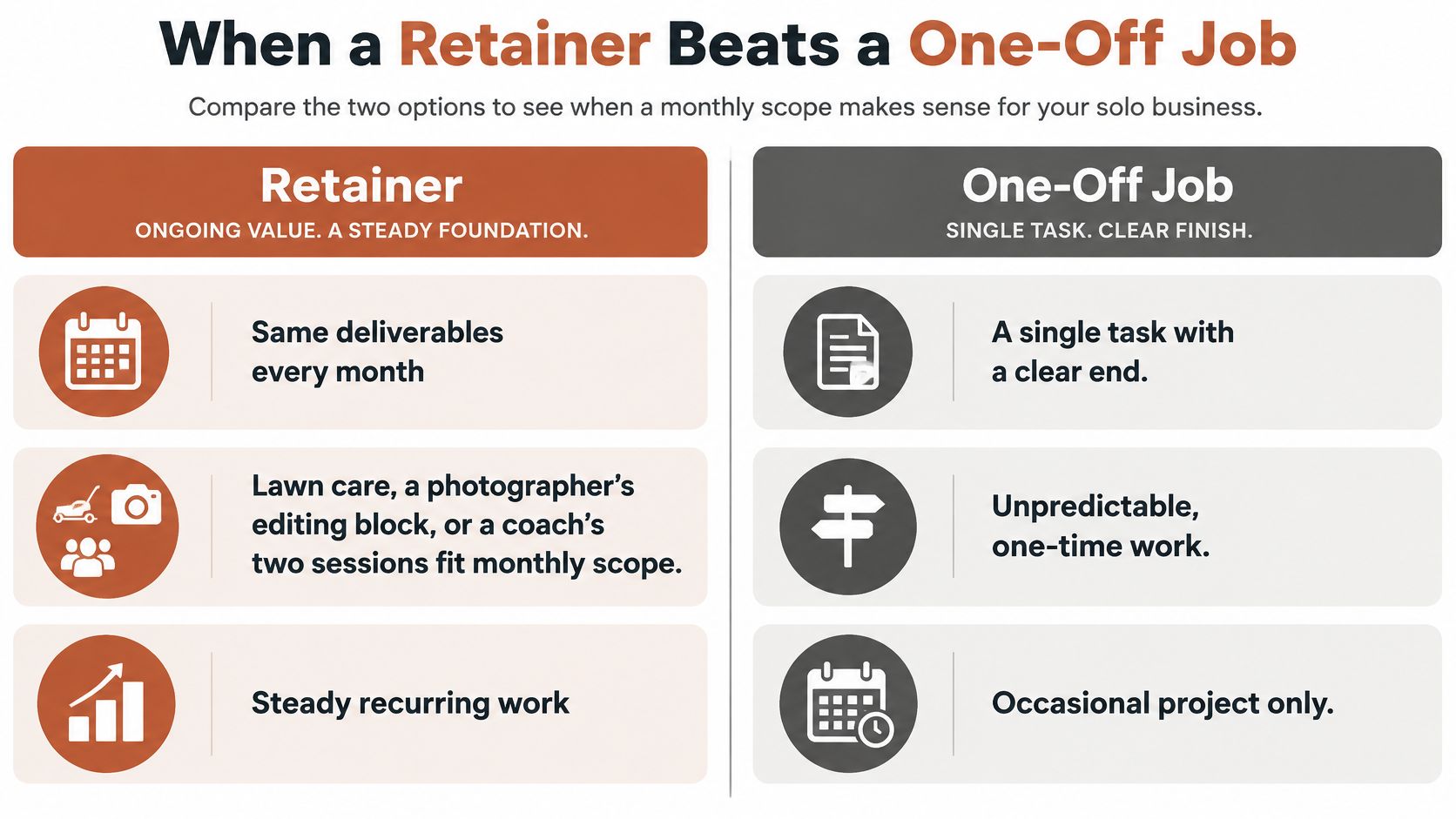
Repeating work is the strongest starting point. A lawn-care route, a photographer's editing allocation, or scheduled coaching sessions gives you something concrete to price and deliver. The client can evaluate the package without guessing what they'll receive.
Use this comparison to separate ongoing service from a finite assignment.
Keep finite work finite
A bathroom repair, a wedding shoot, or a website launch can involve advance payment without becoming a retainer. An estimate, scope, deposit, and completion process can describe those jobs more accurately.
The distinction matters when reserving time or purchasing materials. Don't introduce automatic renewal just because you want payment before work starts.
A tutor working through a school term can use a fixed-term recurring agreement with a clear end. There's no need to imply that sessions continue indefinitely.
Separate priority from performance
A handyman offering emergency priority is making an access promise. The visit, materials, and repair work can remain separately priced, so a client doesn't mistake priority scheduling for an included repair service.
Likewise, a consultant can reserve access without accepting every task that arrives through that access. Specify how you'll assess requests that exceed the available capacity.
For another way to think about ongoing client arrangements, consider the following video.
Don't accept unlimited access just because the client calls it a retainer. Ask what requests they expect, how urgent those requests are, and what volume you can support alongside your other commitments.
Use a retainer when the continuing relationship is real and its boundaries can be written down. Otherwise, price the assignment the client needs.
Clauses That Keep the Monthly Fee Clear
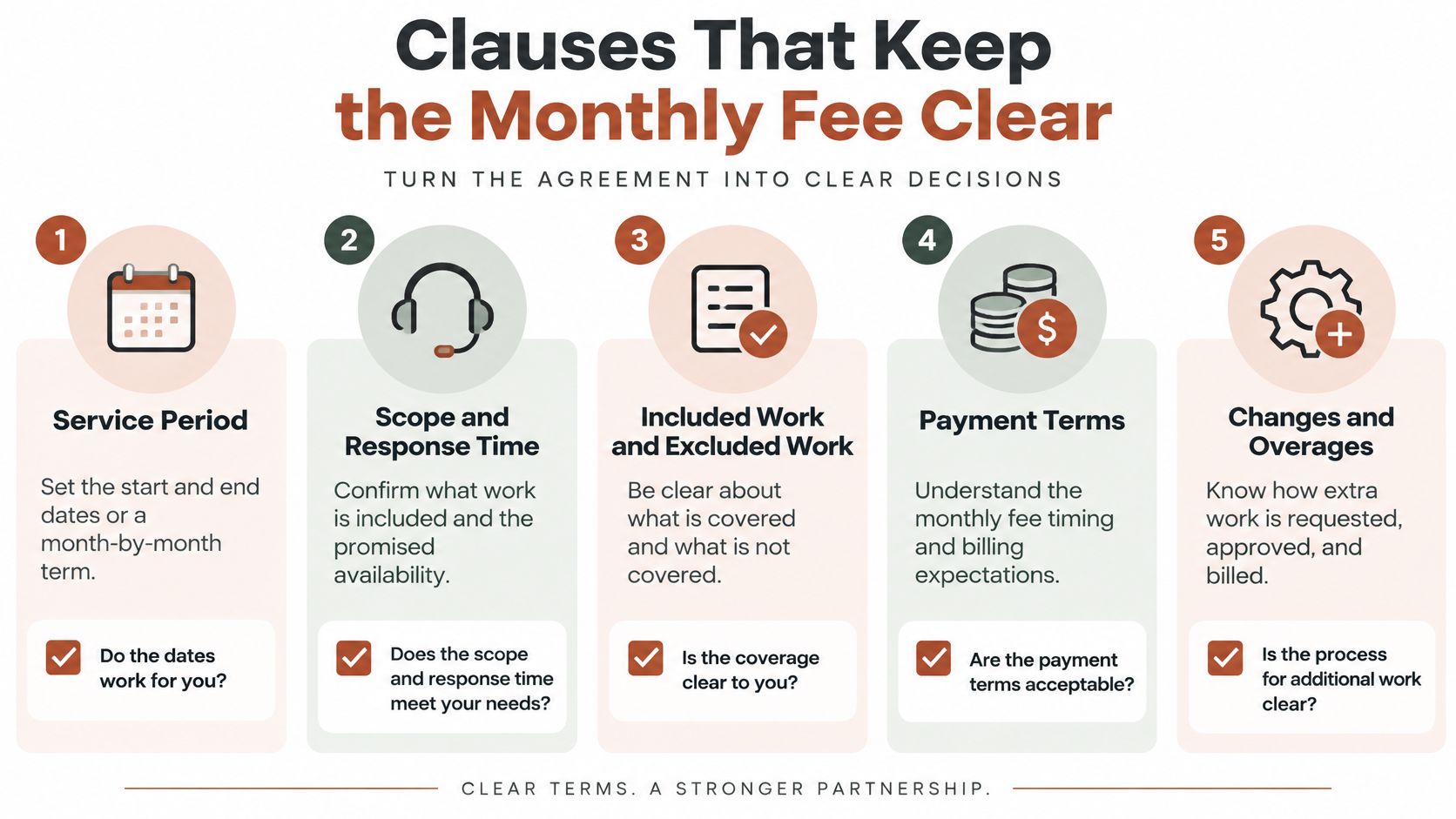
Treat each clause as a decision that prevents a particular argument. The ABA Journal's discussion of retainer and advance-fee ethics highlights the legal distinction between payment for availability and payment for future services, including the separate handling of unearned legal advances.
That's a reason to draft precisely, not a reason to apply lawyers' trust-account rules automatically to every solo business.
Define the service commitment
- Service period: State the start, end, and renewal mechanism. This prevents disagreement about whether another period was authorized.
- Scope and response commitment: Specify deliverables, communication channels, working availability, and what a response means. This separates acknowledgement from completion.
- Included and excluded work: Name revision limits and distinguish maintenance from new projects. This prevents a small change request from becoming an unpriced redesign.
Also identify what the client must supply, such as access credentials, source files, or approvals. Explain how missing inputs affect scheduling rather than leaving delivery dates untouched when work can't proceed.
Decide how additional costs become payable
Write the overage rate or fixed extra-service price, who can authorize it, and when approval is required. A useful solo-provider structure is a regular invoice for the included commitment and a separate invoice for approved extras.
Set an approval threshold you can enforce. Don't perform substantial additional work and ask the client to approve it after delivery.
State the billing cadence and due date explicitly. Clarify whether payment is required before service begins, rather than allowing a floating arrangement in which the client pays after their own customer pays.
For expenses, distinguish costs already covered by your fee from reimbursable purchases. Require approval for external spending and explain what receipts you'll provide. The same drafting discipline applies to estimate terms and conditions, especially when an extra request becomes a separately priced job.
Plan the exit before anyone needs it
Cancellation terms should address notice, work in progress, handover, outstanding invoices, and whether a partial period is prorated. Pause terms should distinguish nonpayment from client-requested suspension.
For unused included time, choose an explicit expiration, rollover, or credit rule. Don't use that rule to dispose of unearned prepaid money without checking the legal requirements that apply.
Drafting safeguard: Describe what happens to each kind of money separately. A cancellation clause shouldn't silently turn an advance into an availability fee.
Local tax, consumer-protection, and trust-account requirements differ. These drafting suggestions aren't legal advice, and you remain responsible for making the agreement fit your jurisdiction.
AurenWell provides software only, not legal, tax, accounting, or financial advice. We aren't a party to agreements customers form with their clients.
How an Evergreen Balance Stays Funded
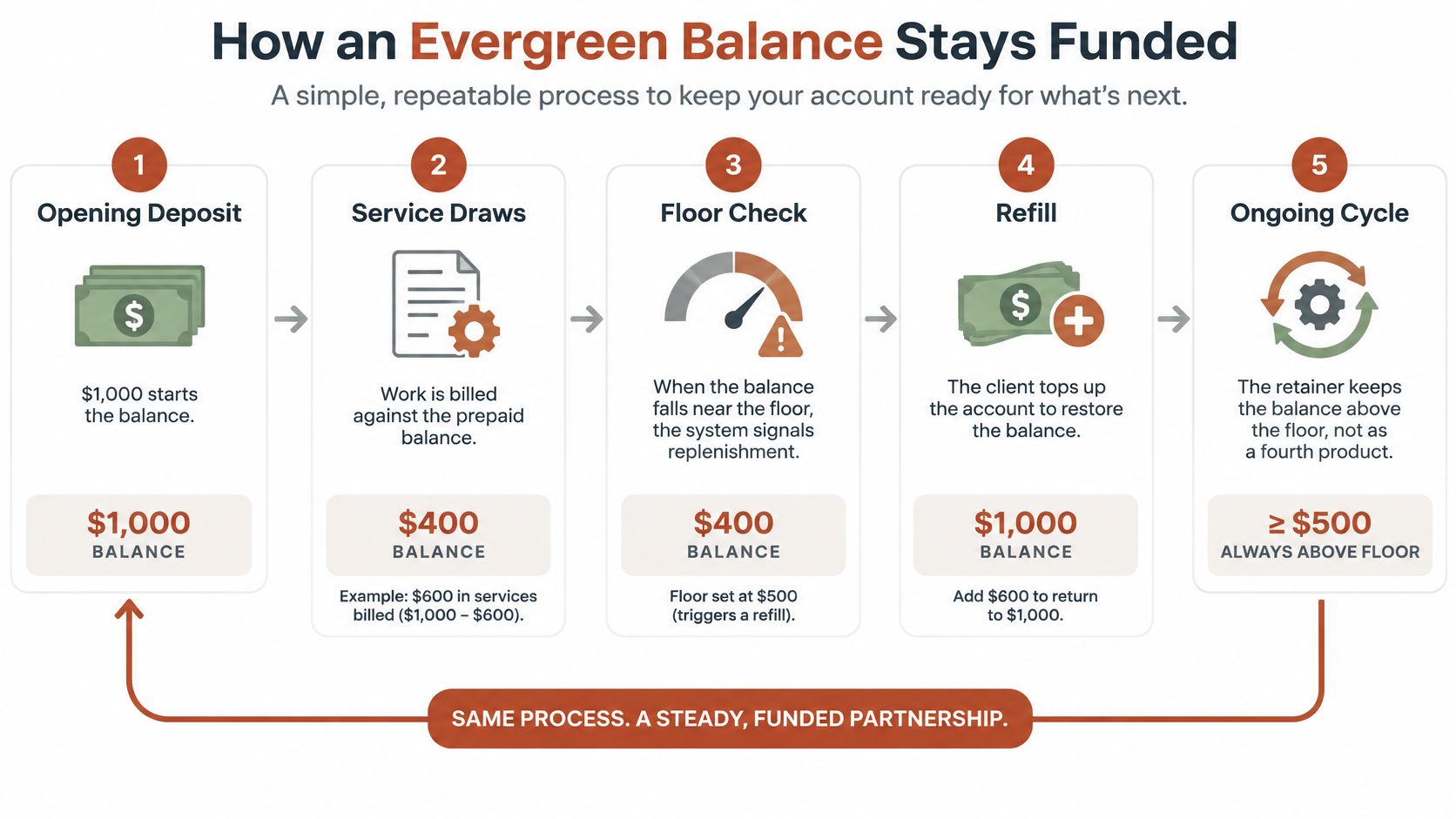
An evergreen retainer keeps a prepaid balance funded as you use it. It's a control for a drawdown arrangement, not a separate service product.
Using the mechanics described in the American Bar Association's lawyer-retainer guide, an illustrative arrangement starts with $1,000, triggers replenishment below $300, and calls for a $1,000 refill. The agreement must say whether you invoice that refill or collect it through an authorized charge.
Run a documented funding loop
Record completed work against the balance, then issue a usage statement showing the deductions and remaining funds. Check the threshold after posting charges, not only when you happen to prepare an invoice.
Each deduction needs enough detail for someone else to verify it:
- Date and task: Identify when you performed the service and what you did.
- Rate and quantity: Show the agreed charging basis and the amount used.
- Supporting record: Retain the approval, time entry, delivery note, or expense receipt.
Send the replenishment request when the trigger is reached. Waiting until the account is empty defeats the purpose of maintaining advance funding.
Be precise about the refill instruction. Adding a fixed payment isn't necessarily the same as restoring the balance to its original level. Your contract and invoice should describe the same operation.
Set the stop and dispute rules
Decide whether replenishment is mandatory and whether new work pauses below the minimum. Specify who receives the warning and what happens to an urgent request while funding is outstanding.
Disputed charges need their own process. Explain whether you temporarily exclude a disputed deduction when calculating the threshold, and how the client must raise the issue.
A flat monthly package doesn't require this kind of running credit ledger. A genuine availability fee also isn't a deposit gradually consumed by task charges.
For non-legal services, recurring invoices, activity logs, and client approvals can support the paperwork. Understanding recurring payments helps you distinguish the billing schedule from the balance calculation.
At closure, reconcile completed work and expenses before settling the remaining funds. Return unearned money when the agreement or applicable rules require it, and verify any profession-specific handling requirements.
Sample Language for a Capped Monthly Scope
Consider a marketing consultant selling a defined package rather than an hourly bank. The following illustrative sentences show the decisions to express, not a jurisdiction-ready legal form.

Give each promise a measurable boundary
Fee and scope. The client pays the stated monthly package fee on the invoice due date. The package includes scheduled strategy calls, a landing-page revision, and email responses within the agreed business-day window.
The schedule attached to that sentence should identify the call allocation, revision limit, and reply commitment. Keep those details together so the reader doesn't have to reconcile conflicting descriptions elsewhere.
Exclusions. New landing pages, advertising production, and weekend work aren't included. Requests for these services require a separate written estimate.
Additional work. The consultant bills approved additional work at the hourly rate shown in the service schedule. Written approval is required before that work begins.
This version avoids a common approval gap: permission to discuss an extra request isn't permission to carry it out.
Make the remaining terms consistent
- Unused scope: Included services don't accumulate into future periods unless the service schedule expressly allows rollover.
- Payment and pause: New work pauses when an invoice remains unpaid after its stated due date.
- Termination: Either party may terminate by giving the written notice specified in the service schedule.
- Closing work: The notice period doesn't expand the included scope. Any separately held advance is reconciled under the unused-funds provision.
Because this example sells deliverables, don't insert an unused-hours clause unless hours limit the package. Mixing units makes it difficult to tell whether you owe a finished revision or merely the time allocated to it.
Delete vague language such as ongoing support as needed. A client could reasonably read it as permission to request continuing help without a measurable limit.
For an availability variant, describe the capacity reserved and the response commitment, with task execution priced separately. For a drawdown variant, identify the hourly rate and state that completed time is charged against the prepaid balance.
If you want another starting document to compare, AmaJova offers a resource to find a seller-friendly service contract. Check its jurisdiction and adapt its terms to your service rather than assuming a template fits unchanged.
These examples don't replace legal review. Customers are responsible for verifying that invoices, estimates, contracts, and tax records made with AurenWell meet the legal and regulatory requirements applying to their business.
Record the Retainer and Invoice From It
A signed agreement and an invoice serve different purposes. The agreement establishes the bargain; the invoice requests payment under it. Keep them connected without allowing invoice descriptions to rewrite the service commitment.
Build the client record
Write the agreement in clear sections. Name the model, service scope or balance rules, overage rate, due date, and termination process. Check that the same service names appear in the proposal and billing description.
Send a secure signing link. Give the client a document they can read on a phone and sign in the browser. Resolve substantive questions before signature rather than treating a payment as proof that every term was understood.
Preserve the signed version. Keep the signed PDF and signature audit trail with the client record, separately from editable draft text. If you later change the arrangement, retain the earlier signed version and document the amendment.
The client record should make the current commitment easy to identify. Don't overwrite the evidence of what was agreed just because you've improved your template for future clients.
Make billing follow the signed terms
Set the repeating invoice schedule. Match the amount, cadence, service period, and payment timing to the agreement. Check the first invoice before activating repetition, particularly if the initial period is shorter than later periods.
Invoice approved extras separately. Use a description that identifies the additional request and its written approval. Don't increase the recurring fee to absorb work the client hasn't authorized.
Attach usage details to replenishment requests. For an evergreen arrangement, maintain the balance calculation and send the refill invoice when the agreed trigger is reached. Don't assume a repeating invoice alone tracks consumption.
In AurenWell, contracts are included without another subscription. Clients can read and draw their signature through the same secure browser link on their phone, and we keep the signed PDF and signature audit trail with the client record; our invoicing tools also support repeating schedules for retainers and repeat jobs.
Software stores the paperwork and supports billing. It doesn't decide whether your fee has been earned, whether a charge is enforceable, or whether a balance must be refunded.
The invoice should follow the agreement, not become the place where you invent new terms.
Choose availability retainer, prepaid drawdown, or monthly scope subscription and put that model in the first line of your agreement. Then record the scope, payment rules, and exit terms, send the signing link, and set up the matching invoices in AurenWell only after the client has agreed.