
The first bad storm always exposes the same problem. The truck is ready, the blade is sharp, the salt is stacked, and the phone starts lighting up, but the contract in your inbox is vague enough to argue about after the lot is already half cleared. That's where solo operators lose money, not on the plow, but on the paperwork.
Snow work looks simple from the outside. In practice, snow plowing contracts decide whether you get paid for every pass, whether you're exposed to extra trips nobody mentioned, and whether you spend half the night chasing signatures, invoices, and proof of service. The market itself shows how normal contracted winter work has become, with a North American study finding that about 60% of 51 agency respondents used contracted snow and ice services, while a government-contract index showed 1,006 open snow removal and ice control contracts across 49 U.S. states and 794 newly added in the last 30 days (North American contracting study, open snow removal and ice control contracts index).
Defining Scope and Trigger Thresholds
The ugliest disputes usually start before the first flake settles. A client thinks “plow it when it's bad,” and the operator thinks “I'm not eating another unpaid second pass because the lot drifted back shut.” If the contract doesn't define the trigger, the storm writes the rules for you.
Make the trigger visible, measurable, and tiered
A solid scope starts with a clear depth trigger. Public contract samples show service triggers can start only when the official measurement reaches four inches, while common templates also use 2 to 4 inches as the point where plowing begins (sample retainer contract, snow removal contract template guidance). That range matters because depth isn't just a number, it changes push time, fuel burn, and how many times you have to make the same lot passable.
The contract should also tier deeper accumulations. A lot that's manageable at a light event can turn into a slow, labor-heavy job when snow piles up, and your pricing needs to reflect that shift. Templates and pricing guides show separate billing for additional passes during the same storm, hourly minimums for larger jobs, and separate charges for sidewalk crews or de-icing, because those tasks change the economics of the visit (snow removal contract template guidance).
Practical rule: if the client can't point to the line that says when service starts, you'll be the one defending your judgment call after the storm.
Write out the exclusions before they become disputes
Scope also needs to name what's not included. Sidewalks, mailboxes, salt, sanding, and re-plow rights are not small details, they're the places where underbilling and blame usually show up. Strong contracts treat those items as separate line items or separate duties, not as assumptions hidden inside the main price.
The easiest way to protect yourself is to write the site map into the agreement language. If a driveway, side lane, walkway, or mailbox area takes extra handling, say so in plain English and attach the map or site notes. A well-built estimate and terms page helps keep that language consistent across jobs, and an internal reference like these estimate terms and conditions can be a useful model for keeping scope language tight.
A vague template feels fast on day one. It gets expensive on the second storm. Once you've done a few hard winters, you stop asking, “Can I get away with simple wording?” and start asking, “Will this still make sense at 2 a.m. when the lot needs another push?”
Structuring Pricing and Seasonal Rates
Snow pricing is a weather bet, but it should be a calculated one. If you guess low on a seasonal flat rate, a heavy winter eats your margin. If you guess high without explaining why, the client walks. The only durable answer is to tie the price to your actual cost structure, then decide which billing model fits the property.
Build the number from your real operating cost
The most defensible seasonal rate starts with historical snowfall exposure and your fully loaded per-event cost (pricing guide). That means counting truck hours, labor, subcontractor payouts, salt or de-icer, mobilization, and a contingency for heavier winters. Don't price off last season alone, because one mild year can make a bad quote look brilliant until the next one wipes it out.
Seasonal pricing works only when the contract accepts that winter is variable. Industry guidance calls it a weather bet, and that's exactly right. A seasonal agreement should include a cap, a re-open clause, or another reset point after a defined event threshold so one extreme season doesn't collapse the whole job's profitability (pricing guide).
If you want a clean way to compare models in the office before you send the quote, keep your options in a simple pricing matrix and line them up against the client's reliability and property size. A product like see our pricing page can make that comparison easier to review when you're deciding how much structure to build into the proposal.
| Model | Best For | Risk Level |
|---|---|---|
| Per-push | Properties with irregular demand and clients who want pay-as-you-go billing | Medium |
| Seasonal flat rate | Clients who want predictable winter spend and operators who want stable cash flow | High if winter is severe |
| Hourly | Large or irregular jobs where site conditions change fast | Medium to high |
| Hybrid seasonal plus overage | Mixed routes where baseline coverage matters but big storms need a second layer | Lower than pure seasonal if written well |
Match the model to the route, not your mood
Per-push and per-event pricing are usually easier to defend on small commercial lots because every storm has a visible billable event. Seasonal retainers are better when the client values predictability more than storm-by-storm accounting. Hybrid contracts sit in the middle and can work well if the base fee covers ordinary response and the overage language kicks in when the winter gets ugly.
Practical market ranges help anchor expectations, even if you still need to price from your own costs. Contract templates and pricing guides show residential per-push rates around $35 to $95 per hour equivalents and small commercial lot per-push rates around $150 to $400, with 15 to 30 plowable events per season often cited in northern U.S. markets (contract template guidance). Use those as context, not as a shortcut.
For your own internal pricing discipline, keep a written calculation trail and store it with the proposal. The point of how much should I charge as a reference is not to copy a number, it's to force consistency across quotes so one rushed estimate doesn't undo the whole route.
Managing Liability and Insurance Clauses
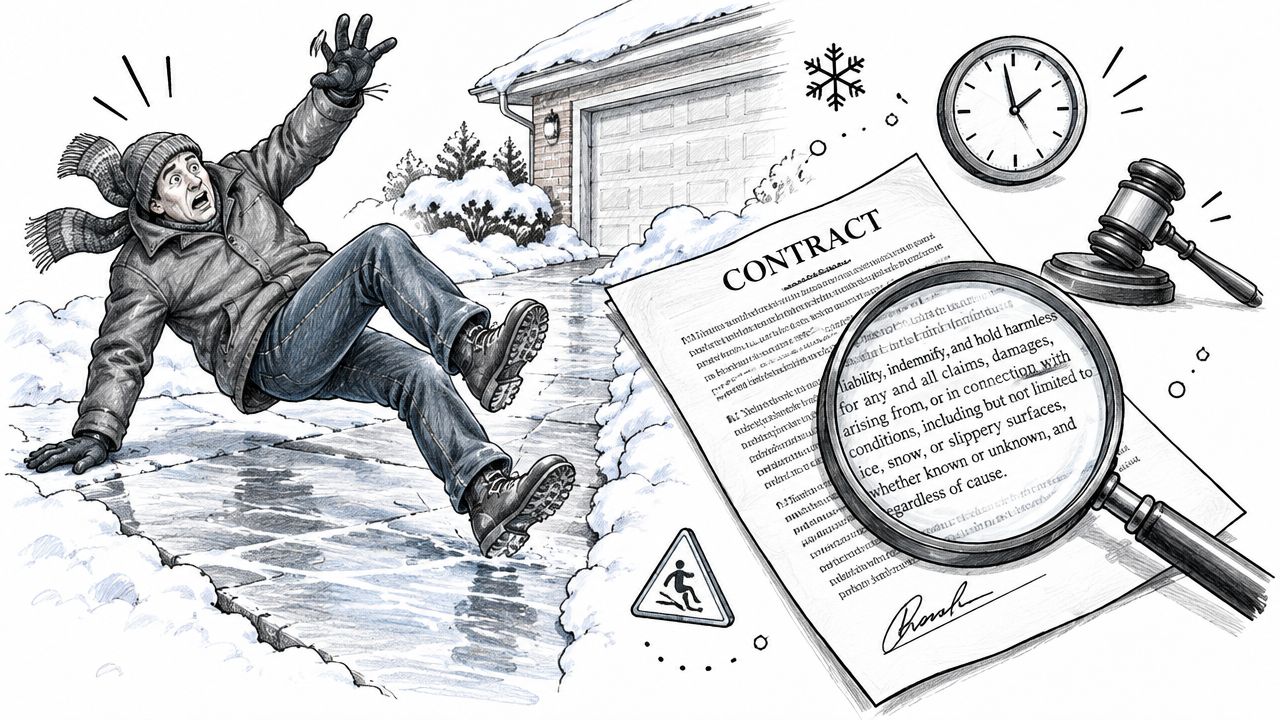
A storm can end, but a slip-and-fall claim can sit on your books for months. Liability language matters as much as blade width or truck size. If the contract is loose, everyone stays calm until somebody falls on black ice and starts asking who was there, when they came, and whether the subcontractor who showed up was approved.
Put the records in the contract, not in your memory
A recent industry report warns that slip-and-fall claims, undeclared subcontractors, and weak documentation still expose snow removal contractors even when they carry commercial general liability coverage. That is a direct warning for solo operators. Coverage helps, but it does not replace proof.
Your agreement should require service logs, time stamps, and site notes after each visit. If a claim shows up later, the record trail needs to show when you were there, what you did, and what conditions looked like. Photographs, weather notes, and a consistent log format turn a fuzzy memory into usable evidence.
A signed contract without a service log is only half a defense.
Control subcontractors before they control your liability
Undeclared subcontractors are a quiet margin killer because they create billing confusion and coverage risk. If someone else is working the client's property under your name, the client should know it, and the contract should say whether subcontracting is allowed and how approval works. That is not bureaucracy, it is risk control.
contractors general liability from ISU Insurance is useful background when you are reviewing what commercial general liability generally does and does not cover. The contract should still define who can perform the work, how proof of service is stored, and what records you will provide if a claim lands on your desk.
Operational continuity matters too. Municipal bid documents often reflect recurring payment structures and longer terms, which tells you buyers care about documentation and reliability, not just the first visit price. Solo operators who act like recordkeepers, not just plow drivers, look far more credible when a property manager starts asking hard questions.
Streamlining Signatures and Invoicing with AurenWell
Paper contracts usually fail in the gaps between steps. The signed copy sits in a text thread, the deposit never gets marked down, and the invoice waits on a wet signature photo that never arrives. In snow work, that kind of admin drag eats time right when the weather is already chewing up your day.
Put the agreement, signature, and invoice in one workflow
AurenWell's contract feature is built for service agreements that need mobile signing, stored signed PDFs, and an audit trail inside the client record. For a solo operator, that keeps the contract from floating around as a loose attachment and folds it into the same file as estimates, invoices, and payment history. You can review the feature details on the contracts page if you want to see how the signed document flow works in a browser-first setup.
The workflow should stay simple. Send the agreement as a browser-based link, let the client sign on a phone, collect an optional deposit if your policy calls for it, and save the signed version automatically with the customer record. That cuts the usual winter mess of “I thought I sent that,” “I can't find the PDF,” and “Did they sign the second page?”
Practical rule: if a client can sign while standing in a parking lot, your admin stops acting like a second job.
Use recurring billing to stop chasing payment after every storm
Snow work often needs recurring invoicing because the visits repeat, but the admin should not repeat with it. A single system that moves from estimate to signed contract to recurring invoice saves time when the route gets busy. That matters when the truck is moving before sunrise and you do not want to spend the afternoon stitching together PDFs.
A separate reference helps if you are setting up digital signatures, so the PDF signing workflow tutorial is a useful practical companion. The point is not the tool list. Signatures, invoices, and client notes should live in one workflow so you can see who agreed to what and when.
Video can help clients too, especially when they need a quick reminder of what they signed and how recurring billing works.
The gain is cash flow. When the signed document, payment record, and invoice sit together, you stop burning prime winter hours on cleanup work that has nothing to do with plowing. That is the point of software in this category, it reduces the narrow admin layer between finishing the job and getting paid.
Choosing the Right Agreement for Your Route
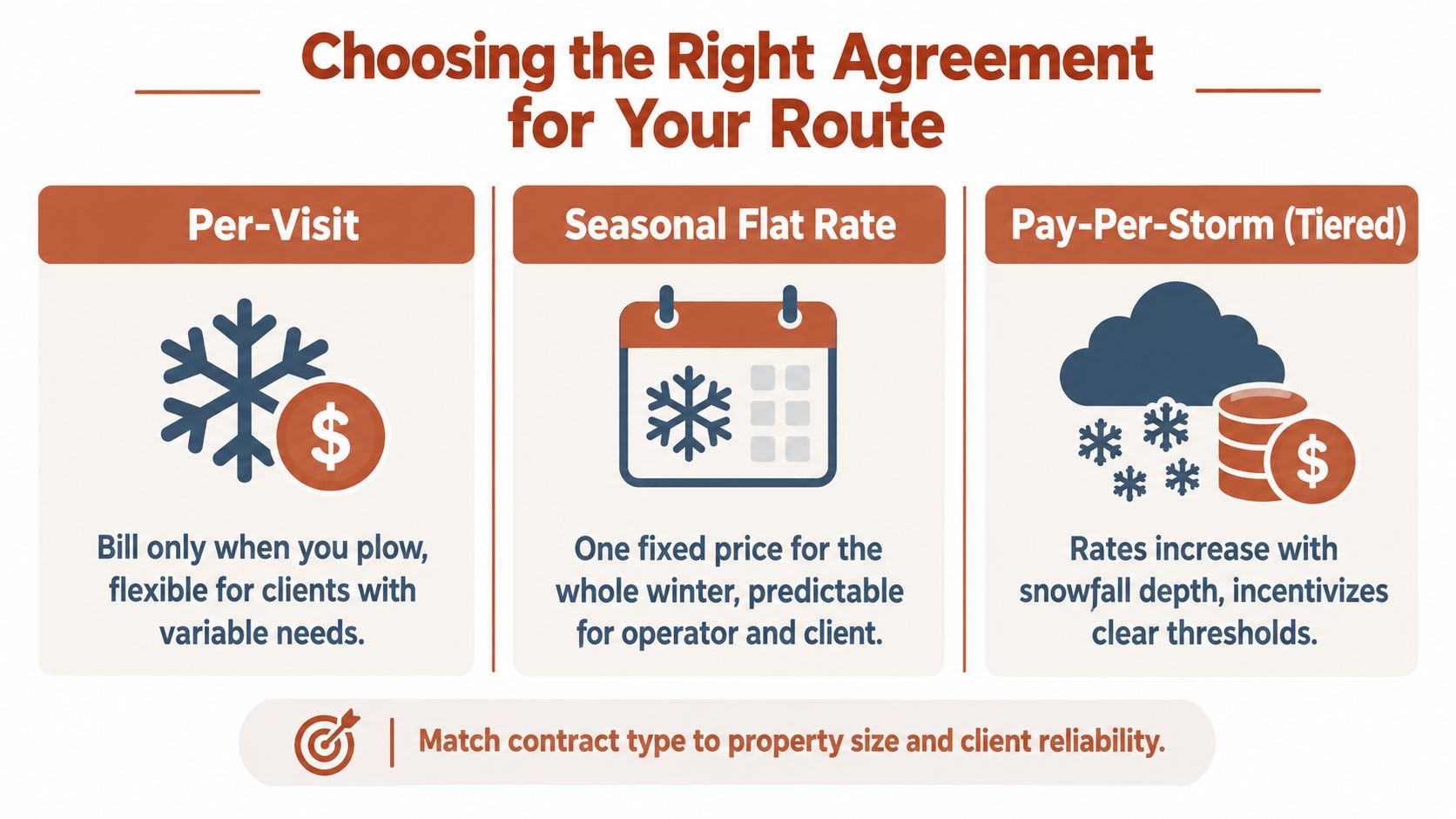
Not every property deserves the same contract shape. A driveway client who values predictability has different expectations than a small commercial lot that only wants service when the trigger is met. If you force one structure onto every property, you either overcomplicate the simple jobs or leave money on the table on the harder ones.
Read the client before you pick the billing model
Seasonal retainers give you baseline income and smoother planning, which is why they fit many residential driveways and clients who hate surprise invoices. Per-event billing works better when a property wants direct correlation between service and payment, especially on small commercial lots where each storm can be tracked and billed cleanly. Hybrid agreements add a base amount with overage triggers, which helps when the site needs reliable response but the winter may swing hard.
The market shows that both small and large deals exist side by side. Toronto approved seven-year winter maintenance contracts with a total cost of C$253,388,689.20 net of HST, while one Spokane Valley snowplowing agreement was renewed annually at US$26,500 across multiple option years (winter maintenance contract index). That spread tells you a simple truth, route structure should follow property complexity, not one universal price model.
Use buyer behavior to guide the offer
Municipal and commercial buyers usually care about continuity, documented response, and clean scope language. Residential buyers care more about simplicity, fast response, and not getting surprised by add-ons they didn't expect. That's why the same operator can use a seasonal retainer in one lane and a per-storm schedule in another without being inconsistent.
A route with mixed property types usually works best when the stable clients cover the fixed overhead and the variable clients create upside during active winters. You're not trying to force every customer into the same box. You're trying to build a route where the contracts match the actuality of the property and the reliability of the buyer.
Bottom line: the right agreement is the one you can explain in one sentence and still defend after the second storm.
Your Pre-Season Contract Audit Checklist
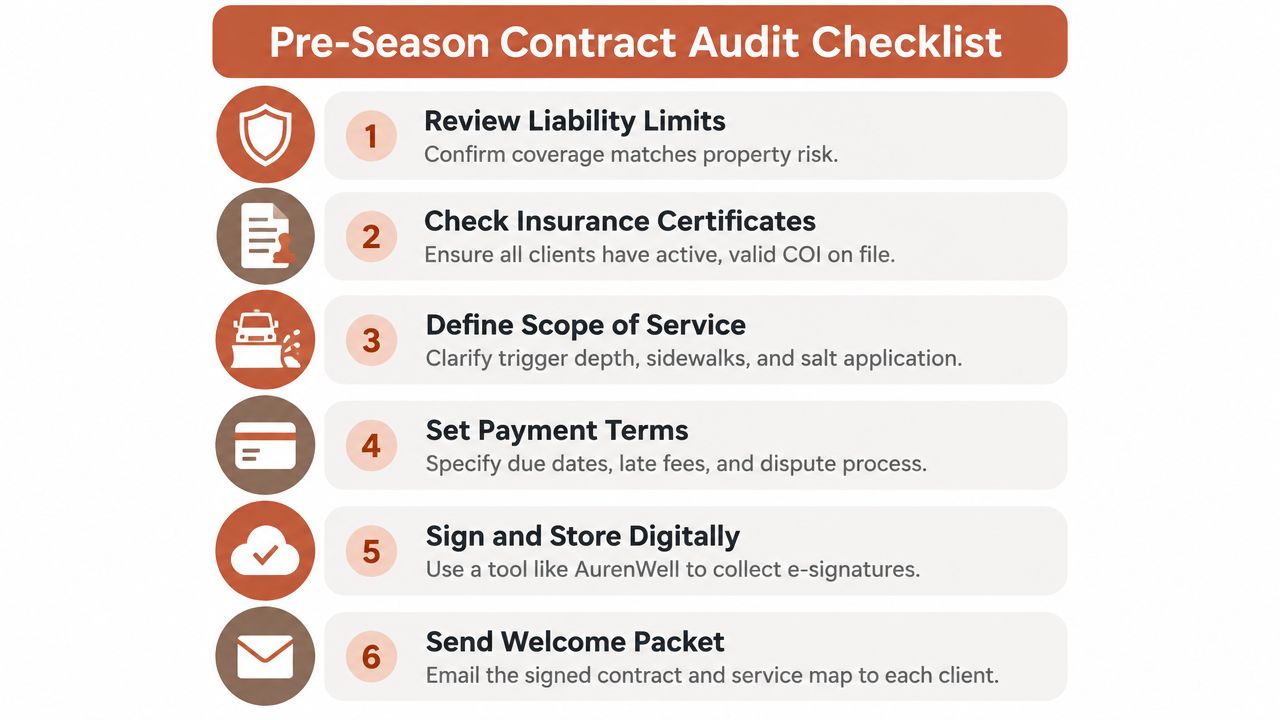
The cleanest winter operations start before the first freeze. A contract that looked fine in August can fall apart by November if the insurance file is missing, payment terms are fuzzy, or the client still hasn't signed the current version. A pre-season audit catches those problems while the weather is still forgiving.
Review every file before the storm cycle starts
Start with liability limits and insurance certificates. If the paperwork does not match the risk on the site, fix it before the first plowable event, not after a claim call. Then confirm the scope of service, especially trigger depth, sidewalk handling, and salt application, because vague depth triggers and loose service language are where the billing fights start.
Check the payment terms next. The due date, late-payment behavior, and dispute process should be in writing and attached to the active contract, not buried in a forgotten email thread. If you use a digital workflow, the signed agreement, deposit status, and client history should stay linked in one place, because disconnected invoicing slows cash flow and turns simple follow-up into admin drag.
Lock the operational details into the client record
A smart audit also covers the less glamorous pieces. Send a welcome packet with the signed contract, site map, and exclusions so the client knows what to expect before the first storm. If a contractor or helper touches the property, keep that approval trail in the file so subcontractor liability does not become a winter surprise.
For solo operators using a system like AurenWell, the value is organization, not shine. The signed agreement, recurring invoice, and client notes stay together, so questions get answered faster when the route is full. That matters more than fancy features when the snow is stacking up and every minute counts.
Read the client before you pick the billing model
The season rewards operators who get the boring details right. Review scope, insurance, payment, signature storage, and welcome materials now. Update weak spots, then make sure every active client is ready before the next forecast turns real.