
You've sent the estimate, the homeowner wants a start date, and you're ready to order shingles. Then they ask whether replacing the roof includes the damaged fascia. Your price doesn't, but your paperwork doesn't say that.
A roofing service agreement should settle that question before you load the truck. Treat it as an evidence file: every promise should identify the photo, approval, inspection record, or signature that will prove what happened if someone later disputes the bill.
Which Clauses Every Roofing Agreement Needs
A solo roofer needs nine core clauses before work starts. Use this checklist to mark what your agreement lacks, then put the contractor's legal name, customer's name, property address, and applicable license information above the terms.
Essential clauses and the disputes they prevent
| Clause | What to Specify | Dispute It Prevents |
|---|---|---|
| Scope | Property address, roof area in squares, tear-off layers, exclusions | A promise to replace the roof without measurements or exclusions |
| Materials | Manufacturer, product line, color, underlayment, fastener type | Customer expects premium shingles; crew installs standard |
| Timeline | Start window, completion window, weather-delay rule | No start commitment, leaving the deposit tied up |
| Payment and deposits | Deposit amount, milestone triggers, final due date | Final payment falls due before completion |
| Change orders | Written approval before extra work, pricing method | Hidden deck rot gets billed without authorization |
| Warranties | Contractor workmanship term, manufacturer material term, exclusions | Customer believes a single warranty covers everything |
| Insurance | General liability and workers' compensation certificates, responsibility for damage | No proof of coverage when a neighbor's car is hit |
| Lien waivers | Appropriate signed waiver with each progress payment | Owner pays the contractor but faces an unpaid supplier's claim |
| Dispute and cancellation | Notice procedure, lawful cancellation terms, governing state, agreed resolution process | Neither party knows how to end or resolve the disagreement |
A small gutter-cleaning visit still needs plain-language scope, payment, and approval terms. A reroof requires more supporting paperwork, including coverage evidence, applicable lien documents, and warranty schedules. Price alone isn't a sensible test for whether documentation matters.
Customer interest supports offering a defined maintenance relationship. In its 2024 homeowner survey, Roofing Contractor reported that 28% of homeowners considered roof-maintenance agreements very or extremely important, while 89% of those willing to pay said they would pay $100–$500 annually.
Check the agreement from the customer's side
The ZEV Roofing & Construction hiring guide offers a useful customer-side resource when preparing questions about contractor selection. Your agreement should make your own credentials, responsibilities, and commitments easy to inspect.
Practical rule: Review your last disputed job against the table. The missing evidence usually matters more than the missing legal phrase.
Have a local construction attorney check mandatory notices, cancellation rights, and enforceability. A polished signature page won't cure terms that conflict with local law.
How to Write Scope, Materials and Timeline Terms
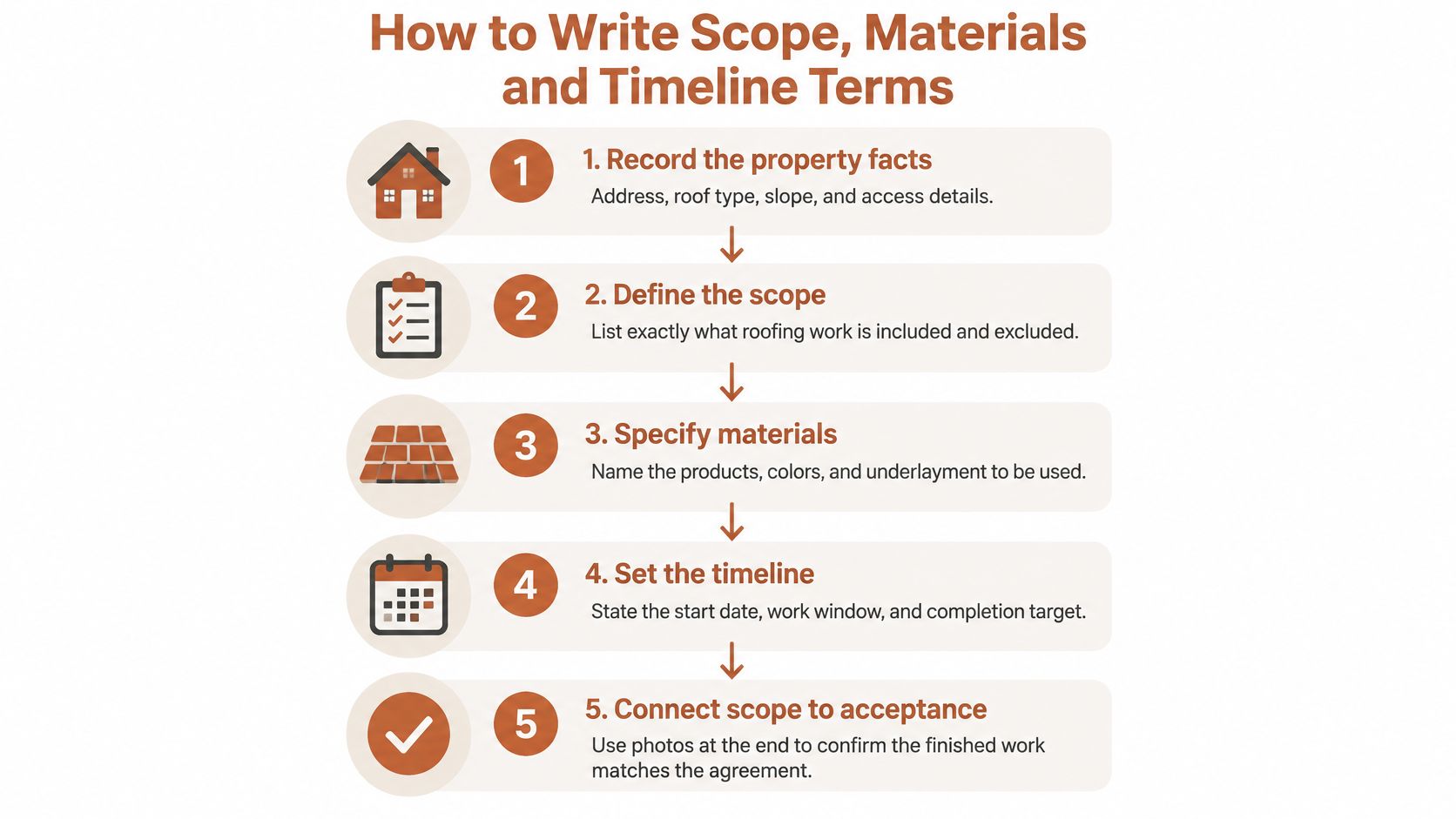
Scope should produce acceptance criteria, not just describe an activity. If you promise flashing replacement, specify where it happens and capture the completed detail before shingles conceal it.
Use this visual checklist when assembling the job description.
Build the scope around observable work
Record the property facts. Identify the address, roof system, measured area in squares, slope, access restrictions, tear-off layers, and visible decking condition. Attach annotated photographs showing ventilation, flashing, penetrations, and any areas you couldn't inspect, so an observation doesn't become an implied guarantee about concealed conditions.
Name the products. Specify manufacturer, product line, grade, color, underlayment, ice-and-water protection locations, fastener type, and installation method. Require written approval for substitutions rather than relying on a broad equivalent-materials provision.
Separate exclusions from responsibilities. State whether concealed decking repairs, skylights, gutters, fascia, and interior finishes are included, excluded, or subject to an allowance. Assign permits, disposal, landscaping protection, temporary weather protection, and code compliance expressly; an exclusion shouldn't leave necessary site protection unassigned.
Set workable timeline windows. Define what opens the start window, including deposit receipt, permit approval, material availability, and customer access. State how unsafe weather affects scheduling, who sends an updated forecast, and how the completion window changes rather than giving yourself unlimited postponement rights.
Define acceptance. List cleanup, magnetic nail sweeping, finished-work photographs, punch-list handling, warranty delivery, and required inspection records. Set an agreed period for reporting visible incomplete items without suggesting that silence eliminates rights concerning concealed defects.
Safety belongs in planning, too: OSHA's residential roofing guidance says fall protection is generally required for residential construction work 6 feet or more above a lower level. Customer approval of the scope doesn't replace the contractor's safety obligations.
Keep reusable language separate from job facts
Our contracts use clear sections in a simple section editor. Build reusable blocks for cleanup and permit responsibility, but replace property-specific descriptions and attachments for every roof.
Use the estimate terms and conditions guide to distinguish pricing assumptions from obligations that belong in the signed agreement. Make sure the estimate, agreement, and exhibits identify the same scope version.
For another way to review roofing-contract preparation, use the accompanying video.
Before signing, ask the customer to explain what they expect you to remove, replace, and leave untouched. Correct any mismatch in the document, not just in conversation.
Payment Schedule, Deposits and Change Orders
Say you're pricing a reroof and want payments to follow procurement, installation, and closeout. The hypothetical schedule below illustrates the arithmetic, not a recommended deposit percentage or a statement of what your state permits.
Worked payment schedule for a hypothetical $12,000 reroof
| Milestone | Trigger | Share |
|---|---|---|
| Deposit | Signed agreement and materials order placed | 20%, or $2,400 |
| Materials delivered | Shingles on site, dated photo logged | 30%, or $3,600 |
| Dry-in complete | Underlayment and flashing done, inspection passed if required | 30%, or $3,600 |
| Final | Cleanup and punch list done, warranty documents delivered | 20%, or $2,400 |
| Total | Full contract price | 100%, or $12,000 |
The customer can verify each trigger. Keep the order confirmation, delivery photograph, dry-in record, and closeout checklist with the corresponding invoice rather than asking the customer to accept your recollection.
Match collection to your actual commitments
Check state deposit restrictions before choosing amounts. The contractor deposit guide helps organize that decision around materials and reserved capacity, but local law sets the limits.
An expected deposit can be set on our estimates for work requiring materials or a reserved date. Account for that deposit explicitly when preparing later invoices so it isn't collected again through the milestone amounts.
Also state when each triggered invoice becomes payable. A completion event and a payment deadline serve different purposes; the agreement needs both.
Handle changing prices without a surprise invoice
National roofing-material costs rose 1.48% in 2025, compared with 0.79% for roofer labor, according to Roofing Contractor. That doesn't justify a blanket right to increase an accepted price.
Separate fixed-price tasks from allowances. For any permitted adjustment, identify quote validity, the supplier document or index used, the affected materials, the agreed cap, and the customer's options if they reject the increase. Supplier invoices should substantiate the difference, not become permission to pass through unrelated overruns.
A transparent adjustment method can be fairer than a fixed-price promise you can't honor. An unrestricted price-change clause isn't transparency.
Suggested change-order wording:
Work outside Exhibit A won't begin until the customer signs a change order identifying the reason, added or deducted price, and schedule impact.
Pair that wording with an emergency exception narrow enough to control. Specify the authorized temporary protective work, an agreed spending ceiling, attempted-contact requirements, and the photographs you'll supply afterward.
For delays, distinguish unsafe weather from a contractor's inability to mobilize. State the rescheduling procedure and what happens to the deposit, unused materials, and documented commitments if you miss the contractual start deadline. Don't leave refund decisions until the customer is already asking for their money back.
Warranty and Maintenance Terms That Hold Up
Contractor workmanship coverage and manufacturer material coverage aren't interchangeable. Building Enclosure's roofing-warranty guidance describes contractor warranties commonly lasting one to five years, while manufacturer material warranties commonly last five to 20 years for new construction, remedial roofing, and recover applications.
The actual warranty documents control. Don't describe a product as fully warranted without identifying who owes which remedy.
Warranty and maintenance coverage types
| Coverage | Typical Length | Usually Covers | Usually Excludes |
|---|---|---|---|
| Contractor workmanship warranty | Term in the contractor's warranty | Qualifying leaks caused by installation errors, including covered flashing or seam defects | Damage unrelated to workmanship and specified maintenance failures |
| Manufacturer material warranty | Term in the product warranty | Qualifying shingle or membrane defects | Installation errors and conditions outside the material warranty |
| Extended manufacturer warranty | Duration stated in the selected plan | Materials and sometimes labor | Obligations beyond stated time limits, exclusions, and monetary caps |
| Routine maintenance plan | Agreed recurring service term | Scheduled inspections, cleaning, specified minor repairs, documentation | Repairs beyond the service scope; qualifying defects follow the warranty process |
Routine maintenance often falls outside workmanship coverage. Keep the maintenance schedule and price separate so neither party mistakes a warranty repair for a billable cleaning visit.
Write a claims process the customer can follow
Suggested wording should leave no mystery about the next step:
Workmanship coverage begins on the date stated in the warranty schedule and applies to qualifying leaks caused by our installation. Send notice through the listed contact method, include the discovery date and available photographs, and allow reasonable inspection access.
Fill in the actual term, notice requirements, and remedy after local review. Don't require the owner to climb onto a leaking roof to preserve a claim.
The schedule should answer these questions:
- Inspection charges: State when a diagnostic visit is free and when an agreed fee applies if no covered defect is found.
- Registration: Name who submits manufacturer paperwork and delivers confirmation.
- Transfer: Explain whether a buyer can receive coverage and what procedure applies.
- Third-party work: Identify notification requirements for solar installation, alterations, and temporary repairs.
For customer education before alterations, Aastro Roofing Company's guide to roof repairs that can cancel coverage provides a focused follow-up resource. Your signed warranty must still identify the applicable restrictions rather than incorporating a general webpage as its terms.
Keep inspection findings, notices, and repair authorizations together. A shorter warranty with a precise claims process is more useful than a long promise nobody knows how to invoke.
Insurance, Lien Waivers and Fall-Safety Terms
Working alone doesn't eliminate exposure. You can damage a neighbor's vehicle, hire help for tear-off, or receive materials from a supplier who hasn't been paid.
The expensive omission is often proof of coverage, not another paragraph promising careful work. Specify the insurance you carry, when certificates will be delivered, and who handles a property-damage report.
Match the insurance clause to the operation
Use a clause built around verified policy details: contractor maintains the general liability coverage identified in the insurance schedule and supplies a current certificate before site work begins. List the actual limits there rather than copying an impressive amount from a template.
Address workers' compensation for employees and any legally applicable sole-operator exemption. If you bring in subcontractors, establish what coverage evidence you'll obtain from them.
A certificate is evidence of insurance, not a guarantee that every incident is covered. Photograph existing driveway, landscaping, siding, and neighboring-property conditions, then record any reported damage promptly without promising an insurer's decision.
Use waivers that match cleared payments
A contractor's waiver doesn't automatically release an unpaid supplier's separate rights. Identify whose waivers are required and collect supporting supplier or subcontractor releases when appropriate.
- Before payment clears: Use the applicable conditional waiver tied to the identified payment.
- After funds are received: Provide the appropriate unconditional release for the amount paid.
- At closeout: Reconcile outstanding suppliers, subcontractors, disputed amounts, and required final releases.
Name the exact statutory form where required and keep each executed version with its payment evidence. Don't promise an unconditional final waiver before receiving final funds just because a generic template says to exchange them together.
Keep safety responsibility with the contractor
Assign responsibility for fall-protection equipment, suitable anchors, ladder setup, and inspection of equipment. State that the contractor can suspend work when conditions are unsafe.
The customer's role is to keep pets, people, and vehicles outside the designated work and drop zones. Their signature doesn't transfer your duty to choose safe working methods.
Have local counsel verify licensing disclosures, lien notices, waiver forms, cancellation provisions, and deadlines. These are drafting principles, not legal advice, and state-specific requirements take priority over convenient template language.
Negotiating, Signing and Delivering the Agreement
Negotiate convenience before you negotiate away control. A customer may reasonably want a different work window or a clearer cleanup commitment; removing the approval requirement for extra work creates a different kind of risk.
Rank requests by what they change:
- Flex on logistics. Access arrangements, communication preferences, and a workable punch-list period can often change without disturbing the price.
- Price additional obligations. A longer workmanship commitment or accelerated completion target deserves a review of capacity, coverage, and cost.
- Protect authorization and collection. Preserve lawful deposit terms, written scope changes, and an objective final-payment trigger.
If the customer wants to delete change orders, explain the practical benefit: you won't expand their bill without their authorization. Offer a reliable response process instead of unlimited verbal discretion.
Let the customer review the actual signing version
Walk through the scope and exclusions in person or by video. Ask the customer to initial important exclusions where your signing process supports it, and resolve questions before sending the final version.
Our service agreements can be sent through a secure link for clients to sign on their phone. Clients access the public contract link, while the signed contract is stored separately from the draft agreement text.
That separation matters. Editing a reusable block for tomorrow's customer must not rewrite yesterday's signed commitment.
For a later negotiated change, use the amendment to agreement template guide to document which provision changes and which terms remain intact. Don't overwrite the original and assume an email conversation supplies consent.
Deliver an evidence package, not just a signature request
Retain the signed PDF and signature audit trail, and promptly provide the customer's copy. Check that every referenced exhibit is included and identifiable by title or version.
Before scheduling: Pause if the customer refuses to identify an authorized signer or wants payment and approval obligations removed without a workable replacement.
For dispute handling, name the notice address, opportunity to inspect or correct, and locally reviewed escalation process. Cancellation terms should explain payment for authorized completed work and material commitments without attempting to override mandatory consumer rights.
Send Your First Agreement This Week
Start with a job you understand well rather than building a template for every roof system you might encounter. Use its inspection notes and estimate to create a realistic agreement.
The document workflow should keep the terms close to the customer's approval and payment records.
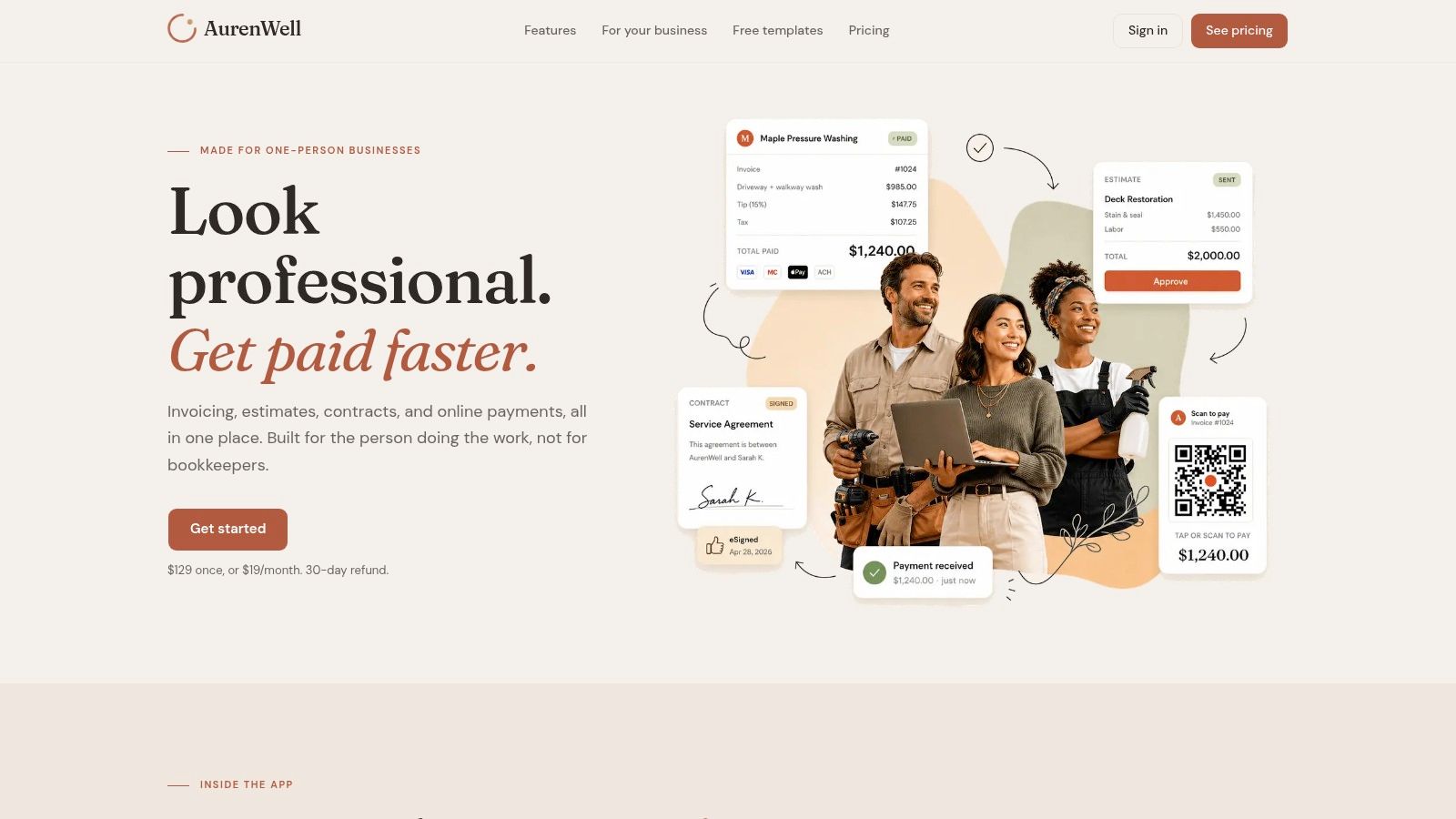
Build the template. Use the section editor for scope, materials, payment, warranty, and insurance terms. Keep site-specific facts visibly separate from reusable wording.
Prepare the estimate and agreement. Itemize the work, set the expected deposit where appropriate, and ensure the agreement identifies the matching estimate and exhibits.
Send the relevant document link. Clients can view, approve, sign, and pay in their browser without a login or app installation. Each estimate, contract, or invoice can be sent by link.
Preserve the signed record. Keep the signed PDF and signature audit trail with the client record, separate from draft text. Add your field evidence to the job's organized documentation.
Convert approved work. Open the accepted estimate and choose Convert to invoice. Approved line items become a draft invoice without rebuilding the job; check deposit credits and the payment schedule before sending it.
Collect and reconcile. Customers can pay by card, ACH, or QR code, and you can record manual payments. Configure overdue reminders to follow your agreed terms rather than treating reminders as a substitute for clear due dates.
You retain rights to the client records and documents you create. PDF and CSV exports let you keep usable copies outside the application.
Choose one past job, draft its roofing service agreement in AurenWell, adapt it to a current customer's actual scope, and send it before the week ends.