
You've finished the jobs, sent the invoices, and paid for supplies. Your calendar looks healthy, but your bank balance doesn't look like a successful month. When you sit down to build a self-employed profit and loss statement, the first problem isn't the arithmetic. It's deciding which money belongs in the month.
Work billed, cash collected, and taxable profit aren't interchangeable. A useful statement keeps those differences visible, so you can judge your pricing without spending money you haven't received or overlooking the tax bill on money you have.
What a Self-Employed Profit and Loss Statement Shows
Say a pressure-washing owner bills $6,200 for completed April jobs, uses $900 of chemicals, and incurs $1,400 for fuel, insurance, advertising, and a helper. In this hypothetical example, matching the completed work with its costs leaves $3,900 in net profit. That's the business result before considering how much the owner withdraws.
The basic calculation is simple: business income minus business expenses equals net profit or loss. The hard part is choosing the right income dates, separating business costs from personal spending, and preserving the records behind the totals.
What the statement reports
For a U.S. sole proprietor, IRS Publication 334 explains that Schedule C, Profit or Loss From Business, accompanies Form 1040 or Form 1040-SR, with net profit or loss carried to Schedule 1; its 2025 guidance also says a federal filing obligation generally exists when net earnings from self-employment reach $400, although other filing requirements can apply below that threshold.
A distinct sole-proprietorship business generally needs its own Schedule C. Don't assume every service you sell is a separate business, but don't combine separate businesses because they share a bank account.
Practical rule: A P&L measures business performance. It isn't a bank balance, a filed tax return, or a substitute for the records supporting it.
For broader context, Everglow Prosperity's guide to measuring your small business's financial health is a useful companion when deciding what you want your statement to tell you.
Start with a consistent line template, write down the accounting basis, and build the totals from individual transactions. You'll then have something you can use for operating decisions and review for tax reporting.
Line Items Every Solo Profit and Loss Needs
Solo profit and loss line template
| Line | What to put here | Effect | Typical source |
|---|---|---|---|
| Gross receipts | Client invoices, card, ACH, check, cash, and income reported on information returns; track tips separately from service prices | Add | Invoices and deposits |
| Returns and allowances | Refunds and price reductions given to clients | Subtract | Refund records |
| Direct job costs | Parts, materials, and subcontractors for a specific job | Subtract | Job receipts and bills |
| Gross profit | Receipts after returns, minus direct job costs | Subtotal | Calculated |
| Advertising | Ads, listings, and promoted posts | Subtract | Categorized expenses |
| Car and truck | Allowable business vehicle costs using the chosen method; business-use share only | Subtract | Mileage log or receipts |
| Supplies | Consumables that aren't tied to one job | Subtract | Receipts |
| Insurance | Liability, tools, and business policies | Subtract | Premium invoices |
| Contract labor | Paid helpers who aren't employees and aren't already included in direct job costs | Subtract | Bills and information-return records |
| Utilities and phone | Business share of phone, internet, and shop utilities | Subtract | Mixed-use split |
| Professional fees | Bookkeeper, software, and licenses, separated into subcategories where useful | Subtract | Invoices paid |
| Repairs and maintenance | Equipment and tool repairs | Subtract | Receipts |
| Home office | Allowable business share under the applicable method | Subtract | Worksheet |
| Business interest | Interest on business borrowing only | Subtract | Loan statements |
| Net profit or loss | Gross profit minus operating expenses | Bottom line | Calculated |
Copy these rows into a spreadsheet and add This month and Year to date amount columns. Above them, record the business name, period covered, and accounting basis. Use the same category names each month so you can compare a busy lawn-care month with a quieter one without rebuilding the categories.
Keep receipts separate from payment channels
An invoice, a card payment, and a bank deposit can all describe the same sale. They aren't separate pieces of revenue. Likewise, an information return is a cross-check against your records, not extra income to add on top.
Track tips separately so you can distinguish the service price from additional customer payments, while still including business income appropriately. Record refunds against receipts rather than hiding them among operating costs.
Separate job margin from overhead
Direct job costs tell you what it took to deliver a particular job. Overhead tells you what it took to keep the business running. A designer's project-specific stock license may belong with that project, while a general design-software subscription belongs with overhead.
Count each cost once. If you place a subcontractor's bill in direct job costs, don't subtract it again under contract labor. These are management categories, not instructions to put every direct service cost into tax-form cost of goods sold.
For a hypothetical tutor with $3,200 in lesson receipts, no direct job costs, $180 in software, and $90 in advertising, net profit is $2,930. The useful next question is whether that result adequately compensates the tutor's working time, not whether the arithmetic looks impressive.
Personal spending needs a different destination. If you pay for concierge help for family logistics, described by Approved Lux Personal Assistant, keep the family purpose separate from your business categories; freeing up working time doesn't automatically turn a household service into a business expense.
Every transaction should have a clear home: income, direct job cost, operating expense, or an owner/personal transaction that stays off the P&L.
Choose Cash or Accrual Before You Build
Choose the accounting basis before trusting the margin. Under cash accounting, you record income when payment arrives and expenses when you pay. Under accrual accounting, you record earned revenue and incurred costs, even when money hasn't moved.
Use this visual to distinguish the timing.
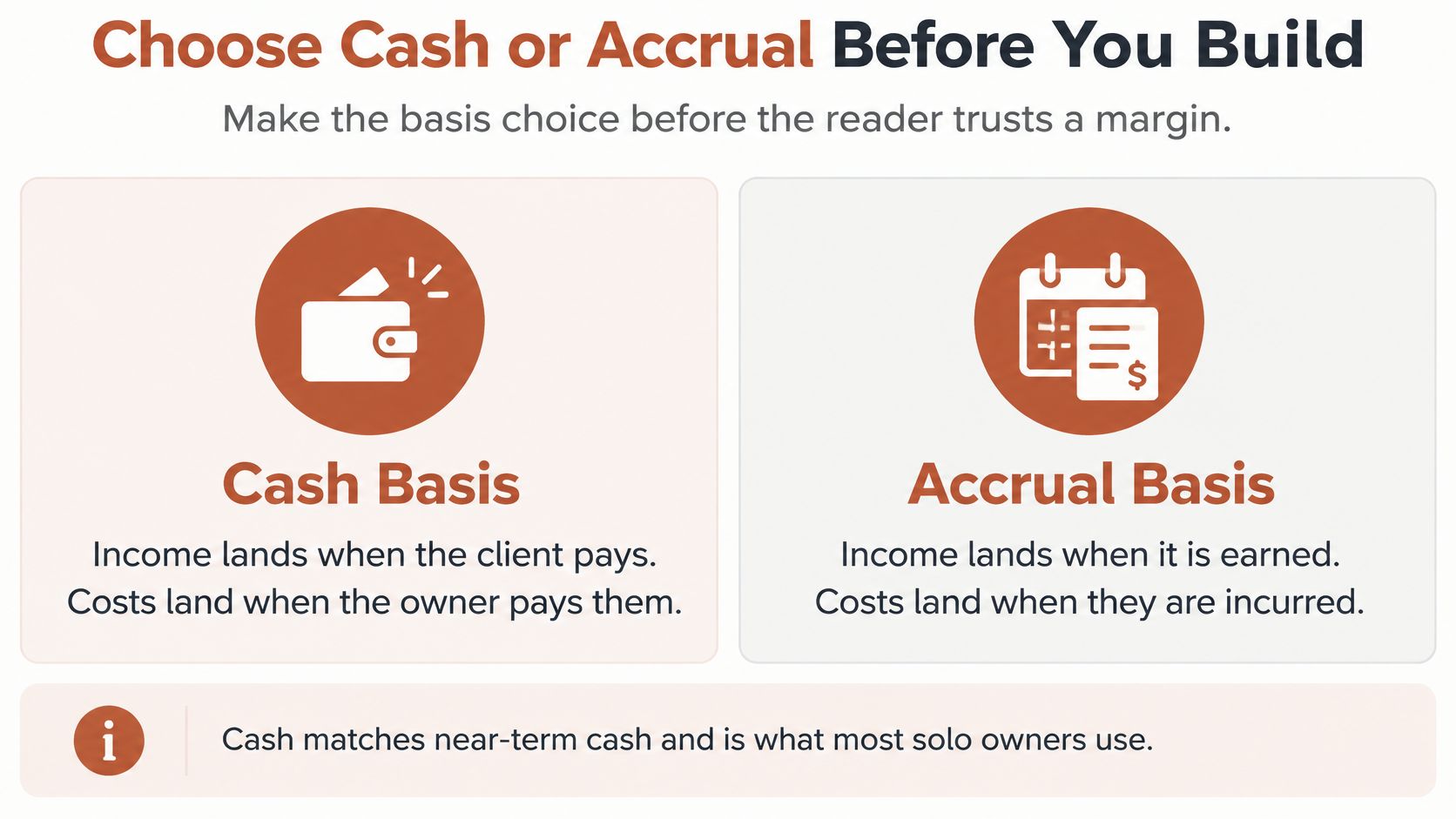
Cash basis versus accrual for a solo P&L
| Basis | Income counted when | Expenses counted when | Extra tracking | Best fit |
|---|---|---|---|---|
| Cash | The client pays | You pay the bill | Bank, processor, and receipt dates | Eligible sole proprietors wanting simpler payment-based records |
| Accrual | The job is delivered or the sale is complete | The cost is incurred, even if unpaid | Unpaid invoices, unpaid bills, deposits, and adjustments | Owners whose deposits and slow payers obscure job margins |
The SBA's business-management guidance describes the trade-off: cash accounting is easier to understand and makes cash movements clearer, while accrual provides a more immediate operating snapshot but requires more complex records. Neither removes the need to track upcoming obligations.
Say a photographer receives an advance before a wedding and the balance after delivering the work. Cash accounting generally records the receipts when collected; accrual management records distinguish the advance from revenue earned on delivery. Tax treatment of advance payments can require separate review, so don't assume a bookkeeping label settles it.
For another explanation of the accounting distinction, watch the walkthrough below.
Write Cash or Accrual at the top of the statement. Keep the supporting books consistent with your tax-reporting method, and identify any management-only adjustments explicitly rather than switching methods to improve a month's result.
How to Build the Statement From Your Records
Build from the transaction trail, not from a remembered monthly total. Open your invoice register, payment records, expense log, and bank or processor statements together.
This visual summarizes the workflow; the detailed checks below prevent the most consequential errors.
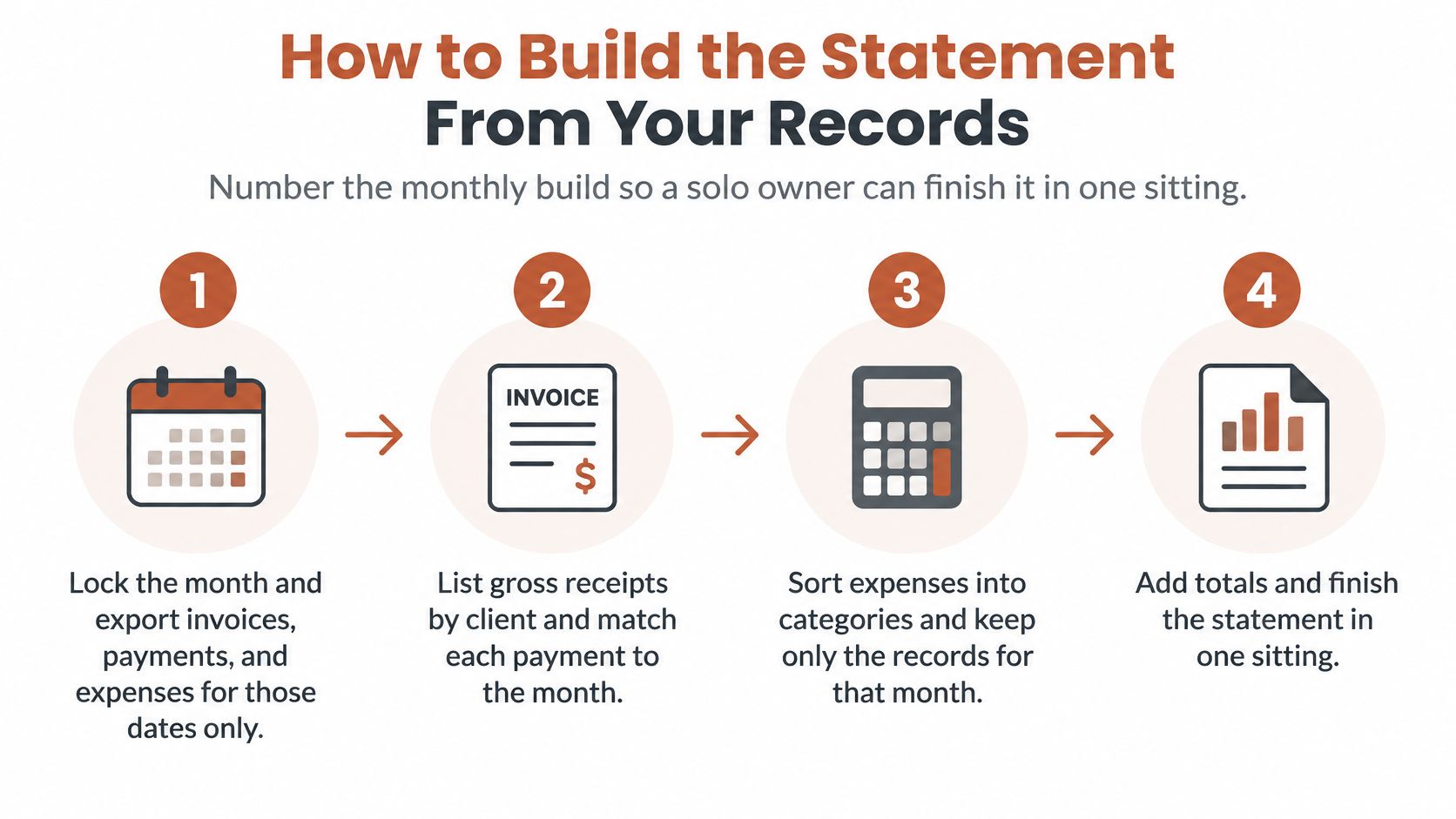
Complete the monthly build
Lock the reporting period. Set the beginning and ending dates, then export invoices, payments, and expenses. Keep unpaid invoices and bills available too, because you'll need them to explain timing differences.
Reconcile receipts by client. Match each payment with its invoice and deposit. Check annual information returns against the underlying customer records rather than treating them as additional sales. If a processor deposits receipts net of fees, reconcile the gross payment and fee separately instead of understating both income and expenses.
Remove non-expense movements. Pull out owner withdrawals, transfers between accounts, and loan-principal payments. Keep these in a separate reconciliation so the bank activity still makes sense even though those movements don't reduce operating profit.
Apply the category names consistently. Separate direct job costs from overhead. On an accrual statement, include qualifying unpaid obligations and match costs to the appropriate period instead of using payment dates by default.
Attach the evidence. Preserve the receipt or invoice and a short business-purpose note. Put unexplained card charges in a review queue rather than classifying them as deductible business costs. Resolve material gaps before calling the statement final.
Calculate the totals. Subtract returns and allowances from receipts, deduct direct job costs to find gross profit, and subtract operating expenses to find net profit or loss. Check formulas before copying the sheet into the next month.
Review the tax mapping. The IRS Schedule C instructions explain the reporting of business profit or loss and the application of at-risk and passive-activity limitations, which can make an allowable tax loss smaller than the accounting loss. Maintain a separate tax-adjustment schedule and reconcile the relevant return amounts before filing.
Fintrack's guide to setting up a money tracking system can help you organize the recurring capture work. The important operational choice is to use a system you'll update while the job and purchase details are still clear.
Check what timing changes
Consider this hypothetical designer month. All invoiced work has been delivered, only part has been collected, and the listed costs have both been incurred and paid.
Designer month on two bases
| Line | Invoiced basis | Collected basis |
|---|---|---|
| Gross receipts | $4,800 | $3,100 |
| Supplies (fonts and stock) | $400 | $400 |
| Software and insurance | $600 | $600 |
| Net profit or loss | $3,800 | $2,100 |
The invoiced column functions as an accrual illustration only because the work is complete. An invoice sent early isn't automatically earned revenue.
For advance payments, keep the original invoice, receipt, and remaining balance connected. The guide to creating an invoice for a deposit helps you preserve that billing trail without accidentally counting the advance again when you issue the final bill.
Save the original exports before making category changes. At year-end, consolidate the monthly statements, check opening and closing adjustments, and give the preparer both the book result and the unresolved tax questions.
Sorting Mixed Costs Before They Hit the Total
Sort each charge into business-only, personal-only, or mixed before assigning an expense category. A handyman who enters an entire truck payment because the truck is usually used for jobs hasn't finished the accounting. The payment may include principal, and the vehicle may also have personal use.
For a mixed cost, document the business-use basis rather than choosing a convenient percentage. Vehicle records should distinguish business travel from personal travel; phone records should support the allocation you use. Home-office costs need their own eligibility and calculation review, not just a room measurement.
Preserve the reason behind the amount
IRS recordkeeping guidance says supporting documents should identify the payee, amount, proof of payment, date, and business purpose, while deductible business expenses must be ordinary and necessary, meaning common and accepted in the trade and helpful and appropriate for the business. Personal expenses don't become business deductions because they were paid from a business account.
Use the checklist as a documentation check, not as a promise that categorizing a charge makes it deductible.
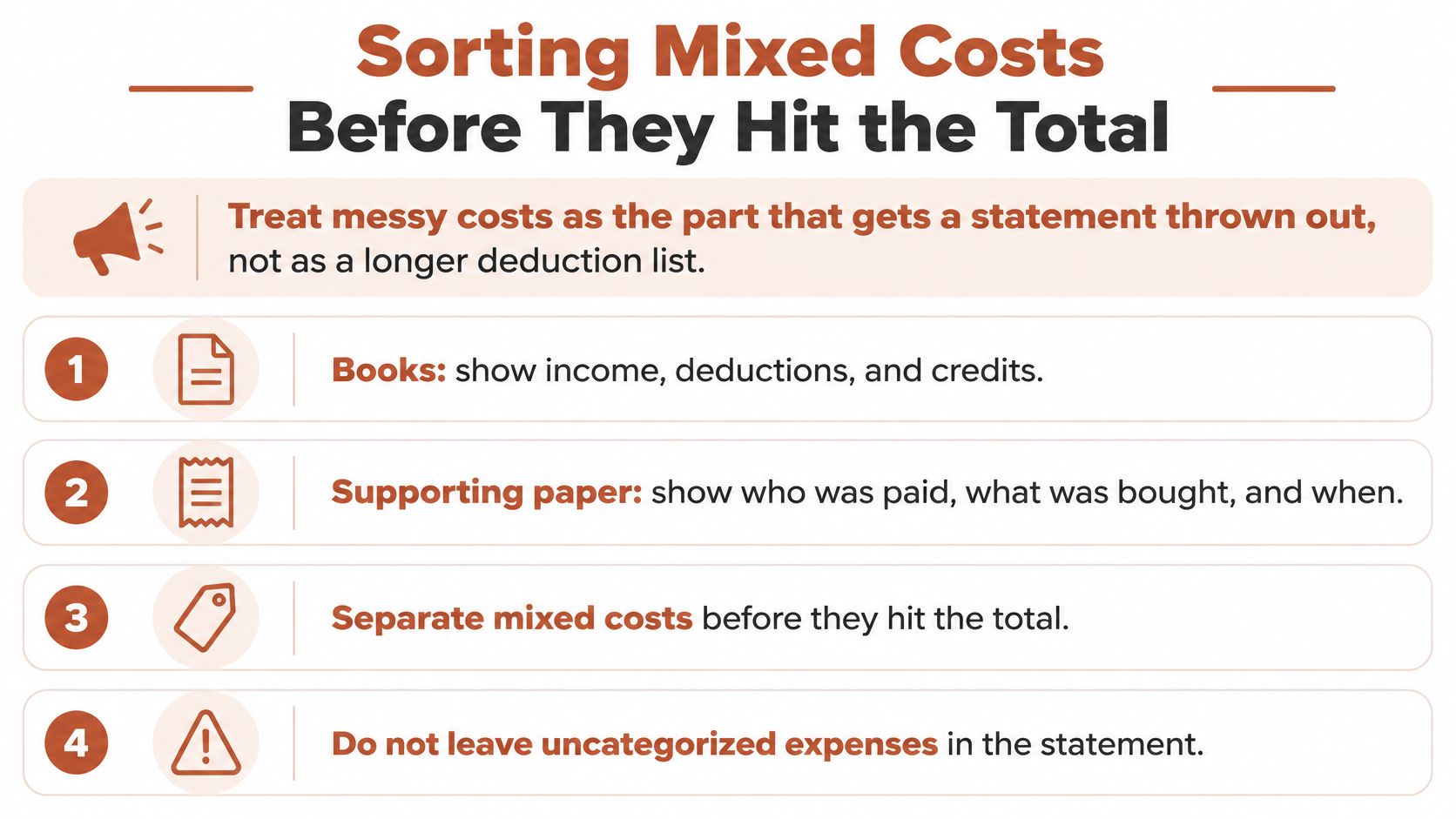
A useful expense record contains:
- Transaction details. Record the merchant, date, amount, and category, with a receipt attached.
- Business explanation. State what the purchase supported, especially when the merchant name doesn't make that obvious.
- Allocation evidence. Keep the log, worksheet, or other support for any business-use split.
- Job connection. Link a cost to its client when it belongs to a specific job.
Keep the record chain intact
Separate business and personal accounts make this work faster, but the account name alone doesn't prove business purpose. Keep the agreement, invoice, payment record, and related expense documents together so you can explain the transaction without reconstructing it months later.
A well-supported spreadsheet is more useful than polished software filled with unexplained transactions.
Use expense tracking for small business as an operating routine, not an annual cleanup project. Flag unusual purchases, large cash transactions, and allocations you can't explain clearly for professional review.
Don't delete uncertain items and forget them. Keep a pending list with the missing evidence and the action needed, then resolve it before the reporting period is finalized. Expense records support accounting and tax preparation; they don't file taxes for you.
Reading Profit Against Cash and Tax
Late payment makes a profitable month feel poorer than it looks. In 2025, 85% of freelancers reported experiencing late invoice payments at least some of the time, according to Remote's Contractor Management Report. Separately, MediaPost reported that 29% of freelance invoices in 2025 were paid at least one day late, based on an analysis of more than 100,000 freelancers' invoices over three years.
Those findings measure different things, freelancers' experiences and invoice timing. Both explain why sending the invoice isn't the same as having money available.
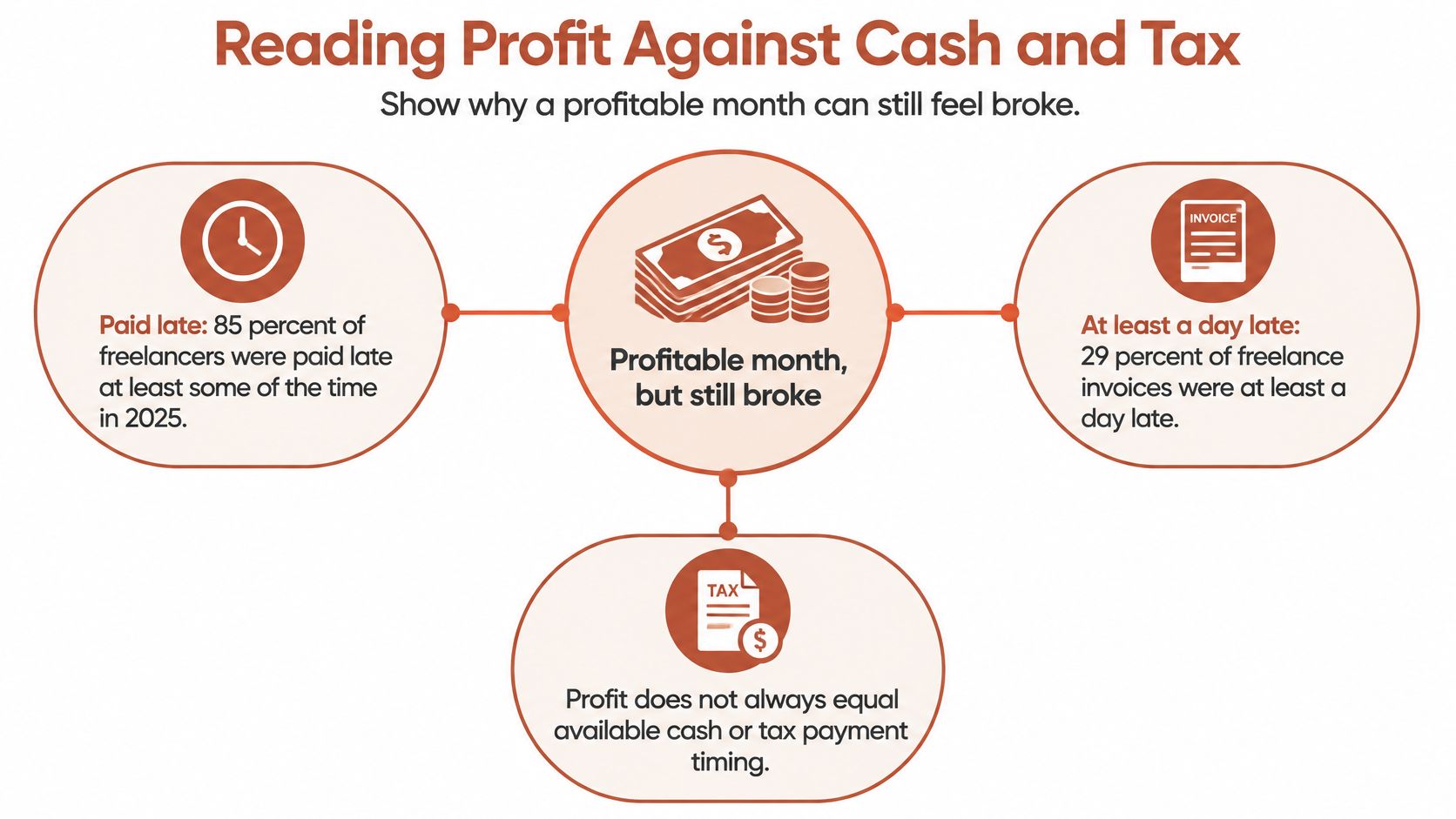
Give each reading a specific job
Three readings of the same month
| Reading | What you count | Date that matters | Use it for |
|---|---|---|---|
| Invoice profit | Work billed minus costs of that work | Invoice or delivery date | Pricing and job margin |
| Cash collected | Payments received minus bills paid | Bank or processor date | Bills, draws, and whether to spend |
| Taxable profit | Income and deductible costs on your tax basis | The date your cash or accrual method uses | Schedule C, Schedule SE, and quarterly reserves |
Invoice profit is a useful management reading only when the invoices represent earned work and the associated costs are complete. Cash collected is a simplified operating view, not a full cash-flow statement: borrowing, equipment purchases, owner contributions, and withdrawals also affect the bank balance.
Consider a hypothetical month with $5,000 billed for completed work, $2,000 collected, $1,200 of job costs paid, and $800 still owed to a helper. Assume all those costs relate to the billed work.
The earned-work view shows $3,000 left after job costs. The simplified cash view shows only $800 left before paying the helper, overhead, owner withdrawals, or tax. You can have a positive margin and no practical room to spend.
A catch-up payment next month changes collection timing, not the profitability of the work you originally performed. Similarly, a weak collection month doesn't prove your prices are too low. Review unpaid balances and job margins separately before deciding which problem you have.
Reserve tax from money you can actually move
The IRS guidance on Schedule C and Schedule SE explains the relationship between business profit and self-employment tax, including that estimated tax payments may be necessary when tax isn't withheld. Your final tax obligation isn't the P&L bottom line multiplied by a universal percentage.
Spending test: Before taking an owner draw, subtract unpaid commitments and the tax reserve from available cash, not from outstanding invoices.
Keep columns for invoice date, payment date, expense timing, and the planned reserve transfer. At each estimated-tax review, use year-to-date taxable results, prior payments, and your broader tax situation to update the estimate with your preparer.
Don't buy supplies merely to make taxable profit smaller. A legitimate purchase can reduce profit while leaving you with less cash and doing nothing to fix underpriced work.
For the operating check, use the reports guidance to review revenue, outstanding balances, and expenses together. If cash can't cover an approaching tax obligation, treat that as a collection or funding problem to address promptly, not a reason to ignore the payment date.
Close This Month With the Backup Intact
A useful monthly close ends with a statement you can explain and records you can retrieve. It doesn't require a perfect dashboard or a complicated chart of accounts.
Finish a close you can repeat
- Label the basis. Put cash or accrual beside the business name and reporting dates.
- Complete the amounts. Fill the monthly and year-to-date columns, then check the formulas against the transaction records.
- Resolve the exceptions. Review mixed-use costs, owner transactions, missing documents, and unmatched payments.
- Record the cash gap. Note what remains uncollected, what you still owe, and what must stay available for taxes.
- Save the backup. Store the statement with the period's invoices, payment records, receipts, and adjustment notes.
Keep unresolved questions visible rather than making a confident-looking number out of an uncertain classification. Ask your preparer to review a business loss, home-office treatment, or vehicle allocation before you rely on the tax result.
The owner remains responsible for verifying that business documents and tax records meet the requirements that apply. An export preserves your records; it doesn't constitute a filed Schedule C.
Close your current month in AurenWell this week. Snap and categorize your receipts, pull the expense totals, and reconcile them with your invoices and payments. Export invoices, estimates, and contracts as PDFs, plus clients, income, and expenses as CSV, at any time on any plan. Save that backup with your completed statement, then use the actual profit and available cash to decide what you can safely pay yourself.