
You've finished measuring a driveway, or you're trying to quote a house wash from a few phone photos. The customer wants a number now, but the surface area, staining, access, and water supply may still be uncertain. A useful pressure washing estimate template makes those assumptions visible, so you can explain what the price covers and what would change it.
The key is to make each line traceable: was it measured, supplied by the customer, or left dependent on an inspection? That record helps prevent the familiar argument that a quote based on a rough description was supposed to cover a larger, dirtier, harder-to-reach job.
Estimate Template Fields You Can Copy
| Field | What to Enter | Example |
|---|---|---|
| Estimate number and date | Sequential number and issue date | PW-104, issued October 25 |
| Valid until | Expiration date of the price | 30 days from issue |
| Client and service address | Full name and property address | Morgan Lee, 14 Oak Street |
| Property type and stories | Residential or commercial, stories | Single-family, two stories |
| Inspection status | Measured, customer-provided, or inspection-dependent | Customer-provided measurements |
| Service method | Pressure wash or soft wash, per surface | Soft wash siding, pressure wash driveway |
| Surface line items | Surface, measurement, unit rate, amount | Driveway, 600 sq ft, $0.15 per sq ft |
| Access and water | Ladder, lift, and hose-reach needs | Water hookup within 50 ft, no lift needed |
| Chemicals and materials | Pretreatment, detergent, degreaser | Detergent and driveway pretreatment |
| Labor, travel, and equipment | Itemized or included in the rate | Included in rate, 25-mile travel radius |
| Minimum service charge | Flat amount for small jobs | $150 flat |
| Discounts | Named reason and amount | Repeat customer, 5% |
| Sales tax | Rate and which lines are taxable | Applicable local rate, taxable lines shown |
| Deposit | Amount or percent and trigger | 25% on approval, large jobs only |
| Balance due | Total minus deposit | Total minus any deposit paid |
| Exclusions | Work and risks not included | Gutters, interiors, sealing, oxidation removal |
| Customer prep | Tasks the client completes | Move vehicles, protect pets and plants |
| Completion window | Date range and weather rule | Within 5 business days of approval |
| Approval method | Link, e-signature, or written confirmation | E-signature on the estimate link |
Start with the header and client details. The estimate number lets you find the document later, while the service address makes clear which property the quote covers. Then identify the property type, stories, access conditions, and how the scope was established.
That inspection-status field matters most when you quote remotely. Mark each relevant measurement as measured, customer-provided, or inspection-dependent. A square-foot figure from a customer's message isn't the same as an area you measured yourself, and the estimate should say so. When the driveway turns out to be 800 sq ft instead of 600, that one word gives you the basis to revise the price.
Practical rule: Price each surface as its own line. A single lump sum hides whether a driveway, siding, and walkway were all included.
Keep the template lean. Every field above exists because it either sets the price, limits your liability, or tells the customer what to do before you arrive. If a field does none of those three, cut it.
Finish with costs, terms, exclusions, prep instructions, and an approval method. Chemicals, labor, travel, and equipment can be separate lines or included in rates, but be consistent. Store the entries as reusable data, so an approved estimate can carry into an invoice without retyping the scope.
How to Price Each Line Item and Total the Estimate
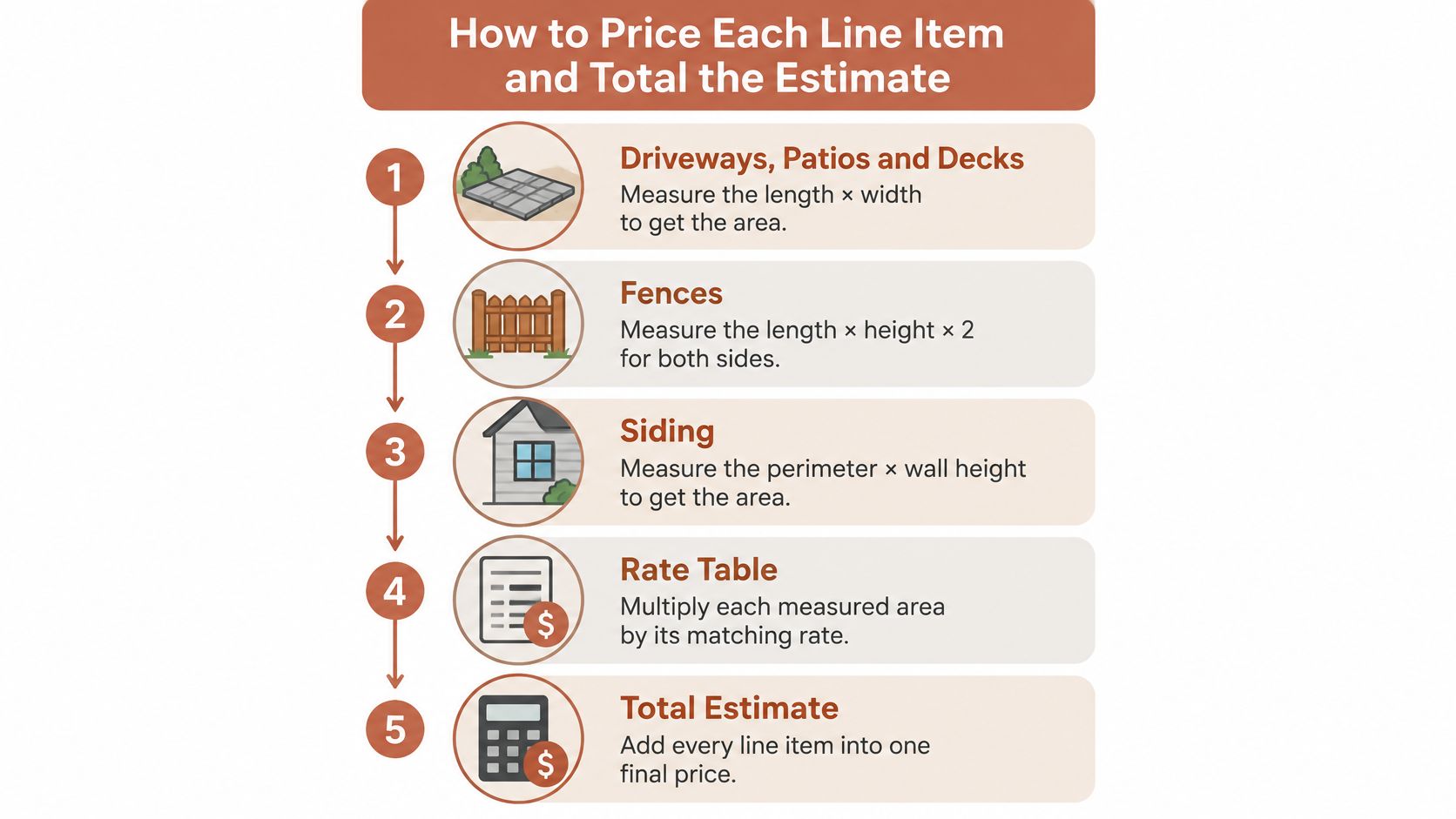
Every line item needs two things: a quantity you can defend and a rate you can explain. Start with the quantity.
- Driveways, patios, and decks: length × width.
- Fences: length × height × 2 for both sides.
- Siding: perimeter × wall height.
| Surface | Typical Rate | Method to Specify | Common Add-On |
|---|---|---|---|
| Concrete driveway or walkway | $0.10–$0.35 per sq ft | High pressure with a surface-safe nozzle | Oil and rust may not fully lift |
| House exterior siding | $0.10–$0.50 per sq ft | Soft wash on painted or delicate siding | Second story, plus 20%–40% |
| Roof | $0.20–$0.70 per sq ft | Soft wash only, no high pressure | Mold and algae treatment |
| Wood deck | Set a local rate | Low-pressure wash with a wide fan tip and a wood-safe detergent; confirm the setting with a test patch before full passes | Stain removal or sealing, billed separately |
| Fence, both sides | Set a local rate | Length × height × 2 | Heavy staining, plus 25%–50% |
| Minimum service charge | $100–$250 flat | Covers mobilization, setup, and teardown | Applies when area is small |
Treat every range in that table as a rough planning estimate. The concrete, siding, and roof figures come from published pressure-washing pricing guidance, which reports broad spans rather than prices in your service area, so check them against a few written local quotes and your own job costs before building a rate card on them. If you are setting a baseline, compare your numbers with how much to charge for pressure washing.
Build the total in this order:
- Verify measurements. Write down where each quantity came from, especially when it came from photos or the customer's description. If a customer-provided square footage turns out wrong on site, that note is what makes a price revision legitimate instead of a surprise.
- Choose the method by surface. Roofs call for soft washing, and wood decks need a gentler approach than concrete. Avoid quoting a single pressure setting for every surface on the job.
- Apply a surface rate. Show the math on each line: quantity × rate = amount. A customer who can check the multiplication rarely argues with it.
- Account for job costs. Labor, chemicals, fuel, water, equipment wear, insurance, and overhead belong in the rate or as visible line items. Pick one approach and stay consistent.
- Apply a minimum charge if needed. A small area still requires mobilization, setup, travel, and teardown.
- Price measurable difficulty. Second-story work may add 20%–40% and heavy staining 25%–50%, depending on the job.
- Add profit. Covering expenses is not the same as pricing a job that sustains the business.
- List optional add-ons separately. Keep services such as sealing out of the cleaning scope.
Never apply an uplift without saying so. Name the added work, show its price, and state the condition that triggers it.
A Filled-In Estimate for a Two-Story House
Hi Morgan, attached is the estimate for your driveway, front walkway and steps, and two-story vinyl siding. The total is $801.05, subject to the scope and tax treatment below. This estimate is valid for 30 days. Approve and sign using the estimate link.
The figures below are an example of how to show the math. The driveway quantity is customer-provided until you verify it, and siding measurements should be labeled according to how they were obtained.
| Line Item | Quantity | Rate | Amount |
|---|---|---|---|
| Driveway, concrete | 600 sq ft | $0.15 per sq ft | $90.00 |
| Walkway and front steps | Minimum charge | $150.00 | $150.00 |
| House siding, two stories | 1,400 sq ft | $0.25 per sq ft | $350.00 |
| Second-story uplift | 30% of siding | 30% | $105.00 |
| Pretreatment and detergent | One job | $45.00 | $45.00 |
| Subtotal | $740.00 | ||
| Sales tax, if taxable | $740.00 | 8.25% | $61.05 |
| Total due | $801.05 |
The driveway line is 600 × $0.15 = $90.00. The walkway and steps use the $150 minimum because mobilizing and setting up for a small area still takes time. Siding is 1,400 × $0.25 = $350.00, with a separate $105 second-story uplift so the added difficulty isn't hidden in the base rate.
Pretreatment and detergent appear as their own $45 line, rather than being disguised as extra square footage. The subtotal is $740.00; the example applies 8.25% tax, or $61.05, where the service is taxable, bringing the total to $801.05.
A routine residential visit may not need a deposit. If none is collected, the balance due is the total. Put the limits directly beneath the totals, where the customer will see them: Oxidation, rust, and oil stains may not fully lift. Don't bury that qualification in a block of terms.
Deposits, Taxes and Terms That Protect Cash Flow
The question isn't whether every customer should pay a deposit. It's which payment structure fits the job's risk. Match each payment to a clear event, so the customer knows what triggers the charge.
| Job Type | Deposit | Payment Milestones | Cancellation or Weather Term |
|---|---|---|---|
| Small residential wash, one visit | None or waived | Balance due on completion | Reschedule at no charge if rain prevents work |
| Recurring residential contract | None, billed per visit | Invoice per visit, reminders at 3, 7, and 14 days | Missed visit rescheduled, billed on the next visit |
| Large job with reserved date or lift rental | 25% on approval | Deposit on approval, balance on completion | Refundable if cancelled 7 or more days ahead, not after materials are bought |
| Multi-day commercial job | 25% on approval | Approval, mobilization, completion, and punch-list acceptance | Weather days logged and billed only if agreed in writing |
A deposit is easier to defend when it corresponds to actual commitments, such as buying materials, reserving a date, or arranging lift rental. Put cancellation terms in writing, including whether the deposit is refundable and what happens if weather stops the work. Pressure-washing estimate guidance on payment terms highlights a gap worth addressing: stating a payment method is not the same as explaining how cancellations and delays work.
Tax treatment varies by location and service. Keep a sales-tax line that you can switch off when it doesn't apply, and confirm local requirements rather than assuming all services are treated alike. For more clauses to adapt, see this guide to estimate terms and conditions.
You can place this directly beneath the totals:
This price assumes hose access to a water source within 50 ft. Plants, pets and vehicles are your responsibility per the prep list. We use the method suited to each surface and do not promise a set PSI. Oxidation, rust, oil and damaged coatings may not fully lift. Rain delays are rescheduled at no charge. A cancellation 7 or more days ahead refunds the deposit.
Handling Uncertain Scope and Change Orders
The common dispute starts with a quote based on phone photos or a rough description. The actual driveway is larger, stains are heavier, or the hose can't reach the work area. A professional estimate doesn't pretend those unknowns are confirmed facts.
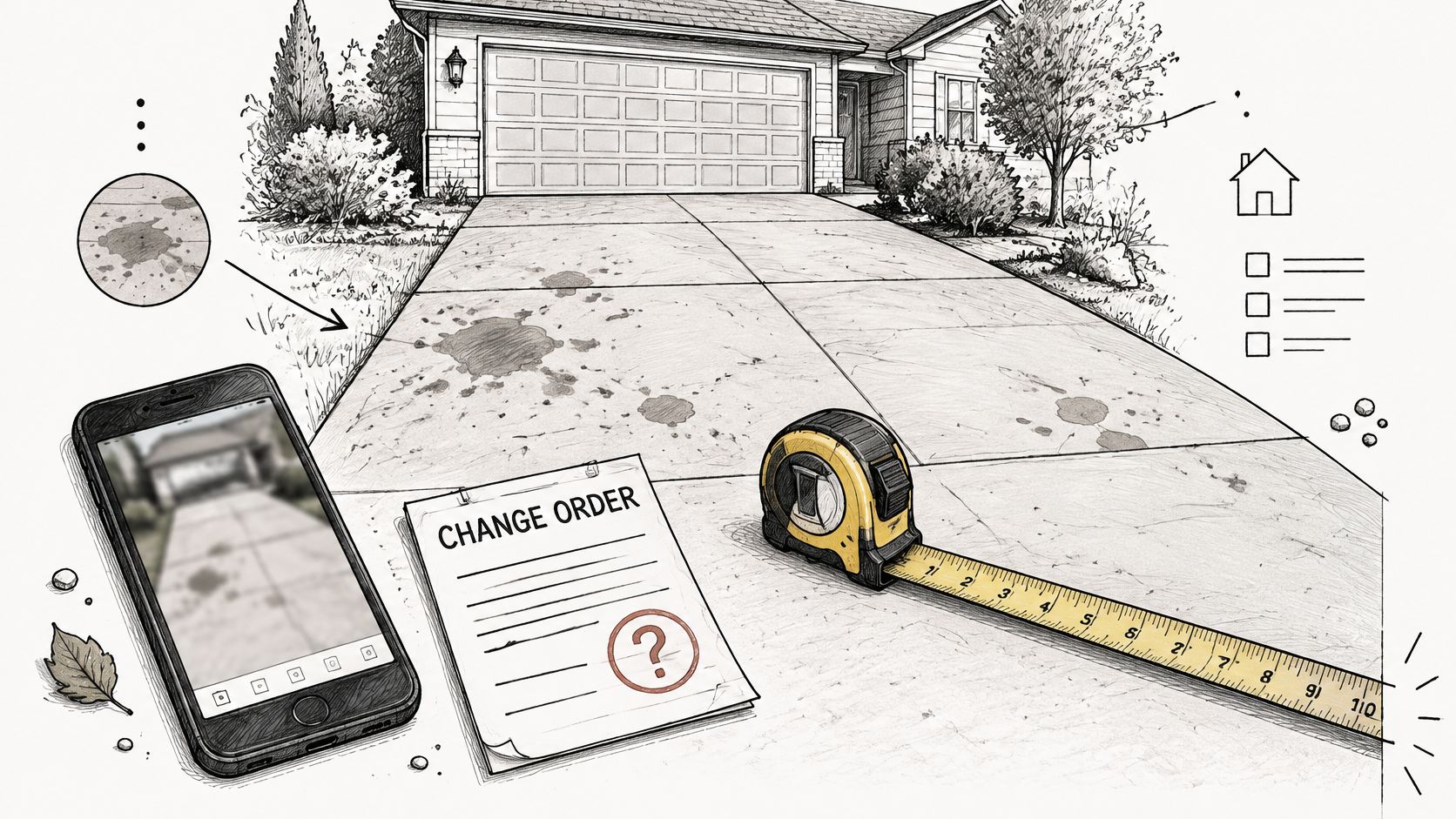
Use three status labels and apply each consistently:
- Measured: You checked the quantity yourself. Treat it as firm unless the site conditions change.
- Customer-provided: The client supplied the measurement. Confirm it on arrival before beginning work.
- Inspection-dependent: The price may depend on what you find, such as stain severity, mold depth, water access, height, or the appropriate cleaning method.
The status should appear beside the relevant measurement or scope line, not in a general note that a customer might overlook. Pressure-washing estimate-template guidance also emphasizes itemized scope and assumptions; make those assumptions specific enough that both sides can tell what was known when the quote was prepared.
State the triggers that can change the price: more stories than quoted, staining beyond what the photos showed, no usable water source within reach, extra chemical dwell time, or a surface that needs a different method. Don't promise a specific result for permanent oxidation, rust, oil, efflorescence, or damaged coatings.
Change-order rule: Don't start extra work until the customer approves the revised line in writing or by e-signature.
A sample clause can be simple: “This estimate is based on the measurements and conditions identified above. If inspection reveals additional area or conditions that change the scope, work beyond this estimate will begin only after your written approval of the revised price.” Attach before-and-after photos to the approval when they help show why the change was needed.
Send Your First Estimate and Turn It Into an Invoice
A quote isn't finished when you calculate the price. The customer still needs a clear way to review the scope, approve it, and understand what happens next.
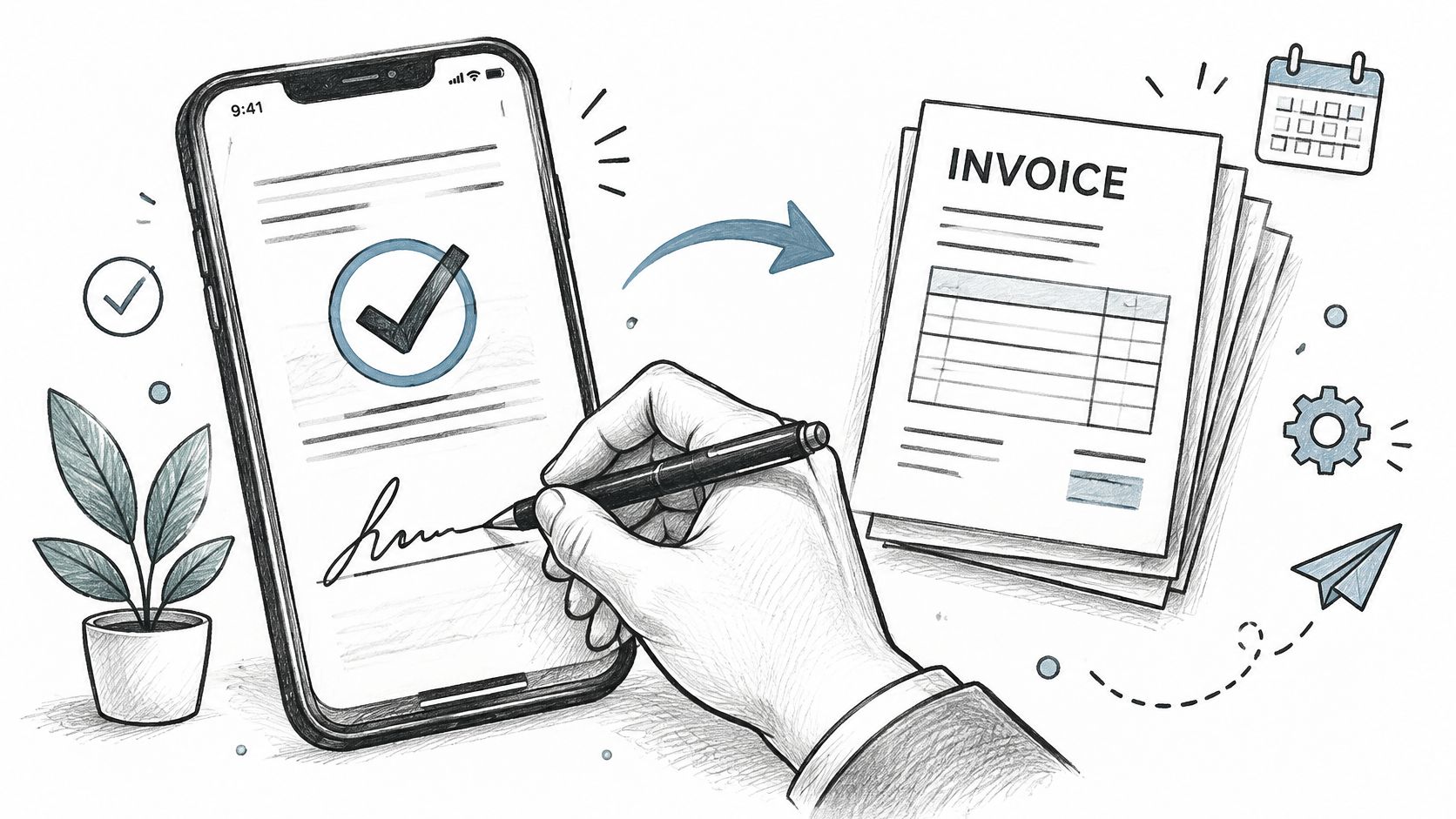
- Complete the fields. Check the inspection status on every line, and make sure exclusions, prep, tax, and payment terms are visible.
- Send a browser-based estimate link. The customer can review and approve without needing to download a PDF.
- Collect a deposit if the job requires one. Tie the payment to approval or another named milestone.
- Convert the approved estimate into an invoice. Carry scope, prices, and exclusions forward instead of retyping them.
- Set reminders for unpaid invoices. Use a consistent schedule, such as reminders at 3, 7, and 14 days.
- Record manual payments. Apply cash, check, or bank transfers to the invoice when received.
A solo operator can handle those steps in a spreadsheet and PDF workflow, or use a document tool built for estimates and invoices. AurenWell is one option: it supports browser-based estimate approval and e-signature, optional deposits, estimate-to-invoice conversion, and online card and ACH payments through Stripe with a 1% platform fee. It also lets users record manual payments without a fee and export PDFs or CSV files. Its listed plans are $19 monthly, $89 yearly, or $129 lifetime, with a 30-day refund on the first payment. If you need to build the billing document from an approved quote, use this guide to write a pressure washing invoice.
The estimate itself should remain the record of what the customer approved. Keep the signed scope and any later change orders with the invoice, especially when the original price depended on photos or customer-provided measurements.
See how the approval and invoice process can work in practice:
Copy the field table into your current tool this week, fill it out for one real job, and send that estimate with the sample terms before you begin work.
This week, build a reusable estimate with separate surface lines, inspection-status labels, and written change-order approval. Send it for your next real quote, then carry the approved scope into the invoice without retyping it.