
You've finished the driveway, rolled up the hose, and the customer points toward the sidewalk: “Could you do that part too?” Then comes the awkward question about whether it was included in the price. Without a written scope, you're negotiating while standing in a wet driveway, with the machine packed or still running.
Pressure washing contracts work best as job instructions and approval records, not paperwork for its own sake. They establish what you'll clean, how you'll clean it, what's excluded, and what the customer approved before work starts. That's especially useful in a crowded market: the U.S. pressure-washing services industry generated approximately $1.2 billion in revenue in 2024, while the number of businesses grew much faster than revenue between 2019 and 2024, according to IBISWorld figures summarized in an industry overview.
A signed scope changes the sidewalk conversation. If it's listed and priced, you can point to the agreement. If it isn't, you can offer a written add-on and get approval before doing the extra work. That protects the customer from surprise charges and protects you from donating labor because the original agreement was vague.
The sections below focus on the practical parts of that system: the clauses that define the job, the insurance gap behind damage disputes, the mechanics of deposits and changes, wastewater responsibilities, and a mobile workflow that keeps the signed record with the client.
Why a Signed Scope Beats a Handshake Every Time
“Exterior wash” sounds clear until you're on site. Does it include the driveway and front walk? The back patio? The retaining wall? Does “clean” mean removing loose surface dirt, or treating every stain until it disappears? If the contract doesn't answer those questions, the customer and operator may each believe they agreed to a different job.
A measured scope makes the difference visible before the first pass. List each surface separately, record its approximate area, and name the method you intend to use. For example, “front driveway, pressure wash, approximately 600 square feet” gives both parties a more useful reference than “wash exterior.” Exclusions matter just as much. If you're not cleaning the fence, treating oil stains, or moving heavy patio furniture, say so.
A contract should describe the work you can verify, not promise an undefined result.
That distinction matters when a customer says a stain remains. You can compare the complaint with the agreed scope and explain what was included. If stain treatment wasn't part of the original work, quote it separately instead of arguing about what “clean” was supposed to mean.
The same applies to completion. Define the observable event that marks the job complete, such as finishing the listed surfaces and walking through them with the customer when they're available. A defined completion point makes the balance due easier to manage and gives both parties a shared record of what happened.
Pressure washing services are spread across many small operators. Broader U.S. Census data for “Other Services to Buildings and Dwellings,” a category that includes pressure and soft washing along with other building services, counted 32,193 establishments with fewer than five employees in 2022. The category is broader than pressure washing alone, but it illustrates why an owner-operator benefits from a plain, self-contained agreement rather than relying on a separate office team to resolve misunderstandings. The Census-based industry summary also explains the limits of treating that category as a pressure-washing-only count.
A useful agreement doesn't need corporate language. It needs clauses, risk records, payment mechanics, and a mobile workflow you can complete on the job site.
Essential Clauses Every Pressure Washing Contract Needs
Start the contract during the walk-around, while you and the customer can point to the same surfaces. A one-line “exterior wash” description leaves too much room for disagreement. A measured list gives you a practical checklist and gives the customer a chance to correct an omission before signing.
For each area, note the location, approximate size, and cleaning method. Record whether you'll use pressure washing or soft washing, and list excluded areas or treatments. Then document access requirements, weather rescheduling, client preparations, price, the completion event, and the process for resolving a dispute.
| Contract Element | Thin Clause | Defensible Clause |
|---|---|---|
| Scope | “Exterior wash” | “Front driveway, approximately 600 square feet, pressure washed; rear patio excluded” |
| Method | “Clean surfaces” | “Soft wash on siding; pressure wash on listed concrete areas” |
| Access | “Customer provides access” | “Customer provides water access and clears vehicles from the driveway before the scheduled arrival” |
| Weather | “Weather permitting” | “Work may be rescheduled if weather makes the agreed cleaning method unsafe or impractical; revised timing will be confirmed with the customer” |
| Completion | “Payment due when done” | “Balance due after listed surfaces are cleaned and the completion walk-through is offered” |
| Changes | “Extra work costs more” | “Additional areas require a written change order with measured area, revised price, and customer approval before work begins” |
Capture the details where they arise. Identify the client and service address before the walk-around. During the inspection, list each surface and method, note exclusions, and record access or property-protection responsibilities. Add the price once the scope is complete. Before leaving, make sure the customer understands the completion definition and how you'll handle questions or disputes.
The wording should be straightforward enough to read on a phone. If you want a general reference for organizing obligations and approvals, LA Law Group's insight on contract drafting offers a broader perspective. For service businesses, the same plain-language discipline applies to estimate terms and conditions: the customer should be able to see what they're approving without translating legal jargon.
Risk, Liability, and the Insurance Gap Most Templates Miss
“I carry general liability insurance” doesn't tell a customer what happens if the surface being cleaned is damaged. The important question is whether the policy covers the specific property involved and the specific kind of claim. A certificate can show that coverage exists, but it isn't a substitute for understanding policy terms or documenting the condition of the work area.
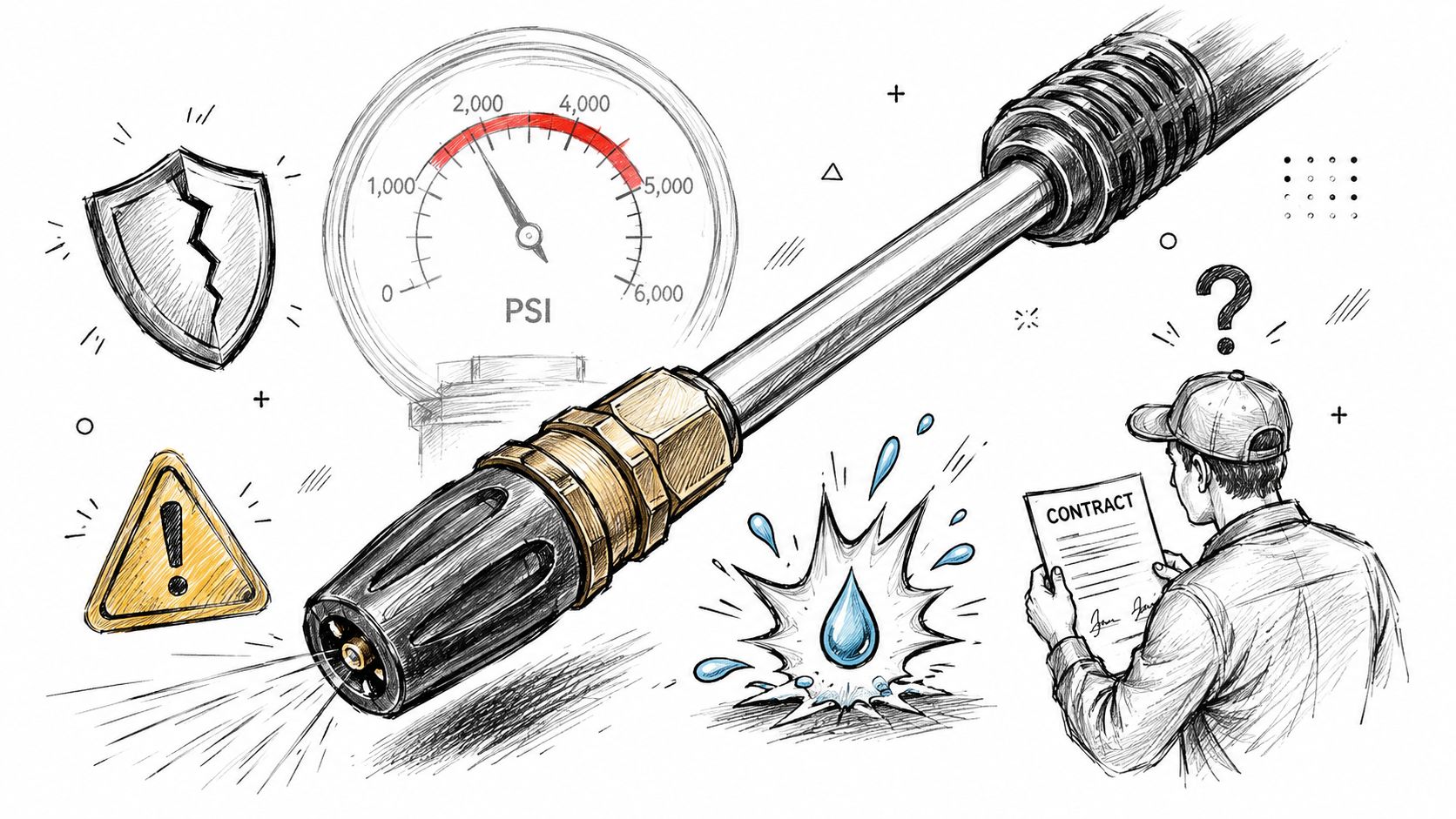
Pressure-washing equipment commonly operates around 2,000 to 4,000 PSI. The wrong pressure, nozzle, or spray distance can etch concrete, damage wood or vinyl, break window seals, or force water behind siding, as described in this overview of pressure-washing insurance risks. Those aren't abstract possibilities. They're reasons to identify the intended method by surface and to record fragile or already compromised areas before starting.
Document what the policy may not cover
A policy's treatment of damage to the specific item being worked on can differ from its treatment of damage to surrounding property. A “your work” exclusion may limit or exclude coverage for damage to the surface under active treatment, even when surrounding-property claims are treated differently. A contract that promises broad protection without explaining that distinction can give both operator and customer a false sense of security.
Use a pre-service condition record: photograph cracks, oxidized siding, failed paint, loose sealant, existing stains, vulnerable landscaping, and fixtures near the work area. Ask the customer to disclose fragile or previously damaged materials, and note how the customer should report a concern after the job. State plainly that coverage depends on the actual policy, rather than suggesting the contract itself guarantees reimbursement.
For commercial work, ask for the certificate of insurance before mobilizing and confirm that the relevant coverage addresses completed operations and applicable care, custody, and control or surface-damage exposure. The market range reported for commercial liability requirements is $500,000 to $2 million, but requirements vary by client and location. Even a policy limit at the higher end won't tell you whether damage to the treated surface is covered. For a plain explanation of what a certificate does and doesn't establish, see Liberty Insurance Associates' explanation of COIs.
Deposits, Change Orders, and Cancellation Mechanics
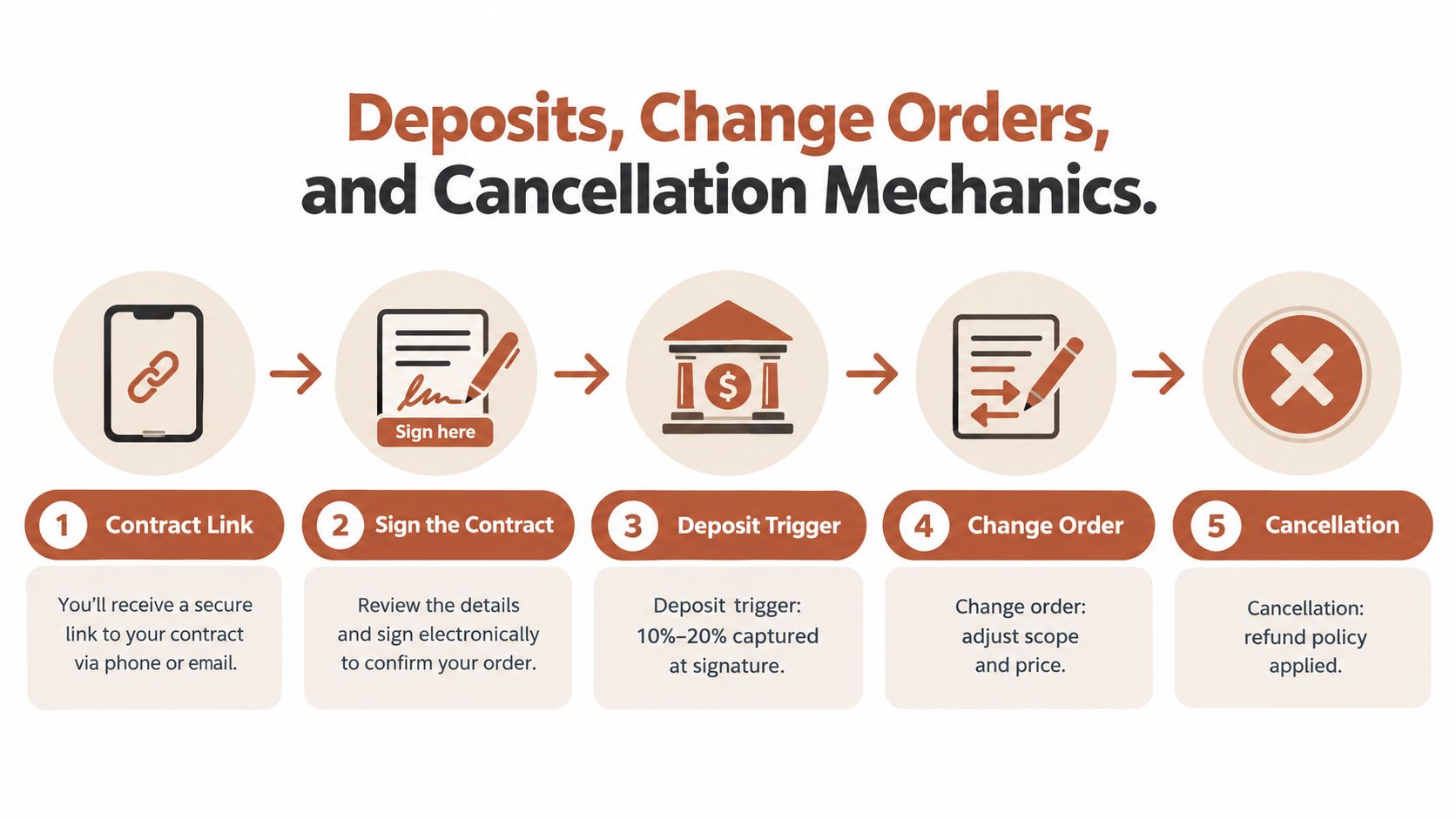
Treat payment terms as a sequence, not a paragraph added at the end. The agreement should state what's due at signing, what happens if the customer cancels, when weather can trigger a reschedule, and what event makes the final balance payable.
A template source says deposits commonly fall in the 10% to 20% range, though the appropriate arrangement depends on the job and local rules. Put the amount and trigger directly in the agreement so the customer knows whether payment is due at signing or later. This pressure-washing contract template guidance also emphasizes written change orders and a defined completion event.
Make additions a separate approval
When the customer asks, “Can you do the back patio too?” pause before expanding the job. Measure the area, write a change order with the additional work and revised price, and get approval before cleaning it. A text confirmation may be useful as a record, but a signed update attached to the original agreement makes the new scope clearer.
A short clause can say: “Work outside the listed scope requires written approval of the additional area and price before work begins.” Keep the change order specific enough that the customer can tell whether it covers a patio, walkway, or another surface.
Cancellation and weather terms should be equally plain. For example: “If unsafe weather prevents the scheduled work, the parties will agree on a replacement date. If the customer cancels, the deposit will be handled according to the cancellation terms in this agreement.” Adapt the wording to your policy and local requirements rather than promising a refund rule you can't follow.
Define the balance trigger precisely. “When you're done” can mean the last spray, the cleanup, or the walk-through. A better term ties payment to the listed work being completed and the customer being offered a chance to review it. If you want a homeowner-facing comparison point, Water Works Power Washing's checklist for Dallas homeowners helps frame the questions customers should ask when reviewing a quote. Contractors setting their own terms can also use this guide to how much deposit to ask for.
Wastewater Handling as a Billable Contract Deliverable
Wash water is easy to overlook because it disappears from the surface. That doesn't mean it disappears as a responsibility. Where the water goes can depend on the municipality, the discharge route, and what the runoff contains. If the contract says nothing, both parties may assume the other person is handling it.
Portland prohibits pressure-washing wash water from entering its stormwater system and requires authorization for certain sanitary-sewer discharges. Sacramento County's guidance says storm drains should be covered or blocked and allows some sanitary-sewer disposal only under stated conditions. The Portland rules and linked local guidance show why an operator should check the actual requirements for the job location instead of assuming one disposal method works everywhere.
Put the disposal plan in the scope
Walk the site before quoting. Identify nearby storm drains and decide whether containment equipment is needed. Then record the intended disposal route, who will provide any required authorization, and who pays permit or disposal costs. Ask the customer to disclose site restrictions, such as rules for a shared commercial property or limits on where water can be collected.
A contract clause can say: “The parties will use the listed wastewater containment and disposal method. The customer must disclose known site restrictions. If compliant disposal requires additional equipment, authorization, or disposal fees, work will pause until the parties approve the revised scope and price.”
That last sentence matters. If the plan requires more containment than expected, the additional work shouldn't be invisible or free. A written change order can name the new equipment, disposal route, and added charge before you continue. If lawful disposal can't be confirmed, stop rather than sending wash water toward a drain and hoping nobody notices.
Treat the wastewater plan as part of the job specification, alongside surfaces, access, and price. It makes the customer aware of the responsibility, gives you a documented reason to pause when site conditions change, and turns compliance work into a defined deliverable.
Mobile Signing and Storage Workflow in the Field
A solo operator can build the agreement while standing at the property, instead of writing a quote from memory after leaving. Start on the phone's estimate screen. Add each measured surface as a line item, select the cleaning method, list exclusions, and enter the price.

Convert the approved estimate into a contract, then send the agreement link by text or email. The customer reviews the scope and signs from the browser. If the agreement includes a deposit, collect it through the same flow and confirm the payment record before mobilizing. Save the signed document and audit trail with the client record so you aren't searching through old messages when a question comes up.
Connect the signed scope to invoicing. Generate the balance invoice from the agreed work, send the payment link, and record any cash, check, or bank transfer alongside online payments. A tool such as AurenWell combines estimates, contracts, invoices, and online payments in one web app, with signed documents and audit trails stored with client records. For a related service-agreement example, see this guide to a landscaping service agreement.
The consumer-protection value isn't limited to payment disputes. Connecticut guidance reports roughly 1,000 home-improvement complaints annually and recommends written contracts, staged payments, and proof of liability insurance; see the state's contract and contractor guidance.
For a visual walk-through of the signing and payment handoff, watch the demonstration below.
Before starting the job, confirm four gates: signed scope, pre-inspection photos, verified insurance requirements for commercial work, and authorized deposit or payment terms. If one is missing, resolve it before the hose comes out.
Build your next agreement around the actual property, not a generic “exterior wash” line. Walk the site, record the surfaces and condition, define wastewater handling and payment triggers, then send the customer a clear document to approve before work begins.