
A client has just emailed asking whether the booking deposit covers extra retouching, whether the images can appear in a paid campaign, and what happens if the shoot moves to another date. You search your inbox and find a friendly message confirming the session, but no document that answers any of those questions. The work may be clear in your head. It isn't clear in the agreement.
That gap is where profitable shoots turn into unpaid work. A useful photographer agreement template does more than protect copyright. It connects the scope, deposit, approval, signature, invoice, delivery, and license in one workflow, so both sides know what happens next.
Why Every Photographer Needs a Practical Agreement
A vague agreement usually fails at the exact point when expectations diverge. A client may assume that “edited gallery” means every usable frame, that social media access includes advertising, or that a cancellation automatically produces a refund. The photographer may assume the opposite. Neither assumption is a workable business term.
A practical contract turns those assumptions into dated commitments. It names the shoot date and location, the deliverables, the number of edited images, the turnaround, the payment schedule, the cancellation process, and the permitted use of the finished work. It also gives the client a clear record of what they bought, rather than forcing them to reconstruct the deal from text messages.

The contract is part of the operating system
For a solo photographer, the agreement should sit beside the estimate and invoice, not in an isolated folder. The signed document should tell you whether the deposit has cleared, which revision limit applies, when delivery is due, and whether the client has approved an add-on. Keeping those records together makes follow-up faster and gives you an audit trail if the client later disputes the balance.
The document also supports the public-facing side of the business. Your photography following strategy may bring a prospect to your inbox, but the agreement converts that interest into a defined commercial engagement. A polished workflow reinforces the same professionalism as your portfolio and client communication.
Practical rule: If a term affects your time, money, files, or reputation, it belongs in the agreement rather than in an informal message.
A strong template doesn't need to sound hostile. Plain language often prevents more conflict than dense legal wording because a client can understand what “three revision rounds” or “commercial advertising use” means. Photographers should still have the final document reviewed for the law of their primary market. The photographer-focused business resource can help you think about the administrative context around that document, but it doesn't replace legal advice.
How to Structure Your Photographer Agreement Template
Build the agreement in three functional layers. Each layer answers a different question, and keeping them separate makes negotiation easier.
Start with scope and deliverables
The first question is, “What exactly will the photographer provide?” State the shoot date, start and end time, location, personnel, coverage, deliverable type, image count, turnaround, and revision process. If travel, overtime, rush delivery, extra retouching, or additional locations may apply, state how the client approves and pays for them.
A usable scope clause should also identify exclusions. Say whether RAW files, rejected images, layered files, source files, or project files are included. Define whether “edited images” means a selected number or the complete professional selection. If the client has responsibilities, such as securing venue access or supplying a schedule, include those too.
Put payment beside the work
The commercial layer should state the total fee, deposit, installment dates, final balance trigger, accepted payment methods, taxes, cancellation terms, rescheduling rules, and consequences of late payment. Avoid “payment upon completion.” Define completion, acceptance, and the date on which the balance becomes due.
Connect the payment clause to performance. You might state that the date is reserved only after signature and cleared deposit, that approved extras require written authorization, and that final high-resolution delivery or expanded usage rights become available after full payment, subject to applicable law.
Separate ownership from permission
The final layer addresses copyright, licensing, releases, portfolio use, and restrictions. Copyright law generally protects an original work automatically once it is fixed in a recorded form. The Berne Convention framework established that automatic-protection principle internationally, and photographic works were expressly included through the Brussels revision of 1948.
That doesn't tell a client what they may do with the images. Your agreement must do that. State who owns the copyright, what license the client receives, and whether a model or property release is attached. A model release authorizes use of a person's likeness, but it doesn't transfer copyright in the photograph.
You can manage the completed document through a contract workflow such as AurenWell contracts, or use another system that preserves the signed version, approval history, and client record. The important point is continuity. The contract, estimate, deposit, and later amendments should refer to the same job.
Writing Usage Rights That Protect Your Work
Usage rights are where a short sentence can give away more than the client intended to buy. “Client owns the photos” may be convenient language, but it can imply unrestricted reproduction, resale, sublicensing, modification, and commercial exploitation. A better clause distinguishes copyright ownership from the license to use the images.
Start with ownership. Unless you've negotiated a separate assignment or buyout, state that the photographer retains copyright in the created photographs. Then describe the permission granted after the agreed payment condition is met. The license should answer five practical questions:
- Purpose: Can the client use the images personally, editorially, on a website, in social posts, in advertising, or in printed promotional material?
- Media: Does the permission cover digital channels, physical print, packaging, paid campaigns, or resale?
- Territory: Is the license limited to a country or region, or does it apply worldwide?
- Duration: Does it last for a defined term or continue indefinitely?
- Exclusivity: Can the photographer license the work to others, or does the client receive exclusive use?
Write the limits in ordinary language
A commercial client might receive permission to use selected images on its website and social channels, but not to resell them, sublicense them, submit them to a third party, or create derivative artwork without written approval. A portrait client may receive personal printing and sharing rights, while the photographer retains portfolio rights subject to any agreed privacy restriction.
Modification deserves its own sentence. Ordinary cropping may be acceptable, while filters, object removal, color changes, composites, or synthetic additions may require approval. State whether the photographer may use the work in a portfolio, and attach the necessary model or property release when identifiable people or private locations are involved.
International copyright protection supports the photographer's ownership, but it doesn't replace a precise license. The Berne system uses national treatment, meaning participating countries broadly protect authors from other member countries as they protect their own nationals. The applicable term and enforceability still depend on national law, so don't promise that one universal rule governs every assignment. For visual inspiration while building a creative presentation, photographers can explore The Sky Above by LesFM, but the agreement itself should remain specific about commercial use.
Usage should be readable at the moment of signing: who may use which files, where, through which channels, for how long, and after which payment.
Including an AI Rider in Your Agreement
A standard copyright clause doesn't answer whether a client may use your images to train an AI system, whether you may process client files through a generative tool, or whether an altered likeness can be used in advertising. Those are separate permissions and should be treated separately.
| Standard photography right | AI-related question |
|---|---|
| Client may use delivered images | May the client submit them to a generative system? |
| Photographer may edit the work | May the photographer use AI-assisted retouching, and must it be disclosed? |
| Photographer retains copyright | Who may use an AI-generated derivative? |
| Model release covers likeness use | Does it cover a synthetic likeness or a newly generated scene? |
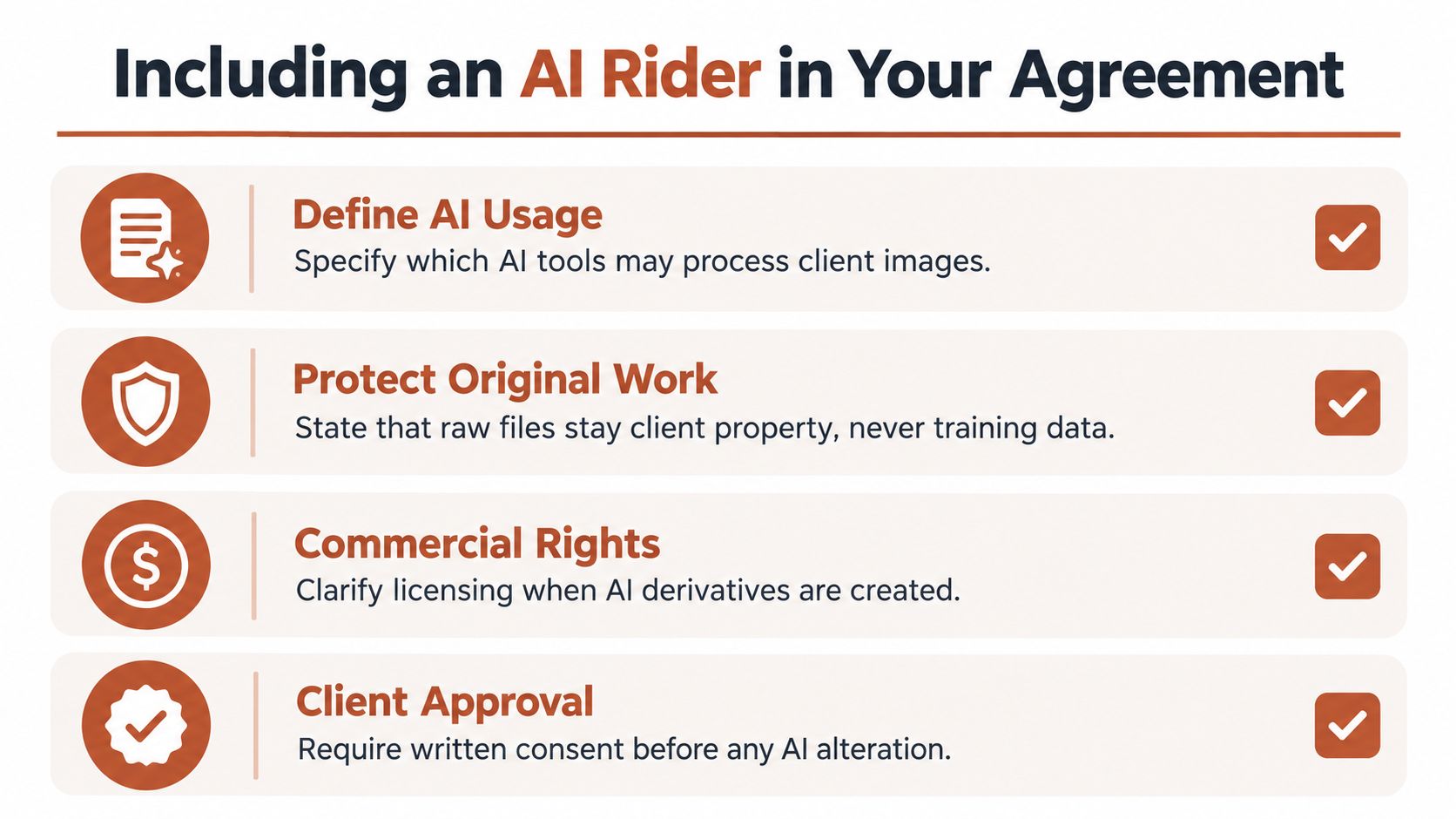
ASMP guidance published in 2025 recommends written consent before generating a person's likeness or a new scene, disclosure of generative methods, and express restrictions on using client assets for AI training. The issue has direct commercial consequences. An Association of Photographers survey reported that the share of photographers losing assignments to generative AI rose from 30% in September 2024 to 58% by February 2025, while reported average annual losses reached about £35,000. ASMP's 2025 AI photography field guide provides the relevant professional context.
Add an optional rider rather than hiding consent in a broad clause. Cover editing, generation, training, dataset retention, synthetic likeness, disclosure, deletion, derivative ownership, portfolio display, and additional compensation. For a client who wants conventional retouching only, mark generation and training as not permitted. For an AI-heavy campaign, negotiate those permissions as commercial rights with their own fee and approval process.
Collecting Deposits and Signatures via AurenWell
A booking often goes sideways in a very ordinary way. The client approves the estimate by email, the contract is still sitting unsigned, the deposit is promised for later, and the date gets penciled in anyway. That is how photographers end up chasing money, arguing about scope, or trying to prove which version of the terms the client saw.

Use one approval path
The safer setup is one client-facing flow. Build the estimate so it matches the agreement, send both together, let the client review the terms in a browser, approve changes, sign on a phone or computer, and pay the deposit before the date is reserved. “Looks good” in an email is not a booking record. A signed agreement tied to a cleared deposit is.
AurenWell is one way to keep that sequence in one place. It connects estimates, contracts, invoices, signatures, payment records, and client history so the job file does not get scattered across email threads and PDF attachments. Its payment workflow uses Stripe for card and ACH payments through AurenWell online payments, can accept optional tipping, and can record cash or bank transfers. For recurring content work, recurring invoices can keep the billing schedule aligned with the agreement. Any system is workable if it preserves the same chain of approval, payment, and storage.
That chain matters when your agreement includes an AI clause. If the contract says no AI training, no synthetic likeness generation, or written approval before expanded usage, the signed version needs to be easy to find before files are delivered or uploaded anywhere. Operationally, the contract is only as good as your ability to connect those permissions to the invoice, the gallery, and the final handoff.
Late payment is common enough that the process should do some of the enforcement for you. A 2022 Independent Economy Council survey of 416 U.S. freelancers found that 74% were not paid on time, 72% had outstanding unpaid invoices, and approximately 16% waited two months or longer despite an explicit due date on the invoice, according to the Independent Economy Council payment analysis.
Set the controls up front:
- Collect before booking: take a non-refundable or clearly defined deposit before locking the date, and check applicable consumer-protection rules.
- Define the trigger: state when the balance is due and whether delivery or broader licensing waits for cleared payment.
- Approve additions: require written approval for overtime, travel, rush delivery, extra retouching, and similar changes.
- Automate reminders: keep logs of views, approvals, signatures, invoices, and payments.
When the balance, approval status, and signed terms sit in one client record, you can check the job from your phone between shoots and know exactly what has been approved. That saves time. It also prevents expensive guesses.
A short video can help clients understand a browser-based signing process before they receive the document.
Handling Cancellation, Rescheduling, and Disputes
Cancellation language works only when it describes the sequence of events. “Deposits are non-refundable” may not explain whether the amount is earned for reserving the date, credited toward a new date, reduced by expenses, or limited by local consumer law.
Separate the scenarios. A client cancellation ends the booking. A rescheduling request keeps it alive only if you confirm a replacement date in writing. A photographer cancellation may require a substitute, a reschedule, or a refund for services not performed. Force majeure should identify the triggering event and the remedy rather than relying on a vague phrase.
Use a decision table
| Situation | Agreement should state |
|---|---|
| Client cancels | Whether the deposit is retained, refunded with deductions, or credited |
| Client requests a new date | The rescheduling window and when written confirmation is required |
| Photographer can't perform | Whether a substitute, reschedule, or refund applies |
| Partial work is complete | What payment remains due and what files, if any, may be delivered |
| Payment is overdue | Whether delivery, licensing, or further work is paused |
Partial performance creates many avoidable arguments. Decide whether proofs can be shared under a limited review permission, whether edited files wait for the final balance, and whether a client who cancels after the shoot receives anything beyond the deliverables already paid for. Make license activation conditional on cleared payment if that matches your business model.
Keep the cancellation clause firm but intelligible. A client is more likely to accept a clear rescheduling credit or expense rule than a paragraph that appears designed only to punish cancellation. If a disagreement still develops, documenting the timeline, approvals, invoices, and signed amendments gives both sides a factual record. A structured service such as Disputely's dispute resolution process may be relevant when direct discussion doesn't settle the matter.
Final Checklist Before Sending the Agreement
Read the final agreement as an operator, not only as a photographer. Ask whether you could use it to answer a client email without opening another application or searching through messages.
- Scope: Confirm the date, location, coverage, personnel, image count, file format, delivery deadline, and revision limits.
- Payment: Check the deposit, installment dates, balance trigger, accepted methods, late-payment terms, cancellation process, and treatment of approved extras.
- Rights: Verify copyright ownership, permitted uses, territory, duration, media, exclusivity, modification rules, sublicensing, and resale.
- Releases: Attach model or property releases where identifiable people or private locations require them.
- AI permissions: Add the rider when AI editing, generation, training, dataset retention, synthetic likeness, or derivative use could arise.
- Workflow: Match the contract to the estimate, signature request, deposit invoice, final invoice, and stored client record.
- Records: Keep the signed version, payment history, amendments, and delivery evidence together, with an exportable PDF copy.
Review your template whenever your service changes. A portrait session, wedding, commercial campaign, and recurring content arrangement may need different addenda even when the core agreement remains stable. Have a qualified lawyer review the version used in your primary market, especially for copyright assignment, cancellation, consumer protection, privacy, late-payment, and governing-law terms.
Choose one upcoming booking and replace its informal email confirmation with a complete agreement workflow. Define the scope, connect the deposit to the signature, state exactly when delivery and licensing activate, add the AI rider where relevant, and store the signed record beside the invoice. That single change will give you a clearer client experience and a more reliable path from scheduled shoot to paid work.