
You've finished the work, delivered the files, and sent the invoice. Then the due date passes, followed by a few days of silence. You open a draft reminder, soften it, delete it, rewrite it, and wonder whether asking for payment will damage a relationship that you want to keep.
That hesitation costs more than a well-written email ever will. An overdue invoice reminder email works best as part of a cash-flow system, not as a one-off exercise in finding the perfect phrase. The practical system is simple: use a defined 3, 7, and 14 day cadence, make every message easy to act on, and decide in advance when email should give way to SMS, a phone call, or a payment plan.
The Moment You Hit Send on the First Reminder
A freelance designer finished a logo project two weeks ago. The final files are in the client's brand folder, the delivery email has gone unanswered, and a soft check-in received no reply. The outstanding invoice is $3,200, and the designer has drafted the first payment reminder three times.
The first draft sounded too sharp. The second sounded apologetic. The third was so gentle that it barely asked for payment at all.
This is a familiar crossroads for solo operators. You've done the work, but you still feel as though you're interrupting someone by asking them to honor the agreed terms. In practice, a concise reminder is usually a professional service message. It gives the client the invoice reference, confirms the status, and offers a direct way to resolve the balance.
Practical rule: If the invoice is valid, undisputed, and overdue, sending the first reminder isn't pushy. Sending it late because you're uncomfortable is expensive.
The problem isn't usually that the client has decided never to pay. The invoice may be sitting with accounts payable, waiting for an internal approval, or buried beneath newer messages. Your job isn't to guess which explanation is true. Your job is to create a reliable path from completed work to received payment.
That path needs three things: a staged cadence, copy matched to the invoice's age, and automation that removes the gut-check before every send. The first reminder should be easy to send because the decision was made before the invoice became overdue.
Why One Reminder Almost Never Works
One reminder assumes the client sees the message, understands what it concerns, has authority to approve payment, and can act immediately. Those conditions often don't exist at the same time. An accounts-payable clerk may process invoices in batches, an approver may be away, or the original PDF may be separated from the email thread.
The historical payment pattern makes the case for persistence. A widely cited 2018 debtor-management dataset found that 59% of overdue invoices required three or more follow-ups before settlement. Its breakdown reported 21% paid after the first follow-up, 20% after the second, 32% after the third, 13% after the fourth, 10% after the fifth, and 3% after the sixth, with a small remainder collected after a demand letter or debt-collection action. Invoice Quickly's summary of the debtor-management data provides the underlying reference.
| Reminder | Approx. share paid after this step | Typical days past due |
|---|---|---|
| First follow-up | 21% | Early overdue period |
| Second follow-up | 20% | Several days later |
| Third follow-up | 32% | Around the first escalation window |
| Fourth follow-up | 13% | Later overdue period |
| Fifth follow-up | 10% | Persistent non-payment |
| Sixth follow-up | 3% | Final email-stage recovery |
The exact timing will vary by client and payment terms, but the operating lesson is stable. Reminder emails are a sequence, not a courtesy ping. The first note gives the client a chance to correct an oversight. The second confirms that the balance still needs attention. The third establishes that the account is being actively managed.
A staged approach also prevents emotional escalation. You don't need to make the first email unusually forceful because later messages already have a defined job. The tone can become firmer while the facts remain unchanged.
Anatomy of an Overdue Invoice Reminder Email
A good reminder is built for a busy inbox. The reader should understand which invoice is involved, how much is due, and what to do next without searching through an old thread.
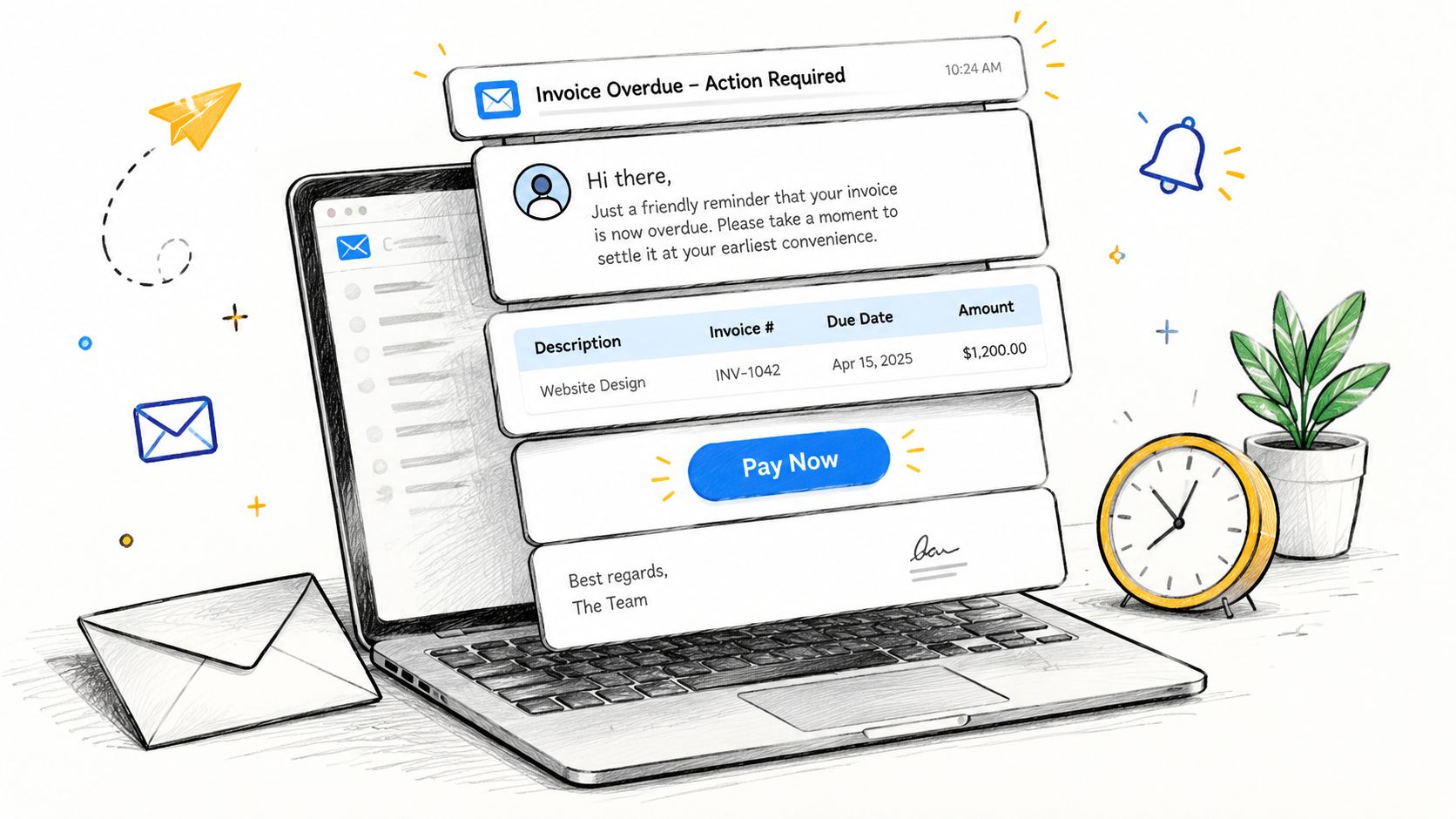
Start with a subject that identifies the account
Use the invoice number and status. Avoid guilt, accusations, or vague subjects such as “Following up again.”
Adaptable subject line:
Reminder, invoice #[Invoice Number] is overdue
The subject's job is recognition, not persuasion. A client who handles several suppliers can route a specific subject to the right person faster than a message framed around frustration.
Put the invoice facts in the opening
Name the client, invoice, amount, and due date immediately.
Copy block:
Hi [Client Name],
I'm following up on invoice #[Invoice Number] for [Amount], which was due on [Due Date] and is still showing as unpaid.
Don't bury the request beneath a long explanation of the work. The invoice itself contains the detail. The email should make the account status unmistakable.
Keep the body factual
Restate what the invoice covered, especially when the client manages several projects.
The invoice covers [Brief Description of Work]. If payment has already been arranged, please disregard this message. If anything needs clarification, reply here and I'll help resolve it.
This wording assumes good faith without pretending the balance isn't overdue.
Give one payment route
Use one prominent payment link or one clear set of instructions.
You can review and pay invoice #[Invoice Number] here: [Payment Link]
A direct hosted payment page removes the need to locate bank details, confirm the amount manually, or ask you to resend the invoice. If you need help preparing scripts for a later phone escalation, these debt collection call scripts for 2026 offer a useful reference for keeping that conversation structured.
End with one next action
Please arrange payment, or reply with the expected payment date, by [Date].
Best,
[Your Name]
[Business Name]
[Email] · [Phone]
The shell stays consistent across the cadence. What changes is the opener, urgency, and consequence language. A reminder should never force the reader to decide among several competing actions.
Templates for the 3, 7, and 14 Day Cadence
The following templates assume the invoice is valid and no dispute has been raised. Replace every bracketed field before sending. Keep the invoice number, amount, due date, payment link, and contact block accurate in every version.
Day 3 reminder
Use a light touch when the invoice has only recently become overdue. Assume it was missed, but don't hide the payment request.
Subject: Friendly reminder, invoice #[Invoice Number]
Hi [Client Name],
I'm sending a quick reminder about invoice #[Invoice Number] for [Amount], which was due on [Due Date].
It may have been missed in the usual inbox traffic. You can review and pay it here: [Payment Link]
If payment has already been arranged, please disregard this note. If there's an issue with the invoice or timing, reply to this email and I'll be happy to help.
Best,
[Your Name]
[Business Name]
[Email] · [Phone]
Day 7 reminder
The second message should acknowledge the earlier contact and ask for a concrete response. It remains professional, but it no longer treats the delay as a possible one-off oversight.
Subject: Follow-up required, invoice #[Invoice Number]
Hi [Client Name],
I'm following up on my earlier email about invoice #[Invoice Number] for [Amount], due on [Due Date]. Our records still show the balance as unpaid.
Please arrange payment here: [Payment Link]
If payment is already scheduled, could you reply with the expected payment date? If something is holding up approval, let me know so we can address it.
Regards,
[Your Name]
[Business Name]
[Email] · [Phone]
Day 14 reminder
At this point, the message should state that the account needs prompt attention and explain the next practical step. Don't threaten action you aren't prepared or legally entitled to take.
Subject: Action needed, invoice #[Invoice Number] remains unpaid
Hi [Client Name],
Despite my previous reminders, invoice #[Invoice Number] for [Amount], due on [Due Date], remains unpaid.
Please settle the balance here: [Payment Link], or reply today with a confirmed payment date. If cash flow is preventing full payment, contact me so we can discuss a realistic payment arrangement before the account is escalated for further review.
I'd prefer to resolve this directly and keep our working relationship on good terms.
Best regards,
[Your Name]
[Business Name]
[Email] · [Phone]
| Element | Day 3 reminder | Day 7 reminder | Day 14 reminder |
|---|---|---|---|
| Opener | Assumes the invoice was missed | References prior contact | Notes repeated non-payment |
| Main request | Pay or report an issue | Pay or confirm a date | Pay, confirm a date, or discuss a plan |
| Tone | Friendly and neutral | Firm and professional | Direct and solution-focused |
| Consequence language | None | Implied follow-up | Signals possible escalation |
| Fixed details | Invoice, amount, due date, link | Invoice, amount, due date, link | Invoice, amount, due date, link |
You can keep a separate library of adaptable payment messages in AurenWell's invoice template collection. Before the account reaches the next escalation window, move beyond inbox-only chasing when appropriate. Chaser's reported channel mix shows email used by 91% of organizations, personal phone calls by 56%, SMS by 23%, WhatsApp by 15%, and LinkedIn by 10%, while its cited data says businesses combining email and SMS are 49% more likely to be paid within two weeks. The Zoho ZeptoMail overview presents that channel data and the practical case for combining channels.
Automating the Sequence in Your Invoicing Tool
Automation should enforce your decision, not replace your judgment. The basic workflow starts when an invoice changes from issued or sent to overdue. A date rule then selects the appropriate message, records the send, and waits for the next condition.
A solo operator doesn't need a complex collections department to run this. The minimum setup is:
- An invoicing tool: It should identify overdue invoices and support scheduled reminders.
- A hosted payment processor: The link should open the relevant invoice and payment page.
- A simple tracking log: Record the invoice, reminder step, send date, channel, response, and next action.
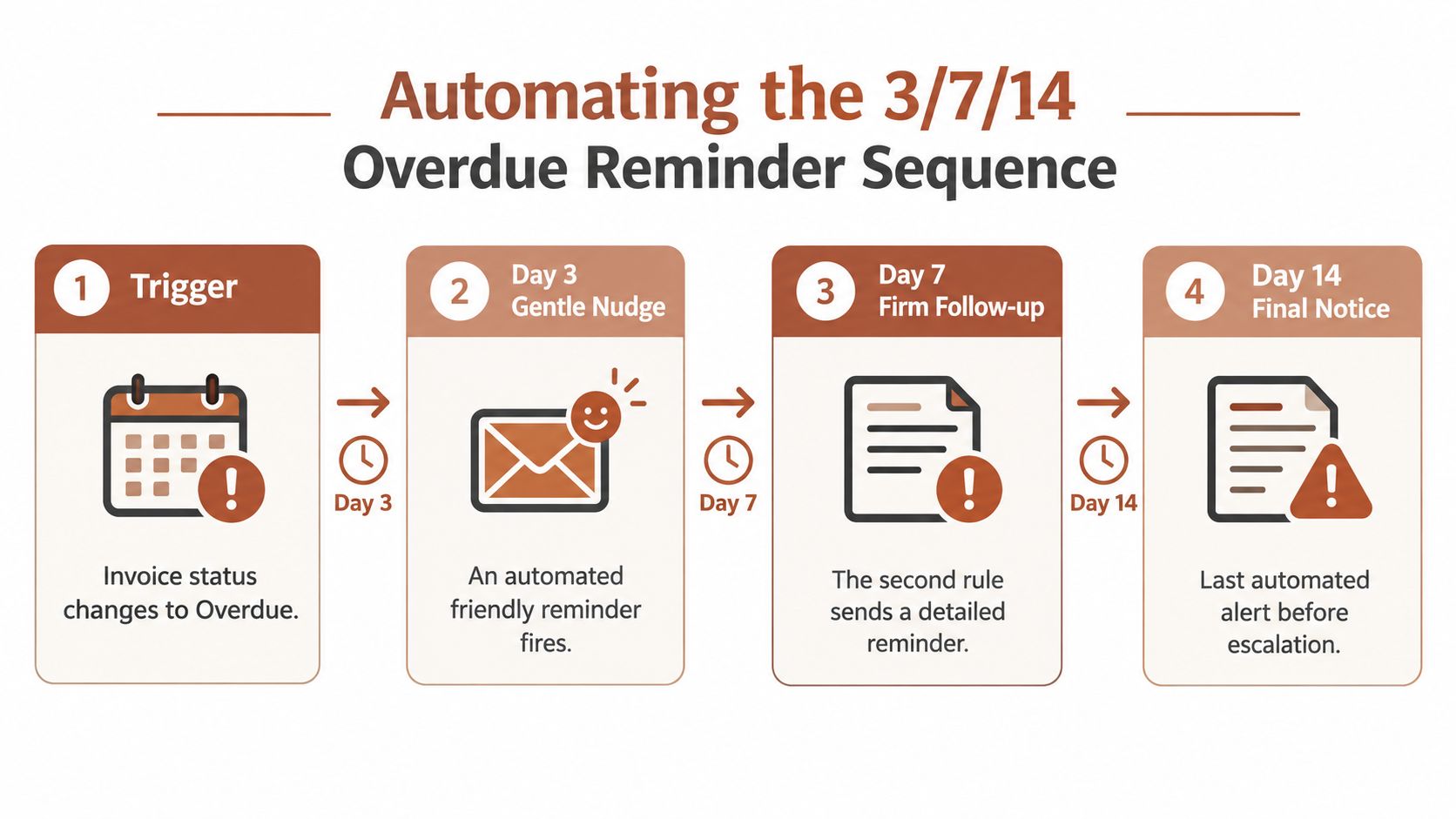
Set the first rule to send the day 3 message after the invoice becomes overdue. If the invoice remains unpaid, the next rule sends the day 7 version, followed by the day 14 message. The system should stop the sequence as soon as payment is recorded.
The most important safeguards are suppression rules. Pause reminders when the client disputes the invoice, reports a duplicate, says payment has been sent, or asks for corrected billing details. An automated reminder sent after a genuine reply makes your business look careless and can turn an administrative issue into a relationship problem.
Automation should make consistency automatic and exceptions visible.
Keep the final day 14 message subject to human review if the amount is material or the client has a complex approval process. For broader workflow choices, this 2026 email automation guide can help you compare scheduling, tracking, and trigger capabilities. AurenWell also documents a focused payment reminder workflow for businesses that want the reminder steps attached directly to their invoicing process.
Tone Is Secondary to Timing and Structure
Operators often spend an hour polishing a reminder while ignoring the mechanics that determine whether the client can pay. A warm email with a broken link, missing invoice, or unclear amount still creates work for the recipient. A plain email that opens the correct invoice and offers one payment action is easier to complete.
Check the delivery structure before rewriting the prose:
- Send during a reasonable working period in the client's time zone.
- Attach the original invoice PDF or provide a direct view link.
- Put the payment action in one prominent place.
- Match the amount and due date to the invoice record.
- Log the send so the next reminder knows what happened.
The right structure also protects you from contradictory follow-ups. If you send a day 7 email without recording the day 3 message, the client may receive two notes that sound like first contact. A simple activity log gives you an accurate history.
Tone still matters, but it should respond to relationship age and invoice age. A long-standing client with a temporary cash-flow problem may deserve warmer language and a payment-plan conversation. A new client who has ignored several factual requests needs a shorter, more direct message. Warmth should preserve cooperation, not conceal the balance. Firmness should clarify the next step, not express anger.
Audit your sequence against these structural checks before changing the copy. If every message contains the correct facts, a working payment route, a visible invoice, and a recorded next action, your wording only needs to be clear and professional.
Pre-Send Checklist for Every Overdue Reminder
Run this checklist before a manual send or use it as the quality-control logic for an automated sequence.
- Subject line: Is it short, specific, and linked to the correct invoice number?
- Payment link: Does it open the right invoice and complete successfully?
- Invoice details: Do the amount and due date match the issued invoice?
- Cadence tone: Is the message friendly at day 3, firmer at day 7, and direct at day 14?
- Activity log: Have you recorded the date, channel, message stage, and any client response?
- Next action: If the client ignores this email, is the next channel or escalation already decided?
The checklist should take less than a minute. It isn't a policy document, and it doesn't change with the template. Its value comes from catching small errors before they create another delay.
For operators who want the payment step connected directly to the invoice, review the online payment features available in AurenWell. The tool choice matters less than the outcome: every overdue reminder should give the client accurate information and a frictionless way to act.
The broader cash-flow problem is too large to solve with nicer wording alone. A 2026 accounts-receivable benchmark reported that 31% of businesses leave some overdue invoices unchased each month, and firms following up on all overdue invoices were 76% more likely to be paid within a week than firms that didn't. SME Tech's debtor-management benchmark also reported that automated reminders at 7 and 14 days past due can resolve 40% to 60% of overdue invoices without human effort. Set the sequence, test the payment path, and send the first reminder before hesitation becomes part of your receivables process.
Create your 3, 7, and 14 day reminder sequence today. Add the templates to your invoicing tool, test each payment link, define the SMS or phone escalation point, and log the next overdue invoice from the moment it passes its due date.