
The wall is finished, the site is clean, and you've sent the invoice. Then the customer asks whether the price includes demolition, the general contractor wants the change-order reference, and nobody can explain when the retained balance will be released. You're answering billing questions instead of getting paid.
A useful masonry invoice template does more than put your logo above a total. It connects completed work to the agreement, separates money already received from money still owed, and gives the approver enough detail to authorize payment without another phone call.
Masonry Invoice Template Fields to Copy
| Field | What to enter | Masonry example |
|---|---|---|
| Invoice number and date | Unique sequential reference and actual issue date | MASON-A, issued on the day submitted |
| Contractor details | Business name, address, phone, license number where required | Ruiz Masonry; business mailing address, phone, and applicable license identifier |
| Customer and project address | Legal billing name and separate job-site address | Property owner's billing name; rear garden wall at the service address |
| Contract or estimate reference | Signed estimate or purchase-order identifier | Approved garden-wall estimate; customer PO attached |
| Service period | Start and end dates of the work billed | Actual first and last work dates for wall installation |
| Line items | Activity, quantity, unit, rate, amount | Brick installation; measured square feet × agreed unit rate |
| Change orders | Approved extra work and authorization reference | Lintel replacement; signed change order attached |
| Subtotal, tax and fees | Work subtotal, applicable tax, authorized fees | Materials tax shown separately; processing fee only when permitted and agreed |
| Deposit or retainage | Money received or withheld, plus release condition | Deposit credited; retainage withheld under the contract until final inspection |
| Amount due and due date | Current payable balance and calendar deadline | Current balance after credits; contractual due date displayed |
| Payment methods | Accepted methods and payment instructions | Check payable to Ruiz Masonry at its mailing address; ACH instructions on request |
| Dispute contact | Named person and contact method for questioned items | Owner's phone or email for billing and defect notices |
Read the layout from top to bottom as an approver would: who submitted it, which job it covers, what was completed, and what must be paid. Keep the billing address separate from the job site. A property manager's office may receive invoices for several properties, and the service address is what lets them assign your bill correctly.
The payment risk is real. Levelset's 2019 U.S. construction payment report found that 49% of construction payments weren't made on time under the original contract terms. A detailed invoice won't fix a customer's lack of funds, but it removes avoidable questions about scope and authorization.
Practical rule: Replace “masonry work completed” with the actual activity and location, such as brick installation at the rear elevation or repointing along the garden wall.
For outdoor projects, Modern Yard Landscapes' page on Austin patio and retaining wall contractors offers useful context for distinguishing patio work from retaining-wall scope. Your invoice should make those distinctions explicit rather than grouping the entire outdoor job under landscaping.
Save the layout as a reusable document with protected formulas and fixed business details. Change the customer, scope, quantities, supporting references, and payment information for each job, not the overall presentation.
Line Item Rates for Masonry Work
| Work item | Billing unit | Reference rate | Source |
|---|---|---|---|
| Masonry labor | Per hour | $40 to $80 | InvoiceNo's 2026 masonry guide |
| Masonry labor | Per hour | $95 | BillingDone's 2026 masonry template |
| Brick work | Per square foot | $10 to $40 | InvoiceNo guide |
| Stone work | Per square foot | $20 to $60 | InvoiceNo guide |
| Tuckpointing | Per square foot | $12 | BillingDone template |
| Brick repair | Per project | $450 | BillingDone template |
| Scaffolding | Per day or per job | Agreed rental or equipment charge | Job quote and rental documentation |
| Demolition | Per hour | Agreed demolition labor rate | Signed estimate |
| Delivery and disposal | At actual cost | Receipt total, with any agreed markup identified separately | Supplier or disposal receipt |
These are published examples, not a local price schedule. The guides offer different labor figures, and their service descriptions don't establish identical inclusions. Don't average the figures and assume you've found your rate.
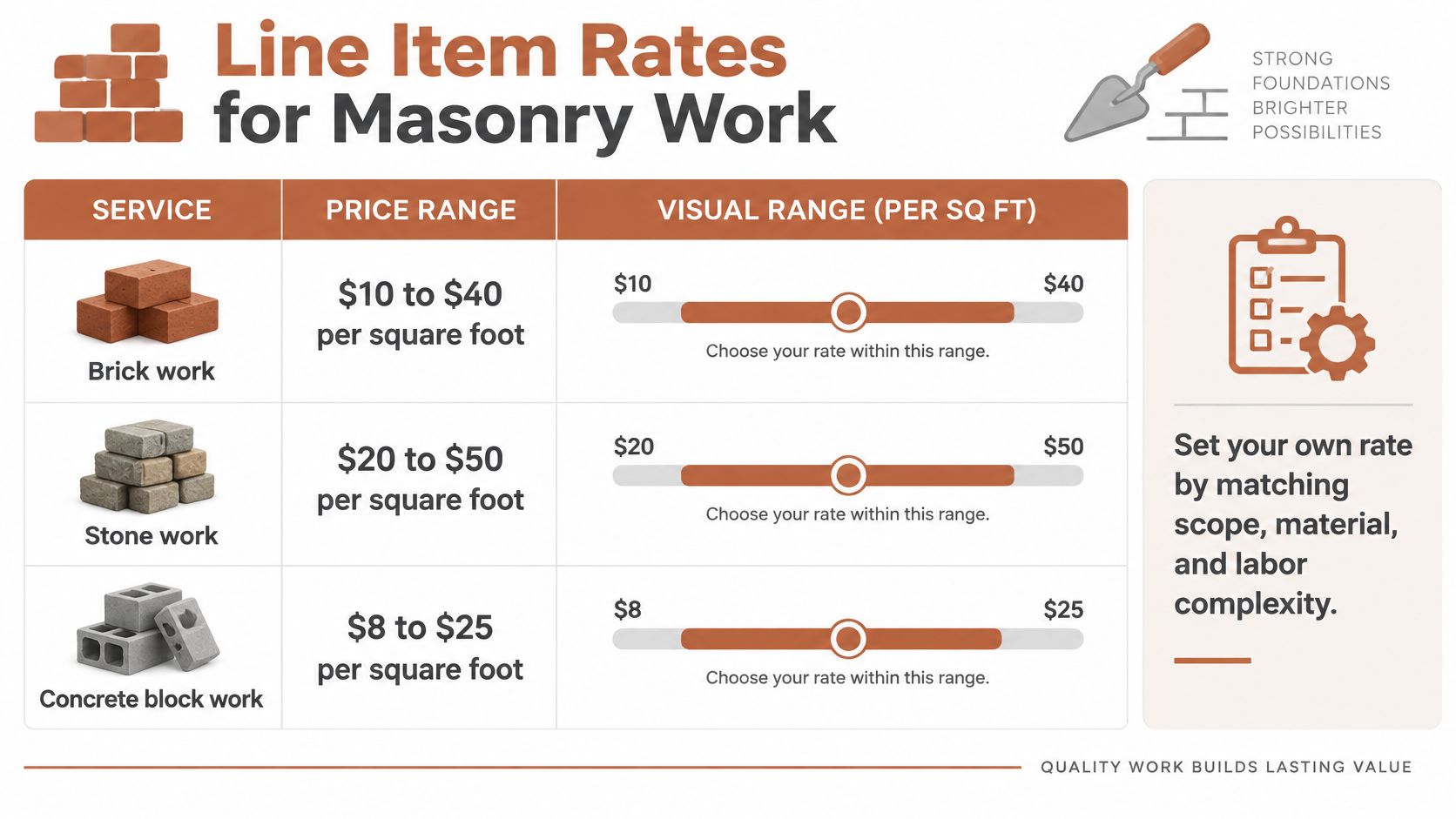
Use the cited table for the published reference figures. The illustration isn't a substitute for checking the scope and inclusions of your own quote.
Turn a rate into a defensible charge
For a hypothetical tuckpointing invoice using the reference rate above, 180 square feet × $12 = $2,160. Record the measured area beside the rate so the customer can follow the multiplication. If your agreement excludes preparation and cleanup from that unit price, bill those activities separately using the agreed labor terms.
Don't add preparation again if your quoted unit rate already includes it. That's double billing, not better itemization.
Access, material matching, joint condition, crew requirements, and regional costs affect what you should quote. A repair scope can also differ substantially from new installation. Atlanta Concrete Solutions' page about restoring your home's concrete and brickwork provides context for describing repair work separately from replacement or installation.
For equipment and disposal, use documented job costs rather than borrowing an unrelated installation rate. Attach receipts and identify any contractually agreed markup.
Before keeping a line item, check:
- Activity: Does it name the work rather than say miscellaneous?
- Unit: Does the billing unit match the estimate?
- Quantity: Can you support it with a measurement or time record?
- Inclusions: Is it clear whether materials, preparation, and cleanup are included?
Billing Progress on Multi-Stage Masonry Jobs
A multi-stage job needs a running billing ledger, not a fresh total disconnected from the previous invoice. The customer should be able to distinguish completed value, prior billings, current charges, and unfinished work.
Say a hypothetical contract starts at $18,000, and an approved lintel-replacement change order adds $1,200. The revised contract is $19,200. If the agreed valuation of completed foundation and wall work is 40%, cumulative earned value is $7,680.
With $3,000 previously billed, the current billing is $4,680, before any applicable retainage, tax, or other contractual adjustment. The uncompleted contract value is $11,520. That last figure isn't the same as unpaid receivables, which may include earlier invoices still awaiting payment.
Keep earned value separate from cash received
Use this sequence on each progress invoice:
- Record the original agreement. List the contract reference and approved changes. Keep unapproved extras out of the revised contract total.
- Calculate revised value. Add signed changes to the original price.
- Value completed work. Show the stage and its agreed completion measure, supported by quantities or the schedule of values.
- Deduct prior billings. Use invoices already issued, not merely payments received.
- Show unfinished value. Keep this separate from the current amount due and the outstanding account balance.
A deposit requires its own treatment. Use an invoice for a deposit to document the upfront request, then apply the credit according to the contract. Don't subtract the same deposit both through prior billings and again as a separate credit.
Name the stage precisely, such as foundation work, wall installation, pointing, or cleanup. Include the actual inspection date or identify the photographs supporting that stage.
Bill the value of work completed under the agreed billing method, not the value you need to collect to fund the next stage.
If pointing remains unfinished, don't mark the whole wall package complete just because the brick is installed. Split the stage into measurable components before submitting the invoice.
Payment Terms and Reminder Schedule That Protect Cash Flow
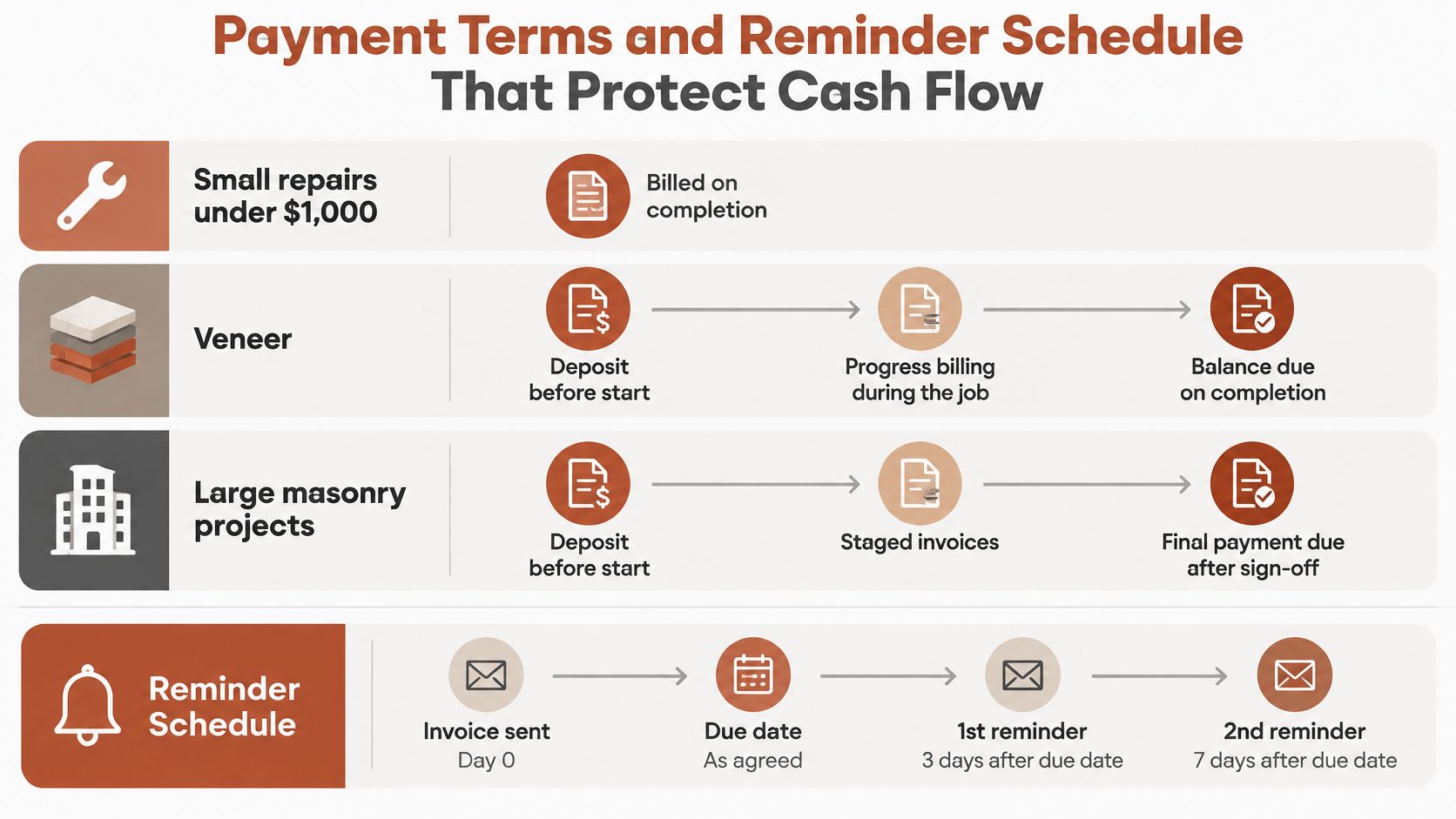
| Job type | Upfront deposit | When to bill | Due date |
|---|---|---|---|
| Small repair | No deposit if exposure is manageable; material deposit if agreed | On completion and acceptance | Contractual completion-payment deadline |
| Veneer or repointing | Agreed deposit tied to startup costs | Deposit, defined midpoint, and completion | Calendar dates established in the agreement |
| Full wall or foundation job | Contractually permitted mobilization deposit | Agreed progress valuation periods | Contractual progress-payment deadline |
| Job requiring materials bought upfront | Agreed amount tied to documented procurement costs | Material ordering or delivery milestone | Agreed procurement-payment deadline |
Treat these as payment structures to negotiate, not standard deposit percentages. Local rules may restrict deposits, and the invoice can't rewrite the agreement after work begins.
A long payment term isn't a harmless courtesy when you're buying brick, block, mortar, and equipment access before collecting anything. Commerce Bank's construction industry report cites collection times of more than three months on average, compared with a 45-day DSO benchmark recommended by construction cost accountants. That mismatch is a reason to agree on procurement and progress milestones before committing your cash.
Set the follow-up sequence before sending
I'd use a simple sequence tied to the actual due date:
- At issue: Send the invoice, supporting documents, and payment instructions together.
- On the due date: Confirm the balance and offer help resolving a specific approval problem.
- After it becomes overdue: Ask whether the invoice is approved and request a payment date.
- If the commitment passes: Send a firmer written follow-up, then call the person responsible for payment.
A due-date reminder message should identify the invoice and requested action without making the customer search through an old email chain.
Deposits reduce upfront exposure, but customers need to understand what they fund. Separate a material procurement payment from earned installation labor, and explain how each credit will appear on subsequent invoices. Never add a late fee, accelerated deadline, or new payment condition that the signed agreement and applicable law don't support.
Retainage, Lien Waivers and Taxes on Masonry Invoices
A lien-waiver checkbox isn't enough. You need to know which document accompanies which payment, what amount it covers, and when it becomes effective. Otherwise, the invoice can look complete while the payment paperwork creates unnecessary risk.
LegalClarity's masonry contract guidance describes retainage as commonly 5% to 10%, recommends documenting its release conditions, and distinguishes a conditional waiver that becomes effective when payment clears from an unconditional waiver that confirms payment immediately. The exact legal effect still depends on the jurisdiction and document wording.
Show retained money without understating earned work
Consider a hypothetical fully earned $20,000 contract with 10% retainage. The statement should show $20,000 gross earned value, $2,000 retained, and $18,000 payable before other credits or adjustments. Showing only an $18,000 contract total would hide part of the agreed price.
Include the retainage withheld on the current billing, cumulative retainage, and the contractual release trigger and deadline. If final inspection triggers release, identify whose inspection counts and what documentation establishes completion.
Before signing: Match the waiver's amount, billing period, project, and effective conditions to the payment it accompanies.
Write the waiver type and document reference beside the associated payment record. Don't send an unconditional waiver just because someone says it's required for processing; review the wording and obtain local legal advice before giving up rights ahead of cleared funds.
Separate tax treatment from job pricing
Keep taxable materials, labor, and permit charges identifiable in your records. Determine whether sales tax applies to the materials, labor, or transaction under your state's rules, then configure the invoice accordingly. Don't assume that separating labor automatically makes it exempt.
For a permit reimbursement, show the charge as a pass-through at cost when that's what the contract provides, and attach the receipt. Check lien deadlines, required waiver forms, tax treatment, and retainage rules locally before using the template, not after a payment dispute starts.
Check, Send and Track Every Invoice
Use the same pre-send routine even when the job feels straightforward. A familiar customer can still have a new accounts-payable contact, and a correct total can still sit unpaid if the invoice goes to the wrong person.
The federal construction prompt-payment clause provides a useful reference for invoice completeness, including contractor identity, invoice date and number, contract reference, work description, payment terms, payment recipient, and a defect-notification contact. Those are federal contract requirements, not a universal rule for every private masonry job, but they're sensible fields to validate.
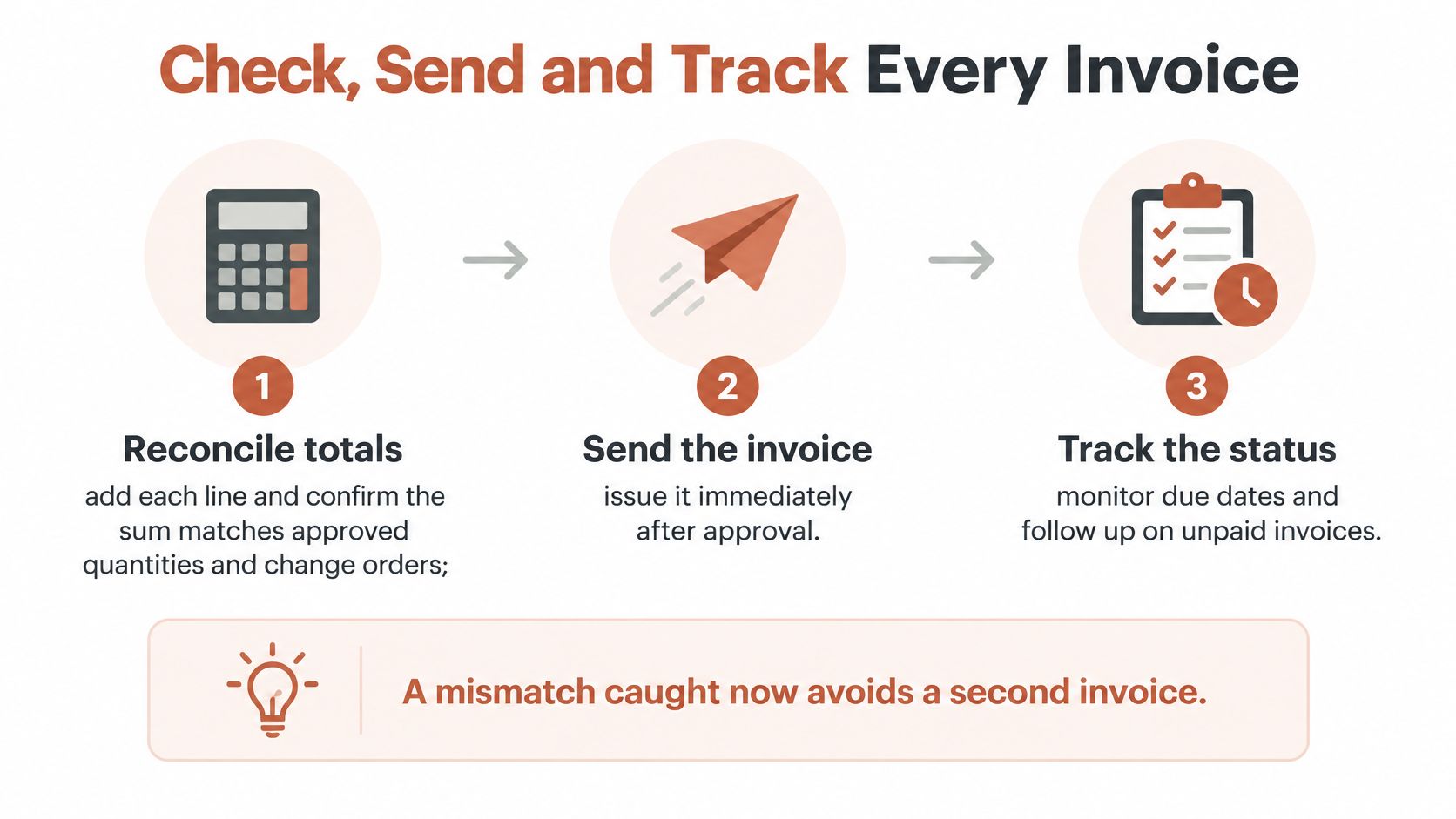
Run the pre-send checks
Reconcile totals. Multiply each quantity by its rate, add approved extras, then check credits and deductions. Confirm that the current invoice agrees with your progress ledger. A common slip is carrying a changed quantity into the description without updating the formula.
Verify the parties and references. Check the contractor name, customer, project address, and contract or purchase-order reference. Confirm the actual recipient responsible for approval. The homeowner who accepted the work may not be the person processing payment.
Attach evidence for the billed stage. Include relevant progress photos, inspection notes, delivery records, and signed change authorizations. Label attachments by location and activity. An unlabeled collection of site photos makes the approver do your matching work.
Confirm the payment instructions. Display the contractual due date, accepted methods, payment recipient, and dispute contact. Check that any payment link works in the client-facing version. Don't leave the customer choosing between conflicting instructions in an email and attachment.
Preview what the customer sees. Open the final document or browser view, preferably on a phone as well as a larger screen. Remove internal notes and check that descriptions aren't cut off. Draft calculations should never appear where the customer expects the final amount.
Send through the agreed channel. Use email, a share link, a PDF where required, or an on-site QR code. Follow the customer's submission procedure rather than assuming a message to the site supervisor counts as delivery to accounts payable.
Archive and track the result. Keep the issued invoice with receipts, approvals, correspondence, and payment records. Record partial payments against the correct invoice, retain the remaining balance, and assign the next follow-up action. A bank deposit alone doesn't explain which job was paid.
Close the administrative loop
Avoid combining separate properties into a single vague charge. If a customer requires consolidated billing, keep each property and phase identifiable so they can allocate payments and raise specific questions without disputing the whole account.
With our invoice software for contractors, you choose a client, add line items, preview the client-facing invoice, then send it and track payment and follow-up status in AurenWell. You can send by email, share link, or QR code, and record cash, check, Venmo, Zelle, PayPal, card, ACH, deposits, and partial payments.
Send as soon as the contractual billing trigger is met. Before issuing your first invoice from the template, check it against the signed agreement, local tax requirements, and applicable lien deadlines.
Build your masonry invoice template around your next approved job: enter the contract reference, measured scope, billing stage, credits, and payment deadline, then preview it before sending. If you use AurenWell, create that invoice from the client record and set the next follow-up action immediately. Finish with the approver test: can the recipient match every charge to authorized work without calling you?