
Subscription contracts already account for 66.45% of the U.S. lawn care market in 2025, and the market is valued at USD 60.0 billion that year, according to a 2026 market analysis. That changes the way a mowing agreement should be written. A lawn mowing contract isn't just paperwork anymore, it's the document that decides whether you get paid like a recurring service business or get dragged back into one-off, unpredictable jobs.
For a small operator, that matters more than most people admit. A solid contract controls scope, protects cash flow, and keeps customers from treating every visit like a fresh negotiation. It also makes your service look organized before you ever step on the property, which is exactly what homeowners and property managers want when they're choosing between a handshake and a schedule.
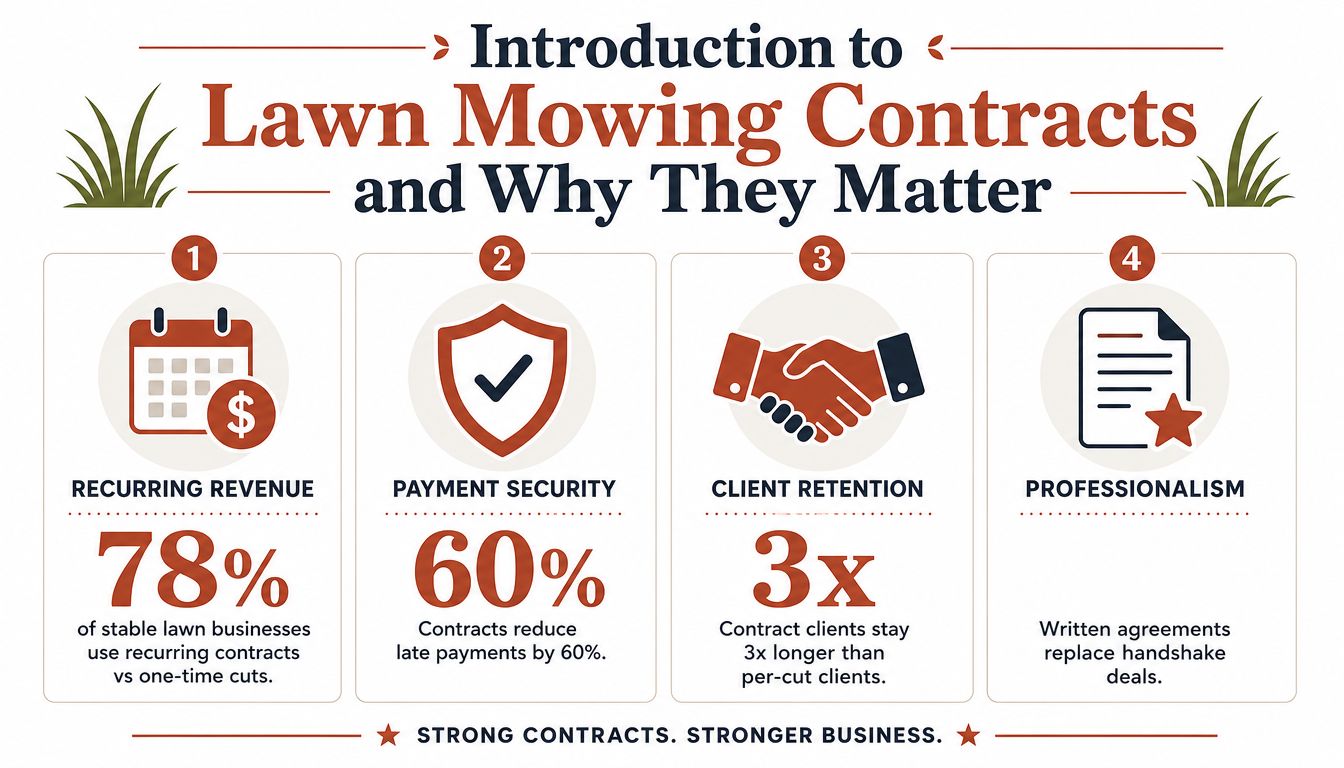
Introduction to Lawn Mowing Contracts and Why They Matter
Recurring service is the default in this market, not the exception. The U.S. lawn care market is projected to rise from USD 62.91 billion in 2026 to USD 79.68 billion by 2031, which implies a 4.85% CAGR over that period, and subscription arrangements already represent more than two-thirds of industry value in the 2025 snapshot (Mordor Intelligence market analysis). That tells you something practical, not academic. Buyers want certainty, and operators who write clear recurring terms are meeting the market where it already is.
A lawn mowing contract turns a moving target into a routine. Instead of answering, “Can you squeeze me in this week?” you're defining when service happens, what it includes, and how payment works when weather or growth changes the schedule. That shift protects you from scope creep, but it also protects the client, because they know exactly what they're buying and when they're getting it.
The broader lawn care industry explains why written agreements matter so much. Independent industry reporting puts the U.S. lawn care services industry at USD 176.7 billion in 2026 across about 556,000 businesses, while the National Association of Lawn Care Professionals reported USD 188.8 billion in 2025, more than 1.4 million employees, and 692,777 businesses (industry report). In a fragmented, labor-heavy market like that, the owners who standardize service terms are the ones who stop losing time to disputes.
Practical rule: if the customer can read one paragraph and still not know what a “cut” includes, the contract isn't finished.
A good agreement also signals that you run a real operation, not a side hustle. It should make clients feel like they're signing up for consistency, not uncertainty. That's why the rest of this guide stays focused on what to write, what to leave out, and how to use the contract as a margin tool, not just a legal shield.
Types of Lawn Mowing Contracts and When to Use Each
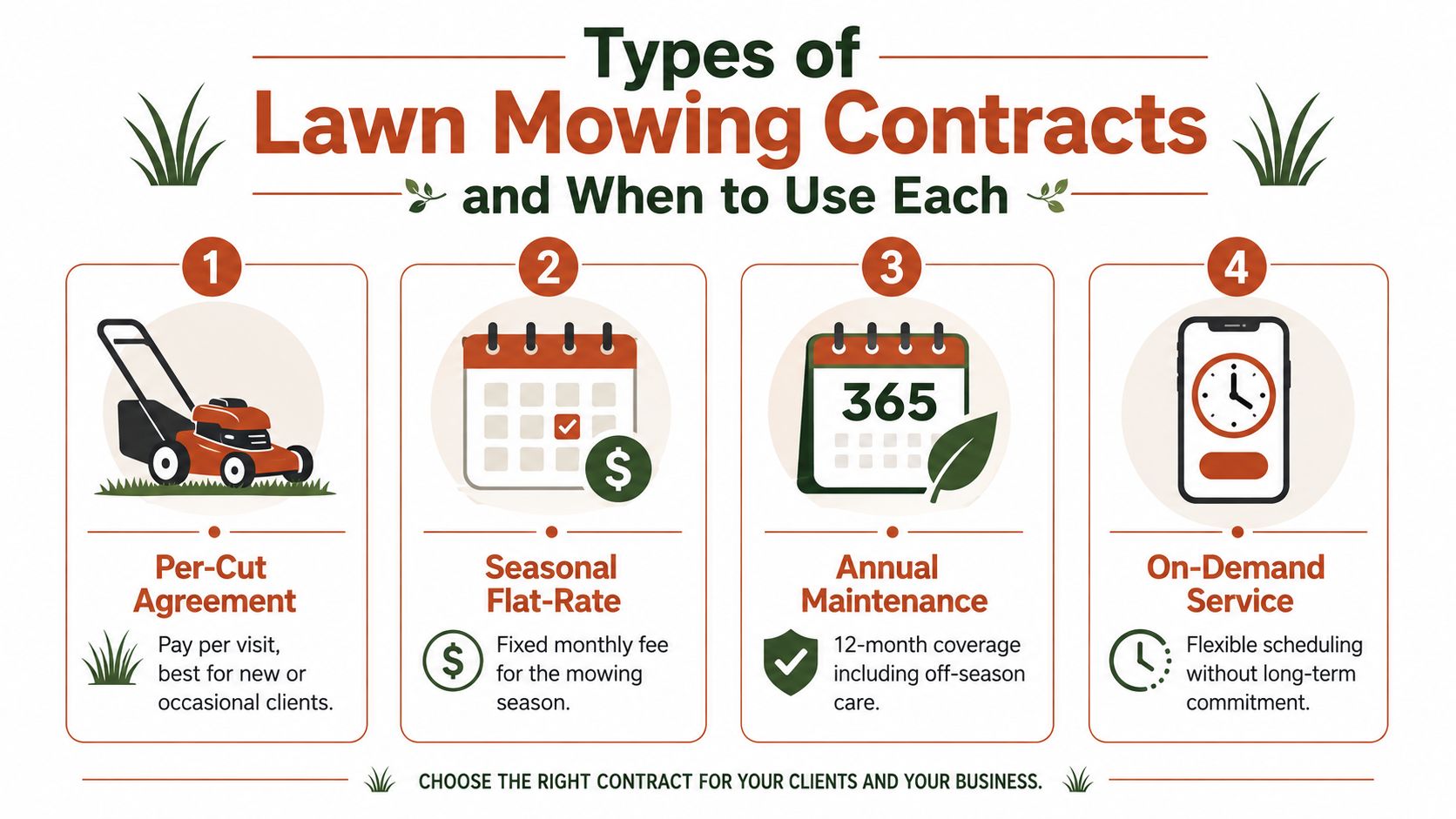
Per-Cut Agreements
Per-cut pricing works when you want simplicity and the property changes often. It's usually the easiest sell for new clients because they pay only when you mow, which feels familiar and low commitment. That said, it puts more pressure on you to manage timing tightly, because every skipped visit can become a revenue gap if the customer pauses service when the lawn slows down.
Use per-cut agreements for occasional clients, smaller yards, or customers who refuse recurring billing. They can also work when you're building a route and want to convert a few trial customers before asking for a season-long commitment. The downside is that it leaves you exposed to weather gaps and last-minute cancellations.
Seasonal Flat-Rate Subscriptions
Seasonal flat-rate pricing is the cleanest fit for most residential maintenance work. The client pays a fixed amount through the mowing season, and you protect your route density because service becomes routine instead of optional. This model works best when you want predictable weekly or biweekly stops and fewer billing conversations.
It's especially useful when you're trying to stabilize cash flow during the busiest part of the year. The customer gets budget certainty, and you avoid chasing payment after every visit. If the property is in a dense neighborhood, this format usually makes scheduling easier too.
Annual Maintenance Contracts
Annual agreements make sense when the client wants year-round coverage, even if mowing pauses in colder months. These contracts are common for commercial properties, HOA-style expectations, and homeowners who want a single relationship instead of season-by-season renewals. They also support smoother billing because the full service relationship is already defined.
The key trade-off is expectation management. A customer paying year-round needs to understand what off-season value looks like, whether that's inspections, cleanup, or other agreed tasks. If that isn't written down, the client may feel like they're paying when nothing is happening.
On-Demand Terms
On-demand service is the most flexible and the least predictable. It fits clients who call only when the lawn gets away from them, or homeowners who don't want to commit. It can fill slow gaps in your route, but it shouldn't be your main revenue model if you're trying to build a stable business.
The smart use of on-demand terms is selective. Keep them for overflow work, one-off needs, or property owners who clearly won't sign a schedule. If you rely on them too heavily, you'll spend more time planning around other people's urgency than around your own route.
Essential Clauses Every Lawn Mowing Contract Must Include
A lawn mowing contract lives or dies by clarity. The useful ones don't sound fancy, they sound specific. If the agreement doesn't define the job in measurable terms, the next dispute is usually just waiting for weather, overgrowth, or a customer who thought “mowing” included half the yard.
Parties, property, and scope
Start with the exact parties and the service address. Don't leave this at “customer” and “provider,” because the whole point is to make the agreement attach to a real person and a real property. Then define the scope of work at the task level, and don't hide behind the word “maintenance.”
A better scope says what a “cut” includes, for example mowing, edging, trimming, and blow-off, and it also says what's excluded. That avoids the common trap where the customer expects cleanup, debris removal, or extra trimming that you never priced. Industry-facing contract templates recommend itemizing service frequency and payment mechanics because ambiguity over what was performed is a common source of billing disputes (contract template guidance).
Schedule, term, and signatures
The contract should state when service starts, how long it lasts, and whether it renews. A weekly or growth-based schedule means something only if the customer can see the term in plain language. Add signatures at the end, and don't treat them as decoration, because a signature is what turns a proposal into an enforceable service relationship.
If a client can argue that the contract was “just a quote,” the paperwork wasn't finished correctly.
The shortest path to fewer arguments is to keep each clause tied to one job. Parties identify who's bound, scope defines what gets done, schedule tells you when, and signatures lock it in. Everything else should support those four pillars.
Payment, access, weather, and cancellation
Payment terms need more than a price. They should say whether billing is monthly flat-rate or per-cut, when payment is due, what happens if payment is late, and whether there's a restart or rebooking fee after a cancellation. If you're collecting by card or ACH, say so clearly. If you're accepting checks or cash, put that in writing too.
Access and client responsibilities matter just as much. Make the client responsible for open gates, cleared obstacles, and pet control, because a crew can't service what it can't reach safely. Weather, rain-delay, and skip clauses should explain what happens when service moves, because “we'll get there when we can” creates conflict the first time a week gets disrupted.
Cancellation should be plain. Write how much notice is required, whether there's a fee, and what happens if the client ends service mid-season. Liability language should be equally plain, with damage limits, pre-existing condition notes, and insurance references written in direct language rather than legal fog.
Pricing and Payment Terms That Protect Your Cash Flow
Pricing is where many mowing contracts often fail. The number itself matters, but the structure around the number matters more. A customer who likes your work can still become a collections problem if you build the agreement around awkward billing, unclear skipped-service rules, or rain delays that no one priced properly.
| Lawn Mowing Contract Pricing Models Compared | Best For | Cash Flow Impact | Risk If Service Is Skipped |
|---|---|---|---|
| Monthly flat-rate | Clients who want predictable billing and regular service | Steadier and easier to forecast | You may absorb some weather or growth swings |
| Per-cut billing | Occasional clients or properties with irregular needs | More variable, depends on completed visits | Revenue drops immediately when visits drop |
| Annual prepayment | Customers who want simplicity and year-round certainty | Strong upfront cash flow | You carry more responsibility if expectations aren't clear |
Flat-rate billing works well when the client wants a stable monthly amount and you want to protect route density. Per-cut pricing is simpler to explain but harder to forecast, because your revenue moves with every skipped visit, rain delay, and pause request. Annual prepayment can strengthen cash position, but only if the scope and service calendar are written tightly enough to prevent disputes later.
The important part is fairness. If the contract lets the customer skip service without changing price, you're carrying the weather risk. If the contract reduces billing every time a visit gets delayed, your cash flow becomes unstable fast. The smarter approach is to connect payment to the service model you run, not to a vague promise that everything will somehow average out.
Late payment language should be direct, and so should any deposit or restart fee. If you use seasonal adjustments for fuel or growth surges, write the trigger clearly so the customer knows when pricing changes and why. The pricing model needs to match the season, the route, and the type of client, not just what sounds easiest in the quote builder.
For a simple pricing page reference, I keep a standing internal note tied to this pricing resource, because billing language and invoice wording should match the contract exactly.
Scheduling Frequency and Seasonal Service Definitions
Mowing frequency shouldn't be written as a guess. Turf growth drives service timing, and the contract should reflect that instead of pretending every lawn grows on the same calendar. Turf references support the one-third rule, which means you should remove no more than 30% of the leaf canopy in a single cut, so frequency has to follow height and growth rate rather than a fixed date alone (mowing frequency guidance).
A practical schedule clause does two things. First, it tells the customer how often you intend to visit. Second, it gives you room to adjust when the lawn grows faster or slower than normal. That's what keeps you from getting blamed for a long lawn after a wet week or for skipping a visit that the turf didn't need.
How to write the schedule
If you maintain a lower-cut lawn, your contract can say service happens when the grass reaches the agreed trigger height. If you maintain a standard residential yard, spell out weekly or biweekly service and note that weather and growth may shift the exact day. The point is to define the range of service, not to promise a magic weekday no matter what the weather does.
A useful clause keeps the seasonal window clean too. Write a start date, an end date, and what happens during spring surge or summer slowdown. If the property owner wants a lighter cadence during dry periods, that should be negotiated up front instead of argued over after the grass browns out.
Rain delay and rescheduling
Rain delay language should answer three questions. What counts as a delay, who decides the reschedule, and whether the missed visit rolls into the next service window or becomes a separate call. Without those answers, a wet week turns into a customer complaint thread.
The best schedule clause is the one a customer can read once and understand why a “missed” visit sometimes isn't missed at all.
I also like to state whether the service is calendar-based or growth-based. Calendar-based service is easier to explain, while growth-based service is more accurate for turf health. The contract works better when it admits that both factors matter, instead of pretending one fixed interval fits every yard.
Liability Property Access and Risk Management Clauses
The clauses that save the most money are usually the least glamorous. Liability, access, and risk terms don't sell the job, but they stop small misunderstandings from becoming replacement claims or unpaid visits. I learned quickly that a mower can't avoid a hidden sprinkler head, a dog in the yard, or a locked gate that no one mentioned until the crew arrived.
Access problems and client responsibility
The contract should make the customer responsible for access. That means gates open, pets secured, and hazards cleared before the crew arrives. If toys, hoses, cables, or decorations are left in the mowing area, the agreement should say the crew may skip that section or treat the obstruction as a separate task.
That language matters because the crew can't be blamed for a missed cut when the property wasn't ready. It also gives you a clean answer when a homeowner expects you to move everything for free. The clause should stay calm and factual, not threatening.
Damage and pre-existing conditions
Property damage language works best when it limits responsibility to your own negligence, not to every condition on site. If a mower hits an unmarked rock or a buried object, the contract should note that hidden obstacles are the owner's responsibility to disclose. Pre-existing damage should be documented before the first service whenever possible, because otherwise every scuffed curb becomes an argument.
Liability limits should also mention insurance in plain terms. If you carry coverage, say so without overexplaining it. If a client asks for proof, send it, but don't let the contract drift into a long insurance essay.
Fair dispute handling
Hold-harmless language sounds stiff, but the purpose is simple: it sets expectations before anyone gets upset. If the customer knows that the crew is not responsible for damage caused by hidden hazards or blocked access, you have a better chance of resolving the problem without a refund fight. The goal isn't to dodge responsibility, it's to assign it correctly.
A useful mental test is this. If the dispute starts with “I thought you'd just handle that,” the clause wasn't specific enough. If it starts with “I forgot to clear the gate,” the clause did its job.
Creating Sending and Managing Contracts With Less Admin Work
The contract process should move in one clean line, estimate, agreement, signature, invoice. If you're copying customer details by hand into three different places, you're burning time that belongs in the truck or on the next estimate. A better workflow keeps the contract, payment, and client record in one place so the paperwork doesn't outrun the work.
Keep the document process mobile
A good field workflow starts on a phone, not a laptop in the office. Build the agreement with your branding, send it for browser-based signing, and store the signed copy with the customer record the moment it comes back. That way, when the customer asks for a copy later, you're not hunting through downloads or text threads.
AurenWell is one option that combines estimates and contracts in a single web app, with mobile signing and stored signed documents in the client record. That kind of setup matters because it reduces the number of handoffs between quoting, signing, and billing.
Connect the contract to billing
Don't let signed agreements sit in a folder without linking them to invoices. Once the contract is signed, the recurring schedule should feed the billing workflow so the first invoice goes out without duplicate entry. The goal is to remove the “we forgot to bill it” problem before it starts.
A clean admin flow usually looks like this:
- Estimate sent: scope and price are approved in the same language that will appear in the contract.
- Contract signed: the client accepts the service terms with an audit trail.
- Service starts: the route schedule is set before the first cut.
- Invoice follows: billing matches the contract, not a handwritten note or memory.
Keep records where you can actually find them
Signed PDFs, notes, and payment history should live in the same client file. If they're split across email, text messages, and a desktop folder, you'll waste time proving what was agreed to. A searchable client record is boring until the day a customer disputes a visit, then it becomes the fastest way to settle the conversation.
For a broader look at contract features in one workflow, I keep a reference tied to these contract tools, because the value is in how signing, storage, and billing fit together.
Quick Reference Templates Checklists and Cross Reference Index
Most lawn mowing contract templates fail in the same places. They look complete at a glance, but they leave out the clauses that prevent margin loss. The missing pieces are usually the ones that deal with payment timing, rain delays, access problems, and what a “cut” really includes.
One-page checklist
Before you send any agreement, verify these items are present:
- Parties and property: legal names, service address, and contact details.
- Scope of work: mowing, edging, trimming, cleanup, and exclusions.
- Schedule and term: start date, frequency, season length, and renewal rules.
- Payment terms: pricing model, due date, and late payment language.
- Access and responsibilities: gates, pets, obstacles, and client prep.
- Weather and cancellation: delay policy, skip rules, and notice requirements.
- Liability and signatures: damage limits, insurance language, and signed acceptance.
That checklist is the fastest way to catch a template that reads well but doesn't protect the business. If any one of those items is vague, the contract still leaves room for a dispute.
Fill-in-the-blank outline
Use a simple structure like this:
Client name:
Property address:
Service type:
Frequency:
Price and billing method:
Weather policy:
Cancellation notice:
Liability terms:
Signature lines:
A blank outline like that forces the contract to be specific. It also makes it easier to spot where your default template is too generic for the actual job.
Cross-reference index
If you're checking one issue only, use this shortcut:
- What a cut includes goes with the scope section.
- How often you mow goes with the scheduling section.
- How you get paid goes with pricing and payment terms.
- What happens if the yard isn't ready goes with access and liability language.
- How to send and store the agreement goes with the workflow section.
For template management, I'd rather have one simple system than five half-finished PDFs. A clean starting point tied to this template resource is usually enough to keep the admin side tight without turning contract writing into a full-time project.
A strong lawn mowing contract doesn't need to be long, it needs to be exact. Pull your current agreement out now, compare it against the checklist above, and fix the clauses that leave room for billing disputes or skipped visits. If you want a cleaner way to send signed agreements and keep the paperwork tied to the customer record, set up your next contract workflow before the next estimate goes out.