
A customer has just finished showing you the back lawn, the side gate, and the overgrown strip along the fence. You're back in the truck, your phone is in one hand, and another provider may be sending a quote before you do. A strong lawn care quote gives the customer enough information to approve the work without forcing them to decode a spreadsheet. It defines the property, scope, timing, exclusions, payment terms, and next action. Where it helps, it separates labor, materials, disposal, and optional services.
The seven templates below match common sales situations, from seasonal maintenance to commercial contracts and difficult diagnostic visits. They also show how to turn a quote into an approved estimate, deposit, invoice, and paid job through an AurenWell workflow.
Clarity gets a quote approved. Excessive detail often makes the customer work too hard to say yes.
1. Seasonal Maintenance Package Quote Template
A seasonal package works best when the customer wants one dependable provider instead of separate conversations for every lawn task. Organize the quote around the customer's year, not your internal service list. That might mean spring cleanup, active-season mowing and maintenance, fall leaf removal, and winter preparation, with each phase clearly labeled.
The U.S. lawn care market was estimated at USD 60.0 billion in 2025, with a projection of USD 79.68 billion by 2031 at a 4.85% CAGR, according to Mordor Intelligence's U.S. lawn care market estimate. The scale and recurring nature of that market help explain why customers are familiar with seasonal and recurring service bundles. Your quote should make the bundle's value easy to compare with separate visits, without hiding what the customer is buying.
Put the schedule before the sales language
Use a clear package name, service frequency, start date, and billing rhythm. A mobile-friendly quote might read:
- Spring reset: Remove leaves and surface debris, edge defined areas, and prepare beds listed in the property notes.
- Active-season maintenance: Mow, trim, edge, and blow hard surfaces at the agreed frequency.
- Fall service: Remove leaves from the lawn and specified beds, with disposal handled as stated below.
- Weather policy: Delayed visits will be rescheduled within the agreed service window.
List exclusions such as irrigation repairs, tree work, hauling beyond the included amount, and work on inaccessible areas. If the customer wants extras, show them as optional line items rather than quietly absorbing them into the package.
Use AurenWell to send the estimate, collect browser approval or an e-signature, and convert the approved package into recurring invoices. The estimate and invoice template guidance can help keep the document and payment workflow connected. An optional deposit at approval can also reserve the route slot and establish commitment before the first visit.
Include a seasonal timeline graphic when it helps a homeowner understand the plan:
2. One-Time Service Quote with Add-On Options
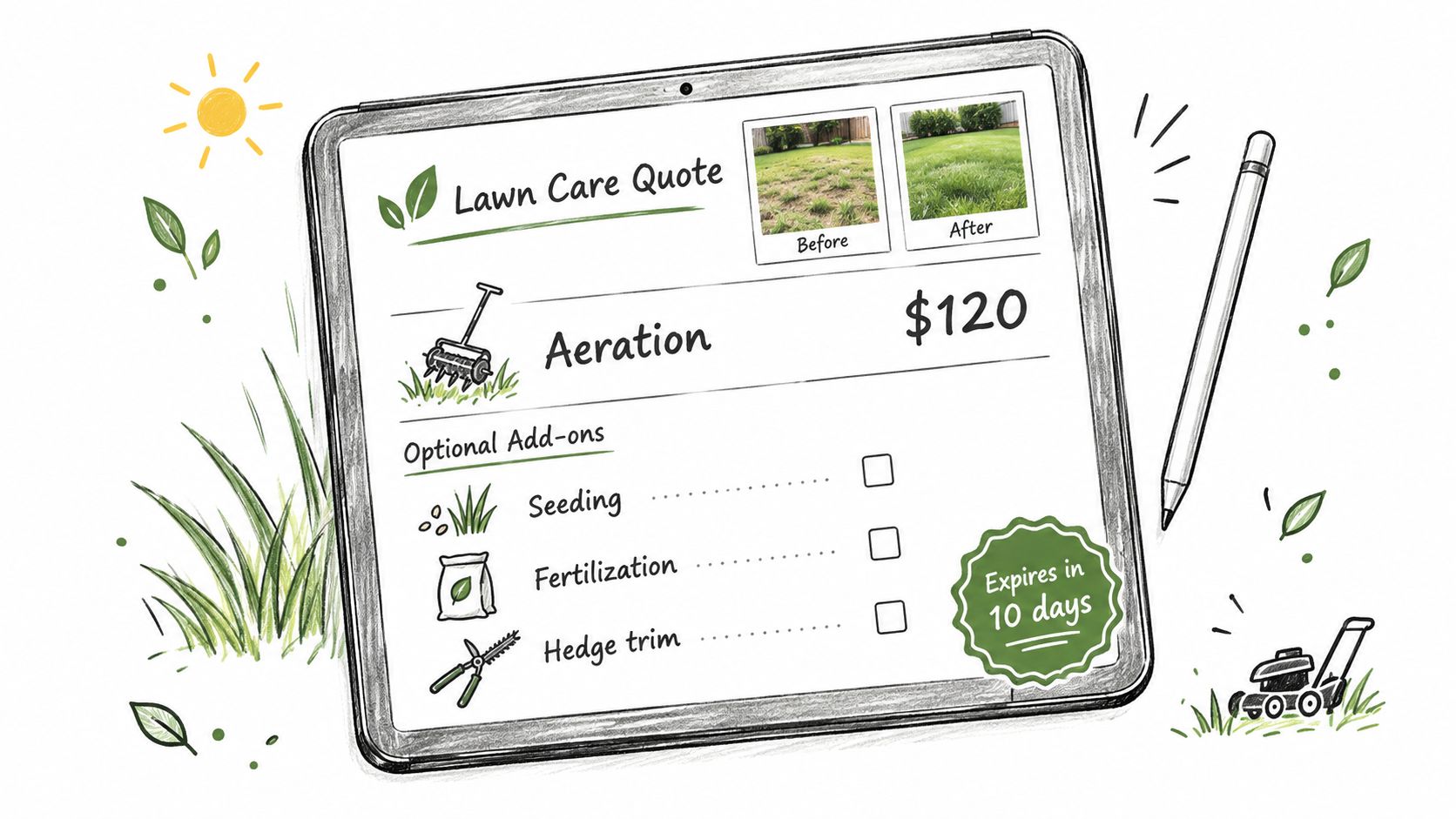
A one-time quote should answer a narrow question quickly: what will you do, what will it cost, and what can the customer add without requesting a new estimate? This format suits aeration, seeding, fertilization, pest treatment, hedge trimming, and similar jobs where the base service is clear but the property may benefit from related work.
Start with one recommended line item. Then place optional work beneath it with separate prices and short explanations. For example, an aeration quote might show the aeration service first, followed by optional overseeding, fertilizer application, and a follow-up visit. The customer can approve the base job without feeling pressured to accept every recommendation.
Regional differences make a single national rate unreliable. One consumer lawn care pricing guide lists mowing and maintenance examples ranging from $115 to $450 in Chicago, $100 to $425 in Dallas, $120 to $500 in Honolulu, $125 to $500 in Houston, and $110 to $430 in Los Angeles. Those figures are a reminder to build your own quote around local labor, travel, property conditions, and scope instead of copying a generic online range.
Make the choice visible
Use labels such as Recommended service and Popular add-on only when they reflect your professional judgment. Explain what changes if the customer selects an option. Seeding may require preparation and watering expectations. Fertilization may require access and weather cooperation. Pest treatment may need a separate service window.
Attach a property photo or simple marked-up diagram so the customer can see which lawn, bed, hedge, or side yard is included. During the walk-through, AurenWell's time tracker can record the assessment and planning time, while the estimate captures the work as itemized services.
Give the quote an expiration date when material costs, weather, or route availability could change. Use a payment link for any deposit, and state whether add-ons must be approved before the crew arrives. This keeps a simple one-time quote from becoming an informal, open-ended request.
3. Commercial Property or HOA Contract Quote
Commercial and HOA customers don't approve lawn care from a vague total. A property manager, board member, or maintenance lead needs to know what areas are covered, how often service occurs, who receives notices, and what happens when weather or access changes the schedule.
Build this quote like an operating document. Name the property and identify specific areas, such as front entrance beds, parking lot perimeters, turf around shared buildings, playground edges, and common areas. Add the service standard for each area. “Maintain beds” is weak. “Remove visible weeds, clear surface debris, and maintain defined bed edges” gives both parties something they can evaluate.
Separate service levels from contract terms
Show recurring services as line items, then add a service-level section covering arrival windows, communication, cleanup expectations, weather delays, access, and approval of extra work. Keep liability, insurance requirements, cancellation, damage reporting, and payment terms in the agreement rather than burying them in a paragraph under the price.
Flat-rate visit pricing is common in lawn care because the job varies by property and route conditions. Your GreenPal's mowing cost guide reports U.S. mowing averages of about $48 to $50 per visit, with most jobs between $49 and $147, while quoted hourly rates are typically $32 to $68. Those benchmarks are not a substitute for your local estimate, but they illustrate why a commercial quote should define the property and service level before presenting a recurring price.
Use AurenWell's contract and e-signature tools so a property manager can approve from a phone. The lawn care agreement resource is relevant when you need to connect the estimate to formal terms. Store the property manager, maintenance contact, and treasurer in the same client record, then set up recurring invoices after approval.
Don't promise a fixed price indefinitely. If the agreement runs for an extended period, explain how material, labor, or scope changes will be handled. A written review or adjustment clause is more defensible than an unexpected increase on a later invoice.
4. Problem Diagnosis and Treatment Quote
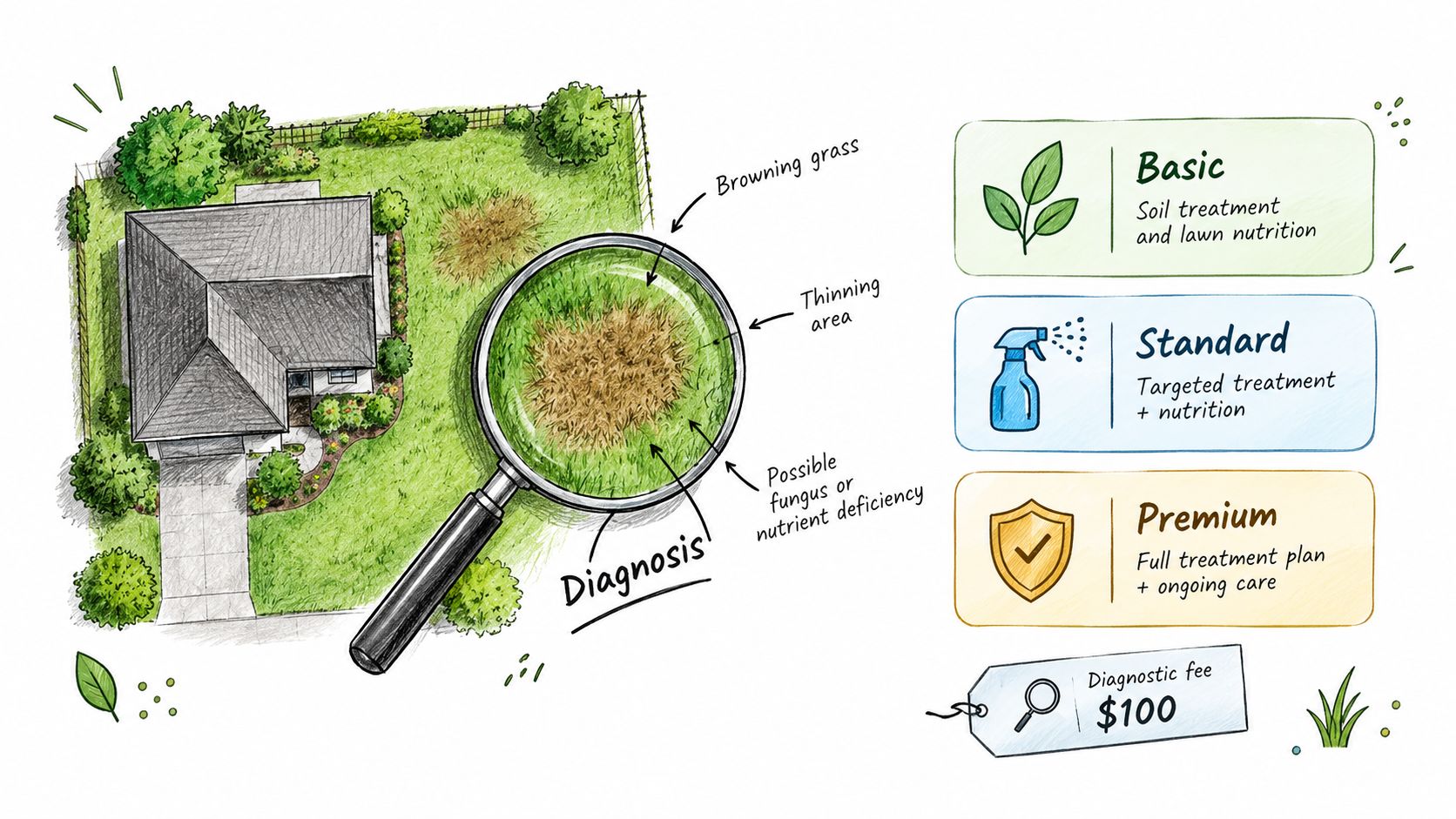
Brown turf, thinning grass, weeds, and bare patches don't always justify an immediate treatment. A responsible operator first determines whether the likely issue is disease, pests, compaction, nutrient deficiency, irrigation, shade, or a combination of conditions. The quote should charge for that professional assessment instead of treating diagnosis as unpaid sales labor.
Open with an assessment line item. Define what it includes: site inspection, photographs, observations, customer questions, and a written action plan. State what it doesn't include, such as laboratory testing, product application, irrigation repair, tree evaluation, or remediation. If the customer approves treatment, you can offer to credit the assessment fee toward the selected plan, but write that condition directly into the quote.
Give the customer a decision without overpromising
Present treatment choices as Basic, Standard, and Premium, but explain the difference in work rather than using empty labels. Basic might address the observed issue with a defined application. Standard might add preparation or a follow-up inspection. Premium might include broader soil, weed, or recovery work where appropriate. Don't guarantee a visual result if weather, irrigation, turf type, or customer maintenance will affect recovery.
A written action plan makes your expertise tangible. Attach before photographs and identify the affected areas. For related planning around larger vegetation or access issues, you can also point customers to tree removal planning tips when that work falls outside your lawn service.
A diagnostic visit may reveal that the requested lawn treatment isn't the correct solution. Your quote should make that acceptable. A clear “no treatment recommended” outcome protects trust and helps you avoid low-margin work that cannot solve the underlying problem.
Use AurenWell's timer to document time spent on the assessment, attach photographs to the estimate, and collect a treatment deposit after approval. A conditional statement can create a useful next step, such as: “If treatment is approved during the estimate window, the assessment fee will be credited as shown.” Keep the condition precise and avoid promising results you can't control.
5. Residential One-Time Cleanup Quote
A homeowner requesting a cleanup often wants an answer while standing in the yard, not a long proposal later that evening. Use a one-page document with a large service title, a property photo, a fixed scope, a clear total, and one approval button.
This template suits spring cleanup, fall leaf removal, dead plant removal, mulch refresh, and general yard reset work. Describe the visible result and the physical tasks required to reach it. “Yard cleanup” could mean anything from blowing leaves into a pile to removing debris from beds, hauling material away, cutting back dead growth, and clearing hard surfaces.
Price the job you can see
A fixed project price is usually easier for a homeowner to approve than an open-ended hourly promise. If the work contains uncertainty, state the assumption behind the fixed price. For example, the quote can say that disposal includes the visible debris shown in the attached photograph, while hidden piles, heavy wet material, or additional areas require approval before extra work begins.
Square-foot pricing can help estimate mowing because it maps job size to labor time. MyQuoteIQ's lawn care cost calculator guide cites mowing benchmarks of about $0.003 to $0.006 per square foot, placing a 10,000-square-foot lawn around $30 to $60 per visit. The same guide describes minimum-ticket pricing around $35 to $50 for small properties, standard residential mowing around $45 to $90, and overgrown first cuts around $75 to $150 or more. Cleanup work still needs its own assessment because debris, disposal, access, and density can change the job substantially.
Use a before photo taken at the property and add it directly to the browser-based estimate. During the job, AurenWell's time tracker lets you compare actual effort with the original assumption for future pricing. At completion, place a QR code or online payment link on the invoice so the customer can pay before you leave.
End with a rebooking prompt, such as: “Would you like to reserve your next seasonal service?” It turns a one-time cleanup into a natural conversation about ongoing maintenance without changing the approved scope.
6. New Customer First-Service Discount Quote
A first-service offer can reduce the risk a new customer feels when choosing an unfamiliar operator. It should introduce your work, not train the customer to wait for discounts. Keep the regular service price visible, identify the introductory adjustment separately, and make the offer apply to the defined property and service.
The quote needs a clear good-through date and a simple eligibility rule, such as one introductory offer per household or property address. Save that note in the AurenWell client record so the same offer isn't accidentally applied again. Don't use a discount to hide an incomplete scope. The customer still needs to know whether mowing includes trimming, edging, blowing, bagging, or disposal.
Connect the trial to the next service
Write the call to action around a real scheduling choice: “Approve this estimate to reserve the available service window.” Add a payment link for any deposit and collect the customer's complete contact details before the job is scheduled. The customer should know what happens after the first visit, whether that's a follow-up recommendation, a recurring maintenance option, or a request to confirm future work.
Seasonality can affect the economics of a promotional offer. LawnStarter reported that average price per mow rose from $49.28 in January to $54.66 in August, a 10.9% peak-season premium, and reported a 6.6% increase from 2024 to 2025 in its industry report. For a solo operator, that kind of timing difference supports a practical rule: set promotional pricing around the actual route and season, rather than offering the same deal when demand and travel conditions are very different.
After completion, use AurenWell's activity log to see whether the estimate was viewed, approved, invoiced, and paid. Schedule a follow-up reminder for the next day to ask how the service went and propose the next appropriate visit. Track the value of the discount against repeat work internally, but don't put unsupported customer-lifetime assumptions in the quote.
A first-service offer works when the customer sees a fair path to continuing service. It doesn't work when the reduced price leaves you short on travel, labor, or disposal.
7. Recurring Maintenance Contract with Price Lock
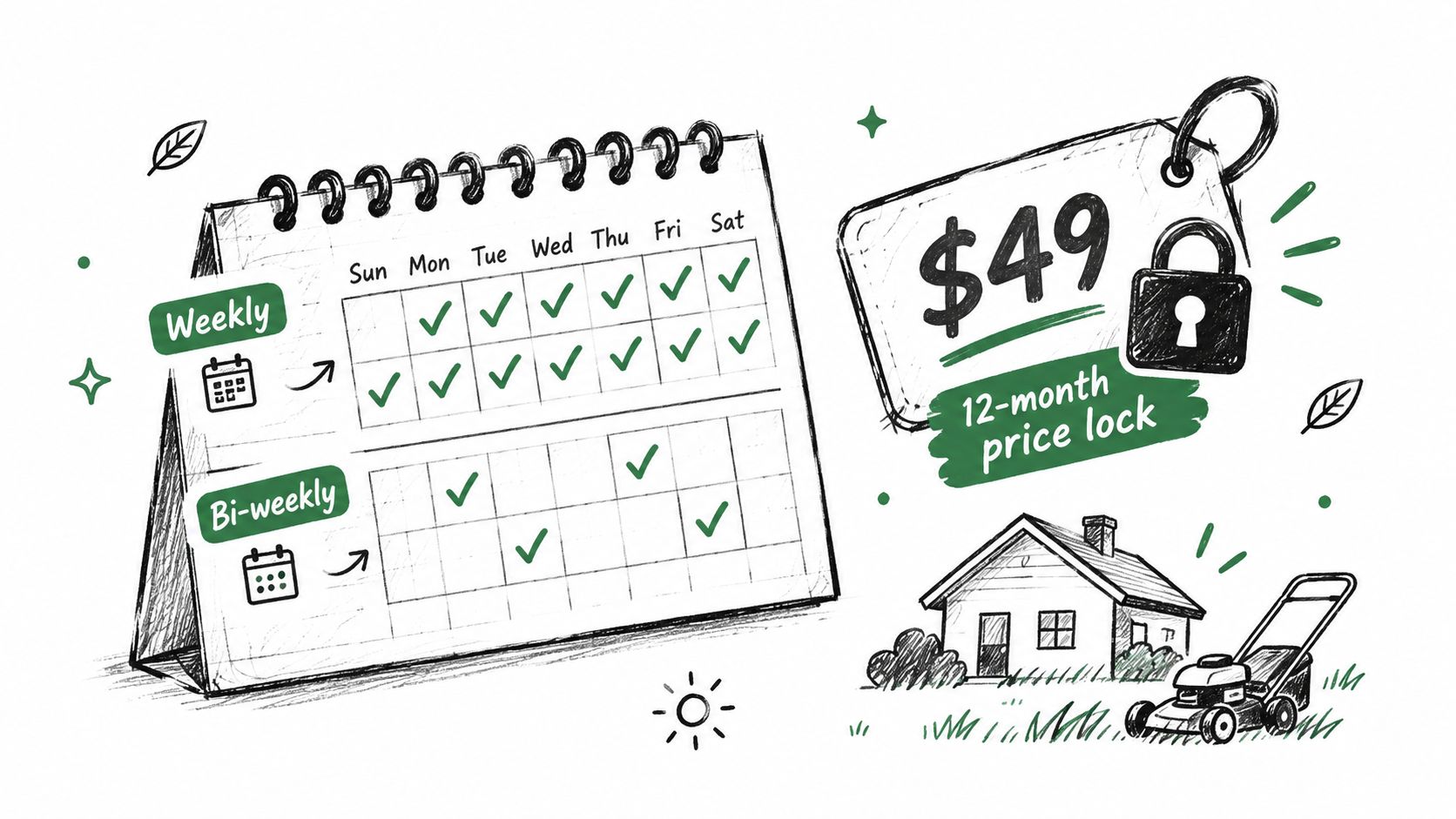
A price-lock quote sells predictability to both sides. The customer gets a known rate and a reserved service rhythm. You get a clearer route, fewer sales conversations, and a basis for recurring billing. The trade-off is that you carry more risk if the property changes, access becomes difficult, or your input costs rise.
Write the quote as an agreement-ready document. State the service frequency, included tasks, property areas, exclusions, seasonal changes, cancellation rules, weather policy, and payment schedule. Make the price-lock language prominent and specific about its end date. If the customer requests work outside the defined maintenance scope, require written approval before starting.
Protect the route and the margin
Don't confuse a recurring quote with an unlimited-service promise. A mowing visit may include trimming and blowing, while leaf removal, overgrowth, bagging, hauling, aeration, fertilization, and weed removal remain separate line items. Zarla's lawn mowing pricing guide notes that weekly mowing is often $41 to $65 for properties under a quarter acre, while overgrown first cuts can range from $75 to $150 or more and unpredictable work may be priced around $35 to $68 per hour. The difference supports a modular quote, with standard maintenance separated from exception work.
Offer a recurring schedule only when the route makes operational sense. A longer commitment can justify a reserved slot, but include a practical cancellation and pause process for weather, travel, property sale, or extended access problems. If you offer annual prepayment or another incentive, show it as a separate payment option and confirm how refunds or cancellations are handled.
Use AurenWell's contract feature for mobile signing, then activate recurring invoices after approval. The estimate terms and conditions guide can help you organize the conditions that customers commonly overlook. Store seasonal notes in the client record, such as access instructions, pet precautions, preferred bed treatment, and areas to avoid.
7-Point Lawn Care Quote Comparison
| Quote Type | Complexity 🔄 (Implementation) | Resources ⚡ (Requirements) | Expected Outcomes 📊 | Ideal Use Cases | Key Advantages ⭐ / Tips 💡 |
|---|---|---|---|---|---|
| Seasonal Maintenance Package Quote Template | Moderate, set up multi-tier pricing and seasonal schedule | Moderate, planning, inventory for seasons, recurring billing setup | Stable year‑round revenue; higher customer LTV | Residential customers wanting ongoing service across seasons | ⭐ Builds recurring relationships; 💡 include clear start dates, weather policy, convert to recurring invoices |
| One-Time Service Quote with Add-On Options | Low, single job + optional selections; simple UI | Low, materials per job, photo capture, mobile approval | Quick conversions; potential upsells increase AOV | Single-project work (aeration, pest treatment, pressure wash) | ⭐ Low barrier to entry; 💡 present base as "Recommended" and use short expiration |
| Commercial Property / HOA Contract Quote | High, formal SLA, legal clauses, multi-contact setup | High, proof of insurance, documentation, negotiation time | Larger contracts, predictable recurring billing, reduced disputes | Office parks, HOAs, multi-unit properties | ⭐ Professional credibility and protection; 💡 use e-signature, include insurance & escalation clauses |
| Problem Diagnosis & Treatment Quote | Moderate, diagnostic workflow then variable treatments | Moderate, diagnostic tools, time on site, photos, follow-up tracking | Paid expertise; higher-margin treatment sales; documented results | Lawn disease/pest issues needing assessment | ⭐ Positions operator as expert; 💡 credit diagnostic fee toward treatment same day |
| Residential One-Time Cleanup Quote | Very low, simple line items and mobile presentation | Low, labor, disposal, quick photo documentation | Fast approvals; same‑day turnarounds; lower margins | Short‑notice cleanups (spring/fall) for homeowners | ⭐ Quick sale and low friction; 💡 offer fixed-price blocks and collect deposit or payment on completion |
| New Customer First-Service Discount Quote | Low, promotional layout with expiration & discount rules | Low, tracking discounts, limiting to one per address | Increased acquisition; possible short‑term margin erosion | Attracting first-time customers and driving reviews | ⭐ Effective for acquisition; 💡 limit to one per address and flag in CRM to avoid reuse |
| Recurring Maintenance Contract Quote with Price Lock | High, contract terms, 12‑month price lock, recurring setup | Moderate‑High, scheduling, staffing, route planning, contract management | Predictable cash flow; long‑term commitments; reduced churn | Customers wanting guaranteed weekly/bi‑weekly care | ⭐ Stabilizes revenue; 💡 use e-signature, 3‑month minimum, offer prepay discount |
Turn the Approved Quote Into Paid Work
A lawn care quote isn't finished when you type the total. It is finished when the customer understands the job, approves the right scope, and knows how payment will happen. Before sending any estimate, check the document against the property and the actual route plan.
Use this final review:
- Name the property: Include the customer name, service address, and the specific lawn, beds, perimeter, or common areas included.
- State the service date: Give the proposed date or service window, and explain how the customer confirms it.
- Define inclusions: List mowing, trimming, edging, blowing, disposal, applications, cleanup, or follow-up work as separate items where useful.
- Define exclusions: Mention inaccessible areas, tree work, irrigation repairs, unusual debris, overgrowth, hauling, and any other work that requires separate approval.
- Show line-item pricing: Present the base service, labor, materials, disposal, travel-related charges, and optional add-ons in a way the customer can scan on a phone.
- State payment terms: Show the deposit amount or payment due date, accepted online methods, and what happens if the customer chooses manual payment.
- Add weather terms: Explain when a visit will be delayed, how it will be rescheduled, and whether weather-related changes affect the service window.
- Set an expiration date: Use one when route availability, seasonal demand, materials, or the quoted scope may change.
- Include the approval action: Tell the customer exactly what to click, sign, or reply to reserve the work.
The right workflow keeps those steps connected. Send the estimate from your phone, let the customer view and approve it in a browser, capture an e-signature when the service requires formal terms, and convert the approved estimate into an invoice. AurenWell supports estimates, contracts, invoices, online payment links, QR codes, deposits, recurring invoices, and client history in one web application. That makes it practical for a solo operator who completes the field work and still needs to manage the administrative steps.
After payment, retain the quote, signed terms, service notes, photographs, and transaction history with the client record. The next estimate becomes faster because you already know the gate access, lawn conditions, preferred schedule, and exceptions. For a commercial prospect, a resource such as this quote for property managers can also show why property-specific scope and approval details matter.
If you're sending a quote today, open a mobile estimate, attach the property photo, add the base service and any optional line items, write the weather and payment terms, and send the approval link before the customer hires someone else. Once approved, collect the deposit or online payment through AurenWell, convert the document to an invoice, and save the service history for the next visit.
The quote isn't merely a price document. It's the first step in the payment workflow.