
You finish a mowing route, rinse the trailer, sit down in the truck, and send an invoice that says “Lawn service.” A customer writes back asking what that covered, whether it included trimming, and why the amount is higher than last time. Nothing about that invoice was technically missing, but it still slowed payment.
That's the problem with a lawn care invoice. It isn't just a form. It's the handoff between field work and cash in the bank.
The payment side matters more than most template posts admit. Invoice payment data for 2026 found that lawn care invoices had a median payment time of 13 days, with a 58.0% share paid and a median invoice size of $195. The same dataset found that invoices with an online payment link were paid 79.6% of the time versus 56.1% without one, and they were paid in a median of 8 days instead of 15 according to invoice payment timing data for landscaping and lawn care. That changes how you should think about invoicing. The design of the invoice and the way the customer pays are tied together.
That's especially true if you run solo and bounce between weekly mowing, seasonal cleanups, mulch installs, and the occasional upsell. The invoice has to do several jobs at once. It needs to remind the customer what happened, show the property serviced, separate labor from materials when needed, and remove any friction around payment.
Some operators are also starting to blend traditional service with newer equipment decisions, and if you're comparing route efficiency against low-touch maintenance setups, these vision navigation robotic mower insights are worth a look because they show how property type affects what you bill for and how often you bill it.
Introduction to Lawn Care Invoices That Actually Get Paid
Invoices with easier payment paths get paid faster. That sounds obvious, but a lot of lawn care businesses still treat the invoice like a receipt instead of a payment system.
After billing hundreds of recurring cuts, cleanups, mulch jobs, and small repair add-ons, I can tell you the slow-pay problem usually starts before the customer ever opens the invoice. It starts with how the work is described, whether labor and materials are separated clearly, whether tax is handled the same way every time, and whether the reminder schedule is set before the invoice goes out.
A good lawn care invoice does more than record a visit. It confirms what happened at the property, shows the charges in a format the customer can scan quickly, and gives them a clear next step to pay without emailing questions back and forth.
What usually slows payment
Three patterns cause most payment delays in lawn care billing:
- Vague line items. “Yard work” leads to callbacks. “Front and rear mow, string trim, edge sidewalks, blow clippings off drive and patio” gets approved faster because the customer can match the charge to visible work.
- Mixed charges with no structure. If labor, mulch, replacement sprinkler heads, herbicide, and discounts are bundled into one number, customers hesitate and your books get messier.
- Weak follow-through after sending. A due date alone does not collect money. The invoice, payment method, and reminder cadence need to work together.
Practical rule: If the customer has to ask what was done, what is taxable, or how to pay, the invoice is not ready to send.
What works in the field
The operators who get paid on time usually run the same billing process every visit. They use consistent service names, send the invoice close to the work date, separate labor from materials when needed, and make payment easy from the first message.
That matters because the invoice affects payment speed in more than one way. Line-item detail reduces disputes. Clear tax handling prevents “why did this total change?” emails. Automated reminders catch the customers who intended to pay but forgot. Template posts often stop at layout, but layout is only part of the system.
Equipment choices can affect billing structure too. If you are comparing traditional mowing routes with low-touch properties that need fewer onsite visits, these vision navigation robotic mower insights help show how property type can change what you charge for, how often you bill, and which services stay recurring.
Essential Fields Every Lawn Care Invoice Must Include
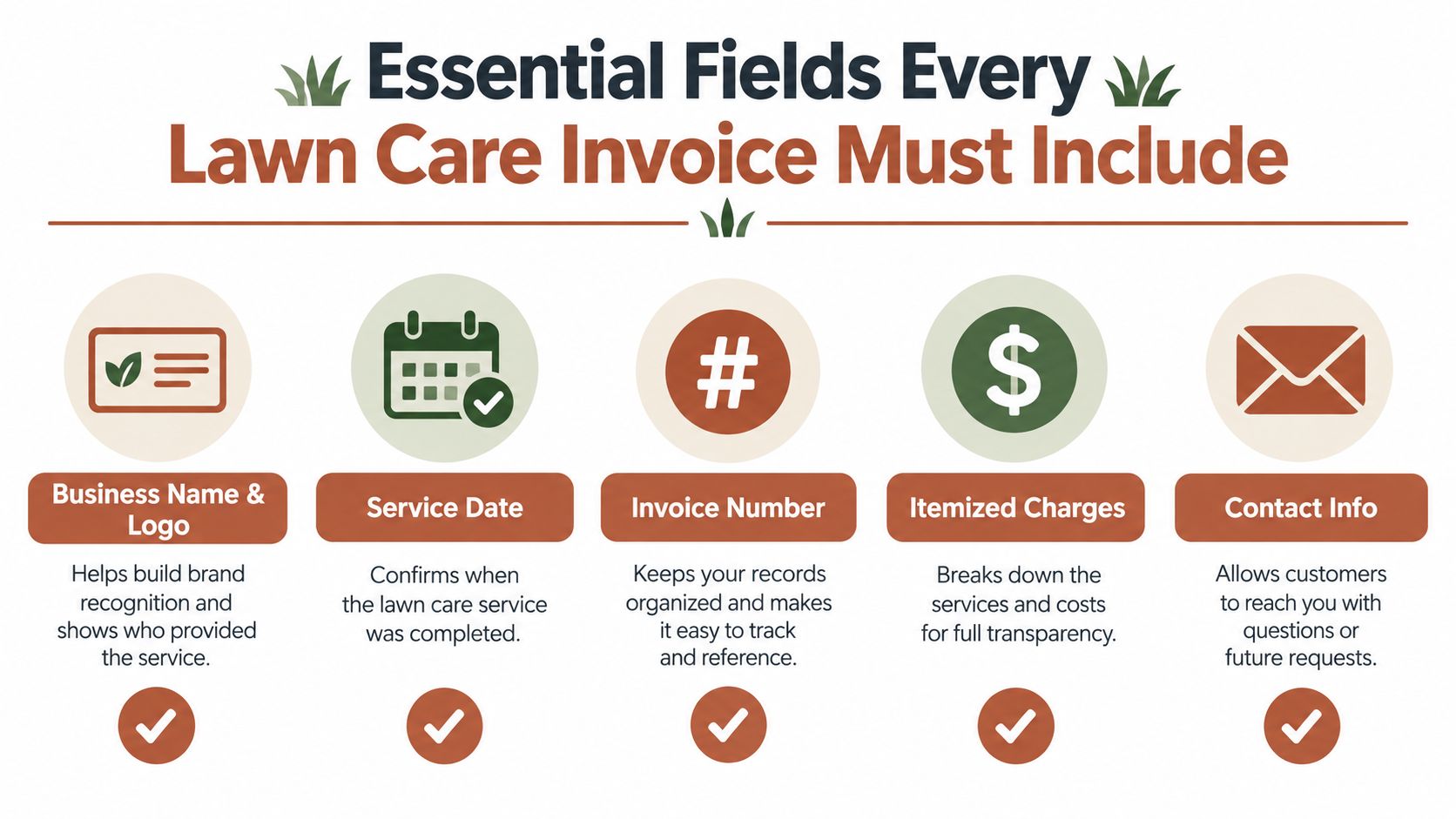
The invoices that get paid fastest usually answer three questions without a callback: who did the work, what was done at that property, and what the customer needs to do next to pay. After billing hundreds of routine cuts, cleanups, mulch jobs, and treatment visits, I have found that missing fields rarely cause one big problem. They cause small delays that stack up. A manager has to confirm the address. A homeowner asks why tax was added. An office admin cannot match the bill to the service date.
Required fields
Industry guidance for lawn and landscaping billing recommends a repeatable structure that includes business identity, a unique sequential invoice number, service date or billing period, customer and property address, itemized services with quantities and prices, subtotal, taxes or discounts, total due, explicit payment terms, and accepted payment methods according to lawn care billing guidance from Smart Service.
Here is the field set worth standardizing across every invoice:
- Business identity: Business name, phone, email, and license details if your area or service type requires them. A logo is optional. Clear contact info matters more.
- Invoice number: Use a clean sequential number. It speeds up follow-ups, payment matching, and year-end bookkeeping.
- Issue date and service date: These should not be treated as the same field. The issue date shows when you billed. The service date shows when the work happened.
- Customer name and service address: In lawn care, the property address is often the reference point, especially for landlords, HOAs, and multi-property clients.
- Line-item descriptions: Each service needs a clear label, unit or quantity where relevant, rate, and line total.
- Subtotal: Show the pre-tax amount before discounts or tax adjustments create confusion.
- Tax field: Break out tax as its own line when it applies. This matters most on invoices that mix labor with materials or taxable products.
- Discount field: If you gave a referral credit, prepaid plan discount, or service recovery adjustment, label it clearly instead of burying it in a lower total.
- Total due: Put this where the customer sees it immediately.
- Payment terms: State the due date, late fee policy if you use one, and deposit balance if part of the job was prepaid.
- Payment methods: List the exact options you accept, such as card, ACH, check, or cash.
A good invoice also includes a short customer reference, such as an account number, route code, or property nickname for larger books of business. That is not mandatory for a one-truck operation, but once you manage recurring routes, it cuts down on payment posting mistakes.
Fields that prevent tax and pricing disputes
Many template articles stop too early. They tell you what boxes to include, but not why the fields affect payment speed.
If your work mixes mowing labor, mulch, replacement parts, herbicide, or other materials, the invoice should separate those charges before tax is calculated. In many areas, labor and materials are not handled the same way for sales tax. If you lump them together, the customer sees a total they cannot follow, and you create cleanup work for yourself later.
Use separate lines for labor, materials, and discounts whenever the job includes more than routine mowing. That structure helps the customer verify the amount and helps you apply tax correctly the first time.
Formatting choices that help invoices clear faster
Layout still matters, just for practical reasons.
- Keep the top section easy to scan: Business name, invoice number, issue date, due date, customer, and property address should be visible without scrolling.
- Put total due near the payment option: The customer should not have to hunt for the amount and then hunt again for the pay button or remittance details.
- Use the same service names every time: If last month says "weekly mowing" and this month says "yard maintenance," customers sometimes assume the scope changed.
- Leave room for short notes: Gate code updates, weather reschedules, or "includes two extra bags of clippings removed" can stop avoidable questions.
The goal is simple. Every field should either help the customer approve the bill, help your system calculate the amount correctly, or help money come in with less chasing.
How to Itemize Mowing Treatments and Seasonal Services
Itemization decides whether a customer pays from the invoice or emails back with questions.
After billing a lot of recurring yards, the pattern is pretty consistent. Short, generic descriptions slow payment because the customer cannot match the charge to a visit, a treatment, or a visible result. Clear line items do the opposite. They show what was done, where it was done, and whether the charge belongs under routine mowing, a treatment visit, or a seasonal add-on.
Write line items by result, scope, and billing unit
“Lawn service” is too broad. “Yard cleanup” is not much better. A good line item gives the customer enough detail to approve the bill without calling you, and it gives you enough structure to sort labor, materials, and taxable charges correctly later.
Here's a format that holds up well in the field:
| Service Type | Weak Line Item | Line Item That Clears Faster |
|---|---|---|
| Weekly mowing | Lawn service | Weekly mowing, edging, and blow off, front and back lawn, May 6 |
| Fertilizer visit | Treatment | Fertilizer application to turf areas, 1 visit, May 6 |
| Weed control | Spray | Post-emergent weed treatment, front beds and driveway edge, May 6 |
| Leaf cleanup | Yard cleanup | Spring leaf cleanup, beds, fence line, and curb strip, May 6 |
| Shrub trimming | Trim bushes | Shrub trimming, front entry hedge and left side bed, May 6 |
| Mulch job | Mulch | Mulch installation labor, front beds, 3 cubic yards installed, May 6 |
That structure does more than make the invoice look cleaner. It sets up the rest of your payment system. If mowing, treatment work, and seasonal labor are separated properly, customers recognize the charge faster, and you can apply tax rules to product lines without rebuilding the invoice later.
What each service line should answer
Every line should answer four questions:
- What was done: Mowing, edging, blow off, pruning, bed cleanup, fertilizing, weed treatment, leaf removal
- Where it was done: Front lawn, back yard, side beds, fence line, full property
- What unit you are billing: Per visit, per application, per hour, per cubic yard, per pallet, per bag
- What falls outside the standard plan: Bagging, haul-off, storm debris, extra trimming, gate return trip
The billing unit matters more than a lot of template articles admit. Mowing usually bills best per visit or under a recurring plan. Treatments are easier to defend per application. Seasonal work often needs quantity tied to labor or materials, especially on mulch, pine straw, seed, sod, and haul-off.
Common services and the cleanest way to break them out
For routine mowing, one combined line usually works if the scope is standard and unchanged:
- Weekly mowing, edging, and blow off, full property, May 6
For treatment work, keep each application separate:
- Fertilizer application to turf areas, 1 application, May 6
- Spot weed control in front beds, 1 application, May 6
For seasonal cleanups, show the scope:
- Spring cleanup, remove leaves and debris from beds, fence line, and curb strip, May 6
For install work, split labor from product:
- Mulch installation labor, front and side beds, May 6
- Brown hardwood mulch, 3 cubic yards
That split helps with two things. Customers can see why the total landed where it did, and your tax setup stays cleaner where labor and materials are treated differently.
Use notes only where they stop disputes
Notes should support the line item, not replace it.
Good examples:
- Includes bagging and haul-off
- Skipped back gate on first pass, return trip completed same day
- Wet conditions required lighter cut and debris removal
Bad notes are vague promises like “general yard work” or “maintenance as discussed.” Those phrases create room for memory gaps, especially on seasonal jobs quoted weeks earlier.
If a customer is still deciding what they want cleaned up or improved, tools for ai front yard design can help turn a loose curb appeal conversation into a scannable scope you can price and invoice line by line.
Specific invoices get approved faster because the customer can connect each charge to a visit, an area of the property, or a product they can see on the ground.
Recurring Billing Versus One Off Project Invoices
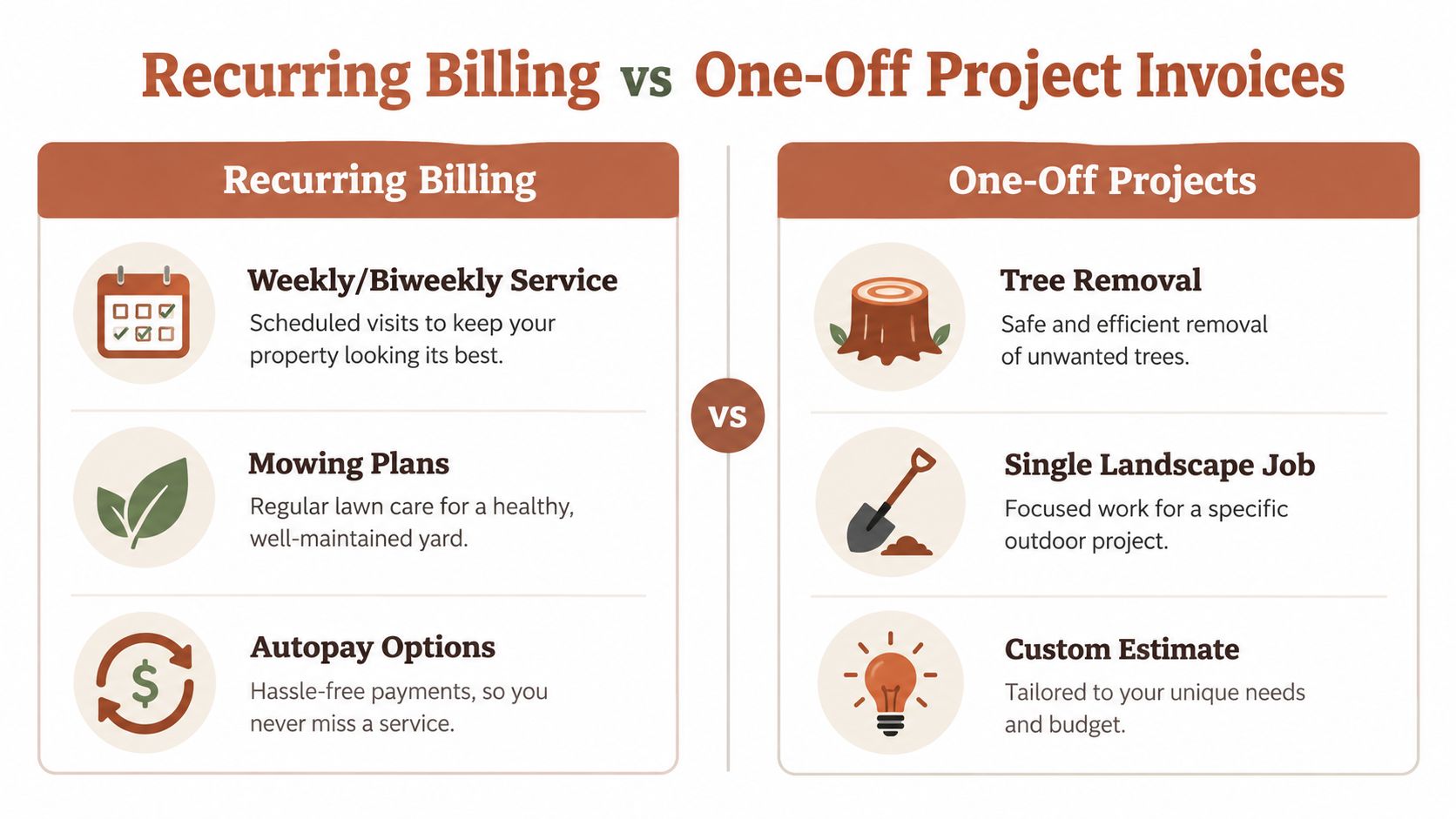
Recurring mowing invoices usually get paid fastest when the customer can predict three things before they open them: the amount, the send date, and the payment method. One-off project invoices need something different. They need enough detail to confirm the scope, the deposit applied, and the remaining balance without a phone call.
Two jobs, two invoice structures
After billing a lot of repeat mowing accounts, the pattern is clear. Simple recurring invoices reduce friction. Project invoices reduce arguments.
| Invoice Type | Best For | Structure That Works |
|---|---|---|
| Recurring billing | Weekly or biweekly mowing, routine maintenance | Service period, flat plan price or visit rate, clearly marked add-ons, due date, auto-send schedule, saved payment method if offered |
| One-off project invoice | Cleanups, mulch installs, sod work, renovation-style jobs | Scope-specific line items, deposit shown as paid, labor and materials separated, change requests listed, balance due |
For recurring work, keep the invoice lean. Show the billing period, the standard service charge, and only the extras that changed that cycle. A skipped cut, bagging request, gate issue, or shrub trim should appear as its own charge so the base plan stays clean month after month.
That consistency matters.
Customers pay recurring invoices faster when each one looks familiar and only the exceptions stand out. If every mowing invoice reads like a custom estimate, people slow down and re-check charges that should have been routine.
One-off project invoices work the opposite way. They need more context because the customer is comparing the final bill to the quoted scope, not to last week's visit. Restate what was done, show the service date or project window, list the deposit already collected, and make the remaining balance obvious. If the scope changed after approval, show that change as a separate line instead of burying it in the total.
A short explainer can help if you're setting up recurring schedules for repeat clients:
How to choose the right setup
Use recurring billing for work with a stable pattern and a known price. Use one-off project invoices for jobs where materials, crew time, or site conditions can change the final number.
The trade-off is control versus speed. Recurring invoices should be easy to approve and easy to pay. Project invoices should document enough detail to defend the bill later, especially when labor, materials, and taxes will not all be treated the same way.
Reminder timing should match the invoice type too. Recurring clients usually respond well to a steady cadence, such as the same send day each cycle and a follow-up reminder a few days after the due date. Project clients often pay faster when they get milestone-based communication: deposit request before scheduling, final invoice right after completion, then a short reminder sequence until the balance clears.
If you want that repeat schedule handled automatically, recurring invoice scheduling for ongoing maintenance can send routine invoices on time while still letting you review add-ons before they go out.
Monthly maintenance clients want a repeatable payment system. Cleanup and install clients want a paper trail that matches the job.
Handling Labor Materials Taxes and Discounts Correctly
Mixed lawn care invoices are where payment slows down. The customer sees one total, asks what part was labor, what part was mulch, whether tax applies, and whether the discount was already included. Every one of those questions adds a delay.
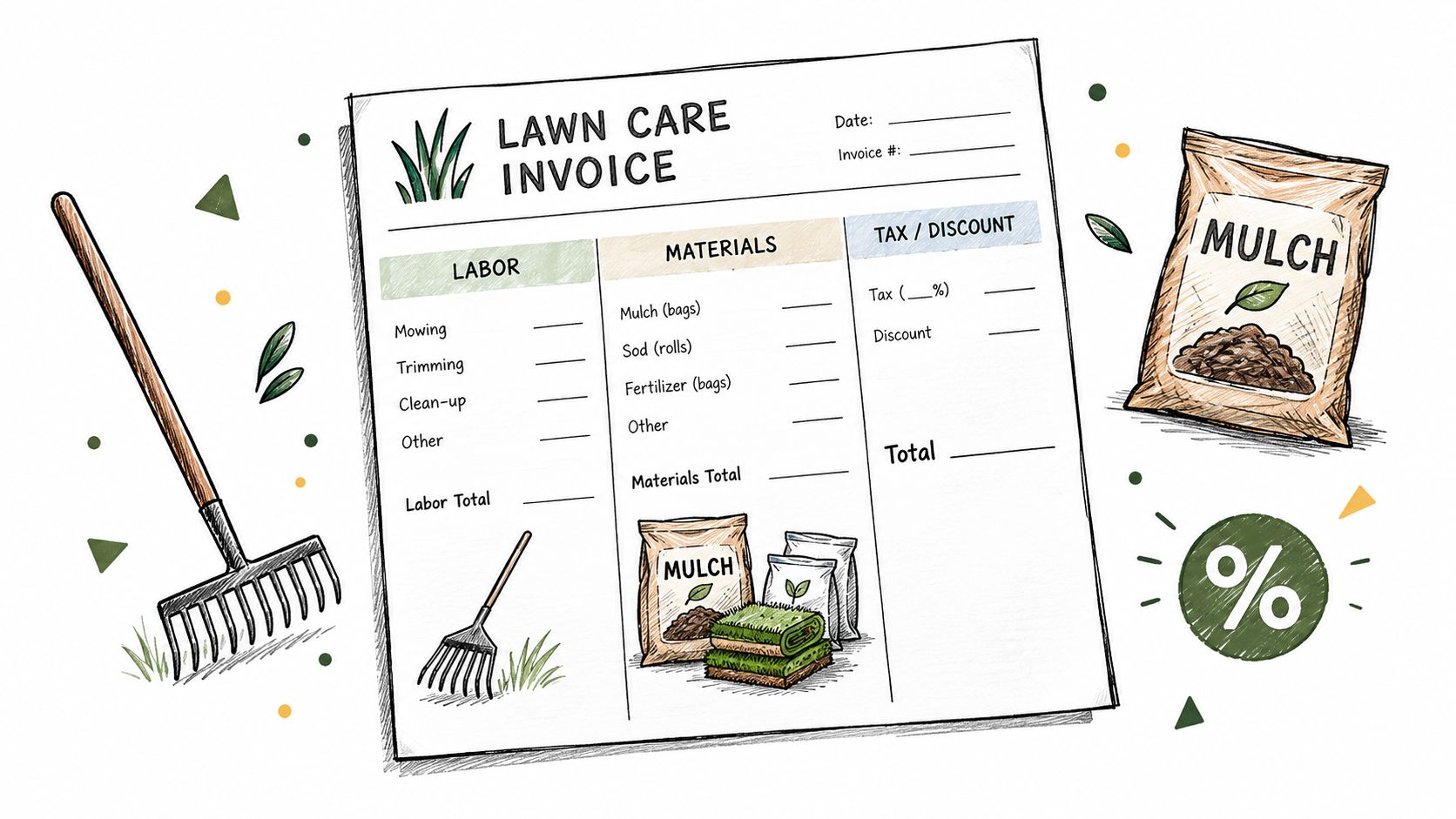
Generic templates miss the part that matters in the field. Lawn care jobs often combine service labor, taxable materials, delivery charges, and credits from deposits or service recovery. As noted in Jobber's lawn care invoice template guidance, some states tax lawn maintenance as a service, while others tax only certain materials such as sod or mulch. If your invoice lumps everything together, you create two problems at once. Tax handling gets messy, and the customer has no clean way to verify the bill.
Break the invoice into billable parts
I bill mixed jobs in separate lines because it cuts down on callbacks and protects margins later.
A clean structure usually includes:
- Labor: mowing, trimming, mulch installation, cleanup, or treatment application, with the service date or date range
- Materials: mulch, sod, seed, fertilizer, plants, or other physical items
- Other charges: delivery, dump fees, haul-off, equipment surcharge, or irrigation parts pickup
- Discounts or credits: listed as their own negative line item with a plain label
- Tax: applied only to the lines your local rules require
That format does more than make the invoice look organized. It turns the invoice into a payment system. Customers can approve it faster, your bookkeeping stays cleaner, and overdue follow-ups are easier because every charge is already explained.
Labor and materials should not hide each other
Bundled pricing works for quick verbal estimates. It causes trouble on the final invoice.
If you invoice “spring cleanup and mulch refresh” as one line, the customer cannot tell whether the higher total came from extra bed prep, more yards of mulch, or a disposal charge. If you separate those items, the conversation stays specific. You are discussing one line, not reopening the whole price.
That matters even more if labor is getting tighter. If you are reviewing labor cost reduction strategies, your invoice should show where crew time ends and material markup begins. Otherwise you cannot see which jobs pay well.
Handle tax line by line
Tax mistakes usually start with shortcuts. Operators either tax the full invoice when they should not, or skip tax because sorting it out feels annoying after a long day.
The safer habit is simple. Mark taxable and non-taxable lines separately in your system, then let the invoice show the result clearly. If your state taxes installed materials but not labor, the invoice should reflect that. If your area taxes lawn treatments as a service, those treatment lines should stand on their own instead of being buried inside a general service charge.
Do not leave tax logic invisible. Customers are less likely to question a tax amount when they can see what it applies to.
Discounts need a reason and a label
A discount should never be hidden inside a lower unit price. Show it as its own line.
Good labels are specific:
- Seasonal maintenance discount
- Neighbor referral discount
- Deposit credit
- Service issue adjustment
That last detail matters. A visible discount does two jobs. It shows goodwill to the customer, and it preserves your original pricing on the invoice so you can still track what the work was worth before the adjustment.
Clean line items, correct tax treatment, and labeled discounts usually get paid faster because the customer has fewer reasons to stop and ask questions. This is not legal or tax advice, and local rules vary, but the billing habit that travels well in every market is the same. Separate labor, materials, taxes, and credits so the final number is easy to approve.
Deposits Payment Terms and Online Payment Options
Jobs that tie up materials, crew time, or a full afternoon need clearer payment mechanics than a basic mow-and-go invoice. This is the part that decides whether you get paid on schedule or spend your evening chasing balances.
Deposits for larger jobs
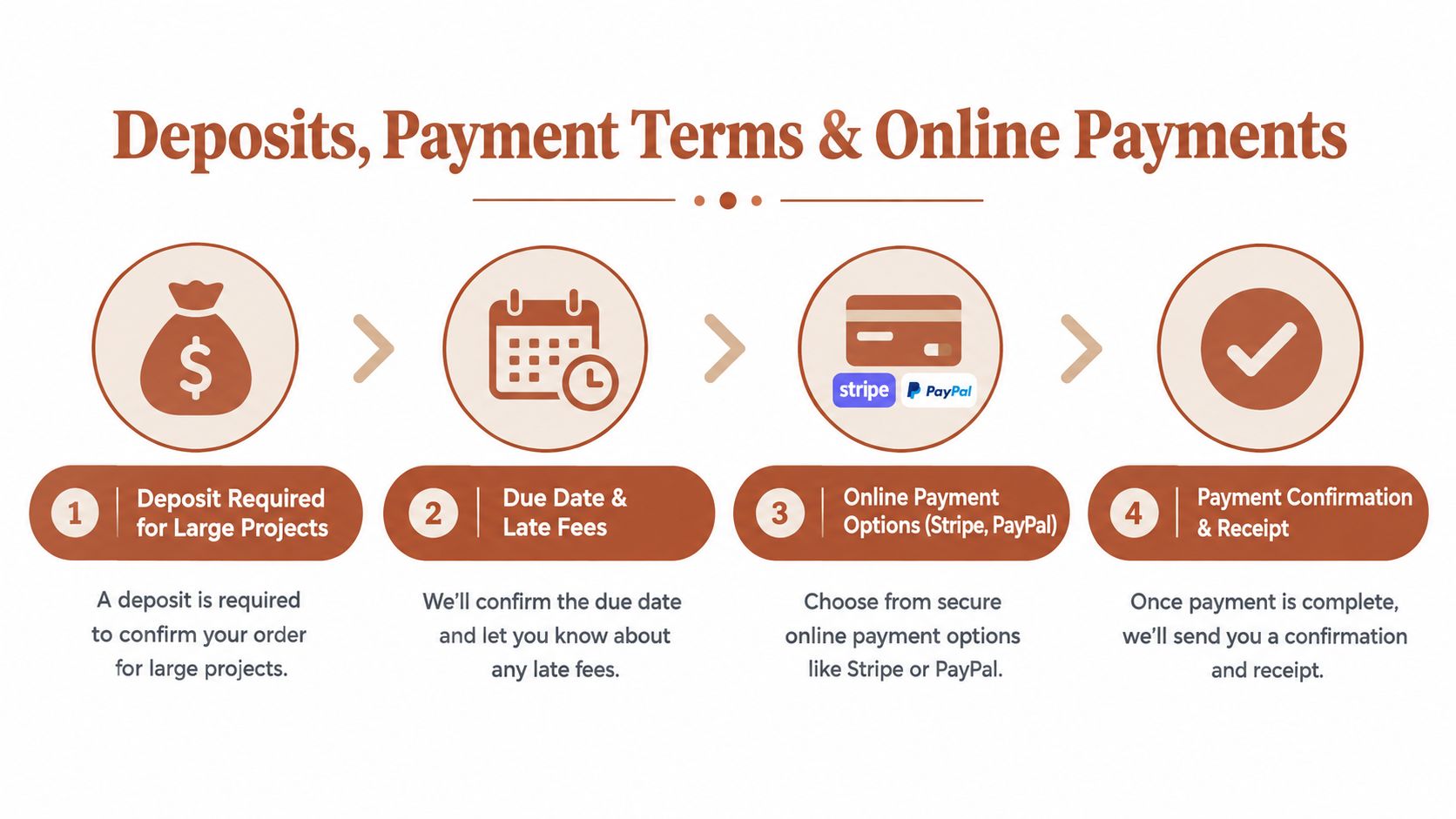
For weekly mowing, I rarely see a deposit help. For mulch installs, sod work, cleanups with dump fees, or any job that requires buying material before arrival, a deposit protects your schedule and your cash.
The key is to treat the deposit as part of the payment system, not a loose promise. Show the requested amount on the first invoice, then show the same amount later as a credit against the final bill. Customers should be able to see three things fast: what they paid, what that payment covered, and what is still due.
If you need wording and layout examples, this guide to an invoice for deposit is useful.
Payment terms that remove ambiguity
Short terms are fine. Vague terms are what cause trouble.
A good lawn care invoice answers the payment questions a customer has before they text you:
- Due date
- Accepted payment methods
- Late fee or overdue policy
- Whether you accept partial payment
Keep the language plain. “Due upon receipt” works if you expect same-day payment and have trained customers to expect that. If not, use a real deadline such as “Due within 7 days” or “Due by June 14, 2026.” A dated deadline gets fewer follow-up questions than a phrase people interpret differently.
Online payment options shorten the gap
Payment speed usually improves when the invoice lets the customer pay immediately instead of making them switch apps, find a checkbook, or ask how to send money. That point was covered earlier with payment-link data, and it is one of the few invoice changes that often shows up in cash flow within the same month.
For a solo operator, the practical setup is simple:
- Send the invoice digitally by text or email on the same day the work is billed
- Offer card and ACH if fees make sense for your margins
- Record check, cash, or bank transfer in the same system so open balances stay accurate
- Send a receipt automatically or right away so customers do not ask whether payment went through
There is a trade-off. Card payments usually arrive faster, but processing fees cut into the job. ACH often costs less, but some customers still prefer cards for convenience or points. I have had the best results giving both options, then pricing jobs tightly enough that the faster collection is worth the fee on at least part of the book.
AurenWell is one example of a tool in this category. It supports online invoice links, card and ACH payments through Stripe, QR codes, and manual payment recording for cash, check, or bank transfer. For lawn care operators, that matters because every extra payment step gives the customer one more reason to wait.
Scheduling Invoices and Reminders for Steady Cash Flow
Late payment usually starts before the invoice is overdue. It starts when billing happens too long after the work, the service date is unclear, or there is no set follow-up schedule once the due date passes.
I learned this the hard way on recurring routes. If I billed whenever I had time, payment timing got loose fast. When I sent invoices on a fixed schedule and chased late balances on set days, more customers paid without questions and fewer accounts drifted into the next month.
Billing cadence shapes payment speed
For one-time work, send the invoice as soon as the job is complete or the same day the crew closes out the service. For recurring maintenance, use one billing cycle for the whole book, such as monthly on the 1st or 15th. That does two things. It trains customers to expect the charge, and it keeps your admin from turning into a pile of small exceptions.
The invoice itself should match the billing cycle. A single service date works for one mowing visit. A billing period works better for monthly plans. If you bill seasonal work or mixed accounts, make the covered dates obvious so the customer can match the charge to the work without emailing you first.
That small detail affects payment speed more than many template articles admit.
Reminders work best when they are scheduled, not improvised
A clean invoice helps. A reminder system gets the money in.
QuickBooks reported that 59% of businesses had invoices overdue by 30 or more days in its late payments report for 2026. Lawn care has the same risk, especially on route work where customers see frequent service and can get casual about timing.
The fix is a repeatable cadence:
- On the due date or 1 day after: Short reminder with the invoice number, amount due, and payment link
- At 7 days overdue: Direct follow-up that restates the service period or job description so there is no confusion about what is unpaid
- At 14 days overdue: Firmer message asking for a payment date or a reply if there is a billing issue
If you want wording that stays professional without sounding stiff, these overdue invoice reminder email examples are useful starting points.
Treat the invoice like a payment system
This is the part many lawn care posts skip. Payment speed depends on how the invoice, tax treatment, and reminder timing work together.
If the customer sees one vague line for "yard work," they are more likely to pause. If they see separate lines for mowing, trimming, mulch, or treatment materials, they can verify the charge faster. If labor and materials are split correctly, tax is easier to explain on jobs that include both. If your reminder goes out with the same wording and timing every time, the customer learns that unpaid invoices will stay visible.
That system gets paid faster than a nicer-looking template sent at random.
Quick Reference Templates Examples and Cross References
When you're billing from the truck or finishing admin, you don't need theory. You need wording you can use.
Copy ready lawn care invoice lines
These work well because they're concrete and easy for a customer to verify:
- Weekly mowing visit: Mowing and edging, front and back yard, service date listed
- Blow-off add-on: Blow driveway, sidewalk, and patio after service
- Fertilizer treatment: Fertilizer application to turf areas, service date listed
- Spring cleanup: Remove leaves and debris from planting beds, fence line, and lawn edges
- Seasonal plan billing: Monthly lawn maintenance plan for listed service period
- Project closeout: Final balance for mulch installation, labor and materials shown separately
One page invoice checklist
Before sending any lawn care invoice, confirm these basics:
- Property address is present: Especially important for landlords and multi-property clients
- Service date or billing period is visible: Don't make the customer guess which visit this covers
- Line items are specific: Use the itemization habits covered earlier
- Labor and materials are separated when needed: Critical for mixed jobs
- Discounts are labeled clearly: Don't hide them in adjusted pricing
- Due date and payment methods are obvious: Put them near the total, not buried in notes
- Payment link or QR code is included if available: Remove friction before it starts
Terms worth using correctly
A few invoice terms get mixed up a lot:
Service period means the date range covered by recurring work, not the date you sent the invoice.
- Deposit: Partial payment collected before the work is completed
- Balance due: What remains after any deposit or prior payment credit
- Recurring invoice: An invoice sent on a repeated schedule for ongoing service
- Itemized charge: A distinct line for a specific task, product, or fee
- Past due: An invoice that has moved beyond the stated payment terms
Common mistakes to stop making
The most common avoidable mistakes are generic descriptions, missing service addresses, bundled labor and materials, and inconsistent reminder follow-up. Those four create more payment drag than most operators realize.
If you tighten those up, your lawn care invoice stops being paperwork and starts acting like part of your collection system.
If you want fewer payment delays, don't start by hunting for a prettier template. Start by tightening the sequence. Send the invoice fast, describe the work clearly, separate labor from materials when the job calls for it, and make payment one click instead of one extra task.