
A customer texts for a mowing quote while you're between jobs. You know the lawn needs edging, but you haven't checked the gate, measured the turf, or asked whether they expect clippings hauled away. If your estimate says only “lawn care,” the client can't tell what they're agreeing to, and you may end up doing extra work for the original price.
A useful lawn care estimate template is more than a price sheet. It makes your scope clear enough for a customer to compare your quote with another, gives you a record of what they approved, and lets the same line items carry into the invoice.
Required Fields Every Lawn Care Estimate Needs
A mowing estimate can look complete and still leave room for disagreement if it does not separate the turf, beds, and hardscape or spell out what each visit includes. Put the people, property, and quote details up front: your business name and contact information, the client's name, the service address, and the issue date. Add your insurance information if applicable, along with a validity window so the customer knows how long the price and availability apply.
Describe the property in measurable terms. Record turf square footage separately from beds and hardscape, then note slopes, gates, obstacles, and equipment access. A lawn that looks similar in a photo may take longer to service if a mower cannot reach the back yard or the terrain slows each pass.
Define the scope in the order the customer will read it. State the visit frequency, list each included task on its own line, and name exclusions. Separate recurring maintenance from one-time work so a customer can compare quotes on the same basis and see what happens each visit.
Lawn-care prices vary with property size, service frequency, and scope. Use measured costs and local rates to set your price; the figures in a quote are specific to the work listed, not universal prices.
| Field | What to enter | Example entry |
|---|---|---|
| Client and service address | Full name, street address, gate code | Jordan Lee, 14 Oak Street, side gate code 2468 |
| Quote date and valid-until | Issue date plus validity window | Issued 3 March, valid to 2 April |
| Turf area | Measured square feet, not a guess | 5,000 sq ft turf |
| Bed and hardscape area | Separate figure for beds and patios | 600 sq ft beds and patio |
| Visit frequency | Weekly, biweekly or one-time | Biweekly, April to October |
| Included services | Each task named on its own line | Mow, edge, trim, blow clippings |
| Exclusions | Work you are not quoting | Leaf removal, irrigation repair, tree work |
| Quantity and unit | Count and billing unit for each line | 12 visits, priced per visit |
| Materials and products | Product type and who supplies it | Slow-release fertilizer, client-supplied seed |
| Disposal and travel | Haul-away and drive charges | Green waste haul-away, travel per visit |
| Tax, deposit and total | Tax rate, deposit amount, final total | Local sales tax, 20% deposit on approval |
| Approval block | Signature or approval line, date | Client approves by link or signs |
If a customer cannot compare your quote with a competitor's without asking you to explain a line, make the scope more specific.
If a customer calls while you are measuring a property, an answering service for contractors can capture their details for a follow-up estimate based on the measured scope.
How to Build the Template Step by Step
Build one master document, then duplicate it for each property. These steps keep your quote readable and reduce the small copy-and-paste errors that turn into disputes.
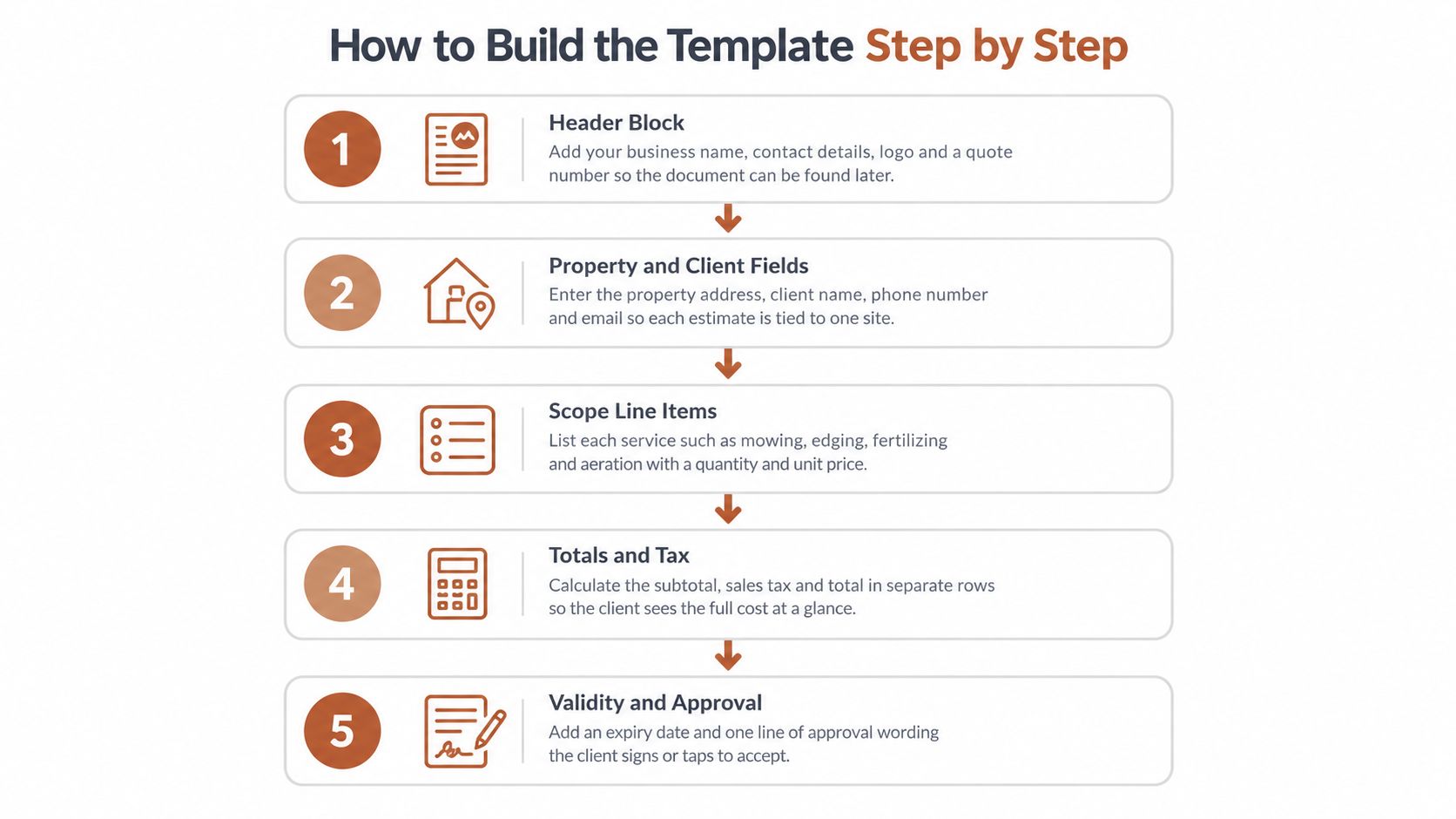
Create the header block. Add your business name, phone number, email, logo, and a quote number. A quote number makes the document easier to find when a customer calls about it later.
Add client and property fields. Enter the client's name and contact details, service address, measured turf area, and access notes. Include the gate location or code only in a way that's appropriate for sharing and storing.
Group services by type. Put recurring maintenance in one block, optional add-ons in another, and one-time work in a third. This makes it clear that a seasonal mowing price doesn't automatically include aeration, a cleanup, or an irrigation repair.
Give every line a quantity, unit, and unit price. Use a formula for each amount, such as quantity multiplied by unit price, instead of typing line totals manually. Formulas reduce arithmetic slips when the customer changes the quantity or declines an add-on.
Show the full cost at the bottom. List the subtotal, tax, deposit, and total as separate rows. Calculate the deposit from the amount your terms specify, and label whether tax is included in or added to the quoted total.
Write three short terms. State how long the quote is valid, require written approval before extra work starts, and explain what happens when weather or blocked access prevents a visit. Plain wording is easier to understand than a dense paragraph of contract language.
Add approval wording and protect the master. Give the customer a signature line or an online approval option, save a blank master, and duplicate it for every new client. Before sending, check that you've replaced the old address, square footage, and exclusions.
Fill the master with a typical job, then read the estimate aloud as if you were the customer. If a line sounds unclear when spoken, rewrite it before the client has to ask what it means.
Keep the working template in a spreadsheet or quoting tool so calculations stay editable, then offer a clean PDF copy for a customer who wants a file to save. A blank version in both formats gives you a practical starting point without requiring you to rebuild the layout for every quote.
A Sample Estimate With Line Items and Totals
A measured 5,000-square-foot lawn with biweekly mowing from April through October runs about 14 visits in this sample. Mowing and edging stay separate, travel stays visible, and optional work sits on its own lines so a client can compare scope line for line and see which items would carry into the invoice later.
Treat these prices as reference points, then build your own from measured quantities, labor time, equipment, materials, travel, overhead, and profit. The NALP's maintenance cost estimating study guide gives a mowing example of 0.00013 labor-hours per square foot before adjustments and recommends checking production assumptions against completed jobs. For a second view of how upkeep charges can be packaged, compare scope and rate structure with garden upkeep costs from Premier Gardens while still pricing your own visits from your own conditions.
| Line item | Quantity | Unit price | Amount |
|---|---|---|---|
| Mowing, trimming and blowing | 14 visits | $55 per visit | $770 |
| Bed edging | 14 visits | $12 per visit | $168 |
| Travel and fuel | 14 visits | $3 per visit | $42 |
| Hedge trimming (add-on) | 1.5 hours | $60 per hour | $90 |
| Weed control treatment (add-on) | 1 application | $95 per application | $95 |
| Fall leaf cleanup (one-time) | 1 job | $140 per job | $140 |
| Green waste haul-away | 1 load | $35 per load | $35 |
| Subtotal before tax | $1,340 | ||
| Sales tax | 8% example rate | $1,340 × 8% | $107.20 |
| Total with example tax | $1,447.20 | ||
| Deposit due on approval (20%) | 20% of subtotal | 20% | $268 |
The subtotal before tax reaches $1,340. At an 8% example rate, tax adds $107.20 and the quoted total becomes $1,447.20; the 20% deposit is $268 because it is calculated from the subtotal in this example. Keep the tax line separate and label the rate as an example when the actual rate depends on service location or billing rules.
Before using a unit price on a real property, compare recorded time and conditions across similar completed jobs. Use the median or a trimmed average rather than the fastest visit, which may not reflect ordinary access, trimming, or cleanup. For work beyond routine mowing, a consistent landscaping service list helps decide what belongs in base scope and what stays optional, so the estimate, approval, and invoice all speak the same language.
Setting Deposits, Payment Terms and Approval Wording
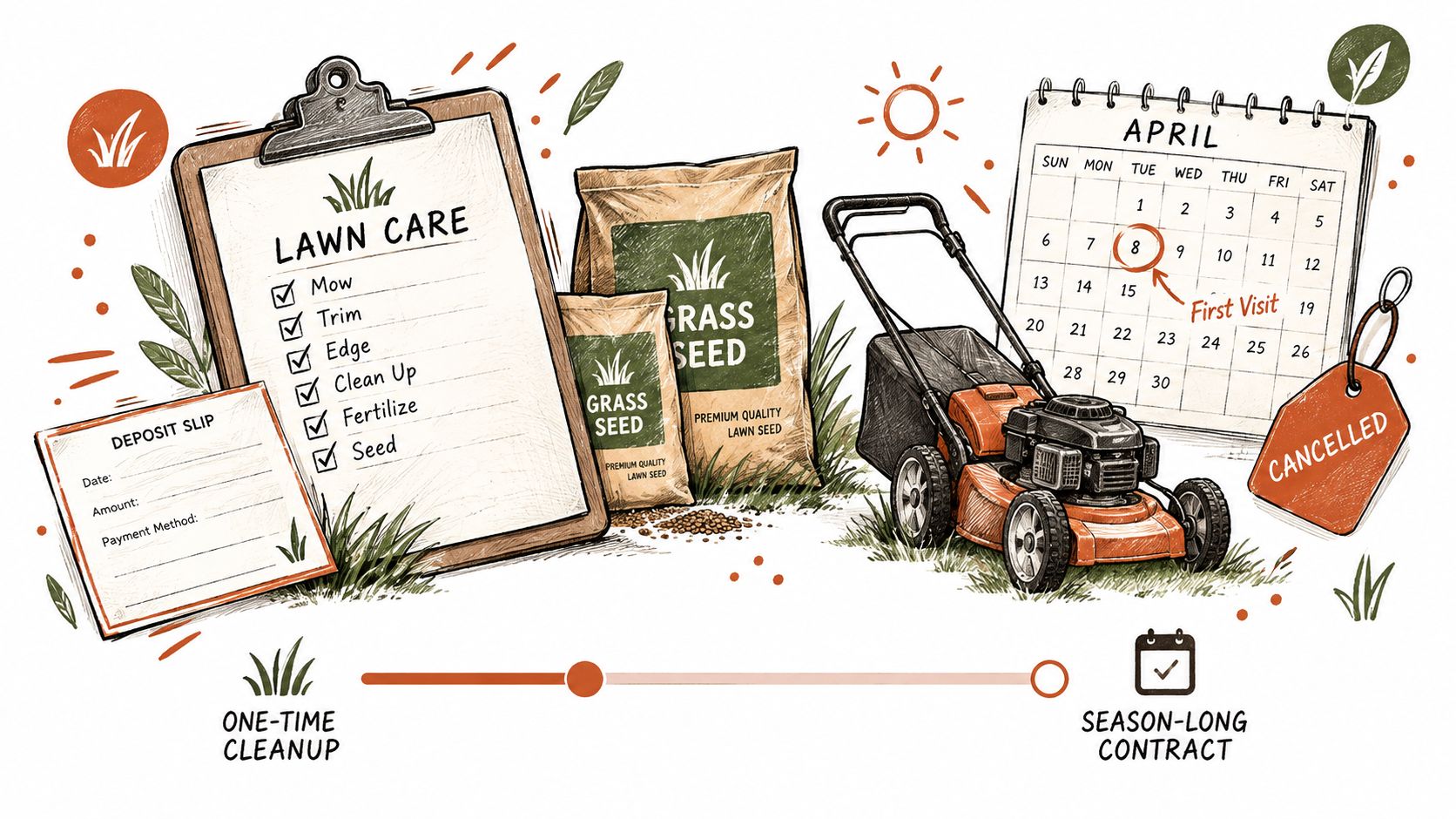
A deposit protects the time and costs you commit before a job begins. You may need to reserve a place in the schedule, buy materials, or turn down other work. The right amount depends on the job: a recurring mowing agreement has a different risk profile from a large installation, so use the table as a starting point and set terms you can explain and enforce.
| Job type | Deposit | Payment due | Approval rule |
|---|---|---|---|
| Season-long mowing contract | First month prepaid or first visit paid | Monthly invoice, due in 7 days | Signed once; scope changes need written approval |
| One-time cleanup or leaf removal | 25% to 50% | Balance due on completion | Approved before the job is scheduled |
| Seasonal treatment (aeration, fertilizer, weed control) | 50% | Due before each visit | Approved per product and per visit |
| Large project (bed installation, sod, renovation) | 30% to 50% with milestones | Milestone payments tied to stages | Signed; change orders priced separately |
Use wording a client can understand on a phone. For example: “I approve the listed services and total shown in this estimate. Any work outside this scope must be priced and approved in writing before it starts.” That sentence ties approval to both the scope and the price, while making the change-order rule explicit.
Add a clear due date instead of “upon receipt,” and state what happens if the client cancels close to the scheduled start. If you keep a deposit when a customer cancels within a defined window, say so plainly and apply the term consistently. Your payment terms should also explain the regular billing cycle: “Recurring visits are invoiced monthly. Visits missed because of weather or blocked access will be rescheduled, not refunded.” For help checking how your broader contract terms fit together, see this guide to estimate terms and conditions.
Late fees don't belong in the template as a bluff. Include them only if you've decided how and when you'll apply them, and make sure your written terms match your actual process.
A short walkthrough can make it easier to put the terms into practice:
Sending the Estimate and Converting It to an Invoice
Send a link that opens in a phone browser, rather than relying only on a PDF attachment that a customer may overlook or struggle to approve on a small screen. Put the service, price, and proposed start date in one short sentence so the customer knows what the estimate covers before opening it.
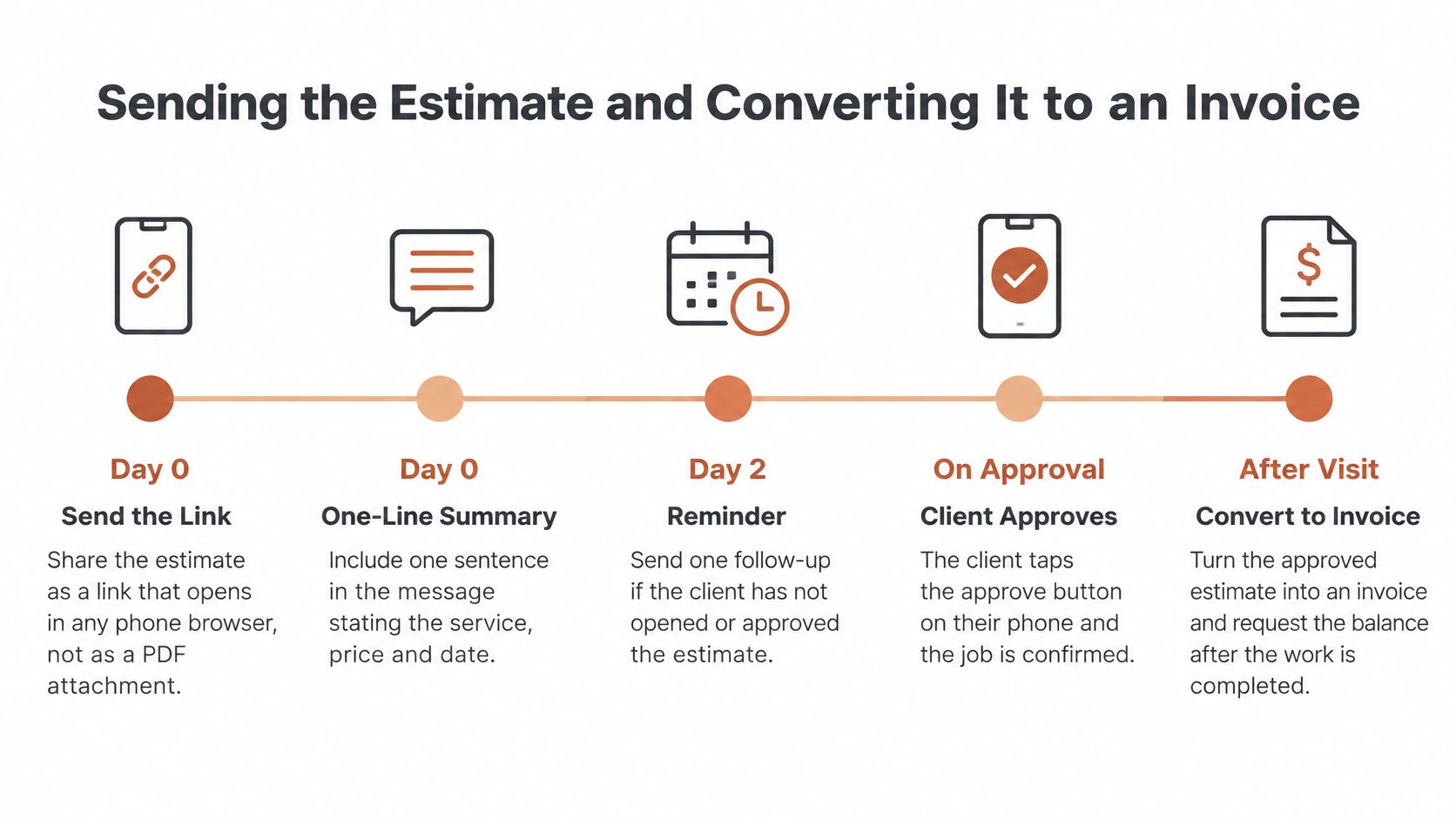
For example, send the link with a note like: “The estimate covers biweekly mowing and edging, with optional weed treatment and fall cleanup listed separately.” If the customer hasn't replied, follow up politely rather than sending a new quote with different numbers. Keep the reminder short and invite them to ask about a specific line.
When the client approves, collect any agreed deposit before scheduling the first visit. If you use a system that supports browser approval, electronic signatures, and online payments, the customer can confirm the scope and pay without printing a document. AurenWell is one option for this workflow, with estimates that can convert into invoices while carrying over their line items.
Don't retype the approved estimate into a new invoice. Carry over the accepted services and quantities, apply the deposit as a credit against the final balance, then schedule the work from the approved record. That gives you one consistent version of the scope if the customer later asks what was included.
For a paper-conscious customer, keep a PDF export available. After the work, invoice from the approved items and note any customer-approved changes separately. If you want to see how those line items can continue into billing, review this guide to a lawn care invoice.
Estimate Mistakes That Cause Disputes and How to Test the Template
A low price doesn't automatically make an estimate comparable or complete. Consumer Checkbook found that providers may recommend different combinations of lawn treatments, making quotes difficult to compare unless the customer specifies expectations such as weed tolerance, grass type, and acceptable fertilizer or pesticide use; its lawn care service selection guidance also advises asking which costly treatments are excluded and what they'll cost later.
Common estimating mistakes are easier to prevent when each one has a matching fix:
- Quoting by square footage alone can leave drive time, edging, disposal, and difficult access out of the price; give travel and haul-away their own line items.
- Submitting unlike scopes makes competing quotes difficult to compare; state the grass type, weed tolerance, and product restrictions near the top of the estimate.
- Leaving exclusions unstated can lead to arguments over whether extra work was included; name excluded services and provide unit prices for likely future work, such as aeration or emergency visits.
- Ignoring weather and water restrictions can turn a rescheduled visit into a billing dispute; define the rescheduling trigger, whether rain extends the service period, and the price of an alternative such as hand watering.
- Starting extras on a verbal request leaves you without an agreed price; require written approval before additional work begins.
- Reusing last season's rates without checking them can make a once-profitable job unprofitable; review unit prices against tracked hours and current job costs before sending seasonal quotes.
Weather deserves specific language, not a vague promise to “reschedule as needed.” Say what happens when rain makes mowing impractical or a gate is inaccessible, and explain how you'll handle a visit that can't be completed. If a local water-use rule changes the work, get approval for the adjusted service before charging for it.
Test the template on real quotes
Use the template on your next three quotes and note which line items each customer accepts, declines, or questions. Questions often reveal unclear wording, while repeated requests to remove the same add-on may indicate that it should remain optional rather than bundled into the base price.
After about ten jobs, compare your estimated hours with the time you spent on site. If edging consistently takes longer than expected, adjust that line's production assumption instead of raising every price in the quote. Keep one master copy with your current rates and the date you last reviewed them.
This week, send one estimate using the sample line-item structure, then compare it with the finished job and update the line that proved inaccurate.