
The phone's ringing, the mower's fueled, and a homeowner wants you to start “today before the price goes up.” That's when a lot of solo operators make the same mistake, they shake on a deal, cut the first lawn, and hope the rest sorts itself out. A lawn care agreement turns that rushed conversation into a working system, so you're not guessing about property access, service frequency, weather delays, or when you get paid.
For a solo route, that matters more than many realize. In the U.S., the landscaping services industry was estimated at $176.7 billion in 2026, with 556,000 businesses operating in the sector, and the broader U.S. lawn care market was projected at $62.91 billion in 2026, rising to $79.68 billion by 2031 at a 4.85% CAGR (market context and recurring revenue). That scale is exactly why recurring maintenance needs to be treated like a revenue engine, not a casual favor.
Why Every Solo Lawn Care Provider Needs an Agreement
A handshake gets the customer on the calendar. It doesn't tell you whether the backyard gate will be open, whether the dog has to be moved, or whether that “quick trim” includes hauling away a pile of limbs. When the spring rush hits, those gaps turn into unpaid labor fast.
A written lawn care agreement gives you a source of truth before the first cut. It should identify the parties, the property, the service term, the recurring schedule, the price, and the rules for weather, access, and changes. That's not legal clutter. It's how you stop memory from becoming the contract six months later.
What the agreement does on the route
The best agreements work like an operating manual for each account. They confirm what you'll do, what the customer has to provide, and how both sides handle exceptions. That matters when a gate is locked, the turf is too tall for the original quote, or payment arrives late and the customer insists the extra cleanup “should've been included.”
Practical rule: if a clause affects your time, your fuel, or your risk, it belongs in writing before service starts.
A solo operator doesn't have room for one bad assumption to eat half a day. A missed visit, an unapproved cleanup, or a damage claim can wipe out the profit on several stops. A signed agreement also helps set expectations before the first invoice, which makes collections and renewals less awkward later.
Keep it plain. You don't need statute-style language to be effective. You need dated signatures, a service address, a pricing schedule, and enough detail that both sides can see what's included and what isn't.
Core Clauses Every Lawn Care Agreement Must Include
A usable agreement starts with identity and authority. Put the legal names, mailing addresses, and service address in the header, then state that the customer is authorized to contract for the property. If you're dealing with a landlord, property manager, or HOA, that authority line matters more than many realize.
Scope, term, and renewal
The scope clause should remove fuzzy promises like “keep the yard nice.” List the actual tasks, such as mowing, edging, trimming, blowing, and scheduled cleanup, and include any exclusions. If you only service certain areas, say so. If you mow at a specific height or on a specific frequency, write that down.
The term should also be clear. For many solo routes, a month-to-month or seasonal arrangement is safer than a long lock-in, but either way the agreement needs a clean end point. Define how either party cancels, what notice is required, and when notice takes effect. If you want auto-renewal, it has to be explicit, or customers can roll into another term without understanding it.
Pricing and change orders
Keep pricing in a separate schedule so you can update add-ons without rewriting the whole contract. That schedule should cover routine service and extras, plus a written change-order rule for work outside scope. If you show up to an overgrown property that now needs a heavy first cut, that's not the same job as weekly maintenance.
The most useful clause I've used is the one that says extra work needs written approval before it starts. That covers brush removal, debris hauling, reseeding, disease control, and any cleanup that wasn't part of the original route plan. It also protects you from the customer who says, after the fact, that the extra work was “obvious.”
Don't rely on memory for gate codes, parking instructions, or pet notes. Attach them to the signed agreement or save them as an exhibit.
If you want a practical framework for drafting this section, the contractor guidance at scope, payment terms, and liability clauses lines up with what prevents disputes in the field. For a cleaner document flow, the AurenWell contracts feature is one option that keeps the signed agreement and record together.
Pricing, Deposits, and Payment Terms That Actually Get Paid
Price the route first, then write the payment terms to support that cash flow. If you bill after every mow but still pay for fuel, labor, and disposal up front, you're financing the customer's lawn with your own operating money. That works for a while, until the route gets larger and the float starts hurting.
Match the billing cycle to the work
Routine mowing and one-time cleanups shouldn't be priced the same way. Weekly or recurring service can be billed per visit or monthly. Cleanup work, bagging, leaf removal, hedge work, and hauling are better handled as separate line items or job-based pricing, because the labor swings more than the mow does.
A deposit makes sense when the job has real upfront cost. For material-heavy or install-heavy work, or for a new seasonal account that requires you to reserve a route day, collect part of the job before you commit the schedule. If the job needs rented equipment, third-party disposal, or a dedicated labor block, the deposit protects you from being stuck with unrecoverable cost if the customer backs out.
Late fees and due dates need to be readable
The terms should say whether invoices are due on completion, net-15, or net-30. Net-15 means payment is due 15 calendar days after the invoice date. Net-30 gives the customer 30 days. For ongoing service, benchmark examples in industry guidance include monthly invoicing with invoices due upon receipt or net-30, and another common example is a 5% late fee after 30 days (payment term benchmarks).
The math on a late fee should be easy enough to explain on the phone. On a $200 balance, a 5% late fee is $10. That only works if the signed agreement says so and local rules allow it. You should also list accepted payment methods, card processing charges if you pass them through, returned-payment fees, and the exact point at which service stops for nonpayment.
| Term | Benchmark Example | Practical Effect |
|---|---|---|
| Billing cycle | Weekly, monthly, or per visit | Matches cash flow to route structure |
| Deposit | Upfront payment for cost-heavy jobs | Reduces exposure on reserved labor and materials |
| Due date | Net-15, net-30, or due on completion | Removes confusion about when the clock starts |
| Late fee | 5% after 30 days | Gives the invoice a real consequence |
| Payment methods | Card, ACH, check, or cash | Makes checkout easier and cuts excuses |
For contractors deciding how much to ask up front, the deposit guidance at how much deposit contractors should ask for is worth comparing against your own route math.
Liability, Insurance, Cancellations, and Weather Policies
A lawn care agreement should say who carries the risk when ordinary work bumps into property reality. That means addressing rock strikes, broken irrigation heads, fence issues, and anything that was already there when you arrived. If you can, document the condition on arrival with notes or photos, especially around fragile areas like windows, sprinklers, and cracked fence sections.
Insurance and damage language
If you work as a 1099 operator or a small subcontractor, the question of general liability isn't theoretical. A practical primer on general liability for 1099 workers helps frame why the policy language matters before you sign. In the contract, state your coverage and keep the wording tied to your own negligence, not the customer's.
You can also ask for proof of homeowners insurance on higher-value properties or where the grounds are expensive to repair. That doesn't make the customer responsible for everything, but it does make the coverage conversation explicit instead of reactive.
Cancellations, weather, and satisfaction
Build a cancellation window that protects the route. A 24-hour notice rule is simple and fair, and a flat cancellation fee equal to one mow is easier to enforce than a vague apology policy. You can also set a separate no-call-no-show charge when the crew shows up and can't access the site.
Weather rules need a trigger. Rain delays should move service to the next business day without penalty. Lightning should stop work immediately. If drought or local restrictions make non-essential service unsafe or pointless, the agreement should allow suspension until conditions change.
A satisfaction clause works best when it's narrow. One free re-cut within 48 hours usually solves more problems than an open-ended promise. Anything broader can turn into free extra work on every route.
| Risk Area | Standard Clause | Operator Default |
|---|---|---|
| Property damage | Limit responsibility to proven operator negligence | Document arrival conditions and hazards |
| Cancellation | 24-hour notice window | Charge one mow for late cancels |
| No-show access | Fee if the crew can't get in | Leave and invoice the missed slot |
| Weather delay | Move to next business day | Pause without penalty |
| Satisfaction | One free re-cut within 48 hours | Close the issue fast and move on |
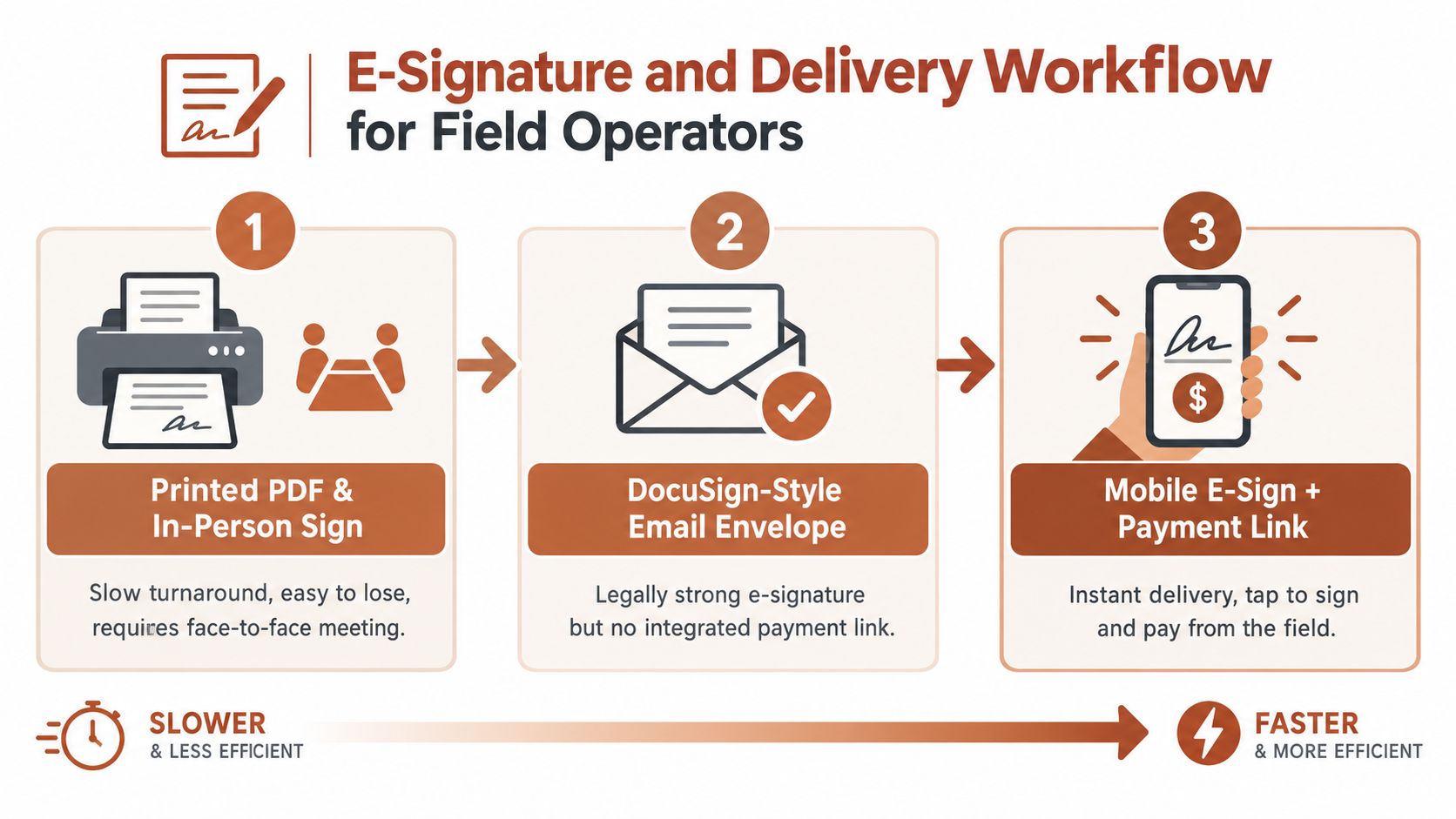
E-Signature and Delivery Workflow for Field Operators
Paper still works, but it's slow and easy to lose in a truck cab. A printed PDF emailed and signed in person can get buried under old estimates, while a DocuSign-style envelope is legally strong but doesn't always tie cleanly to payment. A browser-based e-sign flow with an integrated deposit is usually the fastest path from quote to paid job.
The practical difference is the handoff. If you quote from the truck, send the agreement link by text or email, collect the signature, and charge the first month or deposit right there, you don't have to chase the customer later. That's why tools such as streamline landscaping contracts online are worth looking at if you want the signature and payment step in the same flow.
The field workflow that saves time
- Knock, measure, and inspect the property.
- Quote on a tablet or phone.
- Send the agreement by text or email.
- Collect the e-signature and payment method.
- Save the signed copy to the client record.
- Leave with the route and access notes already stored.
That workflow works because the document version, timestamp, and signer identity are captured at the moment of signing. You're not later trying to prove which PDF the customer agreed to, or whether they got the version with the deposit clause.
Field rule: don't drive away until the signed PDF is in your inbox, the deposit cleared, and the gate code is saved.
For a cleaner document handoff, the AurenWell feature set for contracts is another field-friendly option that keeps signed agreements tied to the client record.
Ready-to-Use Lawn Care Agreement Template and Sample
A good template doesn't need fancy language. It needs blanks that a solo operator can fill in fast, without forgetting the parts that later create disputes. If you want a fuller starting point, the AurenWell template library can help you structure the document before you customize it for your route.
Fill in the blanks
Lawn Care Agreement
Provider: [Your Legal Business Name]
Customer: [Customer Legal Name]
Service Address: [Property Address]
Start Date: [Date]
Scope of Services:
Provider will perform the following services at the service address: mowing, edging, trimming, and blowing. Add-ons may include spring cleanup, hedge trimming, mulching, or other approved work only if listed in writing.
Term:
This agreement will run on a [week-to-week, seasonal, or annual] basis until ended by written notice according to the cancellation clause.
Pricing:
Routine service rate: [Amount] per visit or [Amount] per month.
Approved add-on work: priced by written estimate or attached rate schedule.
Deposit required: [Amount or percentage] for work requiring materials, disposal, or reserved labor.
Payment Terms:
Invoices are due [upon completion, net-15, or net-30]. Accepted payment methods include [card, ACH, check, cash]. Late payments may incur a fee of [Amount or percentage] after [Number] days. Nonpayment may result in service suspension.
Scheduling and Access:
Service is expected on [day or route window]. Customer will provide safe access, water if needed, and notice of pets, locked gates, sprinklers, or restricted areas.
Cancellation and Weather:
Either party may cancel with [Number] days' written notice. Rain delays move service to the next reasonable business day. Unsafe weather conditions suspend work until conditions improve.
Liability and Insurance:
Provider will be responsible only for damage caused by proven negligence. Customer confirms the provider's right to work at the property and acknowledges that normal wear, pre-existing issues, and weather-related limitations are not covered.
Signature:
Provider signature, date, printed name
Customer signature, date, printed name
Worked sample for a residential route
Provider: Green Line Lawn Service
Customer: Jordan Ellis
Service Address: 412 Maple Street
Start Date: April 1
Scope of Services: weekly mow, edge, trim, and blow. Spring cleanup only if approved in writing.
Term: annual.
Pricing: $55 per weekly mow. Spring cleanup $180 by separate approval.
Deposit: $100 applied to the first invoice.
Payment Terms: net-15 invoicing.
Scheduling and Access: Tuesday service window. Gate code and sprinkler notes listed in the property file.
That version works because each blank answers a real field question. You can swap the numbers and access notes for a commercial lot, but the structure stays the same.
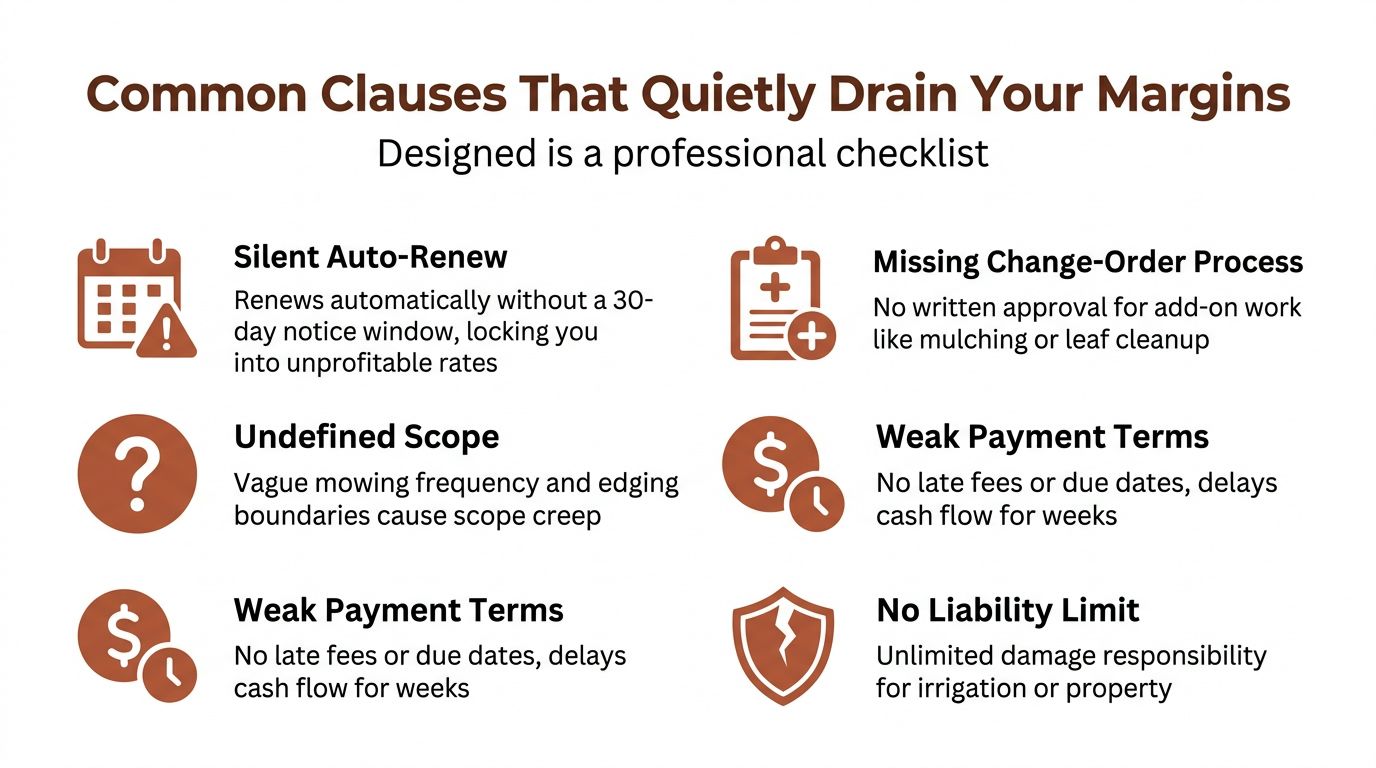
Common Clauses That Quietly Drain Your Margins
The clauses that hurt solo operators rarely look dramatic. They look harmless on the page, then eat the route one unpaid favor at a time. Silent auto-renew is one of the worst offenders, because it can lock you into old pricing without a clear notice window to exit or reprice.
Another leak is the missing change-order process. If a single unpriced spring cleanup lands on a 15-lawn route, the labor can become a hidden bill you never send. That's not a legal problem first, it's a cash problem first.
The traps to catch before signing
- Silent auto-renew: Fix it with an opt-out renewal and a written notice period.
- No change-order step: Require signed approval for anything outside scope.
- Undefined weather day: Use a measurable rain trigger, ground saturation, or a clear reschedule window.
- Unlimited free recuts: Limit satisfaction rework to one visit within a short window.
- Blanket indemnification: Tie responsibility to the operator's negligence, not the homeowner's mistakes.
- Waiver of lien rights: Review carefully before giving up collection rights.
One storm week without a weather clause can force a free reschedule cycle, and that burns fuel, time, and patience even if nobody did anything wrong. A contract that clearly defines the trigger is cheaper than improvising under pressure.
5-minute pre-sign audit: check renewal notice, change-order language, weather trigger, recut limit, liability wording, and payment terms before you hand over the pen.
A strong lawn care agreement doesn't just protect you in a dispute, it keeps the route predictable enough to grow. If you're still working from a handshake, pull your current contract tonight, strip out the vague parts, and rewrite the scope, pricing, weather, and payment clauses before the next customer calls.