
You've just finished a long install, the client is pleased, and then comes the message: “Could you also trim the hedge, haul away the extra soil, and fix that irrigation head while you're here?” A week later, you're still waiting for payment because the client believed those tasks were included.
That's where a landscaping service agreement earns its place. It turns a verbal understanding into a working record of the property, the service schedule, the price, the approval process, and the evidence that the work was completed. For a solo operator, the agreement isn't paperwork for its own sake. It protects the hours you can't recover and the income you need to keep the business moving.
Why Every Solo Landscaper Needs a Service Agreement
A one-person landscaping business has a familiar split personality. During the day, you're mowing, pruning, planting, loading equipment, and answering questions at the gate. At night, you're trying to remember which customer requested extra edging, whether the spring cleanup included hauling, and when the invoice became overdue.
The most expensive problems often start with a small assumption. A client sees you pruning one shrub and assumes all shrubs are included. You see a weather delay as unavoidable, while the client sees a missed appointment. You complete additional work because the customer asks in person, then discover that nobody agrees on the price.
The industry itself is formally defined, not an informal side niche. The NAICS classification for landscaping services covers grounds care and maintenance, planting, and related design or construction work, including features such as walkways, retaining walls, decks, fences, and ponds. That range makes a generic "landscaping" description particularly risky because two people can use the term to mean entirely different work.

The agreement protects the job, not just the invoice
A useful agreement answers practical questions before they become arguments:
- What property is covered: Include the service address, relevant access points, and any areas excluded from the work.
- What happens on each visit: Name tasks such as mowing, edging, pruning, fertilization, irrigation checks, or seasonal cleanup.
- What isn't included: State that tree removal, soil remediation, hauling, irrigation repair, chemical applications, or extra planting require separate approval when applicable.
- What counts as completion: Use observable standards, such as specified beds cleaned, clippings removed from hard surfaces, or approved plantings installed in the listed areas.
- Who carries each responsibility: Address gates, pets, underground utilities, irrigation systems, pre-existing damage, and access.
A contract also helps you separate routine maintenance from project work. A recurring visit might have a predictable scope and rate, while an installation may depend on materials, site conditions, and milestones. Treating both with the same vague template usually creates confusion.
The same principle applies whether you're a solo provider or bidding for a larger property. Government buyers use landscaping agreements for continuing grounds-maintenance obligations, measurable deliverables, and documented payment terms, as summarized in landscaping contract opportunity data. Your residential agreement doesn't need the length of a public tender, but it should borrow the discipline: define the site, deliverables, schedule, approvals, and payment record.
For broader operational planning, a guide to full-service landscaping in Atlanta can also help you compare how providers separate recurring care from enhancements and larger site work. The commercial lesson is simple: write down what the customer is buying before the truck arrives.
A mobile workflow makes that consistency easier. Instead of recreating a document for every customer, use a service-business process that connects the estimate, agreement, signature, invoice, and payment record. A practical overview of software for lawn care business can help you evaluate which administrative tasks should happen from the phone rather than after a full day in the field.
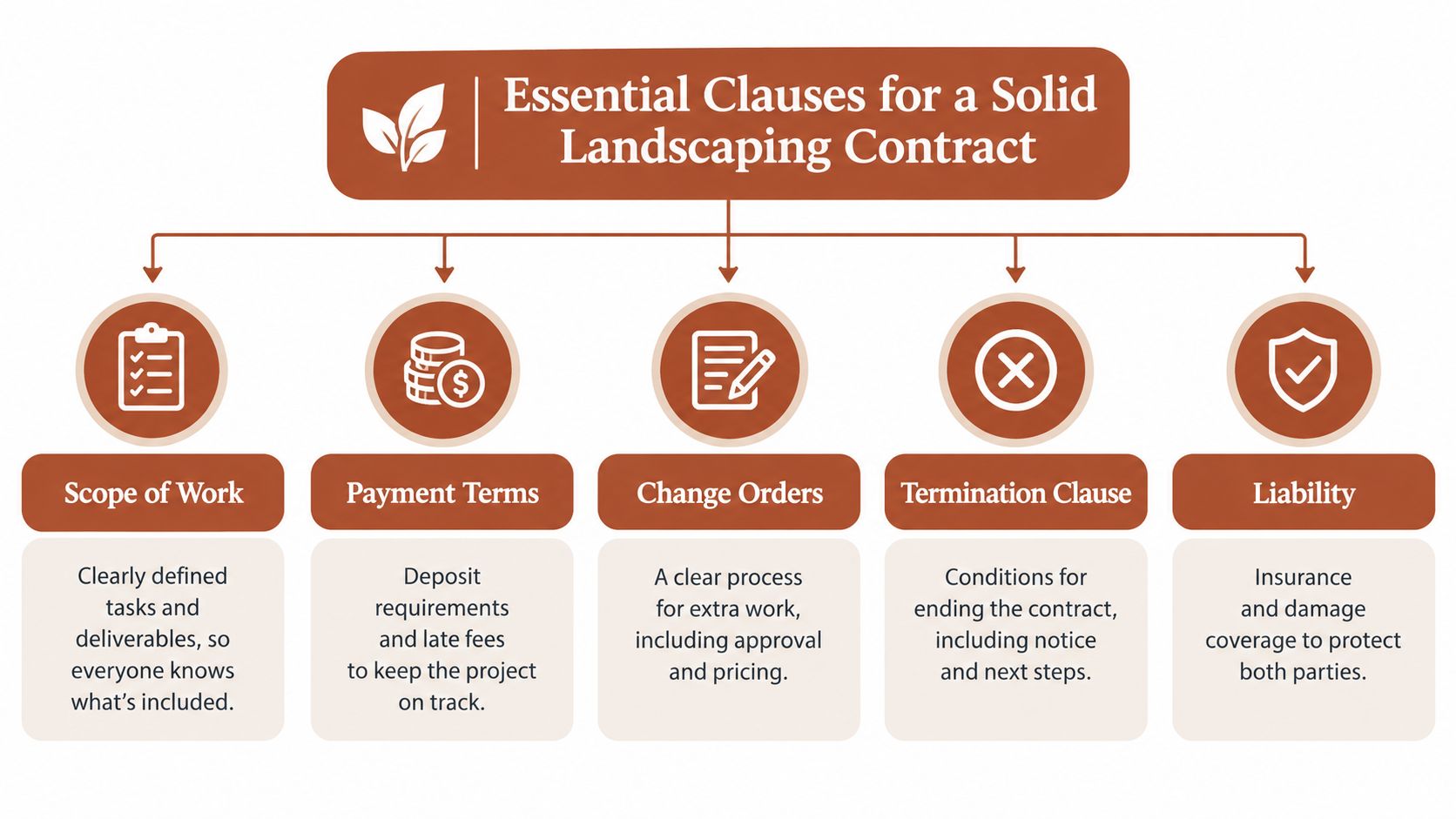
Essential Clauses for a Solid Landscaping Contract
A strong landscaping service agreement isn't the longest document you can produce. It's the one that makes the job understandable to someone who wasn't standing beside you when you priced it.
Start with the parties and the property. Use the legal or business name of the provider, the customer's name, contact details, billing address, and the exact service address. If the client owns several properties, list each one separately rather than assuming one agreement covers all locations.
Build the scope around the actual property
Attach a site-specific proposal instead of relying on a paragraph that says “grounds maintenance.” A useful scope identifies:
- Tasks: Mowing, edging, blowing, pruning, mulching, fertilization, irrigation checks, cleanup, planting, or installation.
- Frequency: The expected visit pattern or project milestones.
- Materials: Product categories, quantities where practical, who supplies them, and how unavailable materials may be substituted.
- Equipment and access: Gates, water access, parking, delivery areas, or equipment requirements.
- Exclusions: Work that needs a separate estimate or written approval.
- Completion standard: What you and the customer will use to judge whether the agreed work is complete.
For recurring maintenance, define what happens when growth, weather, or site conditions make the normal visit impractical. For an installation, describe the finished result and the conditions that may change the schedule, such as poor soil, hidden utilities, irrigation problems, or plant availability.
Make payment events match the work
State the price, invoice timing, due date, accepted payment methods, deposits, late charges, and the circumstances under which service may be suspended. Don't bury those details at the end of a long document. A customer should be able to find the financial terms quickly.
The agreement should distinguish a recurring maintenance rate from unit pricing or time-and-materials work. If hauling, additional soil, disposal, or repairs are priced separately, say how those charges will be calculated and when approval is required.
Put change orders in writing
Your change-order clause should say that work outside the approved scope requires written authorization before it begins. The authorization should identify the added task, revised price, schedule effect, and approval record.
A short clause can be plain:
Additional work: The provider won't begin work outside the attached scope until the customer approves a written change order stating the added work, price, and expected schedule.
That sentence won't solve every dispute, but it gives you a repeatable decision point. If a customer asks for extra pruning while you're on site, send the change order from your phone before you pick up the saw.
Allocate risk without hiding behind boilerplate
Address weather delays, access, pets, underground utilities, irrigation systems, pre-existing damage, plant mortality, debris disposal, and customer-supplied materials. Explain what you'll do when one of those conditions affects the work.
Chemical applications need special care. If fertilizer, herbicide, or pesticide work is included, record the product category, application area, customer notice, re-entry instructions, weather or wind restrictions, and who supplies the product. Licensing and application requirements vary by jurisdiction, so verify the rules for the exact work and location rather than copying a clause from another operator's template.
Your agreement should also record insurance details and applicable credentials. Public-sector contracts commonly request $1 million per occurrence and $2 million aggregate general liability coverage, but the requirement depends on the client and jurisdiction, as explained in this landscaping service agreement guidance. Don't promise coverage you don't carry.
Finally, include termination, warranty, governing-law, and dispute provisions suited to your location. Review local requirements with a qualified attorney. You can also browse our terms and policies to see how clearly written business terms separate responsibilities, permissions, and limitations. The document should be readable enough that your customer understands it before signing.
Managing Change Orders and Payment Workflows
A customer asks for extra pruning while you are already on site. If that request stays in a text thread or in your memory, it can disappear before billing. Field work creates a stream of small decisions, so each decision needs a clear place in the job record.
Use a repeatable sequence:
- Identify the request: Record the additional mowing, pruning, hauling, repair, planting, or cleanup the customer wants. Note the affected area and any materials involved.
- Price the change: State a fixed amount, unit price, or time-and-materials basis. Avoid starting work while the price remains open.
- Explain the schedule effect: Note whether the change adds time, requires a return visit, or depends on material availability.
- Collect approval: Obtain a written signature, approval click, text confirmation, or another durable record before starting.
- Link it to billing: Add the approved change order to the related invoice and keep both documents with the same job record.
A verbal “go ahead” feels efficient when you are holding a trimmer. It becomes weak evidence when the customer receives a larger invoice. The municipal landscape contract shows the control that matters: unspecified work or cost-creating deviations require owner authorization and a corresponding change order before they become billable.
Bill maintenance differently from installation
Recurring maintenance and installation create different cash-flow patterns. For maintenance, choose a consistent billing event, such as issuing an invoice immediately after service or charging monthly against the agreed schedule. For installation, connect deposits and progress payments to observable milestones, including approved preparation, material delivery, installation, and completion.
A 2025 industry report from the green-care sector found that 72% of landscapers use invoicing software and 71% receive payment within invoice terms. It also reported that 15% of clients pay within one week of the due date, while 7% pay two to three weeks late. These figures appear in the 2025 Landscape Industry Report. A due date helps, but your follow-up process determines whether payment arrives.
Set that process up while the agreement is created. On a phone, record the approved change, update the invoice, and set the reminder before leaving the property. A short payment trail is easier to maintain than reconstructing several weeks of visits later.
Your agreement should state what happens when weather delays a visit. Decide whether the service moves to the next available route, whether the scope changes, and how the invoice reflects the completed work. Do not invoice as though a visit happened when it did not, but do not leave recurring schedules undefined.
If a customer disputes one visit, require prompt written notice identifying the disputed work. Keep undisputed amounts payable while you investigate, and state whether service pauses during an unresolved balance. A polite automated reminder often works better than an aggressive late-fee clause because it makes payment easier.
For amendments, use a consistent record instead of editing the original agreement informally. An amendment to agreement template can help preserve the original scope while recording the new terms, approval, and effective date.
Implementing E-Signatures and Digital Storage
A customer can approve the work while you are still at the property. Paper contracts often interrupt that moment with printing, scanning, and follow-up for a returned copy. A mobile process keeps the agreement moving from accepted estimate to scheduled job.
Before sending the document, verify the property address, approved scope, price, exclusions, payment terms, and start date. Use one controlled agreement rather than several loose attachments. A single file makes it easier to confirm what the customer reviewed and what you will use for billing.

Use a repeatable signing sequence
A field-ready workflow can follow these steps:
- Prepare: Convert the approved estimate into the agreement, attach the property-specific scope, and verify the customer's email address or phone number.
- Send: Provide a secure signing link while the property details and expectations are still clear.
- Review: Give the customer time to read the scope, exclusions, price, and cancellation terms.
- Sign: Capture both signatures through the same process.
- Confirm: Send the completed PDF and record the signature date, document version, and any deposit.
- Schedule: Add the customer to your route only after the agreement reaches the required status.
A signature image alone does not give you a useful record. The audit trail should identify the document that was signed, the time approval occurred, and whether the signed version matches the scope used for invoicing. If the customer requests a change, preserve the signed agreement. Issue an amendment or change order instead of editing the original.
A platform such as AurenWell provides contracts for mobile signing, retains signed documents and signature audit trails with the client record, and connects agreements with estimates, invoices, and online payments. Other tools can work as well. Choose a process you will use from the field, rather than paying for features that stay unused.
Store records so you can find them
Cloud storage only helps when the filing method stays consistent. Use the client record as the main location and apply a predictable naming format:
Client name | Property address | Agreement type | Effective date
Keep the signed agreement, approved scope, change orders, completion photos, invoices, payment receipts, and relevant messages together. Store drafts separately from signed documents so an outdated version does not reach the customer or crew.
A maintenance agreement may produce many service records, while the contract should point to one approved scope version. Installation work usually creates more change orders and photographs, so file each approval in chronological order. Export documents periodically as PDFs and keep a backup outside the primary application.
When a customer asks what the agreement included, open the record from your phone and answer without searching through text messages. That response time protects the customer relationship and gives you a clear record for handling disagreements.
Use the following walkthrough to see how a digital contract workflow can fit into a broader service-business process:
Best Practices for Ongoing Agreement Management
A landscaping service agreement should improve as your work teaches you where customers and operators misunderstand each other. Review the template when a dispute, unpaid add-on, weather delay, damaged plant, or access problem exposes a gap.
Keep separate versions for different work. A seasonal maintenance agreement needs visit frequency, weather treatment, renewal, and routine exclusions. An installation agreement needs materials, milestones, site conditions, substitutions, completion standards, and payment stages. A commercial agreement may require more detailed insurance records and formal communication procedures.
Turn completed jobs into contract improvements
After each difficult job, ask three questions:
- What did the customer assume: Add a clearer exclusion or example.
- What did I fail to record: Add a field for approval, photos, access, or completion.
- What took too long to collect: Move the invoice event, deposit, or payment link earlier.
Share the important terms before the customer signs. Explain what happens during weather delays, which services cost extra, how quickly changes need approval, and when payment is due. Customers usually handle firm boundaries better when they hear them before the work starts.
Keep every signed agreement tied to the correct property and current scope. Update prices or renewal terms through a documented amendment rather than silently replacing the original. That habit gives you a clean operational history and makes the next visit easier to prepare.
Choose one current customer, write down the exact recurring scope, and convert it into a mobile landscaping service agreement today. Send it for signature before the next visit, connect the approved scope to the invoice, and store the signed record with your completion notes. For licensing, insurance, chemical applications, and local contract requirements, have a qualified professional review your final template before you use it across the business.