
You finish a clean walkthrough, send a tidy price, and hear the homeowner say, “Looks good, let's do it.” Then the weather turns, the excavation hits rock, the mulch supplier changes the price, and the client asks why disposal wasn't included. The job still has the same approved total, but your hours and costs have started moving underneath it.
That's why a landscaping estimate template must do more than display a total. It should show the scope, quantities, production assumptions, labor burden, material risk, exclusions, approval terms, and payment path in a format you can use from the truck or a phone. The U.S. landscaping-services market includes roughly 692,777 businesses, according to National Association of Landscape Professionals industry statistics, so a consistent process matters in a crowded market dominated by small operators.

A good estimate is a control panel, not bureaucratic paperwork. It lets you see whether a planting bed is profitable before you commit, and it gives the customer a readable record of what they approved. If you use site measurements or design software, resources such as landscape architecture software for site modeling can help turn a physical property into clearer quantities and scope.
This guide gives you a blank structure, a filled planting-bed example, reusable pricing formulas, and decision rules for weather, waste, labor creep, exclusions, deposits, and change orders. For terms that need to protect both sides, use a clearly written estimate terms and conditions guide as a reference.
Why Most Landscaping Estimates Leave Money on the Table
The usual failure starts with a reasonable-looking lump sum. You estimate the bed, add plants and mulch, allow some labor, and round the price into something the client can understand. The problem isn't the simple format. The problem is that the assumptions stay in your head, while the customer sees only a fixed promise.
Rain can force remobilization. Rock can turn hand excavation into equipment work. A supplier can change the cost of mulch, soil, plants, or delivery before the job starts. If your estimate doesn't show what happens under those conditions, you absorb the difference or argue about it after the work is underway.
Field rule: If a cost can change the number of hours, loads, trips, or materials, it deserves a visible field in the estimate.
A vague quote also creates approval problems. Clients often approve the headline price without noticing that irrigation repair, permits, drainage correction, stump removal, private utilities, or unsuitable soil aren't included. When the hidden condition appears, the homeowner feels surprised even if you assumed it was obvious. You feel trapped because stopping work can damage the relationship, while continuing work can damage the margin.
The estimate should work twice
Your customer-facing document needs a clear scope and a simple total. Your internal version needs quantities, production rates, crew assumptions, burdened labor, equipment, disposal, overhead, contingency, and profit. Those aren't competing documents. They can be two views of the same estimate.
The practical structure is straightforward:
- Scope: What work will be performed, where, and to what measurable standard.
- Cost drivers: Labor hours, crew size, materials, equipment, delivery, disposal, and subcontractors.
- Risk controls: Assumptions, exclusions, validity period, weather terms, substitutions, and change-order rules.
- Payment path: Deposit, milestones where appropriate, balance due, acceptance, and payment method.
Labor pressure makes this discipline more important. L.E.K. Consulting reported that landscaping employment declined by an average of 0.4% per year from 2017 through 2021 and rebounded by 2.4% in 2022, while labor costs had more recently grown faster than prices, creating margin compression, as described in its landscaping industry analysis. You don't need a complicated estimating department to respond. You need an estimate that exposes the parts of the job most likely to move.
The next sections give you the fields, formulas, sample numbers, and collection workflow you can adapt to a driveway cleanup, planting bed, retaining wall, or irrigation repair.
How to Build a Landscaping Estimate Template That Works in the Field
A client approves a planting bed quote, then asks why disposal, soil preparation, or extra trips were not included. The problem usually starts before pricing. If the estimate does not expose quantities, production assumptions, and site risks, a clean-looking total can still lose money.
Start with the property and the promise. Put your business name, contact details, estimate number, issue date, validity period, client name, service address, billing address, and preferred contact method at the top. The client should see immediately who is quoting, which property the quote covers, and when the price expires.
Build the document around measurable work
Write the scope in plain language before entering a price. “Install a new planting bed” is too broad. Specify the location, measured area or dimensions, preparation, edging, soil amendment, plant types and sizes, mulch depth, cleanup, and handling of removed material.
A defensible workflow begins with a takeoff, then applies production rates and pricing. Define measurable units, quantify plants, mulch, soil, paving, irrigation, and disposal, then calculate crew-hours as quantity multiplied by hours per unit. Apply a fully loaded crew rate, followed by equipment, delivery, subcontractors, tax, overhead recovery, contingency, and profit, as outlined in this pricing methodology for field work.
Keep the template short enough to use on a phone, but detailed enough to expose margin risks:
| Field group | Include | Field decision |
|---|---|---|
| Scope | Task, location, measurement, finish standard | State what completion means and what is outside the work |
| Materials | Description, quantity, supplier cost, waste percentage | Set the waste allowance before ordering |
| Labor | Task, crew, hours per unit, burdened rate | Price productive hours and account for payroll burden |
| Risk controls | Access, weather, disposal, exclusions, substitutions, change orders | Identify conditions that can add time or cost |
| Approval | Price, deposit, validity, acceptance wording, signature, date | Make authorization and payment responsibility visible |
Require crew-hours = quantity × hours per unit and a burdened rate on every line before adding markup.
Allocate overhead using a method you can audit, such as annual overhead divided by projected billable field-labor hours. Labor-cost creep often hides in loading, setup, cleanup, travel, mobilization, and waiting time. Material waste creates a second leak. Record expected overage and supplier pricing rather than treating either as an incidental cost.
A filled planting-bed example
Suppose the measured work includes a planting bed with 12 cubic yards of mulch, 2 cubic yards of soil amendment, 18 plants, and 40 linear feet of edging. The internal worksheet should show each quantity, unit cost, expected hours, crew size, burdened hourly rate, equipment, disposal, markup, tax, deposit, and balance.
Customer-facing lines could read:
- Bed preparation and planting: Remove existing weeds, prepare soil, install 18 specified plants, and water them in.
- Soil amendment: Deliver and incorporate 2 cubic yards.
- Mulch: Install 12 cubic yards to the stated depth.
- Edging: Install and finish 40 linear feet.
- Cleanup and disposal: Remove included green waste and job debris.
- Exclusions: Irrigation repair, rock excavation, undocumented utilities, drainage correction, and plant replacement caused by watering outside the stated responsibility.
Add estimated hours by task to the internal version. If narrow access, compacted soil, rain, or additional handling reduces production, record the cause and use the change-order process instead of absorbing the time without noting it.
For digital work, keep these fields in your field estimate system. Software can preserve assumptions, calculations, approvals, and revisions, but the site walk still determines whether the quantities and risk allowances are credible.
Pricing Methods and Sample Calculations for Common Jobs
A mulch bed can look profitable until delivery, extra handling, and slow production consume the allowance. A dry-stack stone wall carries different risks. Excavation, access, base preparation, stone handling, weather, and crew output can shift the labor requirement quickly. One pricing method rarely fits every task.
Use unit pricing when quantities and unit costs are dependable. Use crew-hour pricing when site conditions control production. Combining both often gives the clearest estimate: price measurable materials by unit, then price uncertain installation work from expected crew hours.
Sample worksheet
The figures below demonstrate the method, not market benchmarks. Replace them with supplier invoices, measured quantities, tracked production rates, and your burdened labor rate. A client-facing estimate can stay simple, while the internal worksheet should expose the assumptions that protect the margin.
| Line Item | Quantity | Unit Cost | Labor Hours | Total Cost | Markup | Total Price |
|---|---|---|---|---|---|---|
| Mulch | 12 cubic yards | $38 | 8 | $456 materials + $576 labor = $1,032 direct cost | 20% | $1,238.40 |
| Soil amendment | 2 cubic yards | $52 | 3 | $104 materials + labor | 20% | Apply the stated formula |
| Plants | 18 plants | $34 | 10 | $612 materials + labor | 25% | Apply the stated formula |
| Edging | 40 linear feet | $6 | 4 | $240 materials + labor | 20% | Apply the stated formula |
| Stone wall | 30 linear feet | $48 | 24 | $1,440 materials + labor | 25% | Apply the stated formula |
| Disposal and delivery | 1 allowance | $180 | 2 | $180 allowance + labor | 15% | Apply the stated formula |
| Equipment | 1 allowance | $160 | Not applicable | $160 | 15% | $184.00 |
The mulch line is the completed example. It uses a burdened labor rate of $72 per hour and a 20% markup. Replace $72 and 20% with your burdened rate and markup.
Direct cost = material cost + labor hours × burdened hourly rate + equipment + delivery + disposal
Sell price = (materials + labor hours × burdened rate + equipment + delivery + disposal + overhead allocation + contingency) × (1 + profit %)
Keep the formula consistent across the worksheet. If taxes, overhead allocation, or contingency are handled separately, show those fields instead of burying them in an unexplained total. The distinction between cost consumed by the job and the amount charged is covered in costing versus pricing explained.
Two ways to price the same work
For the bed, multiply each material quantity by its delivered unit cost, then add installation hours at the burdened crew rate. For the wall, crew-hour pricing may better reflect uneven access and production. Estimate 24 labor hours, multiply by the fully loaded crew rate, and add stone, base material, equipment, delivery, disposal, overhead, contingency, and profit.
With a burdened crew rate of $72 per hour, the wall labor cost in this illustration is:
24 hours × $72 = $1,728
That figure is labor cost, not the selling price. If the worksheet shows $3,900 in direct cost and the customer price is $5,200, gross profit before costs omitted from the worksheet is:
$5,200 − $3,900 = $1,300
Gross margin on the selling price is:
$1,300 ÷ $5,200 = 25%
Track markup and margin separately. Markup is applied to cost. Margin measures profit against the selling price. Confusing the two can make a quote look acceptable while leaving too little cash for overhead, callbacks, weather delays, or unpaid estimating time.
Lump-sum work needs a clear validity period and visible assumptions. Record hours, crew size, rates, access limits, disposal allowances, and weather-sensitive tasks. For a broader guide to setting charges, see how much to charge for landscaping work.
Mobile Field Use, Client Approval, and Getting Deposits Right
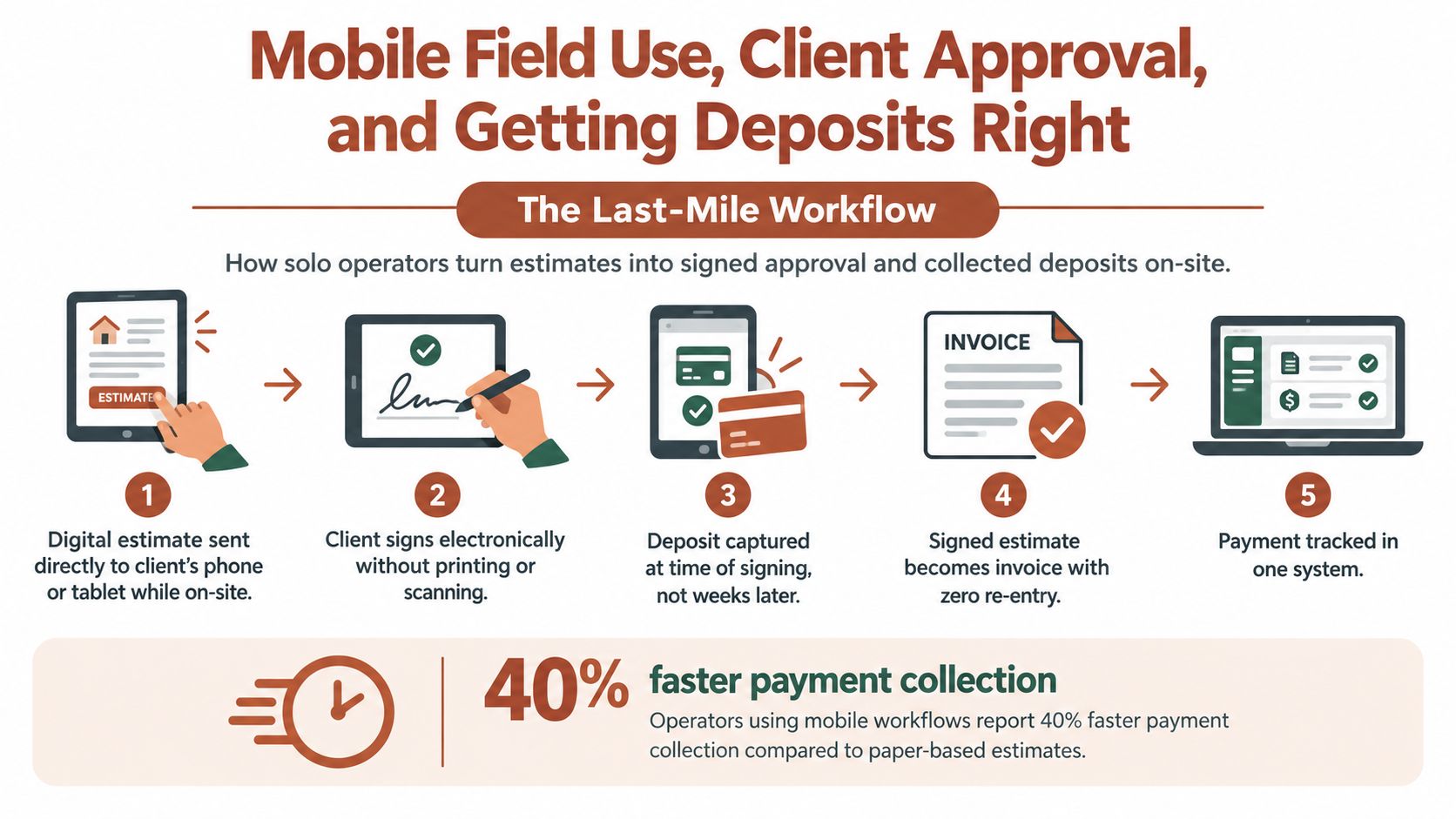
A correct estimate can still fail if the customer can't approve it easily. Many solo operators send a PDF from the driveway, then wait while the client forgets the attachment, asks for a new version, or says they never saw the payment instructions. The final-mile process should be as clear as the takeoff.
Use a browser-based estimate that the client can open on a phone, review, sign, and pay without printing. Keep the scope summary at the top, followed by options, exclusions, validity, deposit terms, and the acceptance block. If the client wants a change, revise the estimate rather than relying on a text message that later becomes disputed.
The approval sequence
- Send the estimate before leaving the property. Confirm the client has opened the document and can identify the project address.
- Summarize the approved scope aloud. Mention the included work, the largest exclusion, the validity date, and the deposit amount.
- Collect the signature electronically. The signature should attach to the exact version the client reviewed.
- Take the deposit through the same record. For larger work, define milestone payments tied to visible stages, such as material delivery or completion of a wall base.
- Convert the approved estimate into the invoice. Don't retype the scope, quantities, or price into a second document.
Construction-estimating benchmarks provide a warning about the cost of weak estimating. One cited industry summary attributes 32% of cost overruns directly to estimating errors and reports that only 31% of projects finish within 10% of the original budget, figures that apply broadly to construction rather than serving as landscaping-specific probabilities, as described in this material-cost tracking discussion. The practical lesson is to make approval traceable, not to pretend every outdoor project has predictable conditions.
Terms should sound like a clear agreement between two people. State what the client provides, who handles watering, what weather can delay, how substitutions are approved, when additional work pauses for authorization, and when the balance is due. For ideas on keeping field records clear, construction data on mobile apps offers useful context, but the best system is the one you update before leaving the site.
Turning Estimates Into Invoices and Faster Payments
The signed estimate should become the financial record for the job. Re-entering its lines into an invoice creates avoidable errors, especially when a client approved an option, paid a deposit, or accepted a revised quantity. A connected workflow carries the approved scope, price, taxes, payment schedule, and client details forward without starting from a blank invoice.
Use the completed job as new pricing data
Your first estimate is a forecast. The completed job gives you evidence.
Record estimated hours beside actual hours, and estimated material cost beside actual material cost. Add a short reason for every meaningful variance: access, weather, rework, supplier substitution, client delay, underestimated setup, or a hidden condition. Over time, your production rates become specific to your equipment, crew, service area, and job mix instead of relying on generic assumptions.
A simple post-job review can answer practical questions:
- Labor: Did the wall, planting, or cleanup consume the hours you allowed?
- Materials: Did waste, breakage, substitutions, or delivery quantities change the cost?
- Travel and setup: Did loading, unloading, and remobilization belong in the original estimate?
- Scope: Did the client request work that should have been a change order?
- Collection: Was the deposit collected before purchasing materials, and did the final payment follow the stated terms?
Weather deserves its own field. Don't bury rain delays inside a vague contingency. State whether the schedule moves, whether a return trip is billable, and which plant-establishment responsibilities remain with the client. For planting work, separate installation from ongoing watering, maintenance, replacement conditions, and optional follow-up visits. Industry analysis has connected changing heat and rainfall patterns with growing interest in native plants, drought-tolerant planting, drip irrigation, weather-responsive controllers, and permeable surfaces, as discussed in the IBISWorld landscaping-services overview. Your estimate should show those operating assumptions instead of promising a result based only on quantities.

Small habits that protect cash flow
Offer online checkout and make the deposit visible at approval. For recurring maintenance, use recurring invoices with a clear service description rather than sending an informal reminder after every visit. Automated, polite payment reminders can handle routine follow-up while you focus on the property.
Keep change orders short. Identify the condition, explain the added work, show the price consequence, and get written approval before proceeding. Never rely on “we talked about it” when the extra work affects labor, materials, disposal, or schedule.
The reliable landscaping estimate template is the one that does four jobs: defines the work, protects the margin, records approval, and feeds the next estimate with better cost data. Build those fields now, use them on the next site visit, and review the actual result when the job closes.
If you want to turn this process into a mobile workflow for estimates, signatures, invoices, and online payments, visit AurenWell and set up the document flow before your next landscaping job is quoted.