
A customer calls after a compressor fails and points to the maintenance agreement. “I thought repairs were included,” they say. You remember writing “annual HVAC maintenance” because it sounded clear at the time. Now you're deciding whether to absorb an expensive repair, argue over wording, or risk losing the customer.
That dispute is usually created before the first visit. A practical HVAC service agreement template must separate scheduled preventive work from corrective repairs, replacement parts, refrigerant, emergency labor, and capital replacements. It should also leave a usable record of what was inspected, what was found, and what the customer approved.
Why Specificity Beats General Maintenance Promises
The trouble usually starts on the first real breakdown. A customer signs up for “maintenance,” the system later quits, and now both sides are reading one vague line in two different ways. That is how a low-priced agreement turns into unpaid repair labor, an argument over parts, or a customer you never hear from again.
An HVAC service agreement is a preventive-maintenance document. It puts recurring inspections, listed tasks, and written findings on a schedule. Its business value is clear too. Proper HVAC operations and maintenance are associated with approximately 5% to 20% annual energy savings, and planned-maintenance programs are reported to reduce total maintenance costs by as much as 50% compared with reactive approaches according to the HVAC energy optimization reference.
Those numbers are not a guarantee. Old equipment, poor access, bad controls, deferred repairs, and inconsistent upkeep all change the outcome. What they do support is a simple point. The agreement needs to describe the work in plain terms, not hide behind a monthly or annual price.
The wording that causes trouble
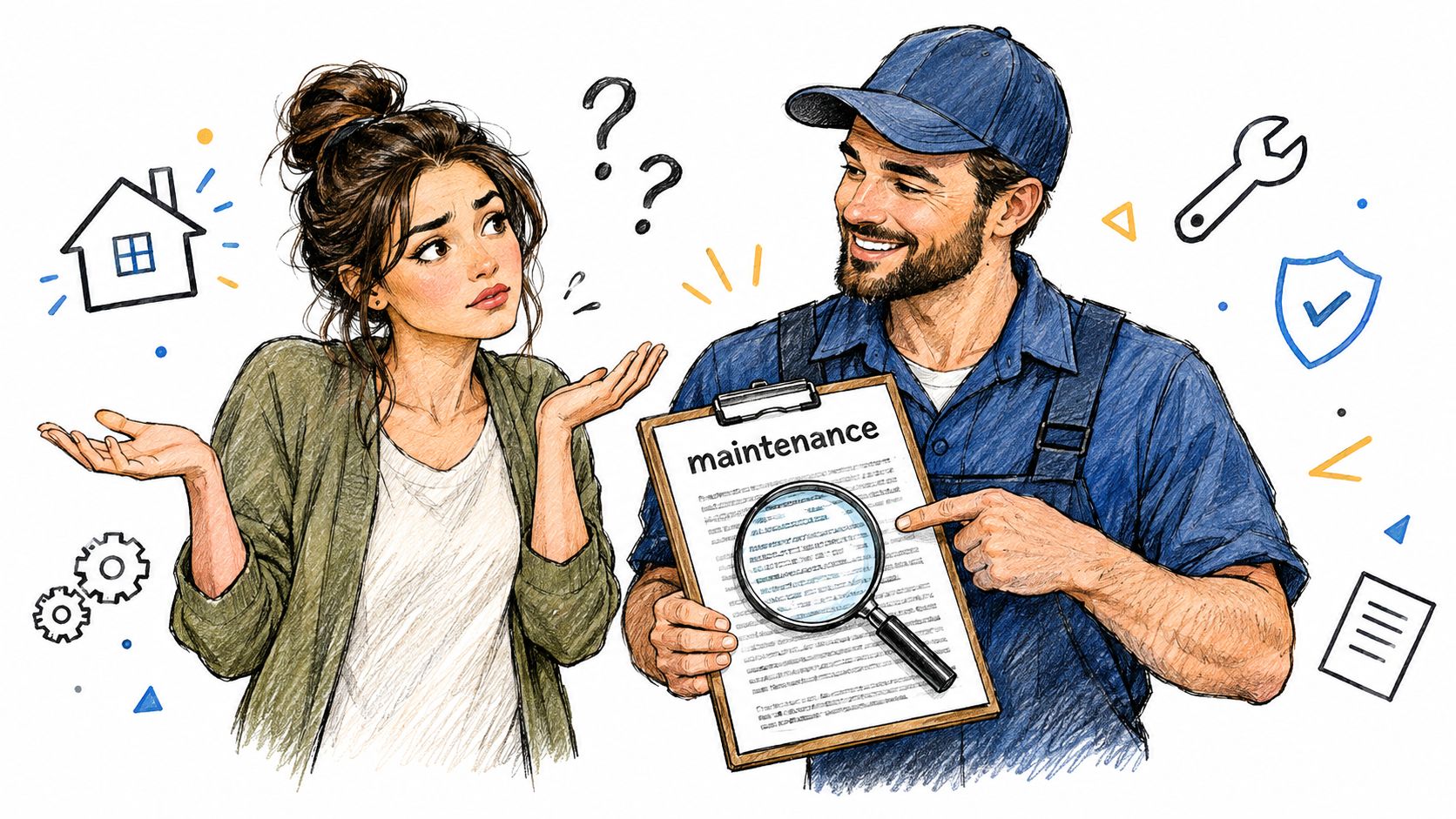
“Maintain the HVAC system” is where solo operators get burned. A customer may hear, “repairs are covered if something fails.” The contractor may mean inspection, cleaning, adjustment, and a written recommendation only. That gap shows up fast with compressors, refrigerant leaks, contactors, capacitors, motors, damaged ductwork, and code-required corrections.
The fix is specificity. I want the agreement to answer the repair question before the customer asks it at 7 p.m. on a hot Friday. A scope-and-exclusions matrix does that better than a general promise because it shows, line by line, what is included during a scheduled visit and what becomes billable repair work.
A better agreement says exactly what happens during a visit:
- Inspection: The technician checks listed components and records relevant readings.
- Cleaning: The technician performs only the cleaning tasks named in the scope.
- Reporting: The customer receives deficiencies, photographs, and recommendations.
- Repair authorization: Corrective work starts only after written approval, unless a clearly defined emergency term applies.
- Billing: Non-covered work is invoiced at the stated labor and parts terms.
The same precision helps on renewals and cancellations. If unused visits expire, if missed appointments still count, or if pricing changes at renewal, put that in writing now. Templates that skip those terms often look easy to sell and expensive to service.
Practical rule: If a customer can reasonably ask, “Does that include the repair?” the template needs a direct answer beside the service item.
That protects both sides. The customer knows what they bought, what proof they will receive, and when extra approval is required. The contractor protects cash flow by keeping preventive maintenance separate from open-ended repair liability, as summarized by the predictive-maintenance reference.
Five Essential Components of a Solid Template
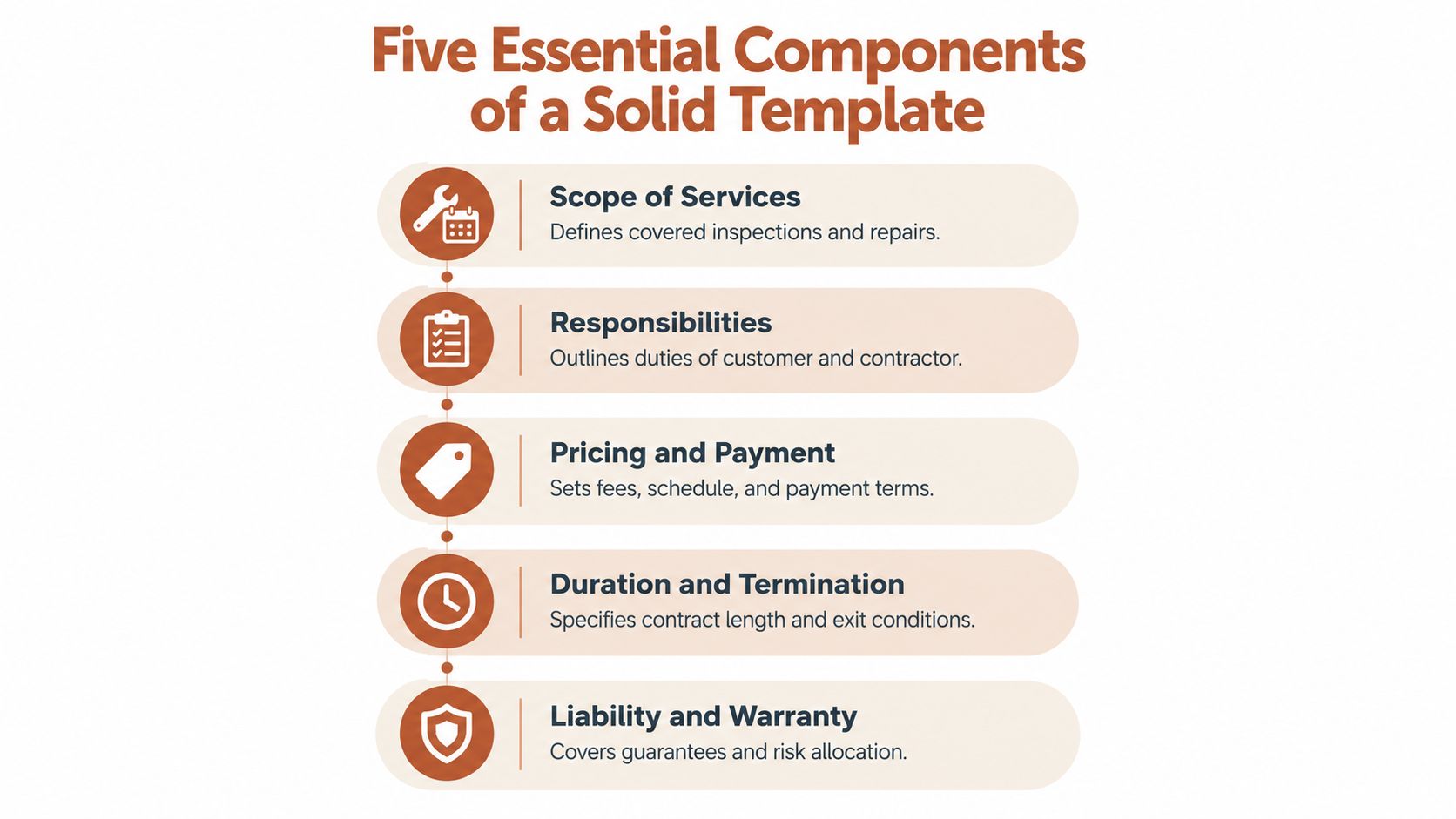
Build the document in the same order you'll use it in the field. The agreement should identify the equipment, define the visit, guide the technician, produce evidence, and settle commercial terms.
1. Identify the covered assets
Don't write “one residential HVAC system” if you can avoid it. List the manufacturer, model, serial number, refrigerant type, capacity, location, and baseline condition for every covered asset. A rooftop unit, split system, heat pump, boiler, or ventilation fan may each need a different checklist.
Record visible defects at the start. A pre-existing coil leak or damaged belt should appear in the baseline condition, with photographs where useful. That record prevents a later argument that the agreement caused, ignored, or promised to correct an existing fault.
2. Set the visit schedule
State the number of included visits, the service months or seasonal windows, and the method for arranging access. A plan might use a pre-cooling-season inspection and a pre-heating-season inspection, but the right schedule depends on the equipment and customer's operating needs.
Also define what happens when the customer can't provide access. A missed appointment caused by the customer shouldn't automatically become contractor nonperformance. Give the customer a rescheduling process and state whether an unattended visit is considered completed, postponed, or chargeable.
3. Attach a repeatable checklist
The checklist is the operational heart of the agreement. It should cover the equipment on the list, not every HVAC component that could exist.
Useful fields include:
- Air path: Filters, coils, condensate drainage, ductwork observations, airflow, and temperature split.
- Mechanical condition: Belts, bearings, mounting, lubrication requirements, and unusual noise or vibration.
- Electrical and safety: Connections, controls, safeties, wiring condition, and disconnect access.
- Refrigeration: Refrigerant-related observations, visible leaks, operating readings where appropriate, and condition of insulation.
- Controls: Thermostat, sensors, sequence of operation, alarms, and control response.
The technician should mark each item as checked, cleaned, adjusted, deficient, or not applicable. A generic “system serviced” line doesn't prove what happened.
4. Define the customer deliverables
Promise specific outputs. A completed visit should generate measured readings where applicable, deficiencies, photographs, recommendations, and a clear statement of whether additional work is proposed.
Require customer approval before extra work begins. If you use service software, the approval should connect to the customer record and the related estimate or invoice. A resource explaining what a service level agreement is can also help clarify the difference between a general service promise and commitments tied to timing, response, and evidence.
5. Close the commercial gaps
The final component contains the terms people tend to skip until a dispute starts. State the agreement's start and end dates, renewal process, cancellation method, payment schedule, response targets, access duties, warranty limits, exclusions, and signatures.
Don't assume a template written for one jurisdiction works everywhere. Refrigerant rules, electrical codes, licensing requirements, and automatic-renewal rules can differ by location. Use AurenWell's service agreement templates as a place to structure the document, then have locally appropriate terms reviewed when needed.
Defining Boundaries Between Maintenance and Repairs
A customer calls after a tune-up and says, “You were just here. Why am I getting another bill?” That argument usually starts with one vague line in the agreement. If the document says “maintenance” without saying where maintenance stops and repair starts, the customer will fill in the blank in their favor.
For a solo contractor, a preventive-maintenance-only plan is usually the safer setup. The visit covers inspection, cleaning, testing, documentation, and recommendations. Repair work stays billable on a time-and-materials basis or goes onto a separate estimate. That sounds less generous than broad coverage, but broad coverage is where small operators get trapped by parts costs, labor overruns, access problems, and failures that were never priced into the agreement.
Use a coverage matrix
The cleanest way to draw the line is a one-page matrix the customer can read in a minute. Put it in front of the signature, not buried after the legal language.
| Service category | Agreement treatment | Example wording |
|---|---|---|
| Included | Performed within the recurring fee | “Inspect and clean accessible condenser coils during each scheduled visit.” |
| Discounted | Available at a stated preferential rate | “Approved corrective labor receives the agreement rate.” |
| Quoted separately | Requires written estimate and approval | “Compressor replacement, duct modifications, and electrical upgrades require separate authorization.” |
| Not covered | Outside the agreement entirely | “Damage caused by misuse, weather events, unauthorized modification, or inaccessible equipment isn't covered.” |
That matrix does two jobs. It gives the customer a fast answer before they buy, and it gives you something specific to point to when a visit uncovers extra work. I have found that money is either protected or lost here. “Inspect evaporator coil” and “clean evaporator coil if accessible and not requiring refrigerant recovery or major disassembly” are not the same promise.
Write the fault decision into the workflow
The agreement also needs to match what happens on site. A good clause follows the sequence. You inspect the equipment, note what you found, decide whether the issue falls inside the maintenance scope, and stop for approval if it does not.
Inspection findings: The contractor will inspect the covered equipment and report observed deficiencies. Diagnosis associated with the scheduled inspection is included only to the extent necessary to document the condition. Corrective labor, refrigerant, replacement parts, code upgrades, ductwork, equipment replacement, crane or specialty access, and after-hours service are excluded unless expressly listed as included.
Then pair it with an approval clause:
Additional work: The contractor won't perform billable corrective work without the customer's written approval of an estimate, except where a separately stated emergency authorization applies.
Be careful with the word “diagnosis.” It causes more disputes than almost any other term. Some contractors include a basic fault check during a maintenance visit and charge only if troubleshooting becomes extended or invasive. Others bill all fault-finding once the work moves beyond routine inspection. Either model can work. The agreement has to mark that handoff clearly.
Separate price protection from unlimited promises
Maintenance plans help customers stay ahead of breakdowns and give you a predictable service schedule. They do not guarantee that every failure will be avoided, and they should not imply that any problem found during a visit gets repaired at no extra charge.
A strong template keeps the recurring scope narrow enough to perform consistently and document properly. Include the scheduled tasks you can deliver every time. If repair-labor discounts fit your pricing model, spell them out. Quote parts, refrigerant, replacement equipment, difficult access, and uncommon failure conditions separately.
That approach is less flashy than an all-in plan. It is much easier to honor. It also gives the customer a fair choice: buy a defined preventive service, approve additional repair work when needed, or decline that work knowing exactly what was and was not included.
Handling Renewals, Cancellations, and Unused Visits
Many service agreements are clear about coil cleaning and vague about cancellation. That imbalance creates avoidable problems when a customer sells a home, misses a visit, disputes a renewal, or asks for money back.
Start by defining the term and renewal in plain language. State the renewal length, the notice method, the notice period, and how the customer can cancel. Automatic-renewal requirements differ by state, and some jurisdictions have recently updated their rules, so local review matters before you use an auto-renewal clause.
Assign value to each visit
Prepaid visits need a fair accounting method. Define a per-visit value in the agreement, even if customers pay through monthly installments. Then state how unused service is treated when the agreement ends.
A practical clause might read:
Unused visits: If the agreement ends before all included visits are completed, the contractor will calculate any eligible refund using the stated per-visit value, less completed visits and approved nonrefundable charges.
Don't leave “completed” undefined. A visit should count when the contractor attended, had reasonable access, performed the listed work, and delivered the service record. If the customer wasn't home, blocked access, or failed to provide required information, the agreement should explain whether the visit is rescheduled or treated as a customer-caused missed appointment.
Cover common life changes
Home sales require their own sentence. Decide whether the agreement terminates at closing, transfers to the buyer with written consent, or remains with the original customer. A transfer clause should identify the information required from the new owner and whether pricing or equipment coverage changes.
Price increases also need advance notice. State when a new price can apply and how the customer can reject the renewal before it starts. Monthly billing may make a plan easier to budget, but it increases the importance of clear recurring-payment authorization and reminder records.
Use a written amendment when the parties change equipment, visits, pricing, or coverage. A practical amendment to agreement template can keep those changes attached to the original relationship instead of scattering them through email threads.
Keep the cancellation path simple
Specify the accepted cancellation channels, such as email, an online form, or written notice. Record the date received, the effective date, completed visits, outstanding balances, and any refund calculation. Send the customer a confirmation.
That process protects both sides. The customer can see how the final amount was calculated, and you can show that the cancellation was handled consistently rather than improvised during a tense phone call.
Integrating the Template Into Your Document Workflow
A signed PDF in a downloads folder isn't a workflow. It doesn't automatically tell you when a seasonal visit is due, whether the customer approved a repair, or which invoice belongs to the current term.

The local-file approach
A simple system can work when your customer list is small. Keep a folder for each customer, use a consistent filename, and store the signed agreement, visit reports, estimates, invoices, payment records, and photographs together.
The weakness is manual follow-up. You must remember renewal dates, create recurring invoices, locate the latest signed version, and prove when the customer approved extra work. A spreadsheet can support the process, but it becomes another record to maintain.
For electronic signing, compare the signing steps before choosing an app. This electronic signatures app guide is useful background when you're deciding how customers will review and sign from a phone.
The connected document approach
A dedicated contracts and invoicing platform connects the agreement to the customer record. The useful features aren't abstract. Look for browser-based approval, phone-friendly signatures, stored audit trails, recurring invoice schedules, payment links, and the ability to attach estimates and service records to the same client history.
AurenWell, for example, provides contracts and service agreements for mobile signing, stores signed documents and audit trails with the client record, and supports invoices, estimates, payments, and recurring invoices in the same web application. It is one option for a solo operator who wants a narrower administrative system rather than dispatch, payroll, or full accounting software. Its contracts feature can support the agreement-signing portion of that workflow.
A connected record also changes what happens after the visit. You can open the customer, confirm the covered assets, complete the checklist, attach photographs, send a repair estimate, and preserve the approval history without searching across paper and email.
Use the video below as a visual example of how digital document handling can replace scattered files with a more consistent process.
The right choice depends on your volume and discipline. A local folder costs little and may be sufficient if you maintain it carefully. A connected platform reduces repetitive administration by keeping agreement terms, signatures, billing, and customer history together.
Final Checklist for a Dispute-Ready Agreement
Before sending your HVAC service agreement template, verify that it answers these questions:
- Assets: Are each manufacturer, model, serial number, refrigerant type, capacity, location, and baseline condition recorded?
- Visits: Does the schedule state how many visits occur, when they're due, and what happens when access fails?
- Checklist: Can another person tell exactly what was inspected, cleaned, measured, and photographed?
- Boundaries: Does the document separate included maintenance from diagnosis, repairs, parts, refrigerant, emergency labor, code upgrades, and replacement equipment?
- Approval: Must the customer authorize extra work before it starts?
- Renewal: Are term, renewal notice, price changes, cancellation, transfers, and unused visits explained?
- Records: Are signed agreements, visit reports, estimates, invoices, and payments stored together?
A good agreement doesn't restrict the customer. It gives both parties a shared operating plan and leaves less room for memory, assumptions, and stressful calls. For broader risk-handling context, review this insurance dispute procedure overview and adapt your own escalation process to local requirements.
Take your current agreement and mark every sentence that could lead a customer to ask, “Is the repair included?” Replace each vague promise with a coverage category, an approval rule, and a documented deliverable. Then turn the finished template into a mobile signing workflow before your next scheduled maintenance visit, so the agreement protects your time and your customer's expectations from the start.