
You're standing beside an aging outdoor unit, checking a distributor's equipment price while the homeowner asks what the replacement will cost. The equipment is straightforward. The job isn't. Before you send a number from your truck, you need to decide what you can price confidently, what needs an allowance, and what requires another inspection.
A dependable HVAC estimate template helps you make those decisions visible. For a solo operator, that means less reliance on memory and a clearer agreement about what the customer is buying.
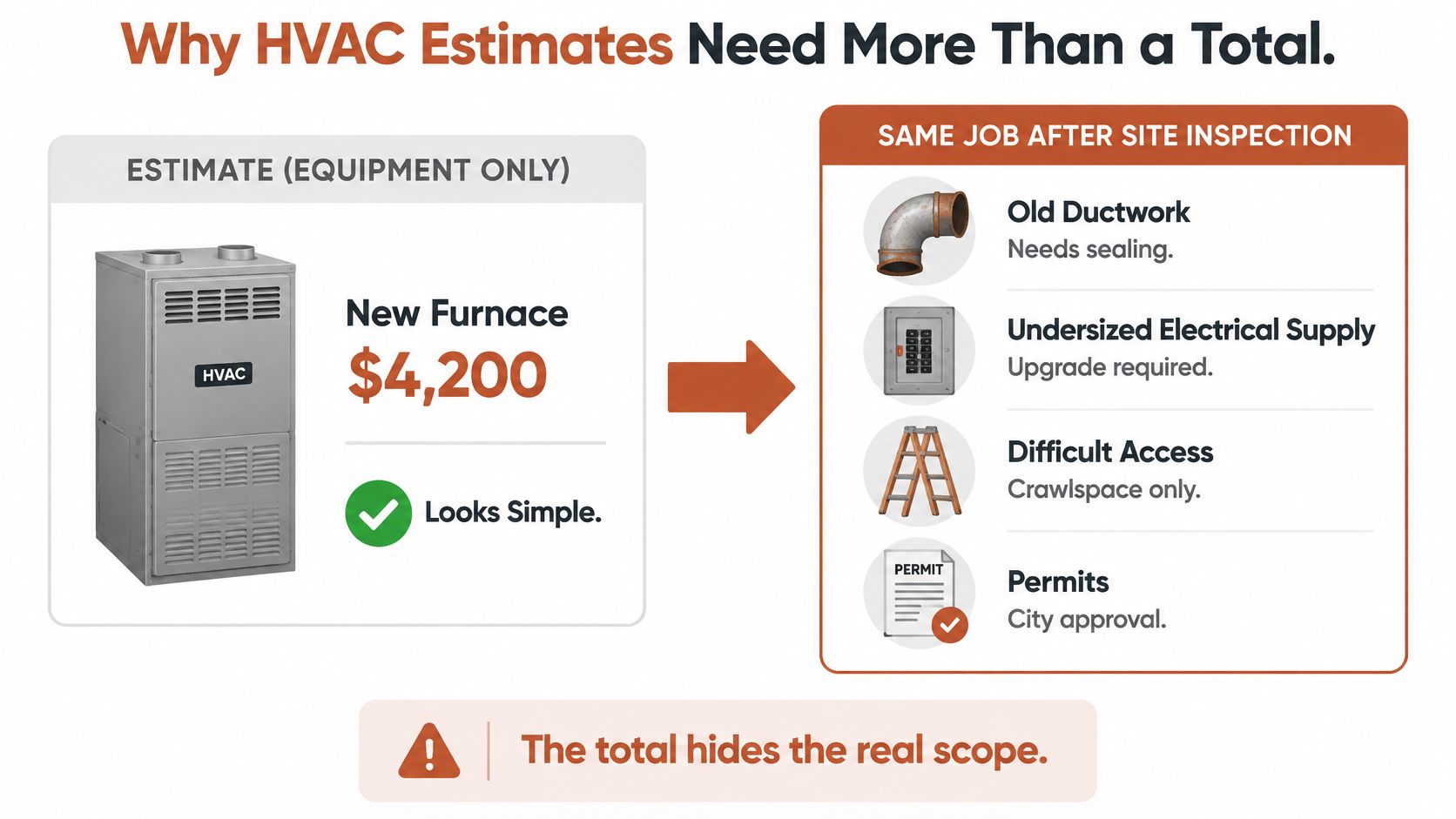
Why HVAC Estimates Need More Than a Total
Consider a replacement where the existing duct connection needs rebuilding, the electrical supply needs verification, and the indoor unit can only leave through a tight crawlspace. Add permit responsibility, disposal, and startup work, and the equipment price becomes only part of the estimate.
A single installed total can still be appropriate for the customer. But you need a structured calculation behind it and a scope statement beside it.
Historical construction research found actual costs exceeded estimates in 86% of projects, with average actual costs 28% above estimates. Those results cover construction broadly, not residential HVAC specifically, so they're context for estimating discipline, not a prediction for your next replacement (international construction cost study).
Why a Structured HVAC Estimate Matters
| Document approach | What the customer sees | What the operator controls |
|---|---|---|
| Informal total | A price with little explanation | Few documented boundaries |
| Itemized quote | Equipment and work categories | More visible cost omissions |
| Structured estimate | Scope, assumptions, pricing, and approval conditions | A baseline for authorized changes |
Build the estimate around evidence
Organize your working document around the existing system, required capacity, infrastructure, detailed pricing, and commissioning or exclusions. That keeps a polished quote from getting ahead of the site investigation.
Keep intake separate from technical approval, too. If you use outside help with incoming calls, Mercateer's HVAC call answering service is a resource to consider within that intake workflow, not a substitute for verifying installation conditions.
The useful estimate isn't the one with the most rows. It's the one that lets you explain what the price covers without reconstructing the job from memory.
The Downloadable HVAC Estimate Template
Use the following copy-ready structure in a spreadsheet or document, then export your completed estimate as a PDF for delivery. It's a reusable layout, not a prepriced quote. Fill it with current supplier pricing and your own labor assumptions.
Core Fields for the HVAC Estimate Template
| Template block | Required information | Decision supported |
|---|---|---|
| Document control | Estimate number, issue date, version, validity | Which offer is current |
| Contractor and client | Business contact details, customer, billing and service addresses | Who contracts for which property |
| Existing system | Manufacturer, model, serial number, age, fuel, refrigerant | What you're replacing or servicing |
| Requested work and scope | Customer request, proposed work, boundaries | What the customer is buying |
| Equipment and materials | Description, specification, quantity, unit cost, markup, selling price | What must be supplied |
| Labor | Task, estimated hours, applicable rate, amount | What work is priced |
| Price summary | Direct costs, overhead, profit, contingency, taxes, total | How the price is assembled |
| Conditions and acceptance | Deposit, payment terms, assumptions, exclusions, change rules, signature and date | How work is authorized |
Copy-ready heat-pump replacement example
Job description: Remove the existing heat-pump system and install the specified indoor and outdoor equipment. Attach the selected model details and the agreed installation scope.
| Pricing entry | Basis to complete | Treatment |
|---|---|---|
| Outdoor heat pump and indoor unit | Supplier quote and exact model numbers | Included and fixed |
| Installation materials | Measured quantities and current unit prices | Included and fixed |
| Recovery and removal | Estimated task hours × applicable rate | Included and fixed |
| Setting and connecting equipment | Estimated task hours × applicable rate | Included and fixed |
| Evacuation, charging, startup, and testing | Estimated task hours × applicable rate | Included and fixed |
| Permit and disposal | Confirmed fees and service costs | Separately identified |
| Concealed duct repair | Defined scope and allowance amount | Provisional allowance |
| Tax | Applicable treatment and taxable amount | Identified in summary |
Keep internal costs and markup in your working sheet. The customer-facing copy should show selling prices clearly without accidentally exposing procurement notes or unfinished calculations.
Identity, service address, scope, pricing status, total, terms, validity, and approval fields are essential. Adapt technical fields to the job rather than leaving irrelevant replacement language on a repair estimate.
For digital acceptance, Closer Innovation Labs Corp.’s esignature for HVAC technicians is an option to evaluate. Whichever signing method you choose, associate acceptance with the specific estimate version.
How to Prepare a Defensible HVAC Estimate
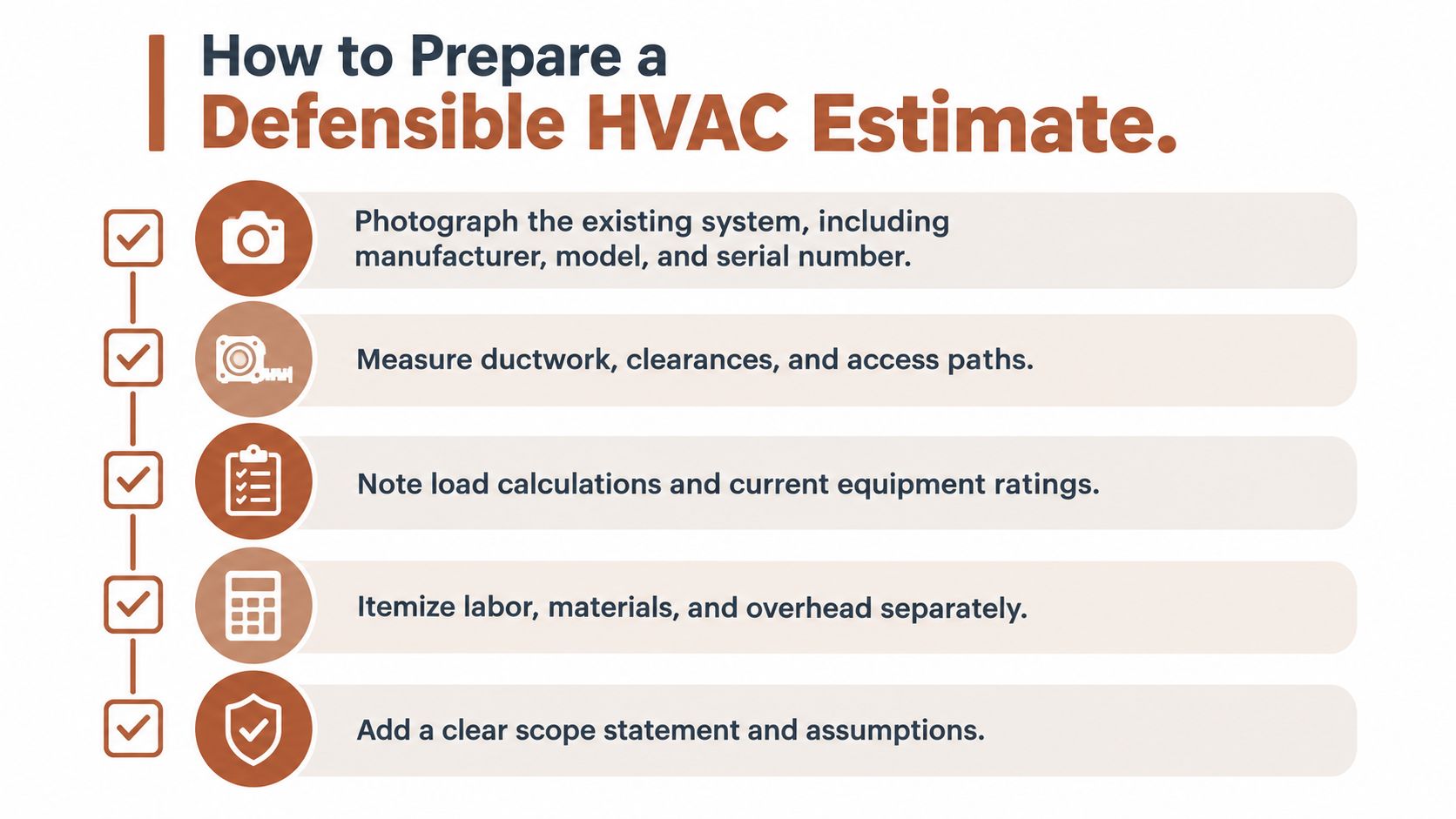
Start with what's installed, not what you expect to sell. Record the manufacturer, model, serial number, age, fuel, refrigerant, reported symptoms, and installation photographs. Mark information as unverified when you can't confirm it.
For a residential replacement, calculate required capacity with a room-by-room ACCA Manual J load analysis, rather than copying the old unit's tonnage. Then verify infrastructure before committing to the installation scope. This sequence, including task-based pricing and commissioning definitions, is outlined in the HVAC system replacement estimating playbook.
Inspect the connections around the equipment
Check duct sizing and condition, static-pressure constraints, electrical capacity, line-set compatibility, condensate routing, venting, clearances, and access. Don't treat existing components as reusable merely because they're already there.
Pre-Estimate Site Checklist
| Check | Capture | Why it matters |
|---|---|---|
| Existing equipment | Nameplate details, symptoms, photographs | Establishes the starting condition |
| Capacity | Load-analysis reference and unresolved inputs | Supports equipment selection |
| Air distribution | Duct dimensions, visible defects, pressure constraints | Defines connection and modification work |
| Electrical | Supply details and items needing specialist verification | Identifies unresolved electrical scope |
| Refrigerant circuit | Existing line-set details, route, compatibility status | Establishes reuse or replacement assumptions |
| Drainage and venting | Routes, terminations, visible conditions | Defines associated installation work |
| Access | Openings, removal route, clearances, working area | Supports realistic labor planning |
Photograph the route as well as the unit. A close-up of a nameplate won't help you remember whether the replacement air handler can turn through the access opening.
Separate findings from unknowns
A visible transition you've measured can become a firm material-and-labor item. A concealed duct section you haven't inspected remains unresolved. Write down what additional access or assessment would resolve it, rather than treating an assumption as a finding.
Before leaving, check that you've captured:
- Equipment evidence: Readable identification photographs and the customer's reported symptoms.
- Installation constraints: Measurements, access conditions, and components requiring verification.
- Scope boundaries: Work you can define and conditions you can't yet confirm.
- Completion requirements: Startup, testing, cleanup, and the records you'll provide.
Field rule: If you can't explain the condition supporting a firm price, investigate it or label the uncertainty.
That distinction makes the estimate defensible without pretending every part of an existing building is visible.
Price Each Part of the HVAC Job
Use quantity × unit price as the basic estimating calculation. Equipment count, line-set length, duct transitions, fittings, electrical components, refrigerant, drains, pads, filters, and disposal all need a place in the working sheet.
Labor needs a different quantity: task hours. Estimate recovery and removal, setting equipment, duct transitions, electrical connections, line-set work, evacuation, charging, startup, testing, and cleanup separately. Multiply each task's hours by the applicable rate.
HVAC Pricing Formula Examples
| Line item | Calculation | What it captures |
|---|---|---|
| Equipment | Equipment quantity × current unit cost | Selected units and accessories |
| Line set | Measured length × unit cost | Route-specific material requirement |
| Duct transition | Required fabrication and materials + task labor | Connection work |
| Installation labor | Estimated task hours × applicable rate | Work under the observed conditions |
| Subcontracted work | Confirmed subcontract scope and price | Work performed by others |
| Permit and disposal | Applicable fee or quoted service cost | Non-equipment job expenses |
Keep overhead, profit, and risk distinct
An HVAC estimating guide gives 5–10% contingency and approximately 12–18% overhead as starting benchmarks, not universal pricing rules. Calibrate those allowances against your own costs and completed-job variance (HVAC estimate cost guidance).
Overhead covers business expenses that aren't tied neatly to a single installation task. Profit is a separate pricing decision. Contingency addresses uncertainty within the defined work, not an unlimited promise to absorb additional scope.
Keep these distinctions in your calculation even if the customer receives a simpler price summary. Also document whether your labor rate already includes overhead recovery, so you don't add the same expense again.
For a broader review of your selling-price approach, use this guide to deciding how much to charge.
- Check duplication: Don't charge disposal again if it's already included in a removal subcontract.
- Check omissions: Look for mobilization, startup, warranty registration, and access-related work.
- Check the calculation base: Label what each markup or allowance applies to.
- Check tax treatment: Apply the rules relevant to the work and location.
A detailed internal worksheet and a readable customer estimate serve different purposes. Keep both useful rather than forcing every purchasing detail onto the customer's page.
Present Uncertainty Without Creating a Dispute
More detail doesn't make an uncertain condition fixed. A long estimate can still mislead if every line appears equally certain.
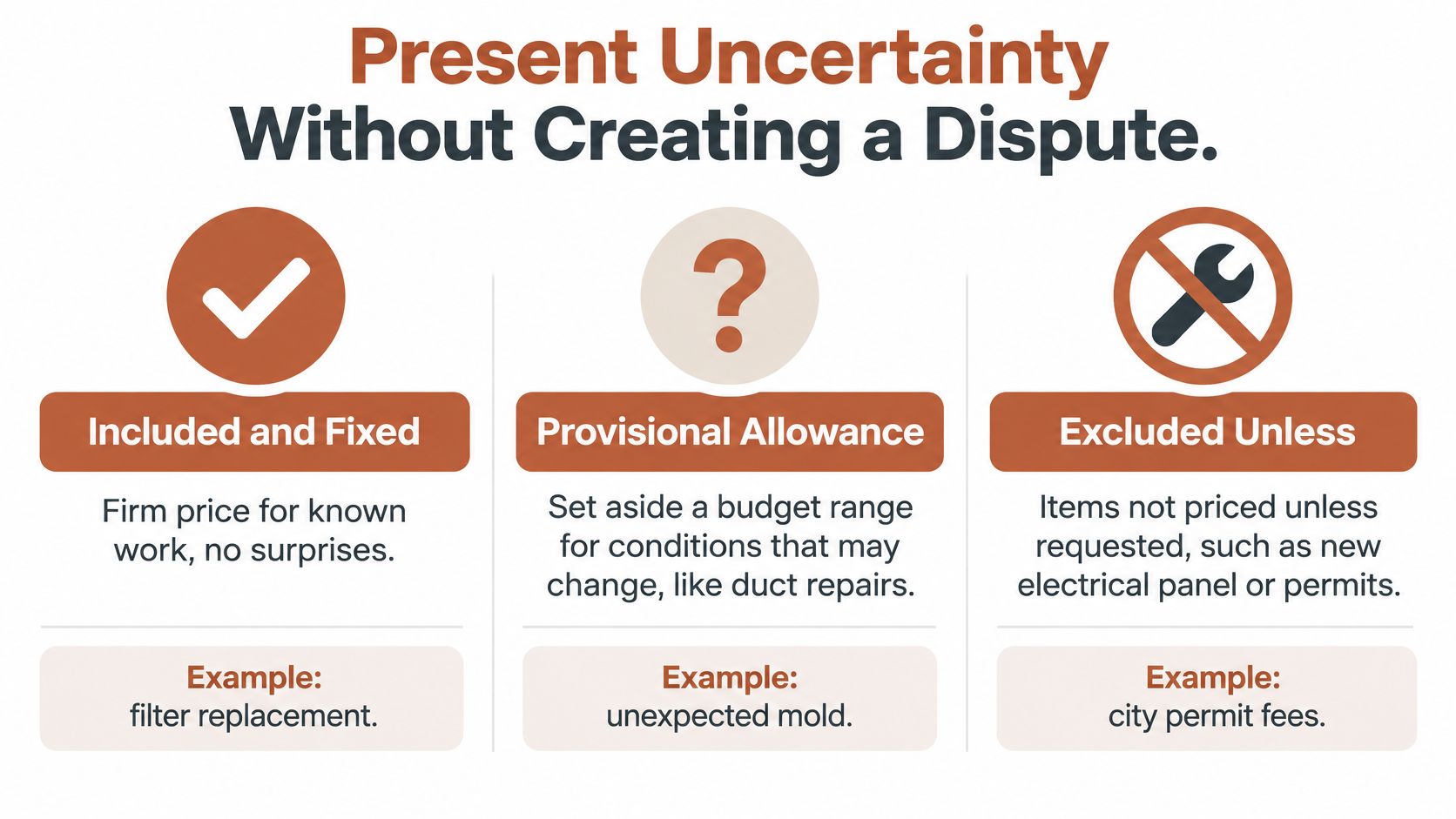
Use distinct pricing categories instead. The approach below adapts the uncertainty-handling framework described in this HVAC estimate template guide, separating known scope from allowances and work requiring additional approval.
Fixed Price Allowance and Exclusion Choices
| Pricing category | Use when | Required template detail |
|---|---|---|
| Included and fixed | Scope and installation conditions are sufficiently established | Exact included work and agreed price |
| Provisional allowance | Work is anticipated but its extent remains unresolved | Allowance, investigation trigger, reconciliation method, and approval limit |
| Excluded unless approved | Work isn't part of the accepted price | Excluded scope, discovery trigger, and authorization process |
Give each unknown an approval path
For concealed duct repairs, identify the area that couldn't be inspected. State the allowance included in the estimate, what happens when that area becomes accessible, and how you'll credit unused allowance or request approval for additional work.
An electrical-panel upgrade may belong outside the replacement scope pending assessment. Don't merely write “electrical excluded.” Specify the boundary between included equipment connections and the separately approved upgrade.
Use plain customer-facing language:
If inspection identifies work beyond the stated allowance, we'll provide the findings and a change price for approval before proceeding with that additional work.
Include an agreed spending ceiling where appropriate. If you can't establish a credible maximum exposure, say further assessment is required instead of inventing one.
Explain what estimate validity means
Tie validity to the supplier price hold, assumed parts availability, applicable tax or tariff treatment, and the proposed approval timing. Explain whether delayed acceptance requires repricing and confirmation of availability.
Avoid treating required work as optional just because it's excluded from your price. Permit responsibility, for example, still needs an assigned party. An exclusion defines who supplies or pays for work; it doesn't remove an applicable requirement.
Add Clauses That Protect the Job and Payment
Useful clauses answer the questions a customer could reasonably ask during installation. They shouldn't read like a list of ways to avoid responsibility.
Attach the equipment schedule to the accepted scope. Identify indoor and outdoor models, capacity, efficiency rating, refrigerant, and included accessories. Then state the treatment of associated components rather than relying on “standard installation.”
HVAC-Specific Clause Checklist
| Clause topic | Question to answer | Outcome for the estimate |
|---|---|---|
| Equipment specification | Which models and accessories are supplied? | Defined purchase commitment |
| Associated components | Are thermostat, pad, disconnect, line set, and safety devices included? | Clear installation boundaries |
| Duct modifications | Which alterations are priced? | Separation from broader duct replacement |
| Permits | Who obtains them and pays the fees? | Assigned responsibility |
| Haul-away | What equipment and debris will be removed? | Defined cleanup scope |
| Warranty | What manufacturer and contractor terms apply? | Clear obligations and exclusions |
| Commissioning | What startup, testing, and records are included? | Agreed completion requirements |
| Customer conditions | What access and site preparation must the customer provide? | Practical scheduling expectations |
Tie payment to defined events
A deposit is an advance payment credited toward the job. The final balance is the remaining amount due under the agreed terms. State when each becomes payable and connect payment events to the project schedule.
Don't copy deposit requirements, cancellation wording, or warranty language blindly. Adapt them to local requirements and have consequential contract language reviewed appropriately. The guide to estimate terms and conditions can help organize the topics you need to address.
For changes, preserve the original estimate and create a separate record identifying the affected scope, additional or reduced labor and materials, price adjustment, scheduling effect, and customer authorization.
- Reference the original: Identify the accepted estimate and version.
- Describe the difference: Record what changes, not the entire job again.
- Confirm authorization: Retain approval before carrying out additional work.
A changed invoice alone isn't a substitute for that approval record. Keep the agreement about the change alongside the eventual charge.
Customize and Convert the Estimate
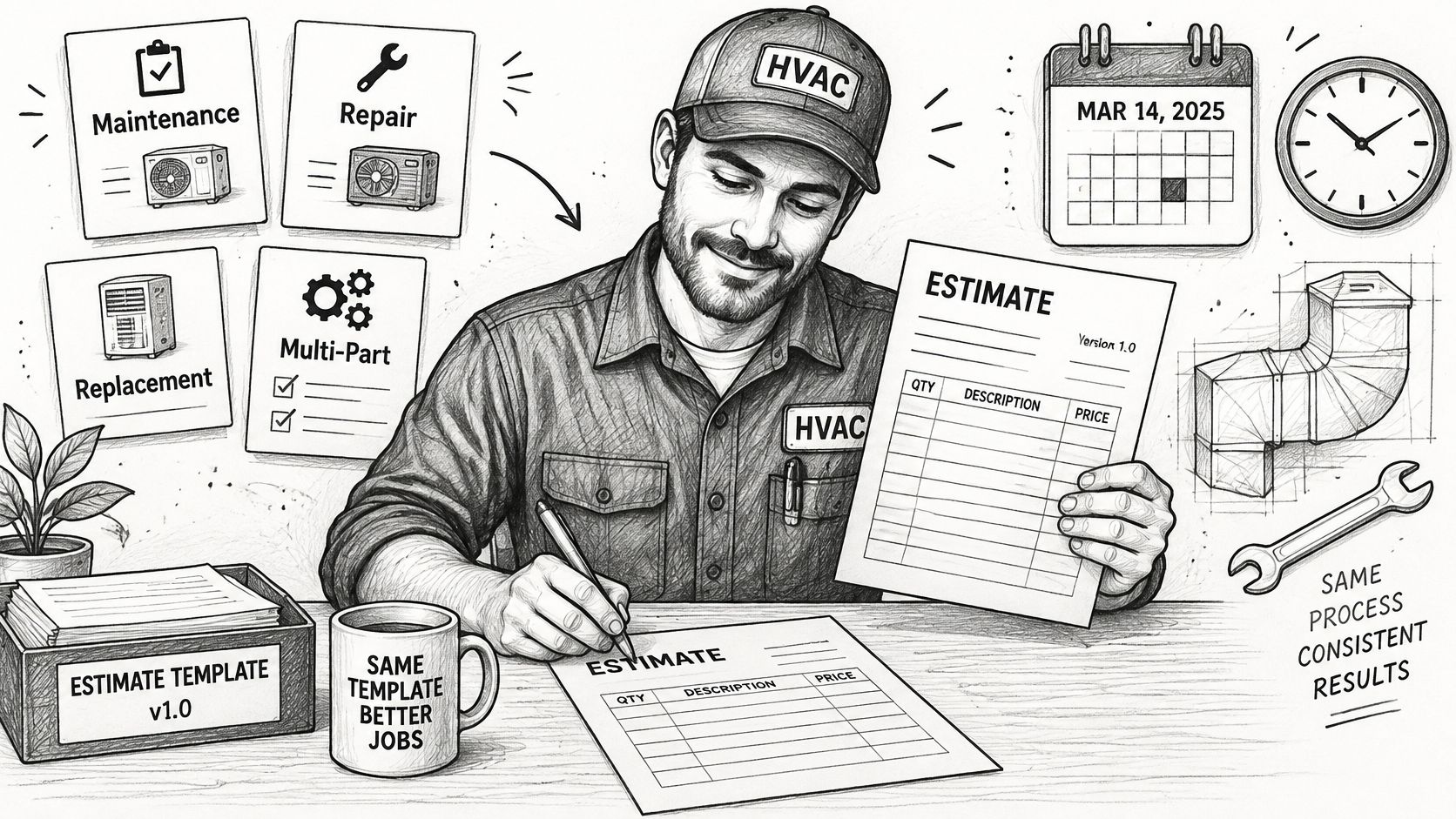
Reuse the document structure, not every assumption inside it. A maintenance estimate needs defined service tasks and repair exclusions. A repair estimate needs the diagnosed condition, proposed correction, and testing. A replacement estimate needs the equipment and infrastructure detail established during assessment.
For multi-part work, group related items into clear scope packages. Keep shared costs identifiable so you don't duplicate mobilization, permits, or disposal across separate parts of the same job.
Preserve the accepted record
Save each issued version with its date and assumptions. Once accepted, retain that version unchanged and attach subsequent authorizations to it. Don't overwrite the record the customer approved.
Construction-estimating literature supports the principle that accuracy improves as project information becomes more detailed (review of construction estimating accuracy). In practice, that means a preliminary budget and an installation-ready estimate should have different status labels, even when they use the same layout.
Carry approved work into the invoice
Convert the accepted scope and agreed pricing into the invoice, then reconcile deposits and authorized changes. Update quantities or labor only where the pricing agreement allows it. A fixed-price job should not become time-and-materials billing because actual hours exceeded your estimate.
Estimate to Invoice Handoff
| Estimate element | Invoice treatment | Verification point |
|---|---|---|
| Accepted scope | Carry forward the agreed description | Matches the approved version |
| Fixed pricing | Retain agreed amounts | No unapproved adjustments |
| Provisional allowance | Reconcile under the agreed method | Supporting record and approval retained |
| Change order | Add a referenced adjustment | Customer authorization attached |
| Deposit | Credit the recorded payment | Receipt and balance agree |
| Taxes and final terms | Apply the agreed, applicable treatment | Amount due and due event are clear |
Use an HVAC invoice template to keep the final billing document consistent with the estimate.
A spreadsheet and document folder can support this process. As another option, AurenWell provides estimate-to-invoice conversion, browser-based approval, e-signature, optional deposits, online payments, and activity logs. Choose the workflow you'll maintain reliably from the field, not the one with the longest feature list.
Review before sending and learn after completion
Check the completed estimate against the site record:
- Client and property: Correct customer, contact information, and service address.
- Technical scope: Existing-system documentation, selected equipment, and installation boundaries.
- Pricing: Labor tasks, material quantities, indirect costs, taxes, and allowance treatment.
- Commercial terms: Deposit, payment events, validity, assumptions, and exclusions.
- Acceptance: Current version, approval fields, and attached specifications.
After completion, record actual labor hours, materials, permit costs, and resulting job margin. Compare them with the estimate and note why they differed. Separate estimating omissions from customer-approved additions so you improve the right part of your process.
Transparent uncertainty is more useful than false precision. Customers should be able to distinguish what they've bought from what still needs investigation and approval.
Copy the template blocks into your estimating workflow before your next site visit. Complete the technical checks, classify every unresolved condition, and send a version you can stand behind. Keep the accepted copy and compare it with the finished job so your next estimate starts with better information.