
The U.S. janitorial services and carpet cleaning industry includes about 60,000 establishments and generates about $50 billion in annual revenue, making office cleaning a realistic entry point for a solo operator. The practical path is to start lean, win recurring contracts, and build dense routes instead of chasing random one-off jobs.
You may be looking at an empty supply closet, a used vacuum, and a list of local offices wondering whether this business can become more than occasional side work. It can, but office cleaning isn't residential cleaning with larger rooms. Corporate buyers care about access, documentation, insurance, sustainability, response times, and whether your team can deliver the same standard after every visit.
The market structure supports that approach. Commercial cleaning represents 73.3% of the cleaning market, including offices, hospitals, retail locations, and other commercial buildings, while industry guidance places a smaller cleaning-business launch at roughly $5,000 to $15,000 depending on the setup and equipment required. (GetJobber's cleaning industry overview)
Your first objective isn't to look like a national facilities company. It's to become the most dependable specialist for a clear type of office in a practical service area. That means choosing the right accounts, setting fair labor rates, documenting your work, and creating systems before growth makes disorder expensive.
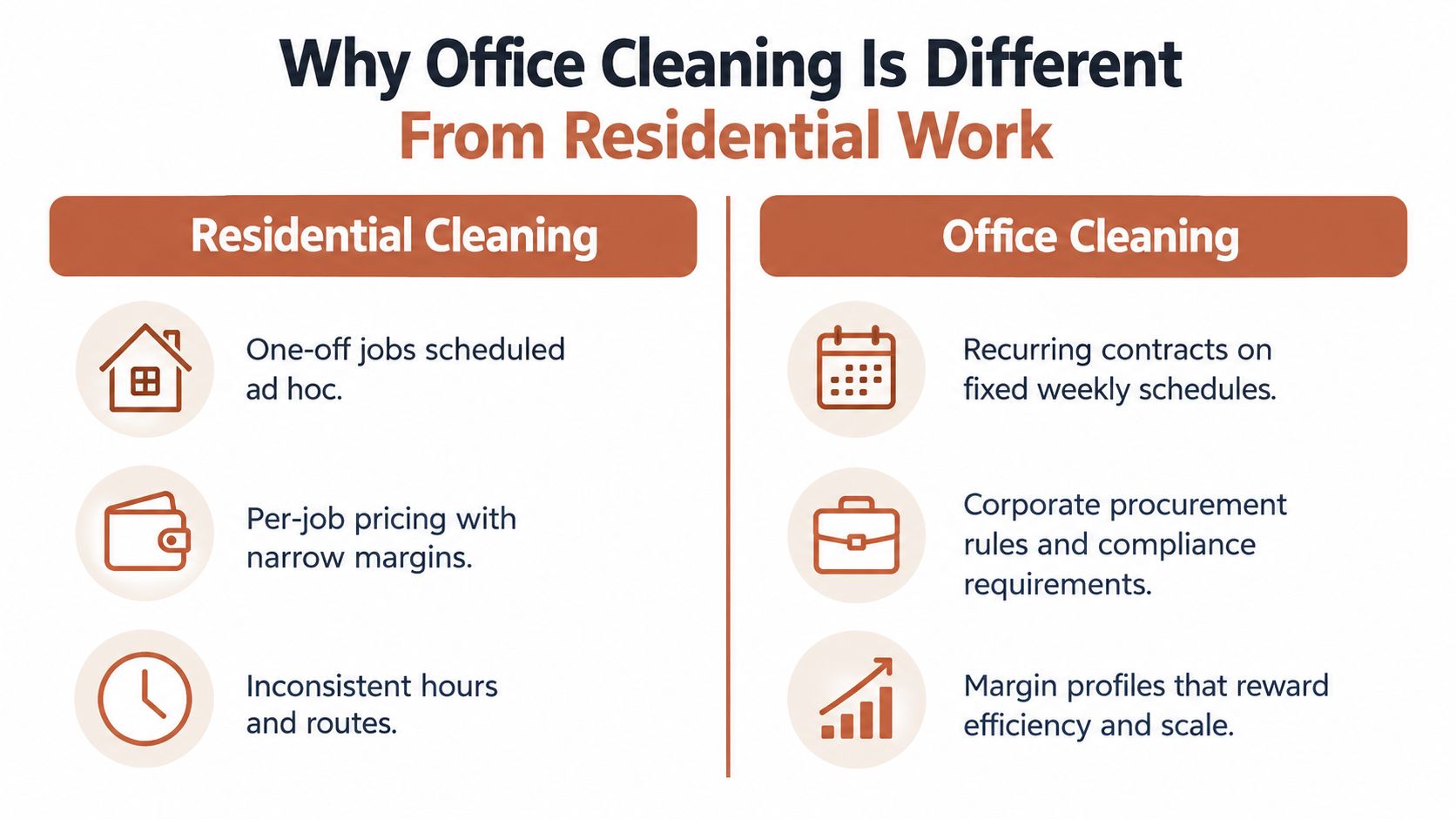
Why Office Cleaning Is Different From Residential Work
An office contract can look simple until the buyer asks for proof of insurance, a service agreement, supply details, key-control procedures, and a way to report missed tasks. Residential customers usually judge a visit by visible results in the kitchen and bathrooms. Office buyers also judge your access controls, documentation, response time, and ability to repeat the same standard after employees leave.
That changes the business model. Residential work often means filling a calendar with separate appointments. Office cleaning depends on recurring accounts served on fixed schedules. A nightly or weekly contract creates predictable revenue, but it also commits you to cover absences, early building closures, access problems, and extra requests without disrupting the agreed service.
The economics favor repeatable routes
Industry benchmarks for office janitorial work place typical gross margins around 30% to 40%, with top-quartile operators exceeding 45%. (IdeaProof's cleaning business guidance) Those margins come from controlling paid labor, reducing unpaid travel, standardizing tasks, and keeping each account within its quoted scope. Expensive equipment will not fix an underpriced contract.
Route density matters because travel consumes time you cannot bill. Five nearby offices may be easier to manage than two larger accounts separated by a long drive. A compact route reduces fuel use, simplifies cover for absences, and gives you more chances to inspect work. It also makes evening operations more practical.
You are selling trust, not just labor
An office manager buys fewer complaints, a presentable workplace, reliable access procedures, and confidence that staff will follow the same checklist every visit. Your proposal, uniform, inspection records, invoice, and response process show whether you understand commercial service.
Green-certification requirements can affect product selection, documentation, and eligibility for contracts. Technology also changes demand. Offices using occupancy data, digital work orders, and remote facility management expect faster updates and clearer service records. Build those capabilities into your operation before a buyer asks for them.
Practical rule: Accept an office account only when you can explain who cleans it, when they arrive, what they do, how you check the result, and what happens when service falls short.
Choose a narrow office segment, price labor and travel accurately, document environmental practices, and sell recurring service to buyers who value consistency. The dependable operator with a dense route will usually outperform the cleaner chasing scattered one-off jobs.
Market Research and Finding Your Niche
Start with buildings, not equipment. Search local business directories, commercial property listings, chamber-of-commerce member directories, and maps for office clusters. Mark addresses by neighborhood and note the types of tenants inside. A concentrated area of professional offices may suit evening janitorial work, while medical offices may demand stricter procedures, specialized waste handling, and stronger documentation.
Return-to-office policies in major metro areas are expected to support commercial cleaning demand, and 57% of firms surveyed expect revenue growth while 50% expect profit increases in 2025, according to the 2025 Facility Services Industry Report. That doesn't mean every local segment is attractive. It means you should investigate where offices are occupied, where service is inconsistent, and where buyers are outsourcing work they once handled internally.
Choose a segment you can serve well
Don't begin by saying you clean everything. Choose an account type with similar needs and building layouts.
- Professional offices: Law firms, accounting offices, consultants, and agencies often need discreet after-hours service and careful treatment of desks, kitchens, and meeting rooms.
- Small medical offices: These can offer repeat work, but you'll need stronger training, chemical controls, and procedures for high-touch surfaces and waste.
- Property-managed office suites: One relationship can introduce you to multiple tenants, although approval and vendor requirements may be more formal.
- Coworking and shared offices: These environments may require more frequent touchpoint cleaning, visible daytime service, and rapid response to complaints.
Visit competing providers' websites and record their service areas, specialties, certifications, response promises, and proposal language. Call as a prospective buyer when appropriate, not to waste anyone's time, but to understand how quickly vendors respond and what information they request before quoting.
Investigate procurement before you pitch
Corporate buyers increasingly look for outsourced providers that use organized, technology-supported workflows. They may expect digital proposals, online approvals, service logs, recurring invoices, and a clear escalation process. Green-cleaning certifications are also becoming baseline procurement requirements for corporate facilities, so sustainability should be part of your operating model rather than a late marketing add-on. (Dataintelo's office-cleaning market coverage)
Attend chamber meetings and property-management events. Ask facility managers what frustrates them about current vendors. The best niche is usually where you can solve a specific operational problem, such as missed restrooms, unreliable substitutes, poor communication, or undocumented green-cleaning practices.
Legal Setup, Licenses, and Insurance Essentials
Before you solicit serious office contracts, make the business legitimate enough for a procurement department to approve. Choose a business structure with professional advice, register it where required, obtain the relevant tax identification details, and check city, county, and state licensing rules. Cleaning requirements vary by location and by service type, particularly if you add floor refinishing, specialty chemicals, construction cleanup, or regulated waste.
Insurance is not a decorative line in your proposal. It protects you from the ordinary risks of entering occupied workplaces, and clients may require proof before giving you keys.
Build the commercial-client checklist
Set up these essentials before your first substantial contract:
- General liability insurance: Covers claims involving property damage or bodily injury, subject to the policy terms.
- Workers' compensation coverage: Arrange it before employees begin work where local law or the contract requires it.
- Commercial auto coverage: Review your policy if you use a vehicle for business travel, transport equipment, or move staff.
- Janitorial bonding: Some clients require a bond or fidelity coverage because cleaners may have access to offices after hours.
- Business registration and local approvals: Keep copies of registrations, permits, and renewals in one accessible folder.
- Safety documentation: Maintain product information, training records, incident procedures, and chemical-handling instructions.
Ask your insurer for a current certificate of insurance. Send the certificate promptly when a prospect requests it, and ask whether the client needs to be listed as an additional insured. Never promise coverage you haven't confirmed with your broker.
Your service agreement should define the premises, frequency, tasks, exclusions, supplies, access arrangements, payment timing, cancellation terms, and procedure for additional work. A practical guide to cleaning service contracts can help you identify clauses and scope details that new operators often overlook.
Don't copy a generic contract and assume it protects you. Have a qualified local professional review the agreement, especially if you work in a regulated environment or hire staff.
Pricing Strategies That Protect Your Margins
Start with the job, not the quote. Estimate labor for each task and each visit first, then add supplies, travel, insurance, payroll taxes, admin time, equipment replacement, and the time spent on inspections and client communication. If you price from the operating cost up, you know where the money goes before you promise a number.
Three pricing models are common, but they serve different kinds of work.
| Pricing Model | Best For | Margin Consideration |
|---|---|---|
| Hourly | Small jobs with uncertain scope or one-time corrective work | Easy to calculate, but clients may focus on hours instead of results, and slow production can hurt your margin |
| Per square foot | Offices with measurable floor area and repeatable layouts | Useful for comparable bids, but you must account for restroom density, furniture, kitchens, and cleaning frequency |
| Per visit | Recurring contracts with a defined checklist | Ties the quote to the outcome, but only works when labor time and extras are documented carefully |
For a simple example, a 10,000-square-foot office billed at $0.12 per square foot would come out to $1,200 per service. That is only a sample calculation, not a market rate. Local wages, building complexity, frequency, security rules, and travel will change the final number.
Quote the work you can actually deliver
Walk the site whenever possible. Count restrooms, kitchens, stairwells, elevators, conference rooms, waste stations, and high-touch surfaces. Ask who supplies consumables, whether cleaning happens nightly or weekly, whether employees stay onsite, and who controls access.
Your proposal should separate routine scope from optional services. Carpet extraction, interior glass, floor restoration, event cleanup, and emergency work should not disappear into a low recurring price.
Use your pricing benchmark as a check, not a target. A practical rate guide from how much to charge for cleaning can help you sanity-check the numbers, but route design decides whether the margin survives. Review every account after the first few visits. If the crew keeps taking longer than quoted, fix the production plan or reprice the added scope. Do not absorb permanent losses just to keep the client happy.
Equipment, Supplies, and Sustainability Credentials
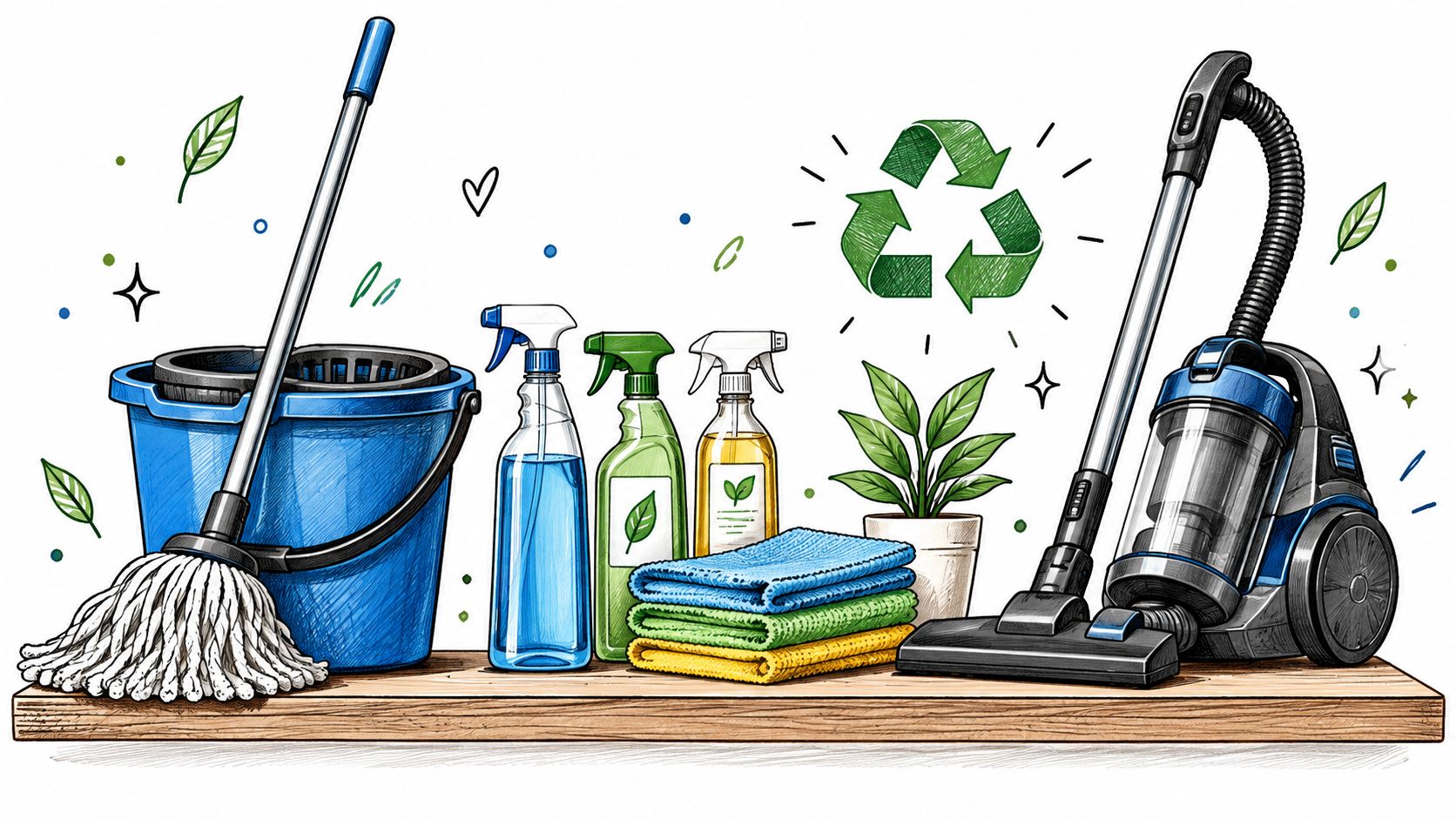
A new office-cleaning business doesn't need a warehouse full of machines. It needs dependable equipment that lets a cleaner work safely, quickly, and consistently. Start with commercial vacuums, microfiber cloths and mop systems, buckets, a durable cart, color-coded tools, liners, spray bottles, gloves, warning signs, and a controlled set of cleaning chemicals.
Buy for the accounts you can realistically win. A small professional office may not justify an auto scrubber, extractor, or burnisher at launch. Rent or subcontract specialized equipment until recurring work makes ownership sensible. Cheap vacuums and poorly designed carts can create downtime, fatigue, and inconsistent results, so don't confuse a low purchase price with a low operating cost.
Make sustainability operational
Corporate buyers increasingly want evidence behind environmental claims. Choose products with credible environmental documentation, keep safety data accessible, record dilution instructions, and train cleaners not to overuse chemicals. A green promise without purchasing records, procedures, and staff training won't survive a procurement review.
Create a simple supply-control system:
- Standardize products: Use a limited approved list so staff know the correct product for each surface.
- Control dilution: Use measured dispensers or clearly marked containers where appropriate.
- Track consumption: Compare supply usage with account size and visit frequency to spot waste.
- Separate tools by area: Use a color system to reduce cross-contamination between restrooms, kitchens, and general office areas.
- Document credentials: Store certification documents, product sheets, and environmental policies with your proposal materials.
Your startup list should support the service you sell, not the service you hope to sell later. Choose durable basics, a repeatable chemical system, safe storage, and a replenishment routine. Sustainability becomes a competitive advantage when it reduces waste, protects surfaces, supports worker safety, and gives the buyer documents they can use internally.
Staffing Decisions and Operational Systems
You can begin as the cleaner, salesperson, inspector, and scheduler. That keeps quality control close, but it also limits how many accounts you can serve and makes every personal absence a service risk. Hire only when the account economics support it, and don't add a cleaner just because a busy week feels uncomfortable.
A part-time cleaner is often the practical first step. Give that person a defined building, written tasks, access instructions, product rules, and a reliable backup contact. Outsourcing a specialized service can also work, but only if the client knows who is responsible and the subcontractor meets your insurance and quality requirements.
Build the system before the team
Every account needs a site file containing:
- Scope sheet: Room-by-room tasks, frequency, exclusions, and special instructions.
- Opening and closing routine: Alarm, lights, doors, keys, and access procedures.
- Supply list: Approved products, storage location, reorder point, and safety information.
- Inspection checklist: Visible standards for restrooms, floors, waste, touchpoints, and kitchens.
- Issue log: Date, complaint, corrective action, responsible person, and client follow-up.
- Substitution plan: Trained backup cleaners who can cover absences without improvising.
A checklist isn't bureaucracy. It turns your standard into something another person can follow. Inspect early visits yourself, photograph only where the client permits it, and ask the facility contact for specific feedback rather than a vague “How did we do?”
Schedule for retention, not just coverage
Night work, split shifts, travel, and short notice can exhaust a small team. A thoughtful schedule gives cleaners predictable expectations and reduces the handoffs that cause missed tasks. Review this guide to employee scheduling that boosts morale for practical ways to structure assignments and communication.
Use a calendar or field-service platform for recurring visits, but don't automate judgment. You still need to verify access, confirm coverage, monitor quality, and speak with clients. Software should remove clerical work, not replace management.
A cleaner who knows the building, the route, and the standard is more valuable than a larger roster of people who rotate through without context.
Sales, Marketing, and Administrative Workflows
Office cleaning sales should be boringly consistent. Make a list of facility managers, property managers, office administrators, and commercial real-estate contacts in the area you can serve efficiently. Contact them with a short, specific message that identifies the building type you serve, the recurring problem you solve, and the next step you want, usually a walkthrough.
Don't lead with a long company biography. Ask useful questions:
- Who currently manages the cleaning contract?
- Which areas generate the most complaints?
- What cleaning frequency does the building require?
- Does procurement require insurance certificates or sustainability documentation?
- When does the current agreement come up for review?
Follow up systematically. A prospect who isn't ready this month may still need a vendor later, but you won't know unless you keep a respectful record of contact dates, objections, decision-makers, and next actions.

Present a proposal that reduces buyer risk
A commercial proposal should make approval easy. Include the service frequency, exact task list, exclusions, supply responsibility, quality-control process, insurance details, start date, pricing, payment terms, and cancellation rules. Use a short cover letter to explain why your route, staffing, and sustainability procedures fit the building.
This cleaning service business proposal guide can help you organize the document. Keep the language specific. “Maintain a clean environment” is weak. “Vacuum accessible carpeted areas, damp mop hard floors, empty designated waste containers, clean restroom fixtures, and replenish client-supplied paper products on scheduled visits” gives both sides something measurable.
A professional workflow should move in one direction:
- Estimate: Record the site details, labor assumptions, frequency, and optional services.
- Proposal: Send the scope, price, terms, and insurance information in one organized document.
- Approval: Obtain a signature before scheduling recurring work.
- Service record: Log visits, exceptions, supply issues, and client requests.
- Invoice: Bill according to the agreed schedule, not from memory.
- Payment: Offer a secure online method and record checks, transfers, or other payments promptly.
- Review: Follow up after the first service cycle and at planned intervals.
A solo operator can use dedicated tools for estimates, contracts, recurring invoices, online payments, client records, time tracking, and expense capture. AurenWell is one option that combines those administrative functions for independent service businesses. The right choice is the one your business will use every day, with records you can export and understand.
Add reminders for unpaid invoices, but don't let automated messages replace a direct conversation with a good client who has a processing problem. Cash-flow discipline matters because payroll, supplies, insurance, and travel continue even when a customer pays late.
Fix the mistakes that quietly destroy profit
Underpricing is the most common failure. Correct it by measuring labor on the first visits and comparing actual time with the proposal. If the scope is too large, remove optional tasks or issue a documented change order.
Vague agreements create arguments. Correct them with room-by-room checklists, visit frequency, supply responsibilities, access instructions, and a written process for extra work.
Skipping insurance or bonding makes you look unprepared and exposes the business to avoidable risk. Correct it before pitching corporate accounts, then keep certificates current.
Taking every type of account creates scattered routes and inconsistent training. Correct it by selecting a service area and account profile that share equipment, timing, and procedures.
Hiring only after winning work leaves you desperate when someone calls out. Correct it by maintaining a small pipeline of screened candidates and training backups before you need them.
Ignoring administrative work turns completed jobs into unpaid jobs. Correct it by converting approved estimates into contracts, contracts into scheduled work, and completed visits into invoices without delay.
Use the same professional discipline whether you're launching an office-cleaning company or researching how to start an HVAC business that wins. Buyers in both fields want clear scopes, credible documentation, responsive communication, and confidence that the operator can fulfill the agreement.
Before approaching your first prospect, decide what you will clean, where you will clean it, how often you will visit, who will perform the work, and how you will prove it was completed. A focused route with sustainable pricing beats a large promise you can't staff.
Start by mapping a tight group of office buildings, speaking with the people responsible for facilities, and offering a walkthrough built around their actual complaints. Register the business, secure the required insurance, prepare a documented green-cleaning process, and send proposals that show exactly what the client will receive. Your first recurring contract should fund a better system, not hide a weak one.
Ready to build your office-cleaning route? Choose a specific local niche today, list the buildings within a practical service area, and contact facility decision-makers with a clear walkthrough offer. Then turn the first signed account into a documented, repeatable operation before you pursue the next one.