
You finish the work, send the invoice, and tell yourself the customer will pay shortly. Then the afternoon disappears, the next day starts, and you're refreshing your bank account while the invoice sits unread or buried beneath other messages. The fact is that how to collect payment from a customer has less to do with becoming more persistent and more to do with designing a payment process that makes delay difficult.
Late payment is now a structural business problem, not an unusual customer quirk. A 2025 global survey covering 10,854 suppliers in 129 countries found that 55% reported late payments, up from 51% the year before, while only 37% said they were paid on time, down from 42% (global payment collection report). Your invoice, payment terms, checkout experience, and reminder schedule all affect whether you get paid promptly.
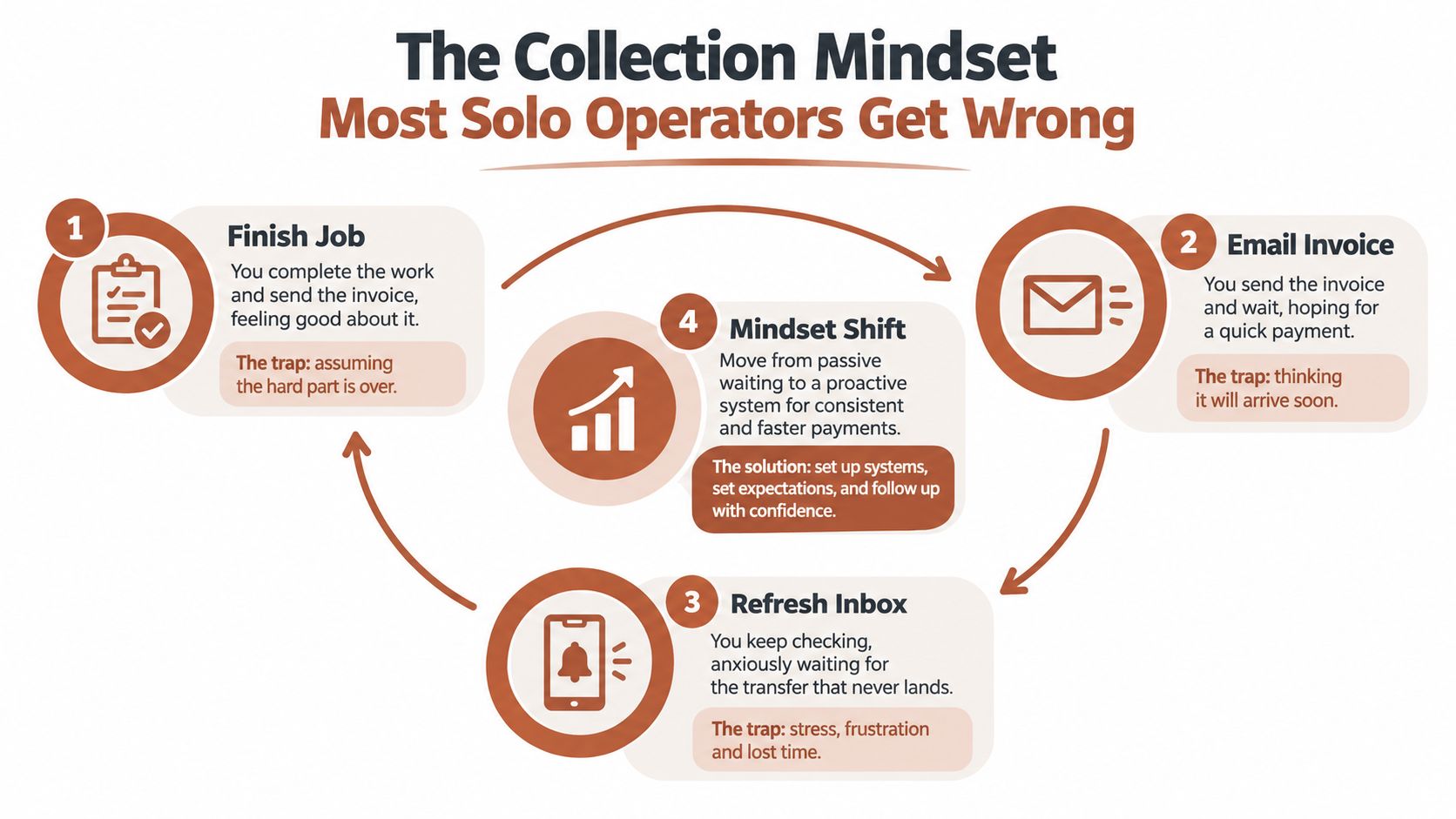
The Collection Mindset Most Solo Operators Get Wrong
A customer can receive your invoice, intend to pay it, and still leave it untouched for days. You then send a polite reminder, wait again, and spend time chasing a delay your process helped create. That cycle feels like a customer problem, but it usually starts earlier.
Collecting payment from a customer has less to do with persistence and more to do with designing a payment process that makes delay difficult. The fastest way to get paid is to remove uncertainty before the invoice reaches the customer, then use reminders as a backup rather than the main collection strategy.
That approach treats collections as a workflow design problem. Before the invoice exists, you have already chosen the deposit, due date, billing trigger, payment methods, and steps required to complete payment. If the customer must search for bank details, request a corrected invoice, create an account, or interpret “due on receipt,” you have given them reasons to postpone.
Practical rule: Don't ask a reminder to solve friction you could have removed before sending the invoice.
Start the payment process during the quote or booking conversation. State the terms plainly, collect any required deposit, confirm the customer's preferred payment method, and explain when the final invoice will arrive. Once the work is complete, send the invoice immediately with accurate line items and a direct payment path. The reminder cadence belongs after that setup is in place.
Stop waiting for a customer's intention
Good intentions do not complete payments. An invoice competes with payroll, errands, approvals, family responsibilities, and other demands. Your job is not to judge whether the customer is trustworthy. Your job is to make the correct action obvious, quick, and easy to verify.
Deposits, payment links, QR codes, clear line items, and scheduled reminders all support that goal. They turn payment from an administrative favor into the next visible step in the service workflow. A well-designed system gets the customer to the checkout page quickly and gives you a documented path when payment still does not arrive.
Setting Up Payment Terms Before the Job Starts
Payment terms belong in the quote, booking message, or service agreement. If you wait until the invoice is overdue to explain them, you've created a negotiation at the exact moment you need cooperation.
Start with the deposit. For a larger job, ask for an upfront amount before reserving time or buying materials. Present it as standard policy: “I reserve the booking once the deposit is paid, and the balance is due when the work is complete.” That language protects your capacity without suggesting that this particular customer is suspicious.
For short, contained work, total payment at completion usually creates the cleanest process. For multi-day projects, use milestone billing tied to observable events, such as completion of the first phase, delivery of a draft, or installation of a defined part of the work. A milestone should describe completed value, not just a date on the calendar.
Match the terms to the work
Repeat clients and retainers need a recurring schedule. Choose a billing date that matches your cash-flow needs and keep it consistent. If the client's purchasing process requires an approval window, account for that before setting the due date. A recurring invoice that arrives predictably is easier for both parties to budget than a series of improvised requests.
Offer a small set of payment methods that customers already use. Cards and bank transfers cover many service businesses, while mobile wallets or cash may make sense for field work. Don't list every possible option if doing so creates confusion. Two or three clear choices are more useful than a long menu with unclear instructions.
For language you can adapt in your own quote, review this guide to estimate terms and conditions. The key is to agree on the payment event before the job begins, so the final invoice confirms an existing agreement instead of opening a new discussion.
| Job Type | Deposit | Billing Trigger | Recommended Methods |
|---|---|---|---|
| Short service visit | Optional, depending on booking risk | Completion of the visit | Card, bank transfer, mobile wallet |
| Materials-heavy job | Required before scheduling or purchasing materials | Balance due at completion | Card, bank transfer |
| Multi-day project | Required before the first workday | Defined milestone completion | Card, bank transfer |
| Retainer or recurring service | First payment before the service period | Agreed recurring billing date | Card, bank transfer, recurring checkout |
Write the terms in plain English. Include the deposit requirement, balance trigger, due date, accepted methods, and what happens if payment is missed. Customers rarely object to a clear policy they saw before approving the work. They object when the rules appear after the work is finished.
Building an Invoice That Gets Paid in One Tap
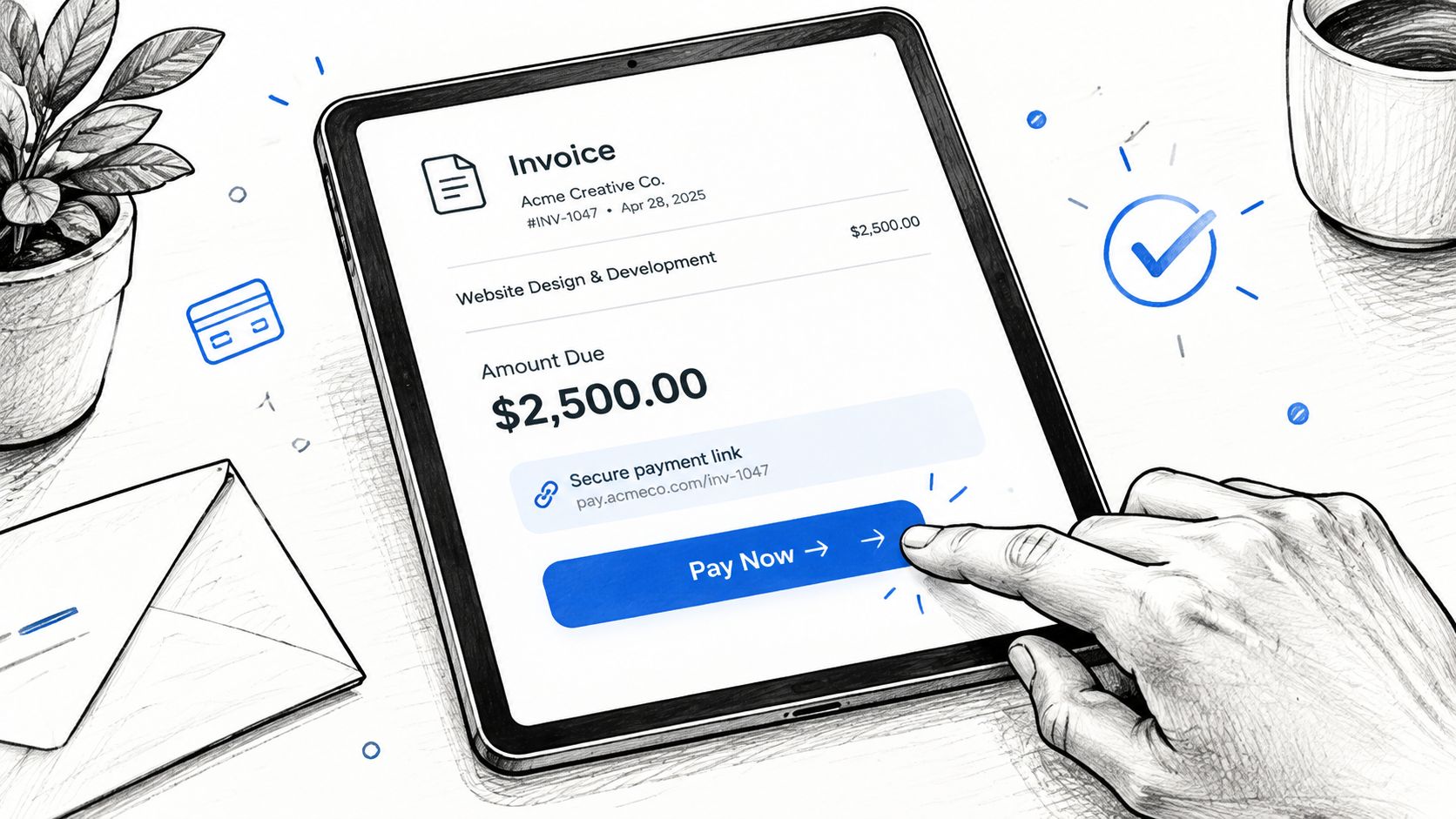
A payment-ready invoice answers five questions immediately: What did I buy? How much do I owe? When is it due? How do I pay? Who do I contact if something is wrong? If the customer has to open multiple attachments or compose an email to request instructions, the invoice is unfinished.
Use a subject line such as “Invoice 1048, website photography balance due” rather than “Outstanding balance.” Put the exact amount due near the top. List the work in understandable line items, include the due date, and show any deposit or prior payment so the remaining balance is unambiguous.
Put checkout inside the invoice
Embed a hosted payment link generated by your payment processor. The customer should tap the button and arrive at a checkout with the amount already filled in. Enable the payment methods your processor supports and your customers use, such as cards and supported digital wallets. A payment page with optional tipping can also suit personal services, classes, or creative work where tipping is customary.
A QR code gives the same route to customers holding a printed invoice or viewing a PDF on another device. Place it beside a short instruction, such as “Scan to pay securely.” Test the code from the final PDF before sending it. A broken or unreadable QR code undermines confidence at the exact point where you want immediate action.
A tool such as AurenWell online payments can combine invoice payment links, QR codes, and payment tracking in the same workflow. Whatever tool you choose, the customer shouldn't have to ask where to send the money.
Record every payment accurately
Manual payments need the same discipline as online payments. When cash, a cheque, or a bank transfer clears, mark the invoice as paid in your ledger and retain the payment date and method. Don't mark it paid because a customer says they've initiated a transfer. “Sent” and “received” aren't the same event.
Keep the audit trail with the invoice. If you need to sign or return a document before payment, these digital signature PDF tips can help you keep the document process separate from the payment instruction without losing clarity.
Use this final check before every invoice leaves your system:
- Specific reference: Include the invoice number and service description in the subject line.
- Clear balance: Show the exact amount due after deposits or credits.
- Due date: State the calendar date, not only vague terms.
- Payment link: Place the checkout button where the customer can see it.
- QR code: Add a tested code to PDFs and printed copies.
- Contact line: Give one direct route for questions or disputes.
A clean invoice prevents many collection conversations before they begin.
A Day-by-Day Reminder Cadence That Actually Works
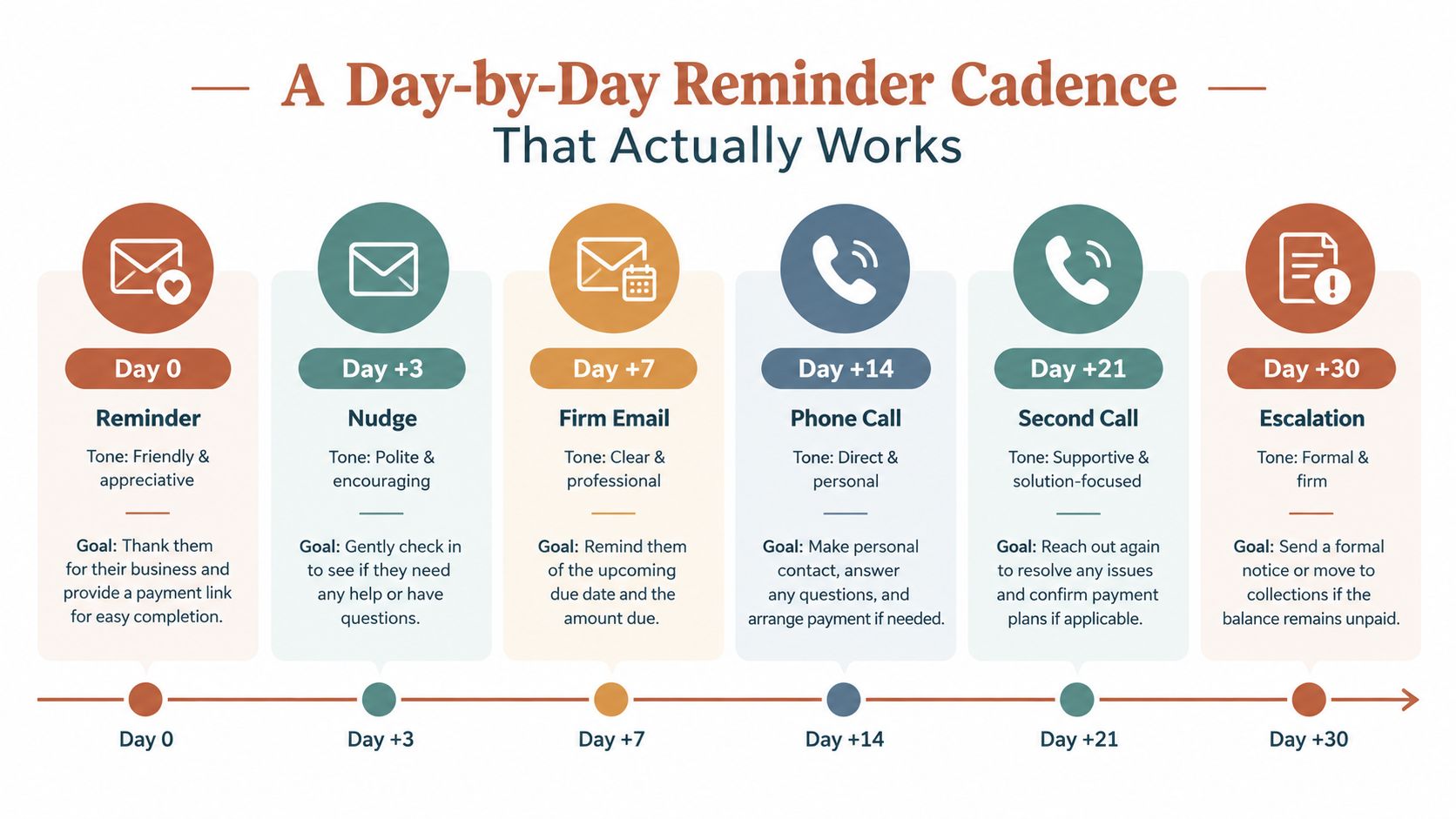
Late payment is usually a design failure before it becomes a follow-up failure. Send a clear invoice, make payment easy, then use a fixed cadence instead of waiting and wondering. Assign every reminder a date, channel, purpose, and next trigger. This schedule assumes the invoice went out when the work ended under agreed terms such as net 7 or net 14.
Day 0, immediately after the due date: Send a friendly email or SMS with the payment link. Keep the message administrative: “Hi Sam, a quick reminder that invoice 1048 was due today. You can pay securely here: [payment link]. Please reply if you need the invoice resent.” A payment reminder tool can schedule this message and preserve the activity record.
Day +3: Check that the invoice reached the correct person. Ask whether approval is blocked by a missing purchase-order detail, incorrect email address, or another simple issue. Keep the question neutral and specific.
Day +7: Send a firmer email with the invoice attached or linked again. Use a subject such as “Payment required, invoice 1048.” State the amount, original due date, and payment date you expect. If the customer disputes the invoice, ask them to identify the exact line item.
Change the channel when email stalls
Day +14: Call the customer. Say, “I'm calling about invoice 1048, which is still unpaid. Can you confirm when the payment will be released?” Record the answer and any promised date. A call removes the delay caused by another unread message.
Day +21: Call again if the promised payment has not arrived. Offer two practical choices: pay through the link today, or confirm a written payment plan with specific dates. Treat a missed promise as a trigger for the next step, not as a reason to restart the conversation.
Day +30: Send an escalation notice under your payment policy. State what happens next and give a final response date. Do not threaten action you will not take.
SMS can be a meaningful part of the cadence, not merely a wording choice. A Netherlands field experiment found that SMS reminders reduced the share of customers charged a first late fee by at least one in five (field experiment summary). For reusable language and a documented sequence, review this proven invoice reminder system. Automate scheduling and logging, but make each escalation depend on a missed payment or unanswered contact.
When and How to Escalate Without Burning the Relationship
Escalation isn't aggression. It's what happens when an objective condition is met. If the customer misses the due date, ignores the agreed reminders, or breaks a promised payment plan, the next step should come from your written policy rather than your mood.
Start with a final notice. State the invoice, balance, due date, contact history, and deadline for resolution. Apply a late fee only if your original agreement and local rules allow it. Never add a surprise charge just because you're frustrated.
A predictable consequence feels professional. A personal threat feels like a relationship problem.
Use a defined ladder
The escalation path should also protect your future work. Suspend additional services when an existing account is overdue, unless continuing the work is necessary to protect people or property. Tell the customer clearly that new work resumes after the account is current or a written plan is accepted.
| Trigger | Action | Message Angle | Expected Outcome |
|---|---|---|---|
| Due date passes | First reminder | Helpful payment prompt | Customer pays or identifies a problem |
| Customer doesn't respond to reminders | Direct call | Confirm status and payment date | Clear commitment or documented dispute |
| Promised payment doesn't arrive | Final notice | State deadline and next step | Payment, plan, or formal dispute |
| Final notice expires | Suspend further work | Existing balance must be resolved | Protect future capacity |
| Continued nonpayment | Collections agency or attorney | Transfer the matter under policy | Professional recovery attempt |
| Disputed or small-value debt | Review economics | Decide whether pursuit makes sense | Avoid wasting more time than the debt warrants |
Use a collections agency or attorney when the amount and evidence justify the cost, and when the customer has ignored your documented process. Small claims court may fit some disputes, but check local rules, filing requirements, contract language, and recoverable costs before starting.
Decide what not to chase
Not every unpaid invoice deserves unlimited attention. Review the balance, the strength of your documentation, the likelihood of recovery, and the value of the relationship. A weakly documented dispute may cost more to pursue than it's worth, while a clear, substantial debt from a repeat client may justify formal recovery.
A 2026 industry summary reported that invoices are paid 6 days late on average, with 20% delayed by more than 2 weeks, 33% of late invoices overdue by more than a month, and 20% at least 60 days late (late invoice payment analysis). The same summary cited invoice errors as the source of 61% of late payments. That makes accuracy and early intervention more valuable than dramatic final notices.
Your Repeatable Collections Checklist
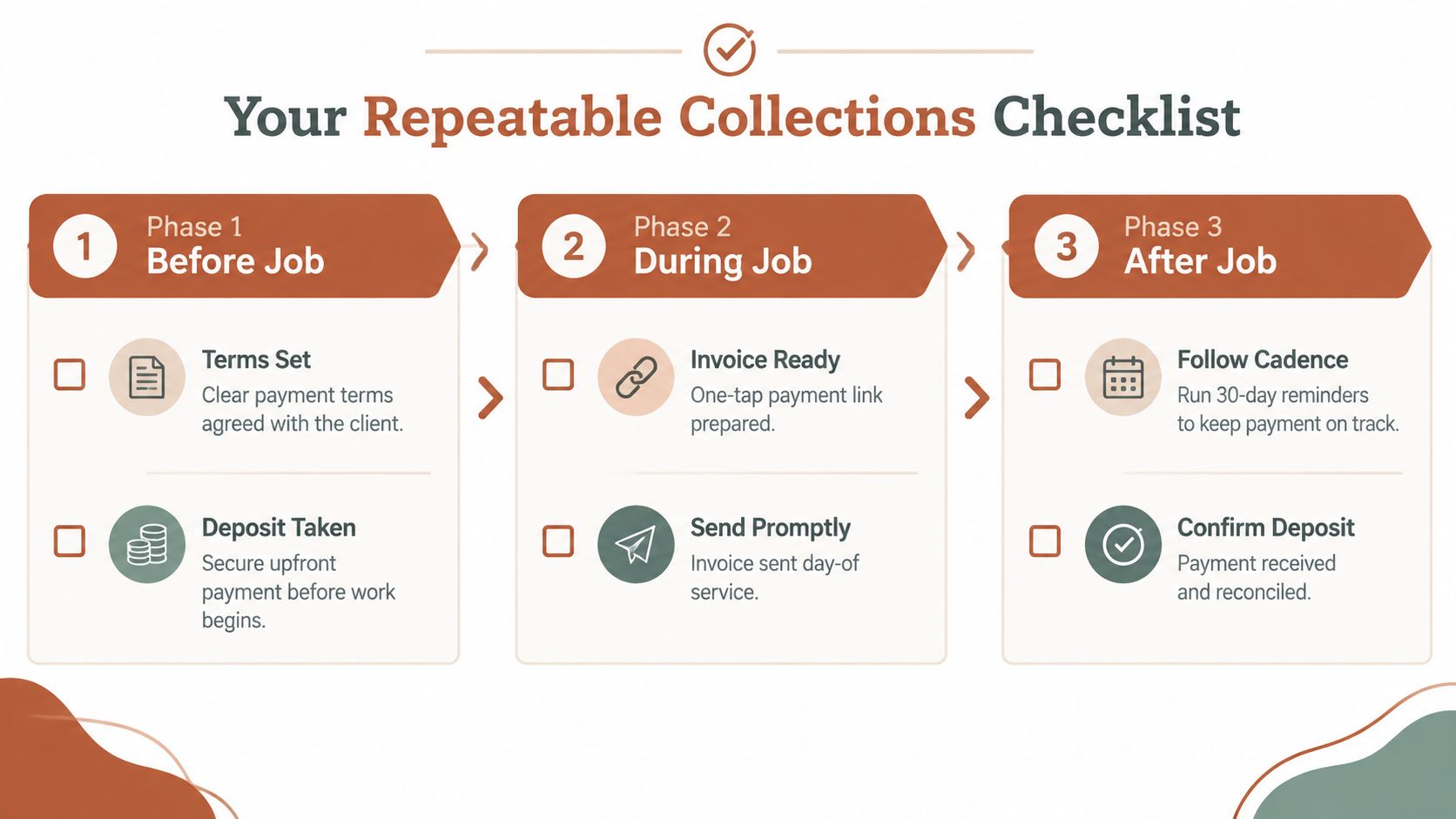
A reliable collection process follows the same rhythm on every job: deposit to work to invoice to reconciliation. You shouldn't have to remember what to do while standing in a driveway, leaving a client meeting, or closing a project late at night.
Save this checklist in your project-management app or print it beside your workstation.
Before the job
- Confirm the scope: Write the deliverables, exclusions, price, and completion condition.
- Set the terms: State the deposit, billing trigger, due date, late-payment policy, and accepted methods.
- Collect the deposit: Receive and reconcile the required upfront payment before reserving the work.
- Confirm the payer: Identify the person who approves invoices and the address where invoices must be sent.
- Prepare the record: Create the client record and connect the quote, agreement, and payment history.
During the job
For a short service, confirm the final balance before you leave. For a longer engagement, issue milestone invoices when the agreed work is complete, not when you suddenly need cash.
- Track the work: Record hours, materials, expenses, and approvals while the details are fresh.
- Watch the scope: Get written approval for additions before doing work that changes the price.
- Keep billing ready: Maintain the line items so the final invoice takes minutes, not a later reconstruction.
- Update the customer: Tell the client when the next billing trigger is approaching.
After completion
Send the invoice the same day the agreed work is complete. Include the exact balance, due date, payment link, QR code, and a direct contact line. Then start the reminder schedule automatically rather than trusting memory.
- Record the send: Keep the delivery time and recipient in the client history.
- Monitor activity: Check whether the invoice was viewed, paid, disputed, or left untouched.
- Run the cadence: Send the planned nudges at the assigned intervals and change channels when needed.
- Reconcile funds: Mark the invoice paid only after the money clears.
- Escalate consistently: Follow the written ladder when the customer misses the next condition.
The maintenance loop keeps the system from degrading. Reconcile the ledger weekly, review overdue accounts monthly, and audit your payment terms quarterly. Look for recurring causes, such as unclear deposits, invoices sent to the wrong contact, missing purchase-order details, or customers struggling with one payment method.
A 2026 QuickBooks small-business report found that 59% of businesses had invoices overdue by 30 days or more, with an average unpaid balance of $17.7K (QuickBooks late payments report). That's a strong reason to review accounts before they reach that age, not after.
Stop treating unpaid invoices as an unavoidable part of solo work. Set the terms before you start, make the invoice payable in one tap, send it immediately, and follow a dated cadence without apologizing for asking to be paid. Put this process into your next quote and invoice today, then reconcile every open account before the week ends.