
You're staring at a blank quote, a client wants a number today, and your gut is doing that annoying thing where it swings between too cheap and they'll walk if I say this out loud. That's usually where people ask how much should I charge, but the core problem isn't confidence, it's that pricing got treated like a mood instead of a system.
A useful price has to do three jobs at once. It has to cover your real costs, reflect the market you sell into, and protect your time when the scope gets messy, which it always does. If you've been using the same rate for years, that also matters, because service prices keep moving. A neutral inflation tracker shows an average annual inflation rate of 4.65% from 1967 to 2026, and the U.S. Consumer Price Index for professional services rose from 442.52 in July 2025 to 457.75 in July 2026, a 3.44% year-over-year increase (FRED professional services CPI).

Why Guessing Your Price Costs You More Than You Think
I've seen the same scene over and over. A solo operator sends a quote, hesitates, trims the number to feel safer, then spends the next week regretting it while the client asks for revisions, faster turnaround, and one more small add-on. The quote was not wrong because the work was bad. It was wrong because the number came from a guess, not from a floor, a market check, or a rule for what gets included.
The hidden cost is not just undercharging
Many freelancers anchor to the cheapest competitor, then shave more off because they feel new, busy, or grateful for the lead. That is a quick way to turn solid work into thin work. You can stay booked and still drift backward if your price never resets while your costs, experience, and response burden keep going up.
The bigger trap is mixing personal worth with business math. Client pushback usually means the logic behind the number is unclear, or the offer is packaged in a way that hides the value. Price conversations get easier when the quote is built from a repeatable method instead of a gut check.
Practical rule: if you cannot explain the number in one sentence, the quote is probably a guess, not a pricing system.
The market itself shows there is no single correct rate. A freelance rates report put the median hourly rate at $95 in North America, $80 in Western Europe, $85 in Australia/New Zealand, and much lower medians in Eastern Europe, Latin America, and South/Southeast Asia at $45, $35, and $25 respectively. That spread matters. Pricing depends on market, specialization, and the kind of trust the buyer is purchasing.
Flat rates that never move quietly become a pay cut
A frozen rate does more than stall growth. It lowers your effective pay every time costs rise and the work expands beyond what you first imagined. Service firms increased prices by an average of 5.0% in 2025, up from 4.1% in 2024, and expected 2026 increases remain above 4% (New York Fed firms inflation expectations). If your price still behaves like it belongs to an older year, you are absorbing that difference yourself.
That is why guessing causes so much damage. The problem is not just a low quote on one job. It creates a pattern, and that pattern makes it harder to separate inflation catch-up from a real value-based raise, or to translate hourly math into flat fees, retainers, and deposits that clients will accept.
Before you calculate anything, gather four things, your true monthly costs, your rough billable hours, your current market benchmarks, and a clear list of what is included in the job. If those are not in front of you, every number you pick is just a feeling with a decimal attached.
Find Your Floor Price With Real Math
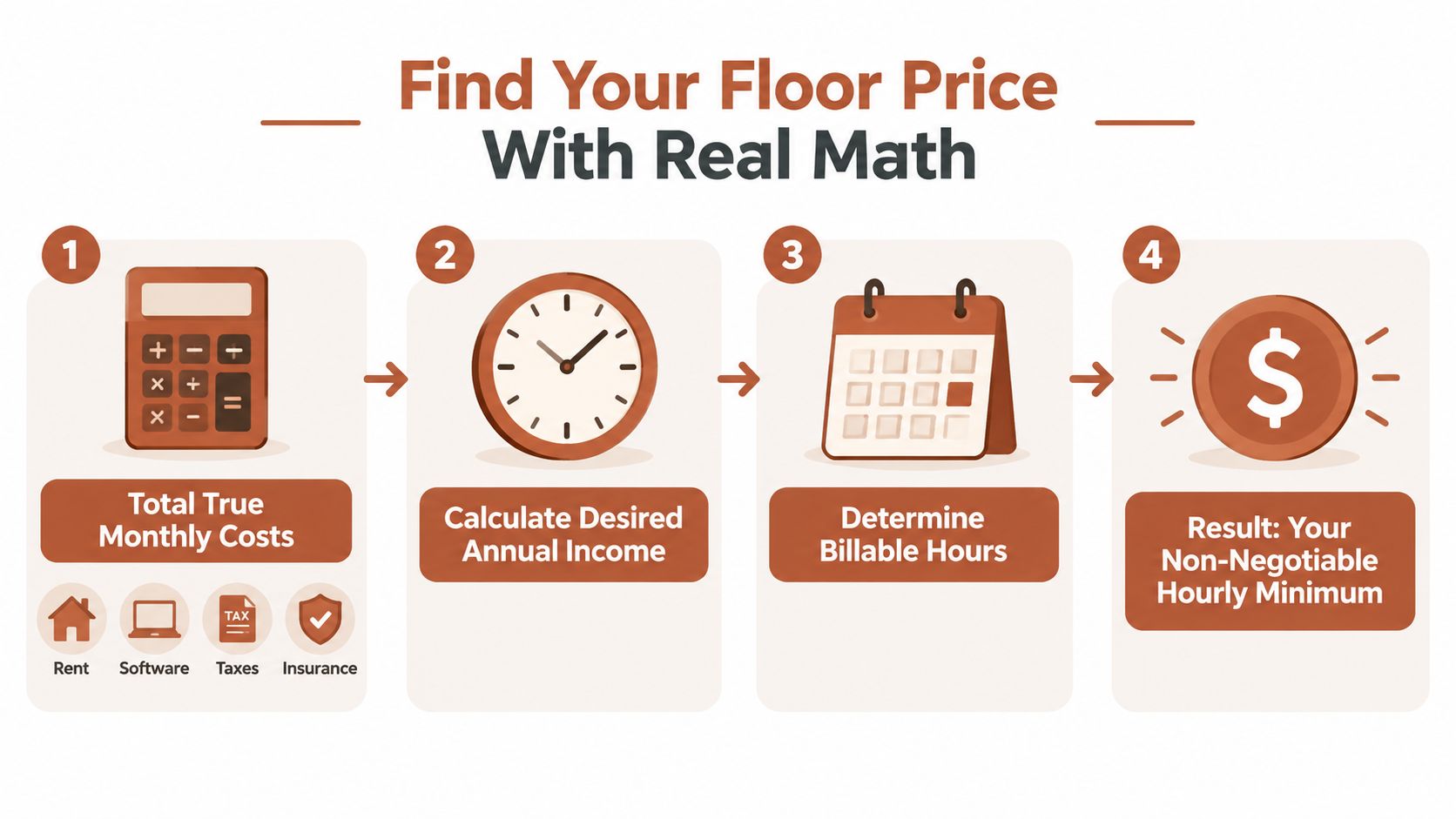
The floor price is the number you cannot go below without subsidizing the client. It's not your dream rate and it's not your market-tested premium. It's the lowest rate that keeps the business healthy after you cover the unglamorous stuff, taxes, insurance, tools, software, and the time you don't invoice.
Start with true monthly cost, not wishful thinking
Add up every recurring cost tied to the business. That includes software, insurance, taxes, admin tools, and any buffer you need for slow months or unpaid time. If you skip the buffer, you'll set a price that looks viable on paper and feels tight in real life.
Then estimate your billable hours, not your total work hours. A 40-hour workweek is not a pricing baseline for a solo operator because you don't bill every hour you work. Sales calls, revisions, admin, travel, follow-ups, and gaps between jobs all eat into the calendar.
Use this simple structure:
Floor hourly rate = true monthly business cost plus desired monthly profit, divided by realistic billable hours
That formula doesn't try to impress anyone. It just keeps you from accidentally pricing below survival level. For teams that want a cleaner way to manage this math in a workflow, time and expense tracking can help keep the numbers visible instead of buried in memory.
Add a buffer for the work that never invoices cleanly
If you only price the visible production time, you'll undercount the job. A tutor may spend time prepping materials and messaging parents. A handyman may quote the repair, then spend extra minutes sourcing parts, coordinating arrival, and cleaning up. Those minutes matter because they're part of the service even when the client doesn't see them line by line.
A workable solo example is simple. Say a tutor has monthly business costs, a target profit amount, and a realistic number of billable hours after admin and prep. Divide the total by the billable hours, and you get the hourly minimum. If the resulting number feels high, that usually means the business was previously relying on invisible labor.
Anything below your floor price isn't a deal. It's a discount you're funding yourself.
A clean way to stay organized is to write your floor number in one place, then keep your target rate, your preferred rate, and your no-go number beside it. That gives you a range instead of a panic response when someone asks for a quote on the spot.
Choose How You Charge Hourly Project and Value Based Models
A fair price can still feel wrong if the billing model fights the work. Hourly pricing rewards time, flat project pricing rewards scope control, retainers reward continuity, and value-based pricing rewards outcomes. The right model depends on how much uncertainty sits in the job and how the client expects to buy.
Compare the models against the work
Hourly works best when the scope is unclear or the task is easy to measure in time. It protects you from surprises, which matters for repairs, troubleshooting, and maintenance where new issues show up mid-job. The downside is simple. If you get faster, your revenue per job does not automatically rise.
Flat project pricing works best when the deliverable is defined. Designers, writers, editors, and many consultants prefer it because the client wants a result, not a stopwatch. The risk is scope creep, so your estimate needs clear boundaries, revision limits, and a trigger for change orders.
Value-based pricing fits work where the client is paying for a business outcome, not labor. That works best when the outcome ties to revenue, conversion, lead quality, or risk reduction. It takes more confidence to sell, but it also gives you room to price against impact instead of minutes.
Retainers work well for repeatable ongoing support. They smooth cash flow and make it easier to bundle admin, communication, and recurring deliverables into one monthly agreement. If you do the same kind of work every month, a retainer often reads better to the client than a stack of disconnected invoices.
Use a decision matrix instead of guessing
| Pricing Model | Best For | Risk to You | Client Perception |
|---|---|---|---|
| Hourly | Unclear scope, repairs, troubleshooting | You cap your upside when you get efficient | Feels familiar, sometimes feels open-ended |
| Project fee | Defined deliverables, creative work, packages | Scope creep if boundaries are loose | Feels tidy and easy to approve |
| Retainer | Ongoing support, repeated monthly work | Underbilling if the scope grows quietly | Feels stable and budgetable |
| Value-based | Outcome-driven consulting, high-trust expertise | Harder to sell if the value is not clear | Feels premium when the result is obvious |
When you're sending estimates, a tool that turns an approved quote into an invoice can cut down on back-and-forth. AurenWell's estimate workflow does that handoff, and the same idea applies even if you use a different system.
Translate hourly math into a project fee
Start with the floor hourly rate from the earlier section, then estimate the hours carefully. Add time for communication, revisions, and anything else that always shows up but never looks glamorous in the proposal. Then decide whether to price the job as a project because that is what the buyer understands best.
If the estimate is built from hourly math, it should still be stated as a flat fee the client can approve. That keeps your pricing anchored in real labor while giving the buyer one number to accept. It also helps to use a tool that turns that estimate into a clean approval flow, like the estimate workflow mentioned above.
A designer who bills hourly may get penalized for working faster. A handyman who bills hourly may get protected from the hidden mess behind the wall. The model should fit the kind of risk you are carrying, matching the actual demands of the job rather than the narrative you hope the market would support.
Research the Market and Package Your Offers to Sell

Once the internal math is done, the next question is whether people will buy at that price. A lot of solo operators get stuck here. They compare numbers all day and never package the offer in a way that helps the client see what changes from one tier to the next.
Pull three kinds of evidence, not fifty competitor tabs
You only need three signals. First, what direct competitors seem to charge. Second, what your ideal client appears willing to pay based on conversations, past closes, and budget language. Third, how much capacity you have, because a price that requires nonstop delivery is not really a price, it's a trap.
The market data already shows why copying another freelancer's quote is weak logic. In one report, U.S. management consultants commonly charged $150–$450 per hour as solo practitioners and $300–$900 per hour for boutique firms, while freelance medians in several regions sat much lower. Analysts at the freelance rates report found that specialization and business model shift pricing a lot, but the report does not give you a ready-made number.
For repeatable service businesses, packaging beats raw hourly comparison. If the buyer only sees an hourly figure, they compare you to the cheapest person with a similar title. If they see a defined outcome, they compare the result, the speed, and the ease of working with you.
Make tiers do the selling for you
Good, better, best works because it gives clients a choice without forcing a custom negotiation every time. The cheapest tier should be useful, not crippled. The middle tier should feel like the obvious default. The top tier should bundle the most support, the fastest turnaround, or the widest scope.
A clean package usually includes:
- Core deliverable: the main work the client is really buying.
- Scope guardrails: what's included and what triggers extra billing.
- Convenience layers: admin help, coordination, or faster response.
- Optional support: recurring check-ins, follow-up, or lightweight maintenance.
That structure also makes flat fees and retainers easier to defend. You are not charging for a mystery. You are charging for a known bundle that saves the client time and cuts down on decision fatigue.
Test new prices on new clients first
New client pricing is the safest place to validate a raise. Existing clients already have a reference point in their head, so keep them on the old rate until you decide whether to grandfather them or move them gradually. That gives you room to protect relationships while still letting the business evolve.
The question is whether your offer is easier to say yes to because the value is clear. Pricing is a number, and it is also the way you frame the work.
Quote Confidently Collect Deposits and Handle Negotiation
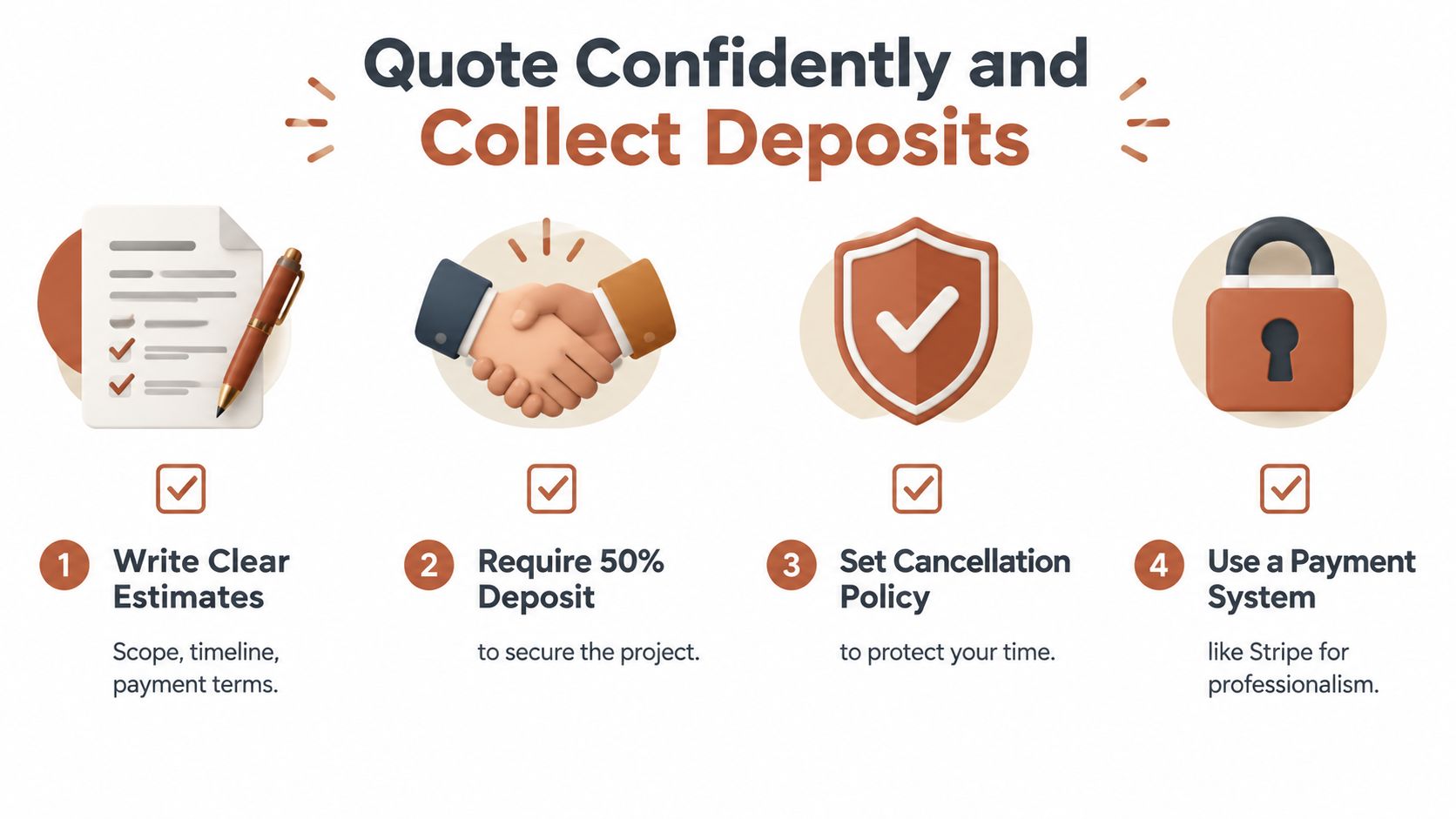
A quote only works if it turns into cash. The handoff from estimate to approval to deposit has to be clear, and the client should know exactly what happens next. If the payment path feels vague, people stall.
Write the estimate like a payment document
A strong estimate does more than name a price. It spells out scope, timeline, revision limits, and payment terms in plain language. If the client cannot see what is covered, they will push on the wrong part of the job.
Make approval easy. Browser-based approval, an e-signature, and a direct move from estimate to invoice cut out the back-and-forth that slows everything down. Solo operators often use simple workflow tools for that reason, because heavy accounting software can add friction where you do not need it.
For contractors who want a direct reference on upfront payment structure, how much deposit contractors should ask for is a useful guide for shaping your own policy.
Hold the line without sounding defensive
If someone says, “Can you do it cheaper?”, do not rush to defend the number. Ask what part of the scope matters most, then cut deliverables instead of cutting your rate. That keeps the price tied to the work, not to your confidence.
Use language that sounds calm and final:
- “I can lower the scope, but I can't lower the price for the same scope.”
- “If budget is tight, I can suggest a smaller version of this package.”
- “That rate reflects the time, coordination, and revisions built into the project.”
Those lines work because they do not argue. They give the client a path forward without teaching them that your first number was fake.
Reduce payment friction before the work starts
Deposits protect your calendar and signal commitment. Milestones help larger jobs feel less risky for both sides. Online checkout shortens the time between approval and payment, and recurring invoices make repeat work easier to manage.
Build reminders into the system instead of your memory. A polite overdue reminder sequence at regular intervals keeps collection from turning into a personal chase. If the payment page allows card, ACH, and optional tipping, that can also make checkout feel more complete for service businesses that welcome it.
Clear terms do not scare away good clients. They filter out the ones who were going to haggle after the work started.
The goal is not to win every negotiation. It is to avoid negotiating against an undefined quote. Once the estimate is clear, the client is responding to a structure, not to a vague number on a page.
When and How to Raise Your Rates Without Losing Clients
A healthy rate needs maintenance. The mistake most solo operators make is treating pricing as a one-time decision instead of a recurring review. That's how a decent number slowly turns into an outdated one.
Separate inflation catch-up from value-based raises
Inflation catch-up is the baseline adjustment that keeps your purchasing power intact. Value-based raises are the ones you justify because you got faster, better, more specialized, or easier to work with. Those are different moves, and mixing them up makes pricing conversations messy.
A practical habit is to review rates once a year and ask two questions. Did costs rise enough that the current number no longer makes sense? Did the value of the service rise enough that the old number is now leaving money on the table? If the answer to either question is yes, it's time to adjust.
Grandfather some clients, move others now
Existing clients usually deserve a smoother transition than new ones. New clients can see the new rate immediately. Long-term clients may need notice, a phased increase, or a grandfathered period if the relationship matters and the workload is steady.
Keep the message short. You don't need a speech, and you definitely don't need to apologize for staying in business. A clean notice says the rate is changing, when it changes, and what stays the same. The less drama you add, the less drama you invite.
Track three signals after the raise
After the new pricing goes out, watch the close rate, the average project value, and how quickly invoices get collected. If close rate stays healthy and collections stay smooth, the raise probably landed in the right zone. If leads disappear, the offer may need tighter packaging, not just a smaller price.
A simple annual checklist keeps the whole system from drifting:
- Review costs and software subscriptions.
- Recalculate the floor rate.
- Check whether your current offers still fit your market.
- Decide which clients get the new rate and which ones stay on legacy pricing.
- Update estimate templates, payment terms, and reminder timing.
That's the part people miss when they ask how much should I charge. The answer isn't a single number. It's a repeatable process that protects your floor, matches the model to the work, and gives you a clean excuse to raise prices before they go stale.
If your rates haven't been reviewed in the last year, block out 30 minutes this week, write down your true costs, set your floor price, and update one estimate template before you send the next quote.