
You've just finished a demanding clean. The kitchen is reset, the bathrooms are done, and the client is happy. Then the administrative part begins: finding the right amount, remembering which extras were requested, creating a PDF, and hoping the client doesn't overlook it in a crowded inbox. A house cleaning invoice should remove that friction, not add to it.
The strongest invoice does more than document work already completed. It clarifies what the client bought, makes add-ons easy to approve, sets a firm payment expectation, and gives the customer a direct path to pay. For a solo operator, that makes invoicing part of the service itself. The U.S. house cleaning industry was estimated at $61.6 billion in 2023, while the global cleaning services market was valued at $442.1 billion in 2025 and projected to reach $770.8 billion by 2033, according to market coverage of the cleaning industry. In a high-volume, repeat-service business, small workflow improvements can matter across many jobs.
The Role of the House Cleaning Invoice
A vague invoice creates a second conversation after the job. The client sees “whole house cleaning” and a total, then starts reconstructing what happened. Was the oven included? Were the inside windows part of the price? Did the visit cover a deep clean or the usual maintenance service? Every unanswered question creates room for delay, negotiation, or a payment dispute.
A well-built invoice closes those gaps while the job is still fresh. It records the service date, the agreed scope, the base cleaning charge, approved extras, applicable taxes, and the exact amount due. The document gives the client a useful reference and gives you a record of what you delivered.
Practical rule: If a client could reasonably ask what a charge means, give that charge its own description or line item.
The invoice also supports premium positioning. A single lump sum makes your work look interchangeable. Itemized service descriptions show that the price reflects distinct tasks, such as standard maintenance cleaning, appliance detailing, or interior window work. Transparency doesn't mean exposing every internal calculation. It means presenting enough detail for the customer to connect the total with the result.
The timing matters just as much as the format. A static attachment can sit unopened, while a digital invoice with a payment link lets the customer review and settle the balance immediately. Stripe's cleaning-service guidance reports that 87% of invoices are paid within 24 hours when Stripe Invoicing is used, a result it connects with online payment access in service billing Stripe's cleaning-service invoice guidance. Your invoice should therefore be designed around the full path from completed work to collected money.
Essential Components of a Professional Invoice
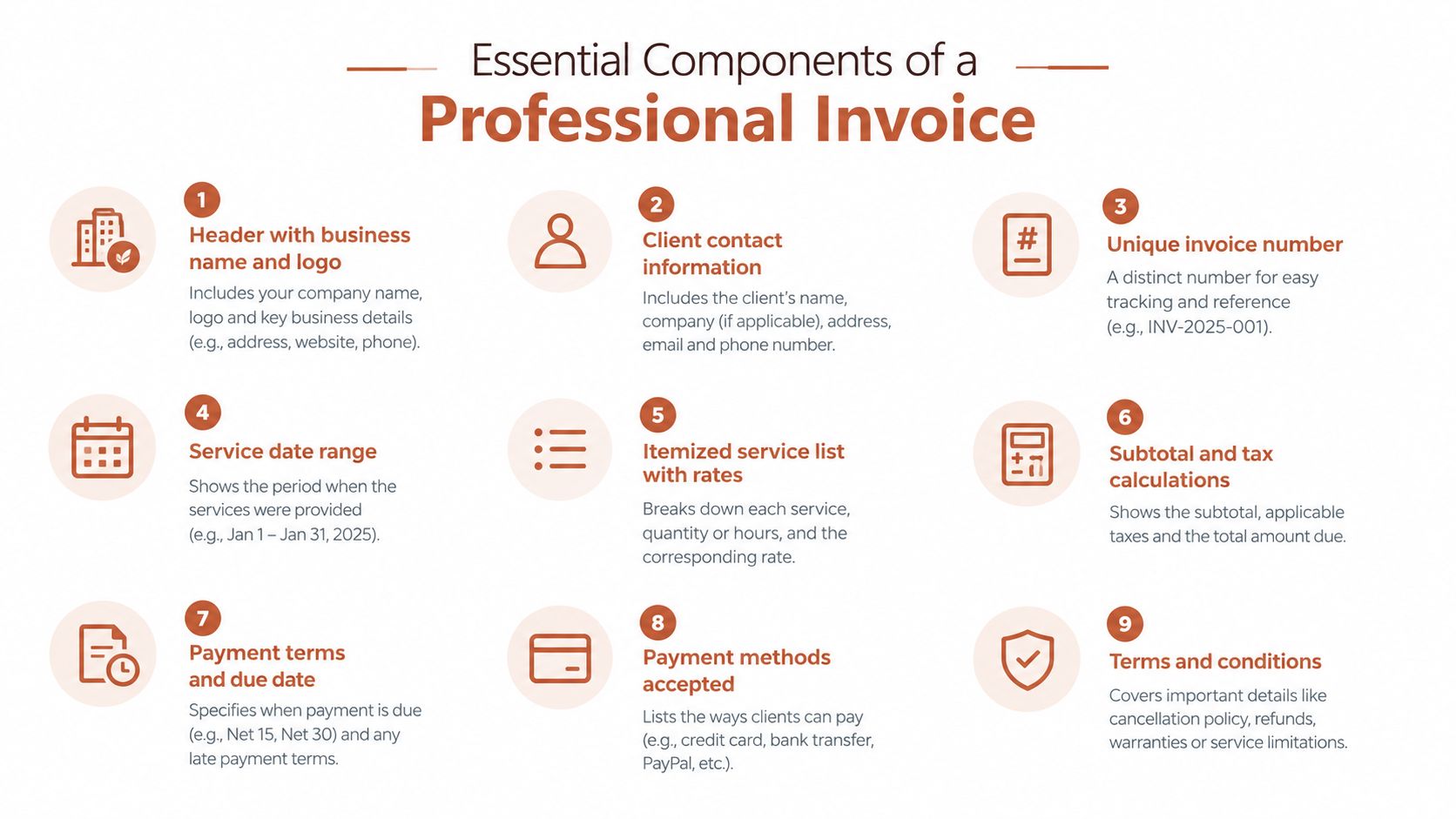
A professional invoice doesn't need elaborate design. It needs complete information arranged so the client can identify the job, verify the charges, and pay without contacting you for clarification.
Build the document in a consistent order
Start with your business identity. Include your trading name, logo if you use one, email address, phone number, and business address where appropriate. The client should know immediately who issued the invoice and how to contact you.
Next, identify the customer and the job:
- Client details: Include the customer's name, billing email, service address, and any account reference you use.
- Invoice number: Assign a unique number using a consistent sequence. Sequential numbering makes missing documents easier to spot and simplifies recordkeeping.
- Service dates: State the date of the visit or the covered period for recurring work.
- Issue date: Show when you sent the invoice, especially if your terms calculate lateness from that date.
- Service list: Describe each cleaning task, quantity where relevant, rate, and line total.
- Totals: Display the subtotal, any applicable tax, adjustments, amount already paid, and balance due.
- Payment instructions: Name the accepted methods and include the payment link, QR code, or bank details.
- Terms: State the due date, late-fee policy, cancellation terms, lockout policy, and any other conditions agreed with the client.
“Pay when you can” isn't a payment term. For small one-off residential cleanings, due upon receipt is a practical default. Ongoing or commercial agreements may use Net 15 or Net 30, provided the client understands the arrangement before service begins. This matches cleaning invoice guidance on numbering, terms, and payment conditions.
Keep the visual hierarchy simple. Put the balance due and payment button where they're easy to find, not buried beneath a long note. A polished invoice earns trust through clarity, not decoration.
Structuring Line Items and Service Add-Ons
The line-item structure determines whether your invoice merely collects the agreed base price or helps you capture the full value of the work performed. “Whole house clean” is fast to type, but it hides the service. It also makes a higher total feel arbitrary if the client remembers asking for several additional tasks.
Use the base service for the repeatable work that defines the appointment. Depending on your package, that might include kitchen surfaces, bathroom sanitation, dusting, vacuuming, mopping, and general tidying. Then separate optional work that changes the time, effort, equipment, or expected finish.
Common add-ons include:
- Interior oven cleaning
- Interior refrigerator cleaning
- Interior windows
- Baseboard wiping
- Pet-hair treatment
- Cabinet interiors
- Move-in or move-out detailing
- Special buildup removal
A separate line tells the customer exactly what increased the price. It also gives you a cleaner sales conversation. Instead of discounting the entire visit, you can remove one optional task if the customer needs to reduce the total. That protects the value of the base service.
| Category | Examples | Billing Method |
|---|---|---|
| Standard service | Routine kitchen, bathroom, floor, and surface cleaning | Fixed package price or recurring rate |
| Deep-clean service | More intensive work across the property | Fixed project price based on approved scope |
| Appliance add-on | Interior oven or refrigerator cleaning | Separate fixed fee |
| Detail add-on | Baseboards, cabinet interiors, or interior windows | Separate fixed fee or scoped line item |
| Special condition | Excess buildup, heavy pet hair, or unusual preparation | Clearly described custom charge |
| Visit-related charge | Agreed travel, lockout, or no-show fee | Disclosed policy charge |
Itemization can increase the average ticket because it makes overlooked needs visible at the point of billing. That doesn't mean adding surprise fees after the fact. The customer should request, approve, or otherwise understand an add-on before you perform it. If the scope changes during the visit, send a quick message and retain the approval with the client record.
The invoice description should be specific enough to stand on its own. “Oven” is weak. “Interior oven degreasing, racks included” gives the client a clearer connection between the line and the completed result. Don't turn the invoice into a work diary, though. A concise description is more useful than a paragraph of cleaning notes.
Handling Taxes, Travel Fees, and Penalties
Extra charges cause disputes when they appear for the first time on the final bill. Handle them as policies, not surprises. Before accepting the booking, explain which charges may apply, when they're triggered, and whether the customer can avoid them.
Treat tax as a local compliance question
Sales tax on cleaning services depends on the jurisdiction and the type of service. Don't copy another cleaner's tax treatment and assume it applies to your business. Confirm the rule with the relevant tax authority or a qualified accountant, then configure your invoice so the taxable subtotal and tax amount appear separately.
A tax line should identify the rate or rule used where required, without pretending that tax is part of your service price. If the service isn't taxable in your area, don't add a decorative tax line that confuses the customer. Keep your records consistent with the treatment you use.
Make travel charges predictable
A travel or trip fee can be reasonable when a property falls outside your normal route or requires a substantially different drive. State the service area and the trigger for the charge in your booking terms. On the invoice, use a direct description such as “out-of-area travel charge for service address,” rather than an unexplained miscellaneous fee.
The same principle applies to no-show and lockout charges. A cleaner may lose the entire appointment window when nobody provides access, but the customer shouldn't learn about the policy only after the missed visit. Include the charge in the estimate, service agreement, booking confirmation, or recurring terms.
Use late fees carefully
Late fees should be disclosed upfront, applied consistently, and allowed under local rules. Put the due date and the consequence in plain language. A calm note such as “Balances unpaid after the due date may incur the late fee stated in the service terms” is clearer than an aggressive warning.
A firm invoice is easier for clients to respect when the policy was visible before the work began.
Estimates vs Invoices for Cleaning Clients
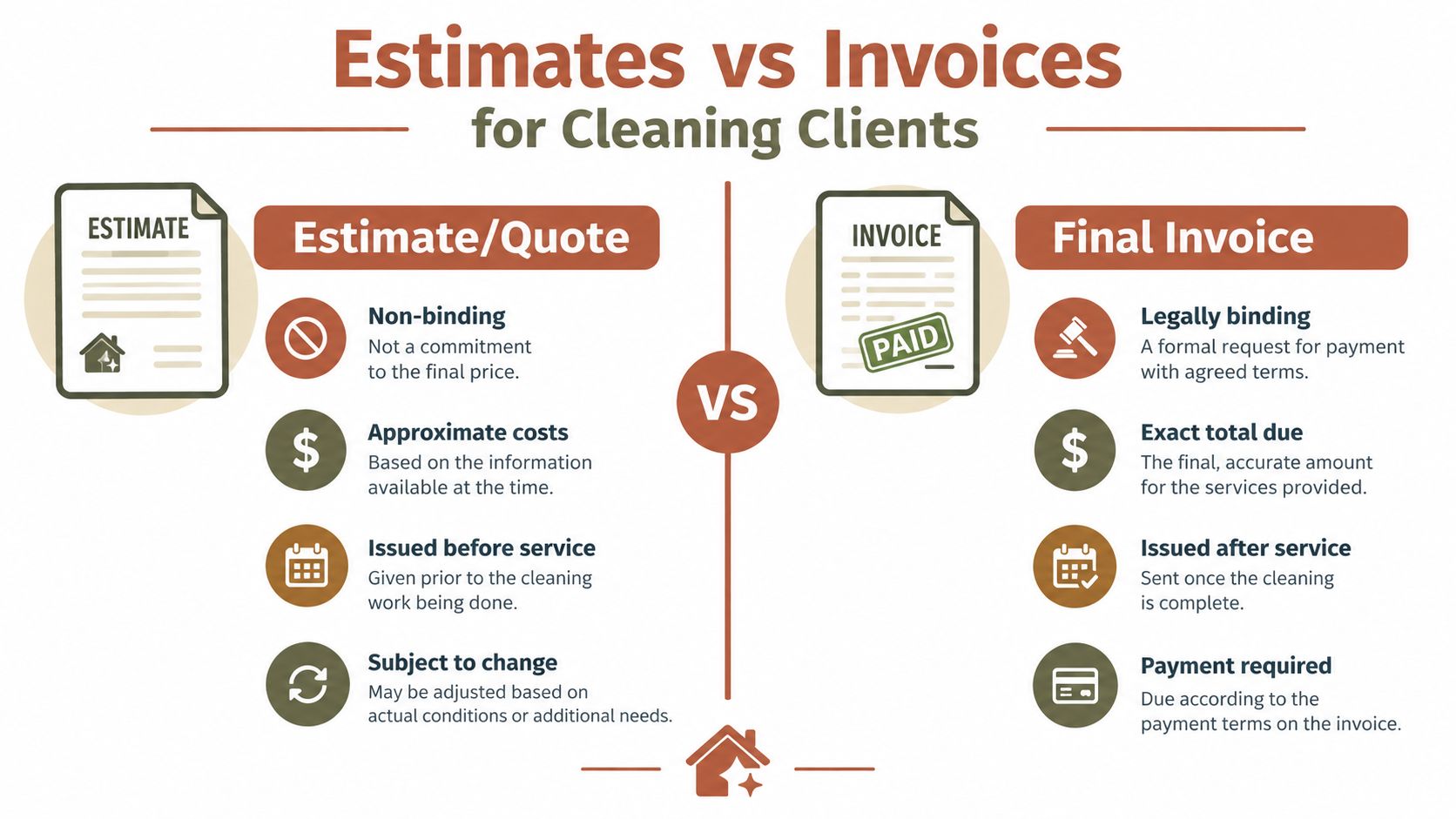
An estimate answers, “What will this likely cost?” An invoice answers, “What exactly is owed for the work performed?” Confusing those documents is one of the quickest ways to create friction when the final amount differs from the initial conversation.
Use an estimate when the scope is uncertain or the job is substantial. Deep cleans, move-in and move-out work, large properties, and homes with unusual conditions usually need a written scope before the appointment. Describe the rooms, included tasks, exclusions, assumptions, optional add-ons, and validity period. If the client adds work, update the estimate or get written approval before proceeding.
An invoice works best when the service is standardized and the price is already known. A recurring maintenance visit with a stable package can often move directly to billing after completion. The invoice should still identify the date, service type, and any approved variation.
Keep approval and payment connected
The smoothest workflow is estimate, approval, service, invoice. A browser-based tool can let the client approve the scope, sign an agreement, and pay a deposit without searching through multiple email threads. After the work is complete, convert the approved estimate into an invoice and adjust only the items that changed.
A PDF can still be useful for records, but it shouldn't be the only route to payment. For a concise explanation of how billing documents differ from proof of payment, review these tax-ready receipt and invoice tips. You can also use a dedicated house cleaner estimate template when you need a repeatable starting point for larger or variable jobs.
Use this short video as a visual primer on the distinction between quoting and billing:
The important control is scope approval. Don't turn an estimate into a final bill with new charges behind the client's back. Show the client what changed and why.
Accelerating Payments with Digital Workflows
A PDF invoice still makes the client do the work of paying. They open the attachment, locate the balance, switch to a banking or card app, enter the details, and remember to confirm the transfer. A payment link removes several of those steps and gives you a clearer record of what remains unpaid.
Place a prominent payment button beside the balance due. Offer the methods your customers use, such as card and ACH, while keeping manual payment recording available for cash, checks, or bank transfers. A QR code helps when you discuss the completed job in person or leave a printed invoice at the property. Used consistently, online payments for service businesses can shorten the path from completed service to collected cash.
Design for mobile completion
Residential clients may review an invoice on a phone, so the total, due date, service summary, and payment action should be readable without zooming. The payment page should open directly from the invoice instead of requiring a complicated account setup.
Keep payment status visible. Record cash and bank transfers against the correct invoice so an automated reminder does not chase a settled balance. A view or activity log can also show whether a client opened the invoice, overlooked it, or needs a personal follow-up.
AurenWell is one example of a solo-service workflow that combines branded invoices, estimates, contracts, payment links, QR codes, manual payment recording, and client history in a browser-based app. Other options include Stripe Invoicing, accounting software, or a payment processor connected to a document tool. Compare fees, available payment methods, export options, and the setup time before choosing.
Automate reminders without sounding hostile
Send the invoice immediately after the job. If the balance remains open, follow up with short, factual reminders that include the invoice number, amount due, due date, and payment link. Avoid adding a long explanation that makes the request easier to ignore.
Use your own collection results to judge whether the workflow works. Track days-to-paid for the ten invoices sent before adding a payment link and the ten sent after. That before-and-after comparison reflects your clients, service area, and route better than a vendor's general claim.
Review the results alongside payment fees and customer preferences. Faster card payments may be worthwhile for urgent jobs, while ACH or bank transfers can suit repeat clients. The goal is a payment process that clients can complete quickly and that leaves accurate records without adding administrative bloat.
Managing Recurring Cleaning Schedules
Recurring clients make billing easier only after you standardize the routine. Give each customer a clear service profile with the address, preferred schedule, package, access instructions, agreed rate, payment method, and relevant notes. Then issue the same recognizable invoice format for every visit.
The recurring invoice should carry the maintenance package as the primary line item. Add a separate line only when the customer approved an extra task or the terms allow a clearly defined variable charge. Consistency helps the client spot changes and helps you notice when a visit was skipped, rescheduled, or underbilled.
Create a repeatable route workflow
A simple operating sequence works well:
- Confirm the schedule: Keep the next service date and access details attached to the client record.
- Complete the visit: Note any approved add-on, unusual condition, or client-requested change.
- Issue the invoice: Send it soon after completion while the work and agreement are still clear.
- Record the payment: Match card, ACH, cash, check, or transfer to the correct invoice.
- Review exceptions: Follow up on unpaid balances and update the next visit only when the schedule changes.
Recurring billing removes repetitive data entry, but it shouldn't remove review. Check the invoice before sending when the property, package, or price has changed. Automated billing is useful for stable services, not a substitute for attention.
If sustainability is part of your positioning, document the products or practices that matter to your customers and use resources such as Fillaree's guide to starting an eco-friendly cleaning routine for ideas you can adapt. Keep environmental claims accurate and tied to what you do.
For recurring schedules, recurring invoice tools for service businesses can automate issuance and reminders while keeping client records connected. Exportable invoice and payment records also make tax preparation less dependent on searching old messages.
Common Invoicing Mistakes to Avoid
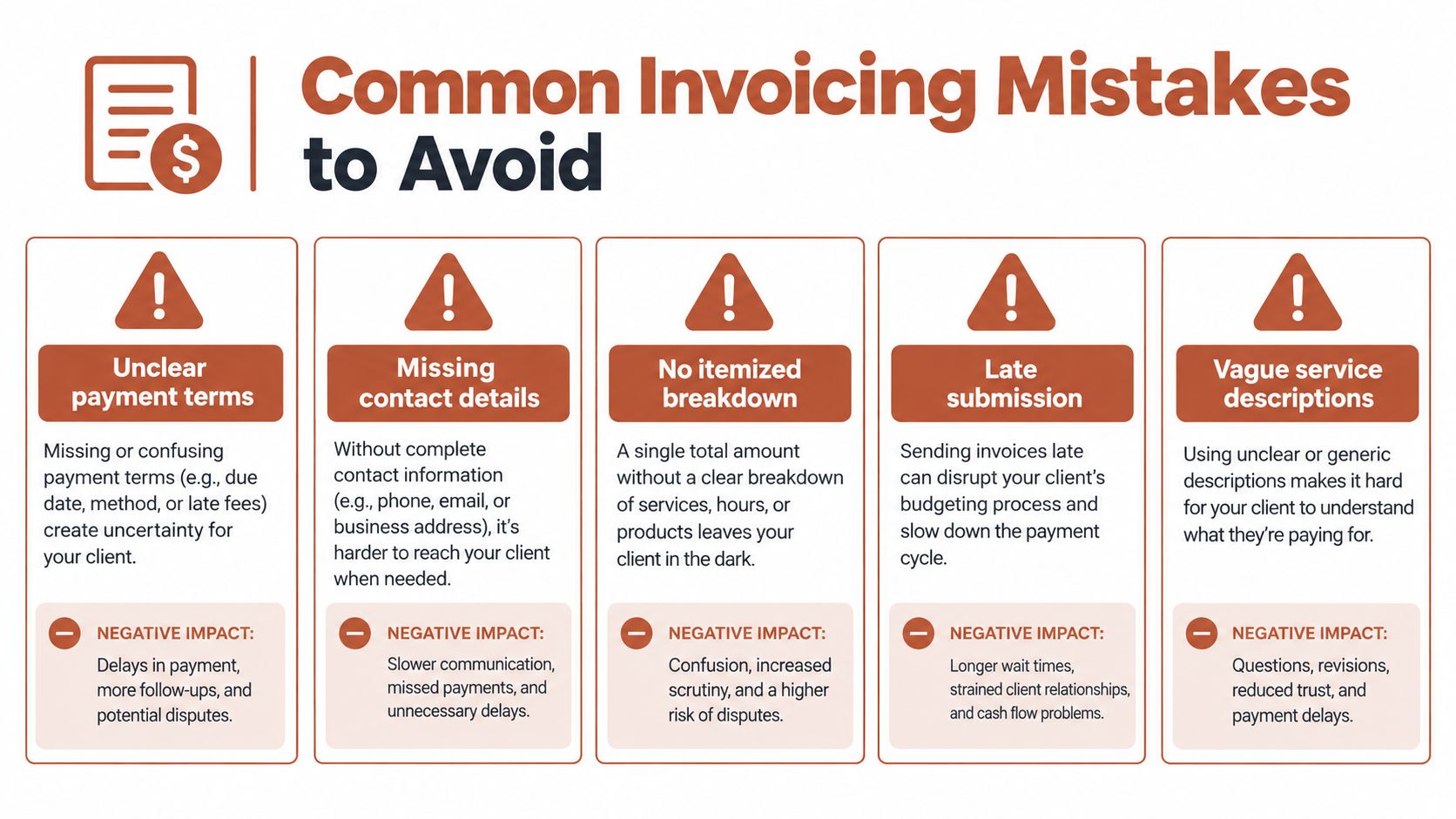
Most billing failures aren't caused by complicated accounting. They come from small omissions that make the client pause. A missing due date, a generic service description, or an invoice sent long after the appointment can turn an easy payment into an administrative conversation.
Run a pre-send check
Before pressing send, look for these common problems:
- Unclear payment terms: Replace “ASAP” with a specific due date or agreed term.
- Missing contact details: Make sure the client can identify the business and reach you without replying to an old message.
- No itemized breakdown: Separate the base cleaning service from approved add-ons and applicable charges.
- Late submission: Send the invoice close to completion, not after several visits have blurred together.
- Vague service descriptions: Replace “cleaning” with a concise description of the actual package or task.
Fix the workflow, not just the document
Missing sequential numbers usually indicate that invoices are being created ad hoc. Choose a numbering pattern and use it every time. The exact format matters less than consistency and the ability to locate the matching client record.
Late follow-ups create another avoidable gap. A polite reminder isn't an accusation. It gives the customer the invoice, balance, due date, and payment route in one place. If a client disputes a charge, respond with the approved scope, service date, and relevant line item rather than defending a total from memory.
Don't overload the invoice with internal notes, long policy text, or every detail of your cleaning process. Put essential terms where clients can find them, and keep the document focused on identification, scope, amount, and payment.
Quick Reference and Billing Glossary
Use this glossary when you're creating or checking a bill from the field.
- House cleaning invoice: The final billing document that records completed cleaning work and states the balance due.
- Estimate: A pre-service pricing document based on an expected scope. It can change when the actual requirements change.
- Line-item detail: A separate description and charge for each service component, such as the base clean, oven, refrigerator, or windows.
- Subtotal: The amount before tax, credits, deposits, or other adjustments.
- Due upon receipt: Payment is expected when the client receives the invoice. This commonly fits small, one-off residential jobs.
- Net 15: The full balance is due within the agreed term after invoicing. Use only when the client accepts the arrangement.
- Net 30: A longer agreed payment term, often suited to established ongoing or commercial relationships.
- ACH transfer: A bank-to-bank electronic payment method available through supported payment systems.
- Recurring billing: Automatic invoice creation or payment collection for a repeating service schedule.
- Deposit: Money collected before the job and applied to the final balance according to the agreed terms.
- Manual payment: A cash, check, or bank transfer payment that you record against the invoice.
- Lockout fee: A disclosed charge that applies when the cleaner can't access the property at the scheduled time.
- Payment link: A clickable route from the invoice to a checkout page.
The field-ready sequence
After the job, confirm the service date and actual scope. Add the base service, approved extras, tax where applicable, and any disclosed policy charge. Check the client details and invoice number, set the due date, then send the invoice with a direct payment option.
When payment arrives, mark the invoice paid and retain the record with the client. If it remains open, send a concise reminder and escalate to a personal message only when the automated path hasn't worked.
For a solo cleaner, the right invoice is small but powerful. It explains the work, supports add-on sales, creates a professional record, and removes unnecessary steps between completion and payment.
Create your own house cleaning invoice template today. Add your business details, standard package, approved add-ons, payment terms, and preferred payment link, then use it for the next completed job. A consistent invoice workflow will help you spend less time chasing balances and more time serving the clients who keep your route full.