
A customer texts while you're still loading the van: “Can you patch the wall, replace the faucet, and look at the sticking back door?” You know how to do the work, but the profitable job starts before the first tool comes out. You need a clear scope, a sensible minimum charge, separate labor from materials, a way to record travel and cleanup, written approval for surprises, and a payment process that doesn't depend on chasing messages later.
That's what makes a handyman job list useful. It isn't just a catalog of repairs. Each category should help you decide what belongs in a quick service call, what needs a material deposit, what works well as recurring maintenance, and where licensing or safety boundaries require a specialist. A strong list also gives you repeatable wording for estimates, contracts, invoices, and change approvals.
The U.S. handyman-services market is highly fragmented. IBISWorld's industry profile estimates about 529,000 handyman-services businesses operating in the United States in 2026, with the work spanning areas such as pipe fitting, HVAC maintenance, carpentry, electrical or mechanical repairs, and building-component installation. That range explains why a solo operator needs a system rather than a loose menu of services.
The practical home repair ideas in these practical home fix guides can help you expand your list, but your administration should stay focused. AurenWell fits that narrow layer between approved work and payment, with estimates, contracts, time, expenses, invoices, deposits, online payments, and client history in one web app.
1. Drywall Repair and Installation
Drywall work is easy to underestimate. A small hole, damaged corner, ceiling patch, or replacement section may require protection, cutting, backing, fastening, taping, multiple coats of compound, sanding, priming, and texture matching. The visible repair may be small, but the labor includes preparation and cleanup that customers often forget when they compare prices.
Quote this work by a clearly defined service unit or by time, depending on the condition. A small, accessible patch can be a flat-fee service, while a ceiling repair or a wall with uncertain damage is safer to estimate with labor, materials, and an allowance for hidden conditions. State whether painting is included, whether texture matching is an exact match or a reasonable blend, and whether furniture moving is part of the scope.

Make the wall repair measurable
Use a work description that names the repair area and finish standard. “Patch damaged drywall in hallway, tape, apply compound, sand, prime, and blend existing texture” is stronger than “fix wall.” Add exclusions for water-source repairs, asbestos-related materials, full-room repainting, and concealed framing damage.
AurenWell's drywall estimate template can help standardize the wording. Attach condition photos before work begins, then use the built-in timer to capture prep, drying-related return visits, installation, and cleanup. If a property manager sends repeated wall repairs, a recurring estimate or invoice workflow can reduce duplicated administration.
Practical rule: Don't price only the time spent spreading compound. Price the complete cycle, including protection, preparation, sanding, cleanup, and any required return visit.
For payment, collect approval before buying specialty materials or scheduling a return visit. Send the invoice promptly after the final coat and include before-and-after photos when they clarify the completed scope. If several small repairs were completed during one property visit, consolidate them into one itemized invoice rather than creating separate payment requests.
2. Plumbing Repairs and Fixture Installation
Small plumbing work often arrives with urgency. A leaking faucet, failed shutoff, loose trap, toilet problem, or fixture replacement can turn into a customer waiting beside a bucket. That urgency makes fast communication valuable, but it also creates risk. A job that looks like a simple replacement may reveal corroded fittings, damaged valves, incompatible connections, or a leak behind the visible fixture.
Keep the boundary clear. Like-for-like fixture replacements and accessible minor repairs may fit a handyman's service range, depending on local rules and qualifications. Work involving concealed supply lines, major drain changes, gas, water heaters, or permit-required plumbing should be referred to the appropriate licensed trade.
Quote the connection, not just the fixture
Your estimate should identify the fixture supplied by the customer or by you, the connection points included, disposal of the old unit, testing, and any assumptions about accessible shutoffs. Include a clause explaining that concealed damage or replacement of nonfunctional valves requires written approval before additional work.
For urgent calls, use a service-call structure that covers travel, diagnosis, and the first defined repair. Don't promise an all-inclusive price before you've inspected the connection. If you source materials, record the purchase and any agreed material handling or markup in the job record.
A mobile workflow matters here. With AurenWell's plumbing services list as a reference for service wording, you can send an approved estimate or invoice from the property instead of waiting until you're back at a desk. A payment link lets the customer review the final amount while the repair is still fresh.
Use a final invoice that separates labor, supplied parts, approved additional materials, and disposal. Note that the system was tested at completion, but don't offer a warranty beyond what you can responsibly support. If the customer hasn't approved additional work, stop at the agreed scope and document the condition with photos.
3. Electrical Work and Outlet Installation
Electrical requests can sound minor while carrying serious safety and compliance consequences. Existing fixture replacement, switch work, outlet-related tasks, and ceiling fan installation may be suitable for some qualified handymen in some jurisdictions. New circuits, panel work, concealed wiring, rewiring, and permit-triggering work belong within the relevant licensing boundary.
Start every estimate with the existing-condition assumption. State that the price covers work on an accessible, suitable electrical box or circuit, and that damaged wiring, inadequate grounding, overloaded circuits, or code-related corrections are excluded unless separately approved and legally permitted.
Separate the visible result from the safety investigation
A good electrical estimate has distinct lines for labor, fixtures or devices, boxes, fasteners, and other materials. It also describes testing. “Install outlet” leaves too much unsaid. “Replace existing outlet at accessible box, connect to existing wiring, secure faceplate, test operation, and clean area” gives the customer a usable scope.
Track assessment time separately from installation time. A site visit that reveals an unsafe condition is still professional work, even if the original installation doesn't proceed. Photos and notes in the client record can save time when the same customer later asks about another fixture or room.
Use a contract or service agreement to document limitations before starting. Don't use a disclaimer as a substitute for licensing, safe practice, or a proper referral. If the work crosses your boundary, explain what you can do and identify the specialist the customer needs.
For payment, require written approval before ordering non-returnable fixtures. The invoice should identify the installed item, labor, approved materials, testing performed, and any excluded correction. That level of detail helps the customer understand the price and gives you a useful record for future maintenance.
4. Painting and Finishing
Painting profitability is decided before the first roller touches the wall. Preparation can include washing, scraping, sanding, caulking, patching, masking, moving or protecting furniture, priming, and cleaning tools. Customers usually notice the final finish, so an estimate that only describes “paint room” leaves you exposed to disagreements about preparation and coverage.
Choose a pricing method that matches the job. A small touch-up may suit a service minimum. A predictable room can use a flat project price. Larger work may need separate preparation, labor, materials, and return-visit lines. Don't promise that one coat will cover every existing color or condition unless you've inspected it.
Put assumptions in writing
Record the selected color, sheen, product responsibility, number of coats, trim inclusion, ceiling inclusion, and furniture expectations. Clarify whether minor wall repairs are included or billed separately. If the customer changes color after materials are purchased, treat that as a change rather than absorbing it without a formal agreement.
Photos help establish the starting condition, especially where there are stains, damaged surfaces, glossy finishes, or uneven previous repairs. An estimate can also state that concealed moisture, peeling layers, lead-related concerns, or extensive substrate repairs require a revised scope.
For a property manager, recurring touch-up work can be scheduled as maintenance rather than re-quoted from scratch each time. Still, inspect each site because paint condition and access can vary. A recurring invoice is useful only when the service itself is genuinely repeatable.
Collect a deposit when the job requires substantial materials or extended scheduling. Convert the approved estimate to an invoice after completion, attach completion photos, and itemize approved expenses. If the customer pays online, the payment record stays connected to the invoice instead of getting lost in a text thread.
5. Carpentry and Wood Repairs
Carpentry ranges from a loose cabinet hinge to custom shelving, door hanging, trim replacement, deck repairs, and work that may affect structural performance. The material may be inexpensive, but accurate measurement, site protection, sourcing, fitting, and finishing take time. Custom work also carries a design risk because the customer may change preferences after fabrication has started.
Break the estimate into stages when the work is custom. Design or measurement, material sourcing, fabrication, installation, and finishing should be visible as separate activities. That structure helps the customer understand why a small-looking shelf or trim project can require more than one visit.
Control custom-work changes
Write down dimensions, wood species or board type, edge treatment, finish, hardware, mounting method, and the number of revisions included. Don't begin fabrication from a casual text message if the materials are expensive or difficult to return. Get signed approval before ordering.
Time tracking should include measuring, supplier visits, loading, shop preparation, installation, and cleanup. Those hours are part of the job even though the customer sees only the finished cabinet or shelf. Expense capture with receipt photos also helps you compare your original material assumption with the actual purchase.
Use phased billing for larger carpentry projects. A deposit can support material purchases, while later invoices follow completed stages. The agreement should distinguish workmanship from product warranties and explain what happens if the customer changes dimensions, finish, or layout after approval.
For a small repair, a flat fee may be efficient. For a custom build, hourly labor plus materials or a detailed project price is safer. Whichever method you choose, list exclusions such as concealed framing damage, structural engineering, permit work, and customer-supplied materials that arrive damaged or incomplete.
6. HVAC Maintenance and Filter Replacement
Basic HVAC maintenance can create repeat business, but it requires a disciplined scope. Filter replacement, accessible cleaning, thermostat installation, and visual checks may fit a handyman's offering when performed within the operator's training, licensing, and local requirements. Refrigerant handling, major repairs, gas work, duct modifications, and complex diagnostics require the appropriate HVAC professional.
Define the service level precisely. A filter visit is different from a system inspection. A thermostat replacement is different from diagnosing an equipment fault. If you sell several service levels, name what each one includes, what it doesn't include, and what condition triggers a referral or revised estimate.
Turn seasonal work into a dependable route
Recurring maintenance works when the customer knows what will happen at each visit. Record equipment location, filter dimensions, access notes, customer preferences, and any observed condition. Send a reminder before the relevant seasonal transition, but avoid implying that a reminder means the appointment is already confirmed unless it is.
Use recurring invoices only for a stable service agreement. If the customer's equipment, access, or filter requirements change, update the agreement before billing. A separate diagnostic visit should have its own scope and invoice so customers don't confuse routine maintenance with repair work.
Track time by task. Filter replacement, inspection, customer communication, and sourcing should not disappear into one vague line. Those records show whether a recurring route is priced correctly and whether a service level is taking longer than expected.
When recommending an upgraded filter or thermostat, explain the reason in plain language and obtain approval before installation. Don't use technical terms as a sales tactic. The customer should understand what is being replaced, why it fits the system, and what remains outside your scope.
7. Flooring Installation and Repair
Flooring is material-heavy and condition-sensitive. Vinyl, laminate, tile, hardwood repair, and subfloor work can all look straightforward until removal exposes uneven substrate, moisture, damaged underlayment, or previous installation defects. Your estimate needs to separate demolition, disposal, preparation, installation, transitions, and finishing.
Inspect the site before promising a fixed price. Record measurements, access conditions, furniture responsibility, existing floor condition, and the customer's selected product. If the customer supplies materials, state that delays, shortages, damaged cartons, or incompatible components may change the schedule and labor cost.
Protect the estimate from hidden substrate work
Use separate lines for removal, subfloor preparation, underlayment, installation, trim or transitions, sealing, and cleanup. Add an allowance or change-order process for conditions that cannot be verified without removal. Never bury a vague “miscellaneous” charge where a clearly described condition would be more professional.
A deposit is sensible when you must purchase material specifically for the job. Tie it to the approved estimate and explain whether unused customer-funded material is returned, credited, or retained for a later phase. Keep receipts and document product details for the final record.
Track removal, preparation, installation, and finishing separately. If preparation consumes more time than expected, you'll know whether to revise future estimates or tighten your inspection process. Include any workmanship and material warranty language in the signed agreement, without promising performance controlled by the manufacturer or the substrate.
8. Gutter, Downspout and Exterior Cleaning
Gutter cleaning, downspout work, minor gutter repair, and pressure washing fit naturally into seasonal maintenance, but they are not identical services. Gutter work involves ladder safety, debris removal, flow testing, and condition documentation. Pressure washing involves surface selection, water control, detergents, equipment setup, and protection of nearby finishes.
Price predictable cleaning as a flat service or package. Price repairs and storm-related work from an inspected scope. For gutter work, describe access, debris disposal, downspout testing, and whether minor fastener adjustments are included. A linear foot gutter pricing guide can help you think through measurement methods, but your final quote still needs to reflect access and risk.
Sell maintenance without overselling
Photograph blocked sections, sagging runs, damaged outlets, loose downspouts, and areas where water is discharging incorrectly. Explain the recommendation and let the customer approve additional work separately. A cleaning visit shouldn't automatically become a replacement project.
For pressure washing, specify the surfaces and treatment. House siding, a deck, a driveway, and a fence may require different methods. Exclude fragile paint, failed coatings, unstable substrates, and repairs that should happen before washing. Travel, setup, hose management, and cleanup belong in your price.
A seasonal customer can be placed on a recurring invoice schedule for agreed maintenance. Send the invoice from the driveway after the work is complete, with photos and a payment link. This pressure washing invoice guide can help you structure lines for labor, service areas, approved treatments, and extra work.
Job-site rule: Never let a recurring schedule replace a condition check. Each visit should confirm that the agreed service remains appropriate.
9. Door and Window Repair and Installation
Doors and windows combine appearance, security, weather control, and precise fitting. A repair may involve hinges, latches, strike plates, weatherstripping, locks, screens, glazing, caulk, or frame adjustments. A replacement can involve measurements, product ordering, trim, finishing, and conditions that aren't visible until removal.
Write the specification in detail. Identify the opening, product type, dimensions, swing or operating direction, finish, glass or screen details, hardware, and disposal. For customer-supplied products, state that installation depends on the item being correct, complete, and undamaged.
Get approval before ordering
Custom or non-returnable materials should never be ordered from an informal request. Use a signed estimate or contract that confirms the selected model, finish, hardware, and installation assumptions. The cracked door repair guide may help you explain why a visible crack can require more than cosmetic filler, but your own inspection determines the actual scope.
Separate measurement, removal, installation, adjustment, sealing, and finishing in the estimate. A door that requires trimming or frame correction needs different labor from a straightforward replacement. A window that has hidden rot or water damage needs a change approval before you extend the work.
Keep before-and-after photos with the client record. Include warranty information for your workmanship and identify manufacturer coverage separately. If the opening affects structural work, exterior envelope performance, or permit requirements, stop and confirm the correct licensed path before proceeding.
10. Deck Building and Maintenance
Deck work can range from board replacement and cleaning to staining, sealing, railing repair, and substantial construction. The larger the project, the more important it is to separate cosmetic maintenance from structural responsibility. Posts, footings, ledgers, framing, stairs, and railings can involve safety, code, engineering, and permit requirements.
For a maintenance visit, document the condition before quoting. Identify washing, sanding, spot repairs, stain or sealer, color, access, and drying assumptions. Don't promise a uniform finish when boards have different ages, previous coatings, or weather exposure.
Use phases for project work
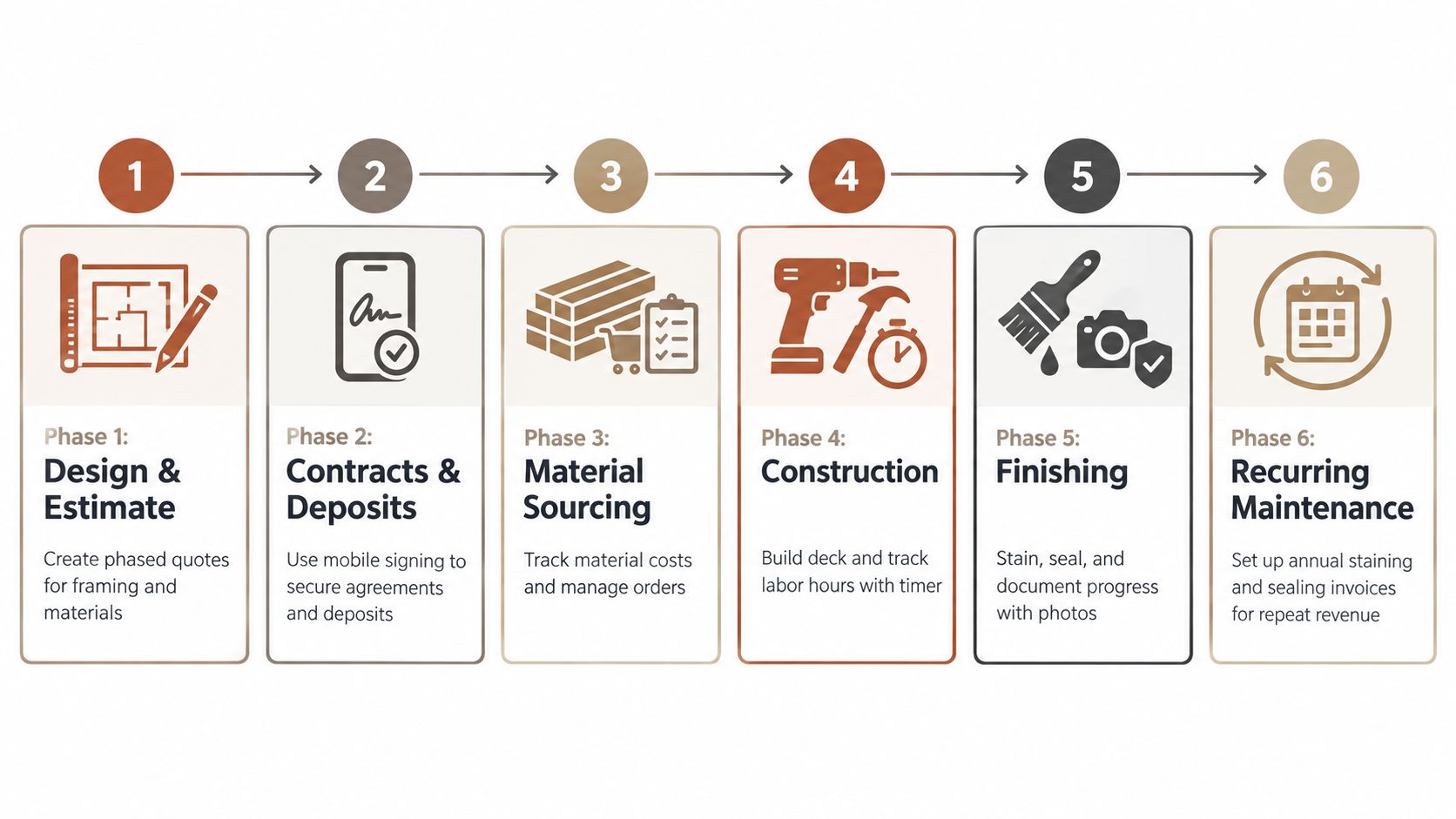
A larger deck estimate should separate design, inspection, demolition, foundation or framing, material installation, finishing, and cleanup. Each phase gives the customer a clear approval point and gives you a logical place to bill. Material deposits should be tied to actual purchasing needs, not treated as an unexplained upfront demand.
Record measurements, selected materials, fastener types, color, railing details, and warranty terms in the contract. Progress photos protect both sides when work happens over several visits. Track time by framing, installation, repair, and finishing so the next estimate reflects your actual production rather than memory.
Annual staining and sealing can become recurring maintenance for customers who want reminders. The agreement should still allow for a condition review because weather, wear, and prior coatings change the work from season to season. If the inspection shows structural deterioration, refer the customer or revise the scope before applying a cosmetic finish.
Top 10 Handyman Tasks Comparison
| Service | Complexity 🔄 | Resources & Licensing ⚡ | Expected outcomes ⭐ | Ideal use cases 💡 | Key advantages 📊 |
|---|---|---|---|---|---|
| Drywall Repair and Installation | Medium, skill for texture/finish; scope-creep risk | Low tools; moderate materials; no license | ⭐⭐⭐⭐, smooth wall restoration, high client demand | Patch repairs to full wall replacements; property maintenance | Billable by hour/sqft; easy time-tracking; repeat business |
| Plumbing Repairs and Fixture Installation | Medium–High, hidden damage, emergency scheduling | Moderate tools & parts; licensing may apply; material passthrough | ⭐⭐⭐⭐, fast problem resolution; high perceived value | Leak fixes, fixture swaps, emergency calls | Premium emergency rates; mobile invoicing accelerates payment |
| Electrical Work and Outlet Installation | Medium, safety-critical; licensing limits scope | Moderate tools; licensing/insurance often required | ⭐⭐⭐, reliable upgrades when within scope; safety-dependent | Outlet/switch installs, fixture swaps, fan installation | Straightforward pricing; material markup; steady homeowner demand |
| Painting and Finishing | Low–Medium, prep time varies; weather-sensitive | Low tools; predictable materials; seasonal constraints | ⭐⭐⭐⭐, visible transformations; strong social proof | Room repaints, trim work, exterior when weather permits | Flexible pricing models; fast estimate→invoice workflow |
| Carpentry and Wood Repairs | High, precision and high skill required | High tool investment; material sourcing and workspace needed | ⭐⭐⭐⭐, premium workmanship; high perceived value | Custom shelving, cabinet repair, door hanging, deck repairs | Premium labor rates; referrals and portfolio-building |
| HVAC Maintenance and Filter Replacement | Low–Medium, tune-ups simple; major repairs need license | Low for filters; licensing for refrigerant/major repairs | ⭐⭐⭐, predictable, recurring results; seasonal peaks | Filter changes, thermostat setup, seasonal inspections | Ideal for recurring invoices; predictable revenue stream |
| Flooring Installation and Repair | High, subfloor issues and precision impact timelines | High material costs; specialized tools; deposit recommended | ⭐⭐⭐⭐, high-value visual impact; durable results | Vinyl/laminate/tile installs, hardwood refinishing, repairs | Premium project pricing; material + labor markups; upsell options |
| Gutter, Downspout & Exterior Cleaning (incl. Pressure Washing) | Low, seasonal; safety at heights is main concern | Low equipment barrier; maintenance and insurance recommended | ⭐⭐⭐, fast, visible results; strong recurring potential | Spring/fall cleanings, storm emergency repairs, driveway/ deck washing | Quick jobs; recurring clients; cross-sell gutter guards and sealing |
| Door and Window Repair and Installation | Medium, precise measurements; custom lead times | Moderate tools; potential lead times for custom units | ⭐⭐⭐⭐, functional and aesthetic improvement | Door/window replacements, weatherization, lock upgrades | Material markups; energy-efficiency upsells; repeat installs |
| Deck Building and Maintenance | High, structural work, permitting, long timelines | High materials and specialized tools; permits/inspections may apply | ⭐⭐⭐⭐, durable high-value asset; long-term client relationships | New deck construction, major repairs, seasonal staining/sealing | High margins; phased billing; marketing through portfolio examples |
Build a Handyman Job List That Gets You Paid
A useful handyman job list starts with your real operating limits. Don't copy every task you see online. Choose services you can perform safely, legally, and consistently with the tools, insurance, training, and time available to you. The broader handyman market includes many trades and maintenance activities, while demand is sustained by recurring repair needs across homes and businesses, as described in the global handyman-services market overview. That breadth creates opportunity, but it also makes boundaries essential.
For every service, answer the same practical questions before accepting the booking:
- What is included: Name the exact repair, installation, maintenance visit, or project phase.
- What is excluded: Identify concealed damage, permit work, structural changes, specialty trade work, disposal limits, and customer responsibilities.
- How will it be priced: Choose a flat service price, hourly labor, a minimum call-out, a bundled visit, or a phased project price based on predictability.
- What materials are needed: Separate customer-supplied items, operator-supplied materials, approved markups, delivery, disposal, and specialty purchases.
- What could change the price: State the condition that requires a written change approval.
- What evidence will you keep: Take condition photos, record measurements, save receipts, and note customer selections.
- When will payment happen: Define deposits, progress billing, final invoicing, online payment, and accepted manual payment methods.
Pricing is where many solo operators underbill. A job can be technically easy and still be unprofitable after travel, sourcing, loading, setup, waiting, cleanup, and collection time. Current pricing guidance commonly places U.S. handyman work around $50 to $150 per hour, with small jobs often sold as flat fees and minimum call-out charges commonly around $75 to $200, according to HomeAdvisor's handyman cost guide. Use those figures as market context, not as a substitute for calculating your own costs and target margin.
The right question isn't only whether you can complete the task. Ask whether the visit works as a standalone job, whether it should be bundled with nearby work, whether a material deposit is needed, and whether the service could become recurring maintenance. A short drywall patch may need a service minimum. A flooring project may need phased billing. A seasonal gutter route may benefit from recurring invoices. A custom carpentry job needs signed specifications before you purchase material.
Your administrative handoff should follow the physical job:
- Inspect the site and document existing conditions.
- Write the scope, assumptions, exclusions, and price.
- Obtain approval and any appropriate deposit before ordering materials.
- Use a contract when specifications, safety boundaries, warranties, or payment stages need more detail.
- Track labor from arrival through cleanup, not just tool-on-task time.
- Capture material and expense receipts while they're fresh.
- Record approved changes before performing extra work.
- Send a complete invoice as soon as the agreed work is finished.
- Offer an online payment option and record cash, check, or transfer payments accurately.
- Review the job after collection and update your next estimate.
That last step improves your list over time. Compare estimated hours with actual hours. Check whether materials, delivery, disposal, and travel were priced correctly. Note which scope changes happened repeatedly. Review how long customers took to approve and pay. If a service regularly creates unpaid return visits, unclear expectations, or difficult collections, change the service wording or stop offering it as currently structured.
AurenWell is one optional administrative layer for this process. Its estimates can move into invoices, contracts can capture signed scope, deposits can be collected through approved documents, time and expenses can be recorded against the job, and payment reminders can support collection. Its client record also gives you a place to keep prior estimates, invoices, signatures, payments, photos, and service notes without building a separate system from scattered files and messages. The platform is designed for one-person service businesses rather than dispatch, payroll, or full accounting operations. Details and availability may change, so review the current information at AurenWell.
A professional handyman job list should make the next decision easier. It should tell you what to inspect, what to write, what to charge, what to document, and when to stop or refer the work. Build the list around the jobs you can deliver well, then connect every accepted job to a clear estimate, approved scope, tracked cost, prompt invoice, and reliable payment path.
Choose your ten strongest services this week and turn each one into a reusable estimate template. Add the scope, exclusions, material rules, payment terms, and safety boundary, then test the workflow on your next booking with AurenWell or the administrative system you already trust. The goal is simple, finish the work with confidence and leave the job with the approval, records, and payment already moving.