
You're a solo cleaner with a service to sell, but the name still isn't settled. One option sounds premium, another feels local, and a third promises speed or eco-consciousness. The choice matters because your name appears before a prospect sees your reviews, estimate, or service standards. The global cleaning services market was valued at over $396 billion in 2023 and is projected to exceed $698 billion by 2032, according to business naming trend research from Name Fatso. In a large, competitive market, a clear promise can help a prospect understand your offer quickly.
The best name isn't the most creative one. It's the name whose promise matches your target client, pricing, service area, and the evidence you can provide consistently. Below are 10 good cleaning service names organized around five positions: professional quality, transparency, speed, trust, and specialization. Use the Star Cleaner Australia guide to starting a cleaning business for broader setup guidance, then test the names against real conversations, search results, and client documents. Consistent use across estimates, contracts, invoices, reminders, and payment links can also make a solo operation feel more established. Tools such as AurenWell can keep that chosen name visible throughout the document and payment workflow.
1. SparkClean Pro
SparkClean Pro makes a direct promise about polished results and professional execution. “Spark” creates an immediate visual association with brightness, while “Clean” tells prospects exactly what the business does. “Pro” adds a more formal tone, which suits a solo cleaner who wants to avoid sounding like the lowest-cost option.
This name works best for residential clients who value a finished, carefully presented home, as well as small offices that want a dependable service without an overly corporate identity. It has enough energy for a van, uniform, or social profile, but it still sounds credible on an estimate or contract.
The positioning trade-off
The main risk is familiarity. Words such as “spark” and “clean” appear frequently in the sector, so the name may need a distinctive visual identity, local modifier, or strong tagline to stand apart. It also implies professional quality, so rushed work, vague scope descriptions, or inconsistent arrival times can undermine the brand.
Use the name consistently in AurenWell estimates, invoices, contracts, and payment pages. A line such as “Where Details Shine” reinforces the promise without adding another service claim. Keep the styling consistent too. Choose one spelling, one capitalization pattern, and one logo treatment.
Practical rule: If you choose a quality-focused name, show the quality in the scope of work, service standards, and follow-up communication.
For search, pair the brand with a location and service phrase on your website and business profiles rather than forcing a city into the legal name. “SparkClean Pro, home cleaning in [City]” is easier to understand than an awkward keyword-stuffed variation.
2. Crystal Clear Services
Crystal Clear Services sells two promises: visible cleanliness and clear dealings. Clients can expect surfaces they can see are clean, quotes they can understand, and recurring arrangements without surprises. That positioning suits a solo operator competing with vague estimates or unclear service terms.
The name fits window cleaning especially well, yet it also covers homes, offices, move-out work, and detail-focused maintenance. Its breadth supports future expansion. The trade-off is weaker category clarity, since the name alone does not say which cleaning service you provide.
Make clarity the proof
Choose this name only if your sales process matches it. State the rooms, tasks, exclusions, arrival expectations, and payment terms in plain language. An estimate that says only “deep clean” makes Crystal Clear Services sound like an empty promise.
The name must also survive spoken referrals. Ask a friend to write it down after hearing it once. If they leave out “Services,” introduce it as “Crystal Clear Services, residential and office cleaning.” Keep the business name identical on every estimate and recurring invoice so clients never see a second spelling of the brand. AurenWell documents can support that consistency without becoming the brand itself.
Use “Transparent Pricing, Spotless Results” only when your prices and service descriptions prove it. The line reinforces the positioning, but “clear” cannot replace a precise scope of work.
Services is the weak point. UK business naming research found the word in 5.4% of business names between 2015 and 2020, as reported by research on naming service businesses. Because the term is common, distinctiveness must come from your local search presence, reviews, photography, and client experience. Pair the brand with your location and service phrase on your website and business profiles, rather than forcing keywords into the business name.
3. SwiftFinish Cleaning
SwiftFinish Cleaning targets clients who care about punctuality, efficient visits, and a clean result without unnecessary disruption. “Swift” signals speed, while “Finish” suggests completion rather than frantic work. Together, they suit weekly home maintenance, office cleaning outside business hours, and time-sensitive turnover work.
This is a strong choice if you can reliably communicate arrival windows, expected duration, and what the client will receive at the end of the visit. It's weaker for a business built around slow, highly detailed restoration unless you explain that “swift” refers to organized execution, not shortcuts.
Make speed credible
Your estimate should state the service scope and expected duration in understandable terms. If a client compares several providers, a clear schedule can make the name feel concrete. A recurring invoice can also use the same SwiftFinish spelling so clients recognize the charge immediately.
The risk is overpromising. A name that emphasizes speed can make customers worry that corners will be cut. Counter that concern with a written quality standard, a room-by-room scope, and a simple process for reporting missed work. Include those details in contracts and recurring service agreements.
Use time tracking when it helps explain the work, but don't make the brand depend on a promise of being the fastest provider. The defensible promise is organized, punctual service that respects the client's time.
For local SEO, keep “Cleaning” visible in the brand presentation and use the service area in page titles, profile descriptions, and service pages. The name should remain readable in a phone conversation, on an invoice, and in a text message. If prospects can't tell whether you clean homes, offices, or exterior surfaces, add a descriptive tagline.
4. DetailOriented Solutions
DetailOriented Solutions makes thoroughness the central promise. It fits a solo operator who wants to serve clients with demanding checklists, move-out work, post-construction cleanup, or upscale residential properties. “Solutions” also gives the business room to discuss customized scopes instead of presenting every job as an identical basic clean.
This name should appear beside specific evidence. A prospect needs to see what “detail-oriented” means: baseboards included, cabinet interiors available, high-touch surfaces addressed, or a defined inspection process. Don't leave the promise at the level of an adjective.
The benefit and the burden
The benefit is premium positioning without luxury wording. The name sounds methodical and capable, which can appeal to clients with complex needs. The burden is length. People may shorten it to “Detail Solutions,” confuse the order of the words, or struggle to say it quickly.
Test the spoken version before committing. Say, “This is [name], I'm calling about your cleaning estimate,” and then ask someone to repeat it. If the name regularly gets shortened, decide whether that shortened form is acceptable for your logo, domain, and invoices.
Use detailed estimates to support the positioning. AurenWell lets a solo operator present a defined scope, convert an approved estimate into an invoice, and keep the client documentation together. Include the precise tasks, service frequency, and any conditions that affect the work.
The name may feel too formal for a friendly neighborhood cleaner. If your clients primarily want warmth and personal attention, a name built around your own name or local identity could communicate that better. Choose DetailOriented Solutions when process and thoroughness are central to the sale.
5. TrustedClean Pros
TrustedClean Pros addresses the core concern many clients have when inviting a solo operator into a home or workplace: reliability. “Trusted” speaks to confidence, while “Pros” suggests organized service and competence. The combination works particularly well for referral-driven operators who want to turn personal credibility into a broader business identity.
The name is easy to understand, but it isn't enough to prove trust. Your estimates, contracts, reviews, insurance information, communication habits, and arrival history must support it. A trust-based name makes unsupported claims more noticeable.
Build the proof into the sale
Add references or testimonials to estimate documents where appropriate, and describe your service boundaries clearly. Include relevant certifications, insurance information, or access procedures in the contract when those details apply. The goal isn't to decorate the document. It's to answer the concerns that made the client hesitate.
A practical cleaning service business proposal guide from AurenWell can help you structure the information prospects need before approving work. Use the business name consistently in the proposal, estimate, contract, invoice, and payment page so the client sees one recognizable provider throughout the decision.
“Pros” can sound like a team, which may create a small expectation gap for a solo operator. Fix that with direct language: “I handle your service personally,” or “I'm the owner and cleaner assigned to your home.” That personal accountability can strengthen the trust promise rather than weaken it.
The name's main weakness is generic wording. Before adopting it, search your service area for similar names and check whether prospects might confuse you with an established company. If the local results are crowded, add a distinctive visual identity or choose a more specific name.
6. Refresh & Renew Cleaning
Refresh & Renew Cleaning sells transformation rather than a basic task. The name fits deep cleans, seasonal resets, move-in work, and homes that need a noticeable change in how they feel and function. “Refresh” sounds immediate and practical. “Renew” adds a longer-term sense of restoration.
The ampersand gives the name some personality, but it creates a small operational issue. Some clients may type “and” instead of “&,” so choose one official spelling and use it everywhere. Put the same version on your website, social profiles, estimates, contracts, invoices, and payment links.
Show the before and after
This positioning benefits from visual evidence. Use permission-based before-and-after photographs, but label the service scope accurately. A dramatic photo won't help if the client expects tasks that weren't included in the estimate.
Package the work in clear terms such as seasonal refresh, deep clean, or move-in preparation. On an invoice, separate the service description from the emotional promise. “Kitchen degreasing, bathroom detail, floors, and high-touch surfaces” is stronger documentation than just writing “renewal.”
The name is less suitable for a strictly commercial janitorial business where a facilities manager may prefer a formal, operational tone. It can also sound too wellness-oriented if your service is mainly exterior cleaning. Match the emotional language to the buyer and the property.
For a solo operator, the strongest version of this brand combines a warm name with precise documents. Clients can enjoy the idea of renewal while still seeing exactly what they're buying, when the work will occur, and how payment will be handled.
7. PrecisionClean Team
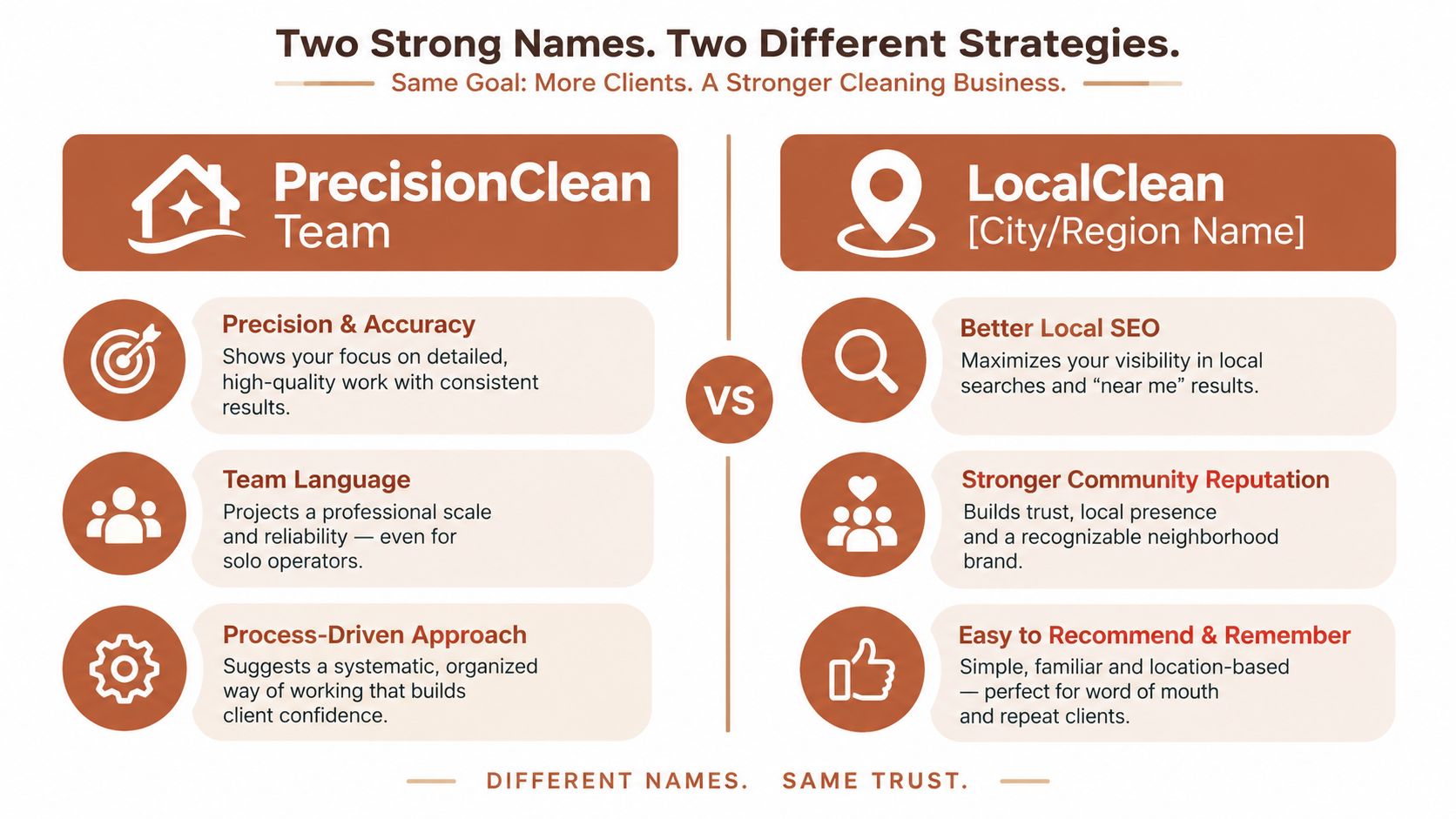
PrecisionClean Team gives a solo operator a structured, process-led identity. “Precision” suggests care and consistency, while “Team” frames the service as an organized operation rather than an informal side job. That can help when a client wants documented standards, repeat visits, or a reliable process.
The word Team also creates the clearest risk in this list. If you work alone, don't imply that multiple cleaners will arrive. Present the name as a professional business identity, then state who performs the work and whether subcontractors or additional cleaners are involved.
Turn the name into a process
A methodical brand needs methodical documents. Describe the cleaning sequence, quality checks, included areas, and client responsibilities in the estimate or service agreement. Use recurring service terms that make repeat work easy to understand.
AurenWell's house cleaner invoice template can support consistent presentation of the business name and service details. Add logged hours or clear line items when they help the client understand the charge. Keep the wording consistent across every recurring invoice.
This name suits specialty work and future expansion better than a playful name. If you eventually add another cleaner, “Team” already accommodates that change. If you remain a one-person business, the name still works as long as your communication is honest.
The main trade-off is warmth. PrecisionClean Team sounds controlled and professional, but it may feel less personal than a name built around the owner. Use a friendly introduction, clear client updates, and a recognizable face in your marketing to balance the formal tone.
8. LocalClean [City or Region Name]
LocalClean [City or Region Name] puts geography at the center of the brand. It tells prospects where you work and can support a strong community identity for a solo cleaner building referrals within a defined service area. The format is easy to adapt, but the location must be the one you serve.
This approach is strongest when you want local residential work, neighborhood referrals, or a tight service radius. It is less flexible if you expect to relocate, serve multiple regions, or move quickly into national work. A city-based name can also become inaccurate when the business expands beyond that area.
Choose the location carefully
Use the official spelling that clients recognize. A city name may be more useful than a small neighborhood name if customers outside that neighborhood also search for your service. If the region has alternate spellings or multiple nearby communities, test which version people say and type naturally.
Place the service area in your website page titles, business profile, estimate header, and client correspondence. Don't rely on the name alone to explain your offer. A prospect should see “LocalClean [City], residential and office cleaning” rather than a location with no category.
The name is intentionally descriptive, so distinctiveness becomes the challenge. Search competing businesses before you commit, then add a visual identity or a focused service phrase if the results look crowded.
For document consistency and solo-operator workflows, review AurenWell's tools for house cleaners. Put the city or region in the business header and service address fields, but keep the formal business name identical across estimates, contracts, invoices, payment pages, and reminders.
9. EcoClean Express
EcoClean Express combines an environmental promise with an efficiency promise. “Eco” attracts clients who actively look for lower-impact products or methods, while “Express” suggests an organized service that doesn't waste the client's time. The name is suitable only when both parts describe the actual operation.
Don't use “Eco” because it sounds appealing while relying on vague claims. List the products, methods, disposal practices, or certifications that justify the environmental positioning. If you use the term broadly, explain what it means in plain language.
Avoid the promise collision
“Express” can create tension with eco-conscious service. A careful client may wonder whether speed means reduced care or whether the product choices limit the service. Resolve that tension in estimates and contracts by describing the process, expected duration, and product approach.
The name can appeal to a defined audience, but it may discourage clients who want conventional cleaning or who don't prioritize environmental issues. That isn't automatically a problem. A focused promise can make sales conversations clearer when your chosen market values it.
Use invoices and estimates to identify the relevant products or service package, not just the brand name. Keep receipts and expense records organized so you can answer reasonable client questions about what you use. Don't claim certification, non-toxicity, or sustainability unless you can substantiate the specific claim.
For SEO, build separate pages around the services and location you offer. “EcoClean Express green home cleaning in [City]” gives searchers more context than trying to cram every keyword into the business name. Use one spelling across profiles so clients don't find multiple versions of the brand.
10. Reliable Service Cleaning
Reliable Service Cleaning chooses reassurance over novelty. The name makes the category clear and places dependability at the center, which suits recurring residential visits, small offices, and clients who value consistency above a fashionable brand voice.
Its strength is immediate comprehension. A prospect doesn't need to decode an abstract name before understanding the offer. Its weakness is memorability. Several service businesses may use similar reliability language, so your schedule discipline, communication, and client records must make the brand distinctive in practice.
Make consistency visible
Use recurring invoices for repeat work and keep the same service description from one billing cycle to the next. Send reminders when needed, confirm schedule changes promptly, and document the agreed scope. These behaviors give the name a meaning clients can verify.
A reliability-focused name can also sound conservative. That's useful for risk-averse buyers, but it may feel less appealing to younger clients seeking a modern, eco-conscious, or highly personalized experience. Add those differentiators in your tagline and service pages rather than changing the core name.
Be precise about guarantees. Don't promise that every issue will be resolved instantly or that delays will never occur. State what happens if a specified task is missed, how the client should contact you, and when you'll respond.
This is the safest choice for an operator who wants clarity and long-term repeat work. It isn't the strongest choice for someone whose main advantage is a distinctive personality, specialty technique, or tightly defined neighborhood identity.
Top 10 Cleaning Service Names Comparison
| Name | Implementation complexity 🔄 | Resource requirements ⚡ | Expected outcomes ⭐📊 | Ideal use cases 💡 | Key advantages ⭐ |
|---|---|---|---|---|---|
| SparkClean Pro | Low 🔄, easy to adopt | Low ⚡, simple branding assets | Professional image; supports premium pricing ⭐⭐ 📊 | Solo operators targeting premium residential/commercial clients | Memorable, professional, invoice-friendly |
| Crystal Clear Services | Low 🔄, straightforward naming | Low ⚡, minimal marketing needs | Builds trust through transparency; clear pricing perception ⭐⭐ 📊 | Window/home cleaning; clients valuing honesty and clarity | Reinforces transparent billing and client trust |
| SwiftFinish Cleaning | Medium 🔄, requires process emphasis | Medium ⚡, scheduling & time-tracking tools | Fast, efficient service; strong repeat bookings; risk of perceived corner-cutting ⚡ 📊 | Recurring maintenance, time-sensitive jobs, busy clients | Differentiates on speed and punctuality |
| DetailOriented Solutions | Medium–High 🔄, detailed processes needed | High ⚡, documentation, training, longer job times | Superior quality; justifies premium pricing ⭐⭐⭐ 📊 | High-end residential, specialty projects, post-construction | Commands higher rates by emphasizing meticulous work |
| TrustedClean Pros | Low 🔄, simple trust-focused messaging | Low–Medium ⚡, testimonials, insurance info | Higher conversion from risk-averse clients; credibility boost ⭐⭐ 📊 | Solo operators building referrals and trust-based relationships | Directly addresses client concerns about solo providers |
| Refresh & Renew Cleaning | Medium 🔄, transformation positioning | Medium ⚡, before/after media, seasonal packages | Perception of renewal; strong visual marketing; premium appeal ⭐⭐ 📊 | Deep cleaning, seasonal services, wellness-focused clients | Effective for before/after marketing and premium packages |
| PrecisionClean Team | Medium 🔄, process and "team" framing | Medium ⚡, documented standards, contracts | Perceived scale and consistency; appeals to reliability seekers ⭐⭐ 📊 | Solo operators scaling or presenting professional systems | Projects organized, process-driven professionalism |
| LocalClean [City/Region Name] | Low 🔄, easy to implement locally | Low ⚡, local marketing focus | Strong local SEO and referral growth 📊⭐ | Neighborhood-focused services, "near me" search capture | Excellent for local visibility and word-of-mouth referrals |
| EcoClean Express | Medium 🔄, must align with sustainable practices | Medium–High ⚡, eco-products, certifications | Attracts eco-conscious clients; supports premium pricing ⭐⭐ 📊 | Urban, younger demographics, sustainability-minded clients | Differentiates via environmental commitment |
| Reliable Service Cleaning | Low 🔄, classic, direct approach | Low ⚡, minimal branding needs | Clear dependability; steady retention and referrals ⭐⭐ 📊 | Conservative markets, long-term client relationships | Simple, unambiguous positioning that builds trust |
Validate the Name Before You Commit
Start by deciding what the name must communicate in one short introduction. A premium name should support premium-level presentation and service detail. A local name should match the area you serve. An eco-focused name should reflect products and methods you can explain. A speed-focused name should fit your scheduling and quality process.
Score each finalist against seven tests:
- Fit: Does the name match your target buyer, service type, price position, and tone?
- Clarity: Can a prospect tell that you provide cleaning services without extra explanation?
- Distinctiveness: Does it stand apart from nearby competitors without becoming strange or difficult?
- Expansion risk: Will the name still work if you add offices, specialty cleaning, another service area, or another cleaner?
- Pronunciation: Can a client say it easily during a phone call?
- Spelling: Can someone type it correctly after hearing it once?
- Promise delivery: Can you prove the expectation created by words such as premium, trusted, eco, precise, local, or express?
Keep the name short. Naming guidance from Housecall Pro's cleaning company name resource commonly emphasizes clear service signals, easy pronunciation, and compact word structures, with two- to three-word names often recommended for recall. Treat that as a practical heuristic, not a guarantee. A short name still fails if it sounds generic or makes the wrong promise.
Generate candidates with repeatable formulas instead of random word combinations:
- Benefit plus service: TrustedClean, Reliable Cleaning
- Sensory result plus service: Crystal Clear Services, Bright Cleaning
- Location plus category: LocalClean [City or Region]
- Audience or value plus service: EcoClean, Home Comfort Cleaning
- Differentiator plus outcome: PrecisionClean, SwiftFinish Cleaning
Then perform the verification work before ordering signs, uniforms, or printed materials. Check your business registry, trademark databases, domain options, social handles, and search results. Look for confusingly similar cleaning businesses in your area, not just exact matches. A name can be legally available and still create costly confusion in Google results, map listings, or referrals.
Use the UK naming benchmark carefully as well. A dataset cited by service-business naming research found that approximately 3.77% of businesses used numbers in their brand name, representing around 214,890 companies in that dataset. The practical lesson is not that numbers are forbidden. It's that coded names can make recall and spoken referrals harder unless the number has a clear reason to exist.
Test two or three finalists with real prospects, referral contacts, and existing clients. Ask each person:
- What service do you expect from this business?
- How would you spell the name after hearing it?
- What kind of client or service does the name suggest?
- Which name do you remember later?
- Does the name sound personal, professional, premium, local, fast, or eco-conscious?
Record their answers without defending your favorite. If several people misunderstand the category or repeat a different spelling, change the name or add a clear tagline.
For SEO, keep the brand readable and place the service and location in your page titles, headings, profile descriptions, and service pages. Don't force awkward keywords into the legal business name. Use one consistent spelling across your website, Google Business Profile, social accounts, estimates, contracts, invoices, payment pages, and reminders.
Once you choose, make the name part of the entire client experience. AurenWell can support that workflow for solo operators by keeping branded estimates, contracts, invoices, payment links, and client records connected in one place. Select your finalist this week, run the availability checks, ask three real people the five questions above, and then use the winning name consistently on your next estimate and payment page.