
You've got the mop, the product knowledge, and a few residential clients who trust you. Then a small office manager asks for a commercial quote, and the conversation stalls. You give a low hourly rate, promise flexibility, and wait for the reply. A larger cleaning company wins, even though its price wasn't necessarily lower.
That loss usually has little to do with cleaning quality. Commercial buyers are purchasing continuity, documentation, predictable service, and lower operational risk. Getting commercial cleaning contracts requires a system that proves you can deliver those things before the first shift begins.
Why Most Solo Cleaners Get Stuck Before the First Sale
A solo cleaner often approaches commercial work as a bigger version of a residential job. The buyer sees something different. They need a defined scope, a dependable schedule, proof of insurance, clear billing, documented quality checks, and someone who can handle an access problem when the regular plan changes.
That gap creates the first major mistake: quoting before understanding the building. A phone estimate based on square footage or an hourly guess leaves out floor types, restroom usage, consumables, travel, setup, periodic tasks, and access restrictions. It also makes you sound interchangeable.
Practical rule: Never price a commercial account before you've seen the site or received a detailed scope.
The second mistake is treating the proposal as a sales letter. Commercial proposals are closer to operating documents. They tell the buyer exactly what gets cleaned, how often, with which supplies, under what assumptions, and what happens when the scope changes.
Your cleaning ability still matters, but it's only one part of the decision. The buyer also asks whether you'll arrive consistently, protect the premises, follow product instructions, respond to complaints, and provide records when someone challenges the invoice.
Before you pursue more leads, prepare the basics covered in this guide to starting an office cleaning business. Define your service area, preferred building types, equipment limits, insurance position, availability, and backup plan.
The rest is a controlled process:
- Choose a narrow target: Pursue facilities that match your capacity and service radius.
- Qualify before estimating: Confirm scope, budget, timing, access, and transition conditions.
- Build the price from the site: Separate recurring work from periodic services.
- Submit a responsive proposal: Answer every requirement and control every document.
- Operate for renewal: Inspect, communicate, invoice, and review the account before dissatisfaction grows.
That process lets a solo operator compete on reduced risk instead of trying to become the cheapest cleaner in town.
Choosing the Facility Segments Worth Targeting
Commercial cleaning is a substantial recurring-services market. One market analysis estimated the global cleaning-services industry at USD 451.63 billion in 2025, with projected growth to USD 859.20 billion by 2034, implying a 7.5% compound annual growth rate. North America represented 37.52% of global revenue in 2025, or approximately USD 169.45 billion, while Europe represented 27.51%, or approximately USD 124.23 billion (Fortune Business Insights market analysis).
That scale supports commercial work as a serious business opportunity. It doesn't mean you should bid on every building with a janitorial requirement.
Start with an ideal account profile. Write down the property type, minimum monthly value, maximum travel distance, access conditions, service frequency, payment terms, and tasks you won't perform. A narrow profile protects your calendar and helps you recognize a good lead quickly.
| Facility Type | Fit for Solo | Why |
|---|---|---|
| Small professional offices | Strong | Predictable layouts, manageable staffing, and recurring evening or daytime service |
| Retail storefronts | Strong | Clear visible standards, repeatable task lists, and local decision-makers |
| Churches and community buildings | Good | Often approachable buyers with recurring facility needs |
| Light medical or dental offices | Conditional | Can work with strict product, safety, and documentation requirements |
| Property-managed common areas | Good | One relationship may create repeat work across suitable buildings |
| Large schools or campuses | Poor for most solos | Staffing, coverage, compliance, and scheduling demands can exceed solo capacity |
| Airports or 24-hour facilities | Avoid initially | Continuous access and replacement coverage create operational pressure |
| Highly specialized healthcare | Avoid unless qualified | The compliance and infection-control requirements may exceed your current system |
The best first account isn't the largest one. It's the building where you can deliver every visit without borrowing labor, improvising supplies, or driving across town.
Use local procurement portals and focused tender services to monitor opportunities that fit your profile. Bidwell tender alerts for cleaning contracts can help you find relevant notices without treating every published opportunity as a reason to bid.
Create a one-page filter and apply it before you schedule a walkthrough:
- Facility match: Does the building resemble work you can already perform well?
- Capacity match: Can you cover every scheduled visit yourself?
- Access match: Can you reliably enter, secure, and leave the site?
- Financial match: Do the payment terms and scope justify the administrative effort?
- Risk match: Can you satisfy insurance, safety, product, and documentation requirements?
If an opportunity fails several checks, decline it early. A rejected bid costs time. A poorly priced contract consumes time every week.
Building a Repeatable Prospecting Pipeline
Referrals are useful, but they aren't a pipeline. You need several sources that produce opportunities continuously, then a qualification process that keeps weak prospects away from your calendar.
A procurement-tracking source reported 662 open janitorial and cleaning-services opportunities across United States federal, state, and local sources, with 507 added during the preceding 30 days (ContractRadar janitorial opportunities). The same source listed 37 open postings from the U.S. Department of Veterans Affairs and 31 from the Department of the Navy. The practical lesson is simple: opportunities appear across many buyers, so lead generation must be ongoing.
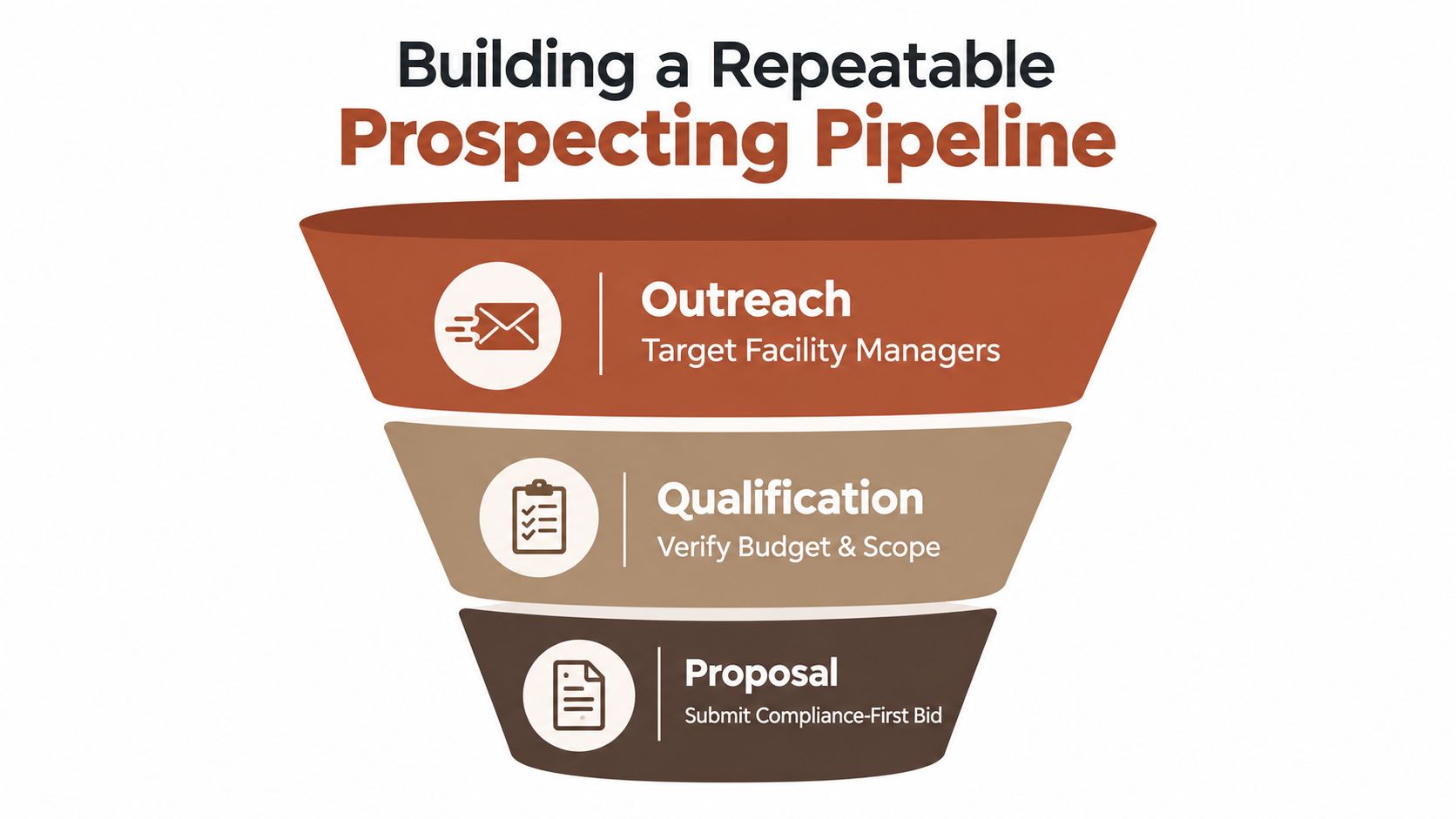
Use four channels with different purposes
Facility managers are valuable when you can speak directly to the person responsible for building performance. Send a concise introduction that names your target facility type, service area, and the problem you solve. Don't send a generic paragraph about being hardworking.
Property-management firms can provide multiple suitable sites, but qualify each building separately. A portfolio relationship isn't automatically profitable if the sites have difficult access, scattered geography, or inconsistent payment practices.
Local procurement portals expose formal opportunities with stated requirements. Read the entire notice before contacting anyone. If the solicitation demands capabilities you can't document, don't manufacture a larger-company image.
Existing clients and adjacent trades can produce warm introductions. Ask a satisfied commercial client whether another nearby facility has a recurring cleaning need. Window cleaners, carpet technicians, maintenance contractors, and property service providers may also know when a vendor is failing.
Qualify before you measure
Ask five questions before you prepare an estimate:
- Is the scope defined? If the buyer can't explain the work, you can't price it responsibly.
- Is the budget realistic? You don't need the exact ceiling immediately, but you need evidence that the buyer understands professional service costs.
- Is there a decision date? An open-ended “we're collecting quotes” process can consume your time without creating a sale.
- Can you access the site? Confirm keys, codes, operating hours, parking, security, and walkthrough availability.
- Is there an incumbent transition plan? Find out whether the current cleaner is leaving, whether the contract is ending, and whether the buyer expects overlap.
Track every lead in a spreadsheet or simple client system. Record source, facility type, contact, scope status, walkthrough date, proposal date, follow-up, outcome, and reason lost.
Here's the video element for a practical visual explanation of the pipeline:
Set a weekly rhythm. Spend one block sourcing, one block qualifying, one block conducting walkthroughs, and one block following up. Consistency beats a frantic burst of outreach whenever revenue feels thin.
Pricing Bids With Site-Walk Math, Not Hourly Guesses
An hourly rate cannot price a building by itself. A profitable commercial bid starts with the site, the workload, and the conditions that can consume unpaid time.
Walk the property before quoting. Measure or estimate cleanable areas, count restrooms and fixtures, identify floor types, note stairs and high-touch surfaces, and record travel and setup time. Confirm who supplies paper products, liners, soap, chemicals, and equipment. List periodic work such as floor care, interior glass, deep restroom cleaning, high dusting, and carpet extraction.

Build the cost before choosing the price
Create a worksheet with separate lines for:
- Direct labor: Estimated cleaning time multiplied by your loaded labor cost or owner labor value.
- Supervision: Site checks, client communication, training, and replacement coordination.
- Chemicals and consumables: Products, dilution, liners, paper goods, gloves, and other materials you provide.
- Equipment: Vacuums, mops, batteries, floor machines, maintenance, and replacement allowance.
- Travel and setup: Driving, parking, loading, access, staging, and securing the premises.
- Insurance and compliance: Required coverage, certificates, licenses, training, and documentation.
- Overhead: Software, phone, bookkeeping, storage, marketing, and administrative time.
- Contingency: An allowance for access delays, rework, supply volatility, and small scope surprises.
Separate monthly recurring service from one-time or periodic services. State the visit frequency and included tasks on the recurring line. List each periodic task, its frequency, and its separate charge.
Commercial buyers often require this level of detail. A Boston janitorial request for bids required itemized cost sheets and stated that bids could be rejected when the total exceeded the buyer's budget (Boston janitorial service RFB). Treat that as a pricing discipline: show what the buyer receives, then test whether the total fits the stated ceiling.
Use a worked worksheet like this:
| Cost area | Your calculation |
|---|---|
| Routine visits | Time per visit, visits per billing cycle, loaded labor cost |
| Supplies | Products and consumables supplied by you |
| Periodic tasks | Separate task, frequency, and price |
| Travel | Distance, parking, setup, and access time |
| Overhead | Allocated share of business administration |
| Risk allowance | Contingency based on known site conditions |
| Final recurring price | Total cost plus sustainable margin |
A service may run several visits each week, so multiply time per visit by the actual schedule before adding margin. Do not bury periodic work inside a low recurring price. That approach makes early invoices look acceptable and turns every deep clean into unpaid labor.
For broader context, review this guide on how much to charge for cleaning services, then adapt the result to the measured site. The final proposal should give the buyer a clear price and leave you enough room to deliver the work consistently.
Writing a Proposal That Survives the Compliance Check
A buyer opens your proposal looking for missing answers, not persuasive adjectives. Build the document so an evaluator can verify scope, capability, evidence, and price without searching through paragraphs.
Request the complete RFP, scope of work, attachments, and addenda. Convert every requirement into a requirements matrix. List the request in one column, your response location in another, and the supporting document, signature, certificate, or attachment in the last.
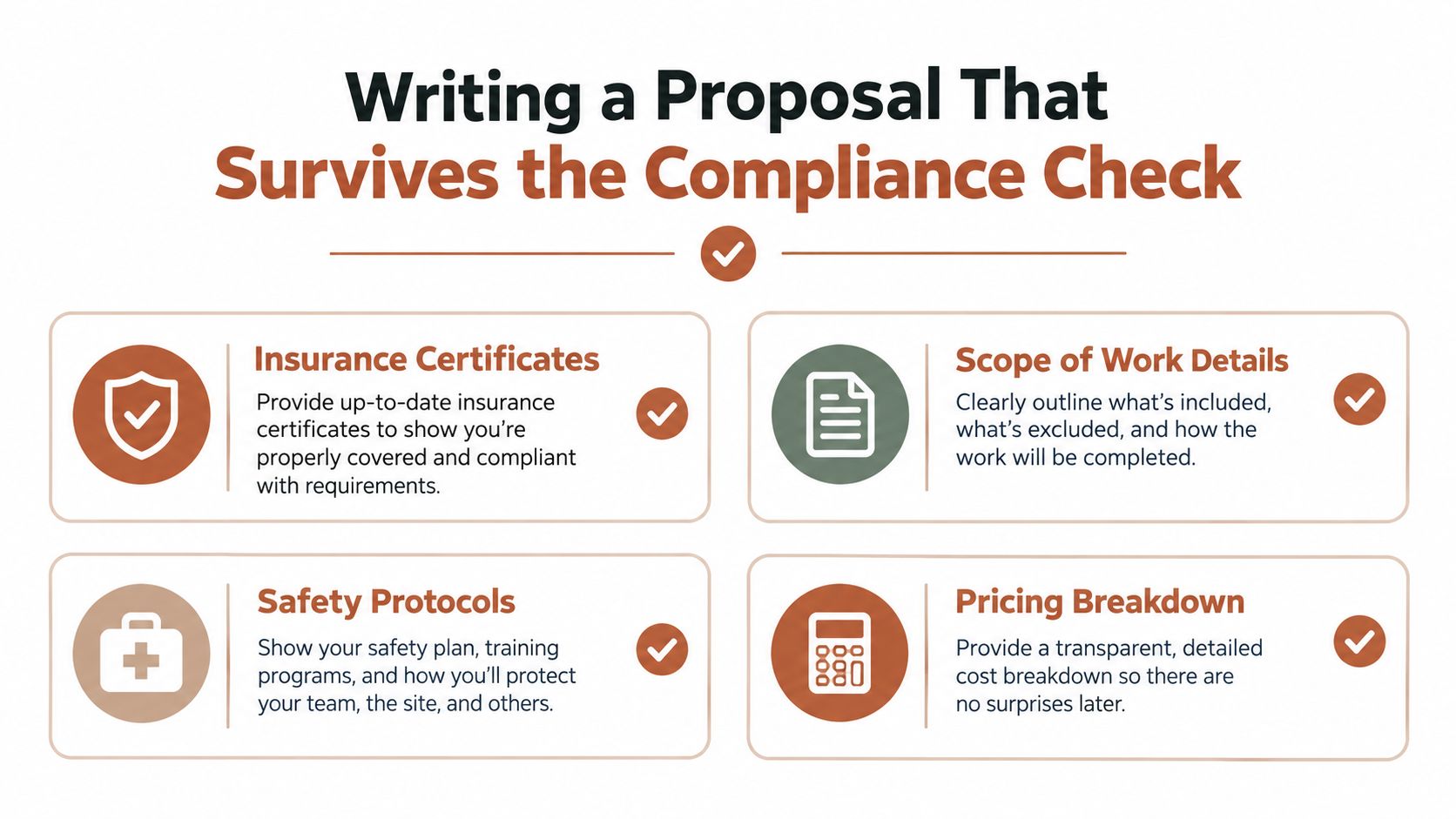
Build four layers into every submission
Scope response: Name each location, area, task, frequency, service window, and quality standard. State exclusions plainly. “General cleaning” leaves too much open to interpretation.
Operating response: Explain staffing, access control, supplies, equipment, response times, inspection method, complaint escalation, and backup coverage. A solo operator does not need to imitate a large contractor. You do need a credible continuity plan that identifies who handles urgent work or an absence.
Evidence response: Attach insurance evidence, relevant references, safety procedures, chemical data sheets, training records where applicable, and every requested form. If you lack a required credential, decide whether the opportunity fits instead of implying experience you do not have.
Commercial response: Show recurring pricing, one-time services, assumptions, applicable taxes or fees, payment terms, change-order rules, and the proposal validity period. Make each charge easy to reconcile with the scope.
The Boston solicitation fixed a three-page cap on the quality justification and required a specified submission order (Boston janitorial service RFB). Formatting errors alone can disqualify a bid. Treat page limits, file names, signatures, and upload instructions as compliance requirements, not presentation details.
The right price cannot rescue a late bid, missing form, unsupported reference, or incorrect submission sequence.
Run this document-control check before sending:
- Read every addendum: Update scope, attachments, and pricing when requirements change.
- Match the requested order: Place forms and supporting documents exactly where specified.
- Confirm signatures: Check the proposal, certifications, forms, and pricing sheets.
- Verify insurance: Confirm coverage limits and named parties on the certificate.
- Check references: Use comparable facilities and provide accurate contact details.
- Confirm arithmetic: Reconcile recurring totals, periodic charges, taxes, and the final bid amount.
- Record delivery: Save the submitted file, timestamp, recipient, and receipt confirmation.
Food-service accounts need clearer controls around task separation, product use, and contamination-sensitive areas. Review this resource on café cleaning and food safety, then state how your procedures protect the client's operations.
Keep the accepted scope, schedule, supplies, inspections, payment terms, cancellation terms, and change-order process in the final agreement. Use this cleaning services contract guide to turn an approved proposal into an operating document both parties can follow.
Picking the Right Bids and Walking Away From the Wrong Ones
More bids can mean more unpaid estimating, rushed submissions, and underpriced work. A disciplined operator filters opportunities before spending time on a walkthrough.
Run a go or no-go review against your capacity, service area, equipment, experience, and backup coverage. Confirm that the buyer's requirements fit your operation without relying on a larger contractor's reputation. Treat every eligibility requirement as a gate. If you cannot document the required facility experience, insurance, staffing, or safety records, reject the bid regardless of its potential revenue.
Ask these questions before proceeding:
- Clear scope: Can you identify the tasks, frequency, service window, exclusions, and acceptance standard?
- Accessible facility: Can you enter, work, store supplies, and secure the site reliably?
- Payment quality: Are the terms written, reasonable, and compatible with your cash position?
- Operational fit: Can you deliver without constant after-hours coverage or a large replacement team?
- Compliance fit: Can you produce each required form, certificate, reference, and safety document?
- Margin protection: Does the budget cover labor, travel, supplies, supervision, and service risk?
Walk away when the scope stays vague after you ask direct questions, the access arrangement creates unpaid time, or the client expects emergency availability without paying for it. A low price cannot repair a bad operating model.
Track every bid by segment and record the price, scope, decision-maker, follow-up dates, objections, outcome, and loss reason. Industry guidance places commercial-cleaning win rates around 20% to 30%, but treat that range as a benchmark, not a promise (Xiri guidance on commercial-cleaning bids). Calculate your own rate by dividing won bids by submitted bids, then compare it by segment and qualification standard.
A lost bid to a better-fit competitor gives you market information. A loss caused by an impossible scope or missing requirement means your screening process needs tightening.
Onboarding, Inspections, and the Renewal System
Winning the signature is only the midpoint. The first service period establishes whether the account becomes stable revenue or a recurring argument.
Hold a kickoff before the first visit. Confirm the start date, access method, alarm procedures, key control, parking, supply storage, contact hierarchy, emergency response, and after-hours expectations. Walk the site with the accepted scope and mark anything that differs from the walkthrough.
Run the account through a 30/60/90-day cycle
First 30 days: Complete the setup, perform the initial cleaning against the task list, document the first inspection, and resolve access or supply problems quickly. Send a short status message so the client knows what you checked.
By day 60: Review recurring issues, missed tasks, complaint response, consumable usage, and invoice status. Adjust the operating notes, not the scope, unless both parties approve a change.
By day 90: Conduct a client walkthrough and review whether the frequency, periodic tasks, access arrangements, and service standards still match the facility. Ask directly what the client wants preserved and what needs attention.
Use a monthly self-inspection with a scored checklist, a quarterly client walkthrough, and an annual scope review. Keep the records with the account. Documentation makes a service problem easier to diagnose and demonstrates that you manage quality deliberately.
The handoff deserves its own checklist. A useful client handoff playbook can help you formalize the transition from signed agreement to active service.
Billing should follow the contract rather than your memory. Set recurring invoices, attach the agreed scope where useful, send polite reminders, and record payments against the client account. Keep change orders separate from routine invoices so the buyer can see why the amount changed.
At renewal, don't wait for the client to raise dissatisfaction. Schedule the conversation, summarize completed work, review unresolved items, and confirm the next term. A contract renews more easily when the client has a clear record of what you delivered and how you responded when conditions changed.
Getting commercial cleaning contracts becomes far easier when your business looks dependable before the first clean. Use AurenWell to turn approved estimates into signed agreements, collect deposits or online payments, schedule recurring invoices, send reminders, and keep proposals, contracts, invoices, and payment records together. Build your target-account checklist today, qualify your next opportunity against it, and send a documented proposal instead of another hourly guess.