
You've just finished a site visit, inspection, consultation, or discovery call. The client wants a price now, preferably through a link they can open and approve on their phone. You send an estimate, they tap accept, and the job begins. Later, they say the extra work was included. You remember discussing it, but the estimate doesn't mention it, the approval record is vague, and your final invoice looks larger than the number they remember.
That situation is rarely caused by one dramatic mistake. More often, the estimate terms and conditions were written as an afterthought, separated from the approval workflow, or copied from an old document that no longer matches how the business sells and delivers work. A well-built estimate should do more than display a price. It should define the commercial relationship before either side invests time, materials, or labor.
Why Estimate Terms Matter More Than You Think
A client taps “approve” on a phone while standing in a driveway, then remembers only the large price at the top of the screen. Weeks later, the invoice includes extra materials, waiting time, or another visit. The client says those items were included. You know they were not. If the approval record does not show the assumptions and boundaries, the dispute becomes a memory contest.
A solo operator can lose money without calculating the original price incorrectly. The problem starts when the estimate describes what the work might cost but leaves unclear what the client is accepting.
A bathroom repair shows the risk. The visible damage supports an initial estimate, but opening the wall reveals another repair. The client then requests removal, disposal, replacement materials, and related work. One side sees a single bathroom job. The other sees the approved repair plus additional work. Without written assumptions, exclusions, and a change process, the final invoice becomes a negotiation.
The same issue affects creative services, tutoring, consulting, landscaping, fitness instruction, and other home services. A one-click approval can make a headline price feel more definite than the wording underneath it. Revisions, travel, waiting time, extra materials, and follow-up visits may seem included unless the estimate states otherwise.
Terms turn an estimate into a working agreement
Estimate terms and conditions are operational controls. They set boundaries for price, scope, timing, payment, approvals, and changes. Australian guidance distinguishes an estimate as a rough, non-binding price guide from a more precise quote that may form part of a legally binding agreement once accepted. TradeBase's explanation of estimates and quotes also identifies payment methods, deposits, revisions, and expiry dates as common terms.
The practical difference is clear:
- A weak estimate gives the client a number and leaves the operator explaining the rest later.
- A usable estimate states the assumptions, exclusions, validity period, and requirements before work starts.
- A transactional estimate links acceptance to a stored approval record, deposit, signature, or invoice conversion.
Practical rule: If a clause changes what you will do, what the client must provide, or what the client may owe, place it beside the approval action. A separate attachment is easy to miss on a phone.
The invoice should follow the estimate. The client sees the scope, accepts the terms, pays any required deposit, approves recorded changes, and receives an invoice that matches those records. The weaker process relies on scattered messages and introduces new conditions only when payment is due.
Terms will not prevent every disagreement. They make the original agreement easier to verify and give both parties a clearer record when the job changes. Review the mobile approval screen as a client would, not just the full document on a laptop.
Understanding Estimates Versus Quotes
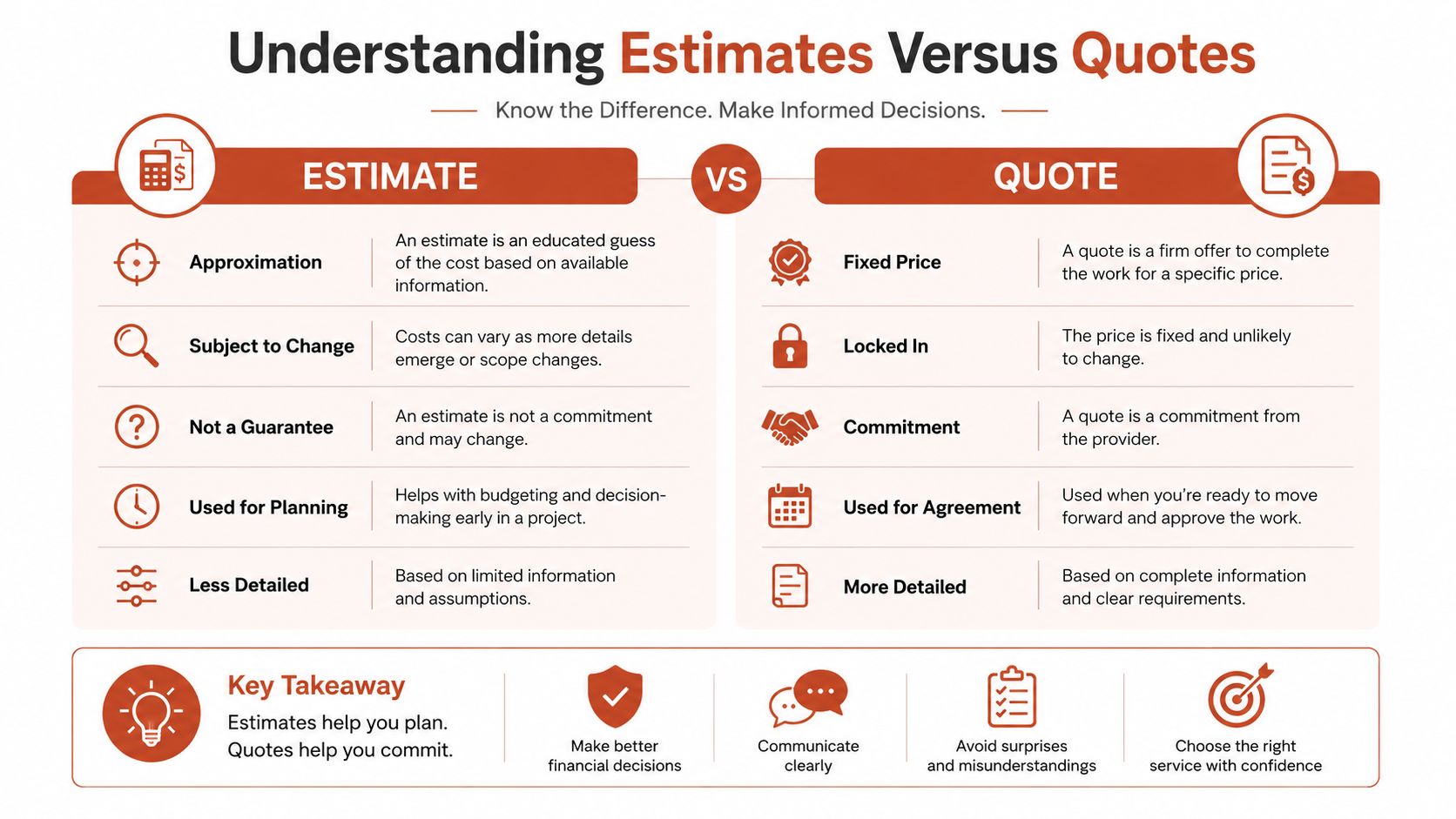
A client approves an estimate on a phone between other tasks, often seeing only the price, summary, and approval button. Decide first whether that action accepts provisional pricing or a fixed-price offer. The document title does not settle the issue. Your wording, scope, acceptance process, and messages around the estimate shape what the client reasonably believes they are accepting.
An estimate is generally an approximation based on information available at the time. A quote is more precise and may become part of a binding contract once accepted. Australian government guidance summarized by TradeBase describes accepted quotes as potentially creating a binding agreement, while estimates are usually treated as rough price guides.
Choose the pricing position before writing
Use an estimate when important facts remain unknown, including concealed damage, final material selection, client revisions, travel requirements, or diagnostic work. Use a quote when you have defined the deliverables, assumptions, exclusions, and price well enough to make a fixed commitment.
State that position in the estimate itself. For provisional work, wording such as this is clearer than “total price”:
“This estimate is an approximation based on the scope and assumptions listed below. The final price may change if the scope, site conditions, materials, timing, or client requirements change. Additional work requires client approval before it begins.”
The clause does not authorize arbitrary charges. It ties a revision to an identifiable cause and a recorded approval.
Remove language that conflicts with provisional pricing. Phrases such as “guaranteed total,” “all-inclusive price,” “no further charges,” and “fixed project cost” can create expectations your estimate cannot support. If you intend to make a fixed offer, label it accurately and explain what acceptance does. If you intend to estimate, do not display the figure as a final invoice amount.
Make acceptance specific
A one-click approval can accept more than the visible price. The mobile approval screen should identify the client, estimate version, scope, terms, and person authorizing the work. A separate attachment or an unchecked “I agree” box gives you weaker evidence than an action that records who accepted and when.
The Jobber estimate terms and conditions template covers practical clauses for approximation language, validity, acceptance, scope changes, disputes, and payment timing. Use those topics to support the pricing model you selected. Do not add formal-sounding terms that the approval screen hides or the client cannot reasonably review on a phone.
Setting the Right Validity Period
A client approves an estimate from a phone, then waits while supplier prices rise, materials become harder to obtain, or your schedule fills. The requested work has not changed, but the assumptions behind your figure may no longer hold. A validity clause sets the point at which those assumptions must be checked again.
Estimate validity commonly falls between 30 and 90 days, depending on the service and the risks behind its pricing. Treat that range as a starting point, not an automatic rule. A short period suits volatile materials, subcontractor availability, travel arrangements, or tightly booked capacity. A longer period can work for repeatable services with stable inputs and predictable delivery conditions.
Match the window to the risk
Choose the period by asking how quickly your labor, material, scheduling, and access assumptions can become unreliable. A validity date that looks standard but does not match your buying cycle creates avoidable disputes.
Once an estimate expires, do not honor outdated terms and add an unexpected adjustment later. Send a revised estimate, or obtain written confirmation that the client wants you to revalidate the original pricing. Record that decision in the same system as the estimate so the approval history remains clear.
A clause might read:
“This estimate is valid until the expiry date shown above. Acceptance after that date does not confirm the original pricing. We may review labor, materials, scheduling, and other assumptions before confirming the work.”
This wording creates a review point without claiming that every expired estimate will change.
Put the date where a phone user can see it
An expiry date buried in a PDF footer is easy to miss during one-click approval. Display it beside the estimate total and repeat it in the approval view. If a client opens an old link, the page should show whether the estimate is current, expired, revised, or awaiting revalidation.
A mobile approval screen should include:
- Issue date, identifying the version under review.
- Expiry date, placed beside the price.
- Revision identifier, distinguishing later changes.
- Revalidation instruction, stating what the client should do after expiry.
The estimate workflow help page can support your internal process, but it cannot replace job-specific terms. The estimate itself must show the wording, date, and approval record that govern that particular job. A client should not need to open several links or download a separate document to understand whether the displayed price is still available.
Defining Scope and Exclusions Clearly
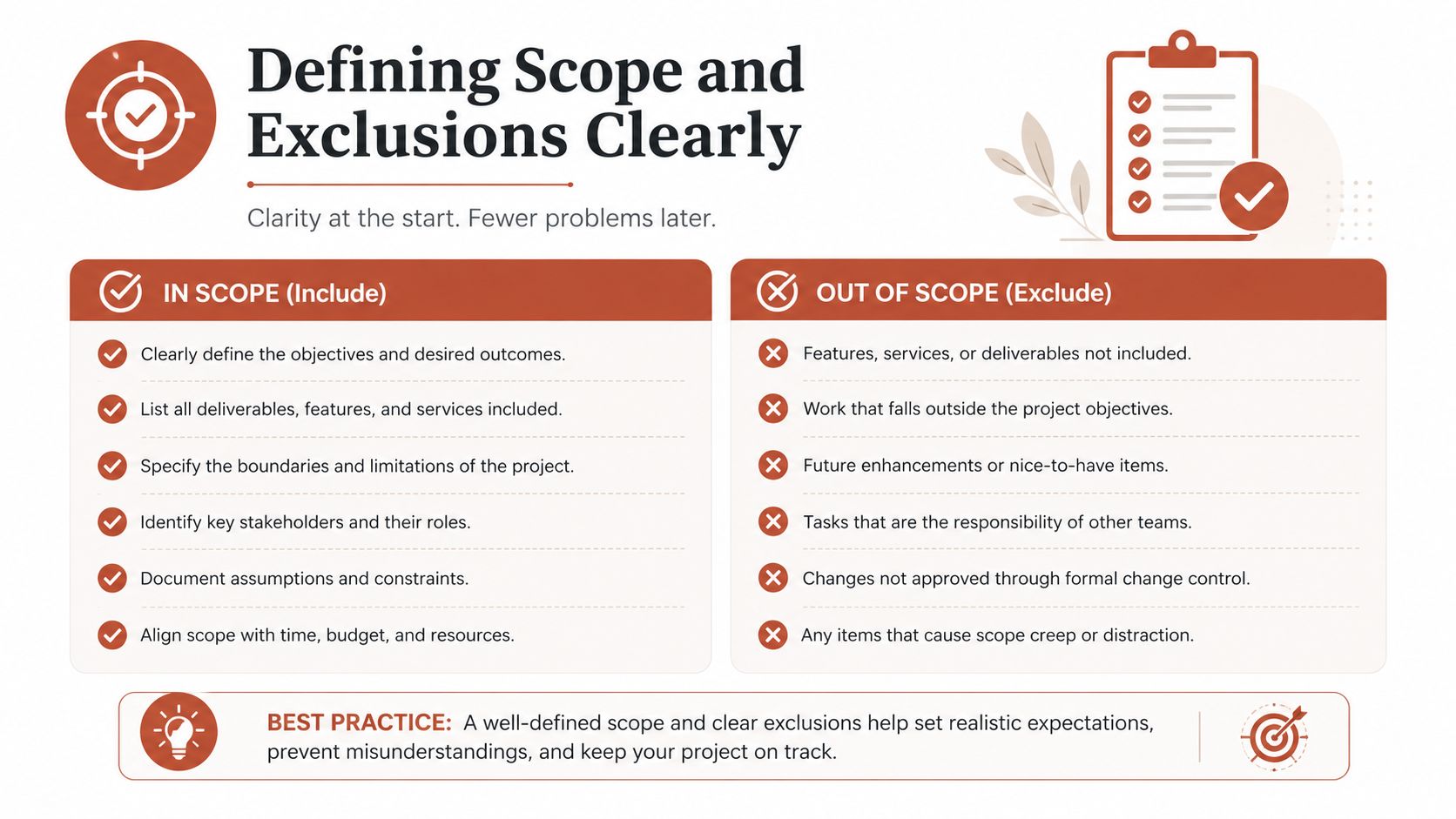
Clients don't dispute scope because they enjoy reading contracts. They dispute scope because the estimate describes an outcome while the operator prices a set of tasks. “Repair the deck,” “design the website,” or “provide coaching” can mean very different amounts of work to each person.
Write the scope as a list of deliverables, actions, and boundaries. If the job depends on information you don't yet have, identify that uncertainty instead of hiding it inside a broad total.
Describe what the client receives
A useful scope statement answers three questions:
- What will you do? Name the service, phase, visit, deliverable, or task.
- What will you provide? Identify the finished result, materials, files, report, lesson, or consultation.
- What must happen before the next stage? State any client approval, access, information, or preparation requirement.
For a design project, “website design” is too broad. A stronger description might identify the agreed pages, included revision process, content responsibility, and final file format. For a repair, specify the visible work, access conditions, disposal assumptions, and what happens if hidden damage appears.
Use exclusions without sounding evasive:
“The estimate includes removal and replacement of the damaged visible section. It excludes concealed damage, structural repairs, hazardous materials, permit fees, and work requested after approval. We'll document any additional requirement and obtain approval before proceeding.”
That wording helps the client understand the price instead of merely protecting the operator.
Separate assumptions from exclusions
An assumption is a condition you're relying on. An exclusion is work or cost you've deliberately left out. Keep both visible.
- Access assumption: The client will provide safe and unobstructed access at the scheduled time.
- Material assumption: The estimate uses the selected material or the stated allowance.
- Information assumption: The client will supply accurate measurements, content, or records.
- Timing assumption: Delays in client decisions may move the delivery date.
- Exclusion: Additional visits, revisions, disposal, permits, rush work, or third-party charges aren't included unless listed.
The most important sentence is the revision rule. State that a material change in scope, site condition, client instruction, or required input may require a revised estimate or change order. Then make the process easy enough that you'll use it.
Structuring Deposits and Payment Terms
Payment terms should match when you incur risk. A deposit protects the start of the job, milestone billing prevents you from financing a long project, and payment on completion can feel simple while leaving you exposed if the client delays acceptance.
There's no single structure that fits every solo operator. A short, low-risk service may work with payment at completion. A project requiring purchased materials, reserved time, or substantial preparation usually needs money collected before the operator commits resources.
| Payment Structure | Typical Percentage | Best For | Risk Level |
|---|---|---|---|
| Upfront deposit | Not specified | Jobs requiring materials, preparation, or reserved capacity | Lower for the operator |
| Milestone payments | Not specified | Multi-stage projects with identifiable deliverables | Moderate |
| Payment upon completion | Not specified | Short services with limited upfront cost | Higher for the operator |
Tie payment to a clear event
Don't write “deposit due soon” or “balance due later.” Link payment to acceptance, a scheduled start, a completed stage, delivery, or another event the client can identify. A practical clause could say:
“Work is scheduled after estimate acceptance and receipt of the required deposit. The remaining balance is due when the listed work is completed, unless the estimate identifies milestone invoices.”
For partial approvals, invoice only the approved portion and state what remains pending. Don't treat a client's approval of one line item as acceptance of the entire estimate.
Balance protection with clarity
Late-payment language should identify the due date, payment methods, and any lawful charge you intend to apply. Don't add a penalty you haven't checked for local compliance, and don't make payment terms so aggressive that a reasonable client can't understand them.
If you're deciding how to set an upfront amount, this guide to contractor deposits can support your internal policy. The estimate itself should still state the actual amount or calculation method, when it's due, whether it's applied to the final invoice, and what happens if the client cancels after you've started preparing the work.
For payment collection, show the client one practical route. A browser payment link, card option, bank transfer details, or recorded manual payment process is more useful than a general instruction to “pay promptly.”
Handling Change Orders and Scope Creep
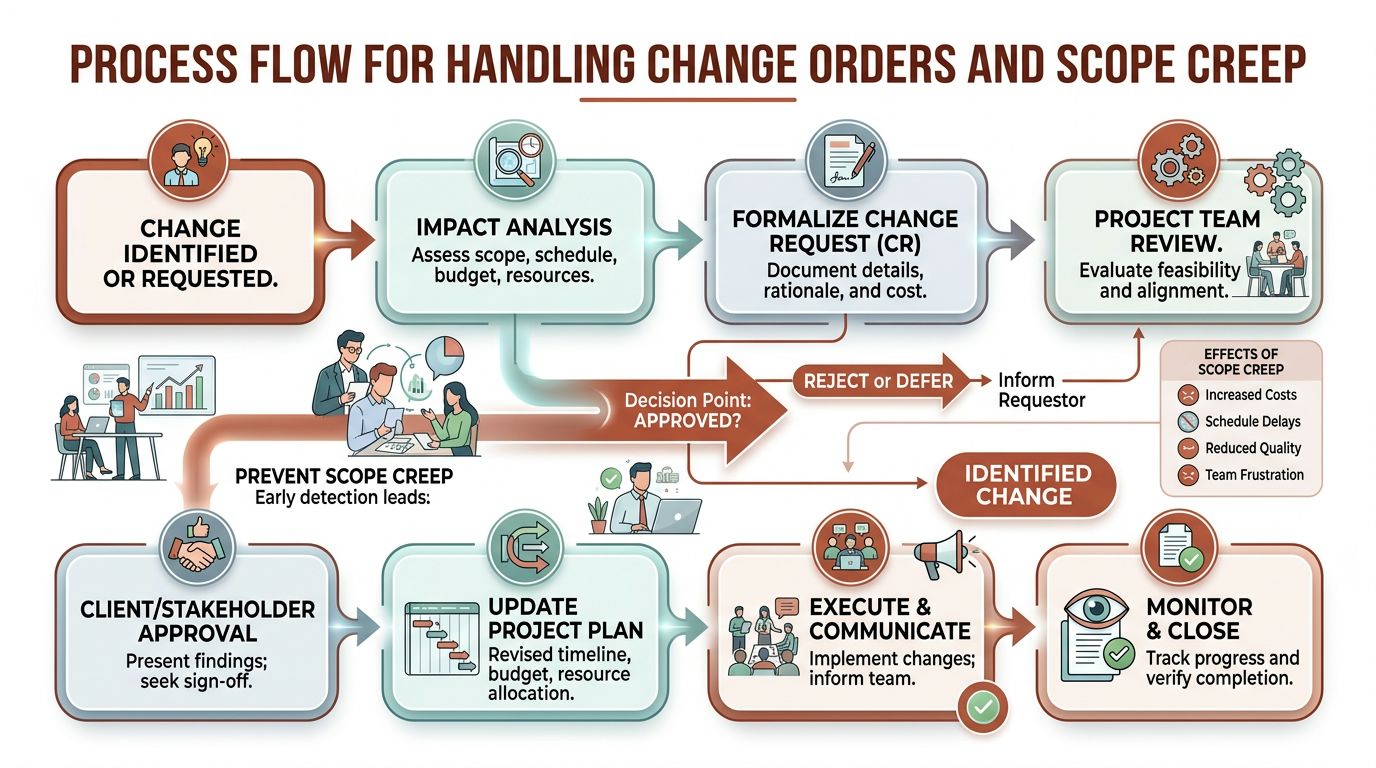
A change order must work while you're standing in a driveway, leaving a consultation, or answering a client message from your phone. If documenting an extra task takes longer than explaining it, you'll be tempted to proceed on trust. That's when unpaid work starts.
The approval process should be short but complete. Create a new change record or revised estimate that states the added work, price basis, timing effect, and approval status. The client should approve that specific change, not merely reply “sounds good” to a long message with several unrelated topics.
Use a four-part change record
A mobile change order can be concise:
- Added work: “Add preparation and repainting of the adjoining wall.”
- Price basis: “Priced as an additional fixed line item” or “priced using the stated hourly rate plus materials.”
- Schedule effect: “Completion date will be revised if approval arrives after the stated decision point.”
- Approval action: “Client approves this change before the added work begins.”
Your clause can reinforce the process:
“Work outside the approved scope requires written approval of the added work and revised price before it begins. We may pause the affected work until approval is received. Silence, access to the site, or a general request to continue doesn't constitute approval of an unpriced change.”
That last sentence matters. A client may believe they approved a change by asking you to keep going. Your record should show exactly what they approved.
Handle delay and partial approval
A client might approve the original work but reject an optional item. Mark the estimate by line item so your invoice reflects the accepted portion. If the client delays a decision, state whether the schedule, supplier availability, or validity of the original price may need review.
Keep evidence together. Store the original estimate, accepted version, change request, approval timestamp, messages, deposit, and final invoice under the same client record. If a phone call changes the job, send a written summary immediately:
“To confirm our call, you've requested the additional work listed below. I'll send the revised price for approval. I won't begin that additional work until you approve it.”
That message protects the relationship because it replaces assumptions with a simple next step.
Navigating Regional Consumer Protection Rules
Estimate terms and conditions don't operate in a legal vacuum. The same wording can carry different risk depending on the client's location, whether the client is a consumer or business, and whether local rules regulate estimates, extra charges, deposits, or cancellation.
Ontario provides a clear example. Under Ontario's Consumer Protection Act, guidance says that when a consumer agreement includes an estimate, the supplier generally can't charge more than 10% above the estimate without consumer-approved changes. Ontario repair and maintenance rules can also restrict estimate fees when those fees weren't disclosed in advance.
That isn't a universal rule. Australian consumer guidance treats an estimate as an educated guess and recognizes that final pricing can move as a job progresses, which creates a different operating environment. The relevant question isn't which jurisdiction has the “right” approach. It's which rule applies to the transaction in front of you.
Classify the estimate before sending it
Use this decision framework:
- Fixed quote: You're offering a defined price for a defined scope. Changes should follow the agreed change process.
- Revisable estimate: You're giving an approximation because facts remain uncertain. State the assumptions and the basis for revision.
- Regulated estimate: Consumer rules may restrict the final charge or require approval for additional work. Treat the estimate as subject to mandatory local protections.
The classification should affect the approval screen, not just the document footer. If local law requires prior approval for an increase, your workflow must make that approval easy to record. If disclosure of a calculation method is required, state the applicable labor, time, material, or service basis before the client accepts.
Make cross-border work deliberate
A solo operator working across regions should identify the client's address, service location, customer type, governing law, and dispute venue. Don't assume your usual terms travel unchanged. A clause saying “additional work will be billed as required” may be inadequate where consumer rules require explicit approval or limit the final invoice.
Use plain language and preserve the evidence trail. The terms should tell the client whether the price is fixed, approximate, or subject to a regional cap. If you're uncertain about a local requirement, get advice from a qualified professional in that jurisdiction before relying on a template.
Writing Cancellation and Dispute Clauses
Cancellation terms should answer a practical question: what happens to reserved time, purchased materials, preparation, and work already completed? A vague “no refunds” statement often creates more conflict than it prevents because it doesn't distinguish between a client changing their mind and an operator being unable to perform.
Write the process in a sequence the client can follow. State how cancellation must be delivered, when it takes effect, what completed work remains payable, and how unused deposits are treated under applicable law.
A balanced clause might read:
“The client may request cancellation in writing. The client remains responsible for approved work completed, non-refundable costs properly incurred, and any cancellation amount disclosed in this estimate and permitted by applicable law. We'll confirm the cancellation and provide an updated account of completed work, costs, credits, or amounts due.”
Avoid calling a charge a “kill fee” unless your clients understand the term. “Cancellation charge” is clearer, but the amount or calculation still needs to be disclosed before acceptance.
Keep disputes out of the invoice
Set a short path for resolving a disagreement. Ask the client to identify the disputed line, explain your review process, and state whether undisputed amounts remain payable. Don't use dispute language to threaten immediate legal action over a small misunderstanding.
Your terms can say:
“The parties will first try to resolve a dispute by written discussion. The client should identify the disputed item and supporting reason. Undisputed charges remain due. If the dispute isn't resolved, the laws and courts of the stated jurisdiction and venue will apply, subject to mandatory consumer rights.”
That final qualification matters for cross-border work. A jurisdiction clause should identify the intended venue, but it shouldn't pretend to override protections that local law makes mandatory.
Putting It All Together in Your Estimate Workflow
A reliable estimate is a document, a decision record, and the starting point for billing. Build it so a client can understand the offer on a small screen, approve the correct version, and find the same terms later if the invoice changes.
Start with identity and traceability. Include the sender's business name and contact details, the recipient's identity, service location where relevant, estimate number or revision, issue date, expiry date, itemized scope, taxes and charges, delivery or service timing, payment terms, exclusions, and governing jurisdiction. Consumer contract guidance from Legacy Legal Services highlights these fields because they make pricing disclosures easier to audit and reduce later uncertainty.

Build the approval path around the terms
The client should review the scope and terms before the approval action, not after it. Use browser-based viewing when possible, require an intentional acceptance or signature, and retain the accepted version with its timestamp and client identity. If a deposit is required, make that obligation visible before the client approves the start.
A compact structure might look like this:
- Description: The approved service and deliverables.
- Assumptions: Site access, client inputs, materials, timing, and other conditions.
- Exclusions: Work and costs not included.
- Pricing status: Approximation or fixed price, stated plainly.
- Validity: Issue date and expiry date.
- Changes: Written approval required before additional work.
- Payment: Deposit, milestones, due date, methods, and lawful late charges.
- Cancellation: Notice process and treatment of completed work and costs.
- Disputes: Review process, jurisdiction, venue, and consumer-law qualification.
- Acceptance: Name, role where relevant, date, and approval record.
Make conversion predictable
When the client approves only selected items, carry only those items into the invoice. When a change is approved, preserve the original estimate and attach the change record rather than overwriting the history. When work is completed, the invoice should explain the connection to the accepted estimate without forcing the client to reconstruct the agreement from email.
AurenWell is one example of a browser-based workflow that combines estimates, approval, e-signature, optional deposits, and one-click estimate-to-invoice conversion. Other tools can work just as well if they preserve the same evidence trail and keep the client-facing terms readable on mobile.
For a practical starting document, use an estimate and invoice template workflow, then adapt the wording to your service, customer type, and jurisdiction. Don't publish a template unchanged. Remove clauses you won't follow, add the assumptions your jobs depend on, and test the approval experience on your own phone.
Review your next estimate before sending it. Confirm that the client can identify the exact scope, see what's excluded, understand whether the price is provisional, approve changes separately, and know when payment is due. Then send a live test to yourself, approve it from a phone, convert it to an invoice, and verify that the record still tells the complete story.
If your estimates still rely on scattered messages and memory, create one reusable terms document today, add it to your next mobile approval workflow, and test the full path from estimate acceptance to paid invoice before the job starts.