
You've just finished a panel upgrade when the customer asks whether the price also includes a detached garage, new light fixtures, and the permit fee. You remember discussing “the whole electrical setup,” but neither of you wrote down what that meant. The customer expects the additions at no extra charge, while you can already see the job taking longer and consuming more materials than planned.
That situation is common for solo electricians because the same person sells the work, performs it, buys materials, handles inspections, and collects payment. A clear electrical contract agreement format gives each part of the job a written boundary. It protects your cash flow, clarifies responsibility, and gives the customer a reliable record of what they approved.
Why You Need a Solid Electrical Service Contract
A verbal agreement can sound perfectly clear at the kitchen table and become completely unclear once work starts. You may remember agreeing to replace a service panel and reconnect the existing circuits. The customer may remember a full upgrade that includes new breakers, labeling, grounding work, repairs to concealed wiring, and cleanup in every affected area.
You complete the panel work, then hear that the extra repairs are “part of the job.” If you do the work without a written change order, you absorb the labor and material cost. If you refuse, the customer may feel you've changed the deal. Neither outcome helps the relationship or your margin.
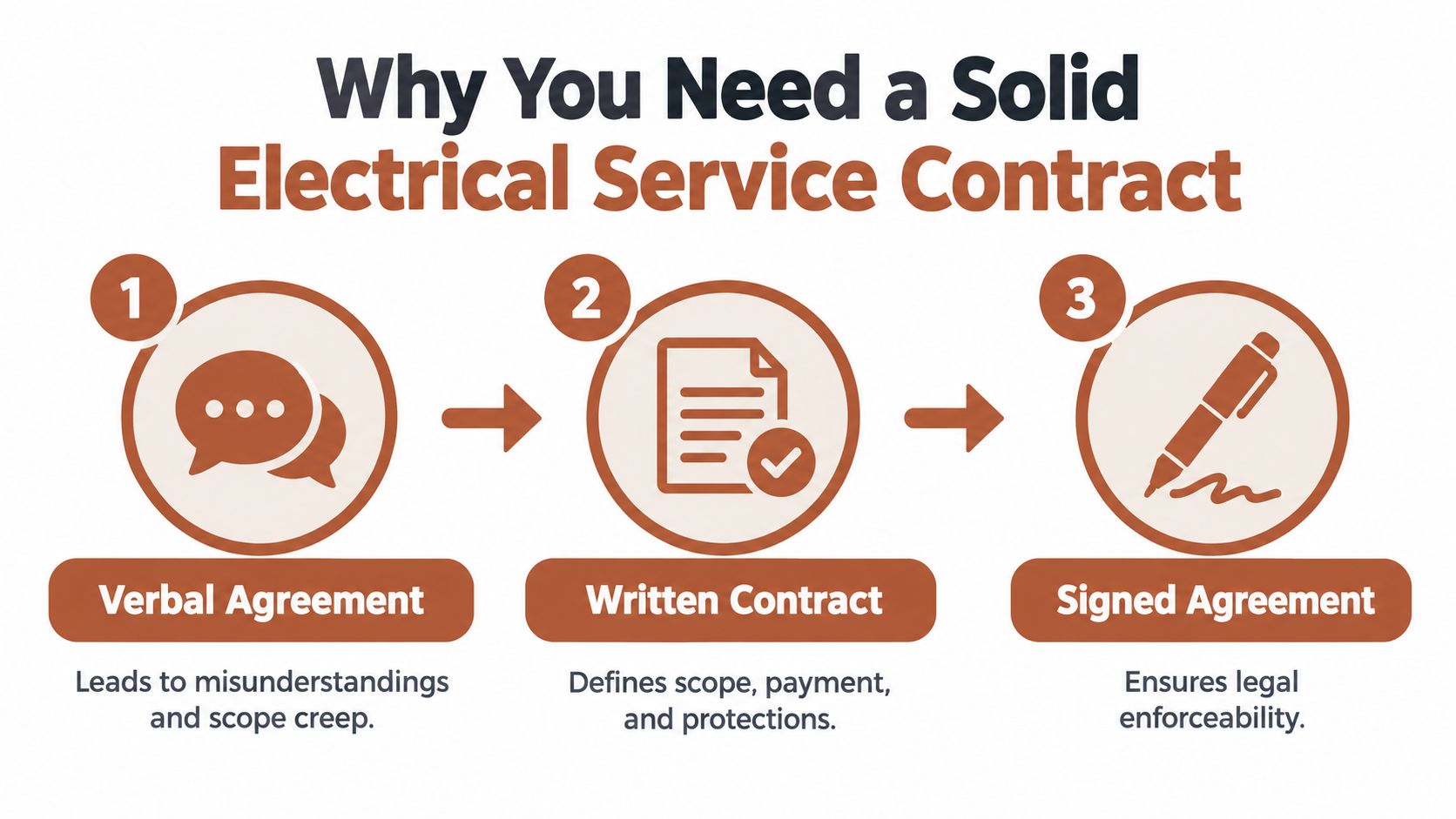
Put the boundaries in writing
A practical electrical service agreement should identify the legal names and addresses of both parties, the job-site address, the detailed scope, materials and brands, start and completion dates, pricing, payment schedule, permit responsibility, inspection responsibility, insurance, warranties, and signatures. These clauses form the basic risk-control structure described in electrical service contract template guidance.
The scope of work deserves the most attention. “Upgrade electrical system” is not a usable scope. “Remove the existing main panel, install the specified replacement panel, reconnect existing branch circuits where code-compliant, label circuits, test the installation, and coordinate the required inspection” gives both sides something they can check.
Write exclusions with the same care. Concealed damage, wall repair, painting, asbestos remediation, utility-side work, engineering, and correction of unrelated code violations may require separate pricing. If an item isn't included, say so plainly.
Practical rule: If a customer could reasonably ask whether an item is included, either include it in the scope or list it as excluded.
Protect time as well as money
A contract also controls the sequence of events. It can state when the customer must provide access, when materials must be selected, who must obtain permits, and what happens if another trade delays the work. Without those details, a customer may treat your completion date as unconditional even when you can't access the site or an inspection hasn't been scheduled.
Payment terms matter just as much. A signed agreement can support a deposit, progress billing, and final payment tied to identifiable milestones. The format isn't legal decoration. It creates a record of what the customer approved before you commit your labor, vehicle time, and working capital.
Building Your Electrical Contract Agreement Format
A professional contract doesn't need unnecessary pages. It needs enough detail for a customer, electrician, inspector, or adviser to understand the same deal without relying on memory. Use a consistent template, then adjust the scope and commercial terms for each job.
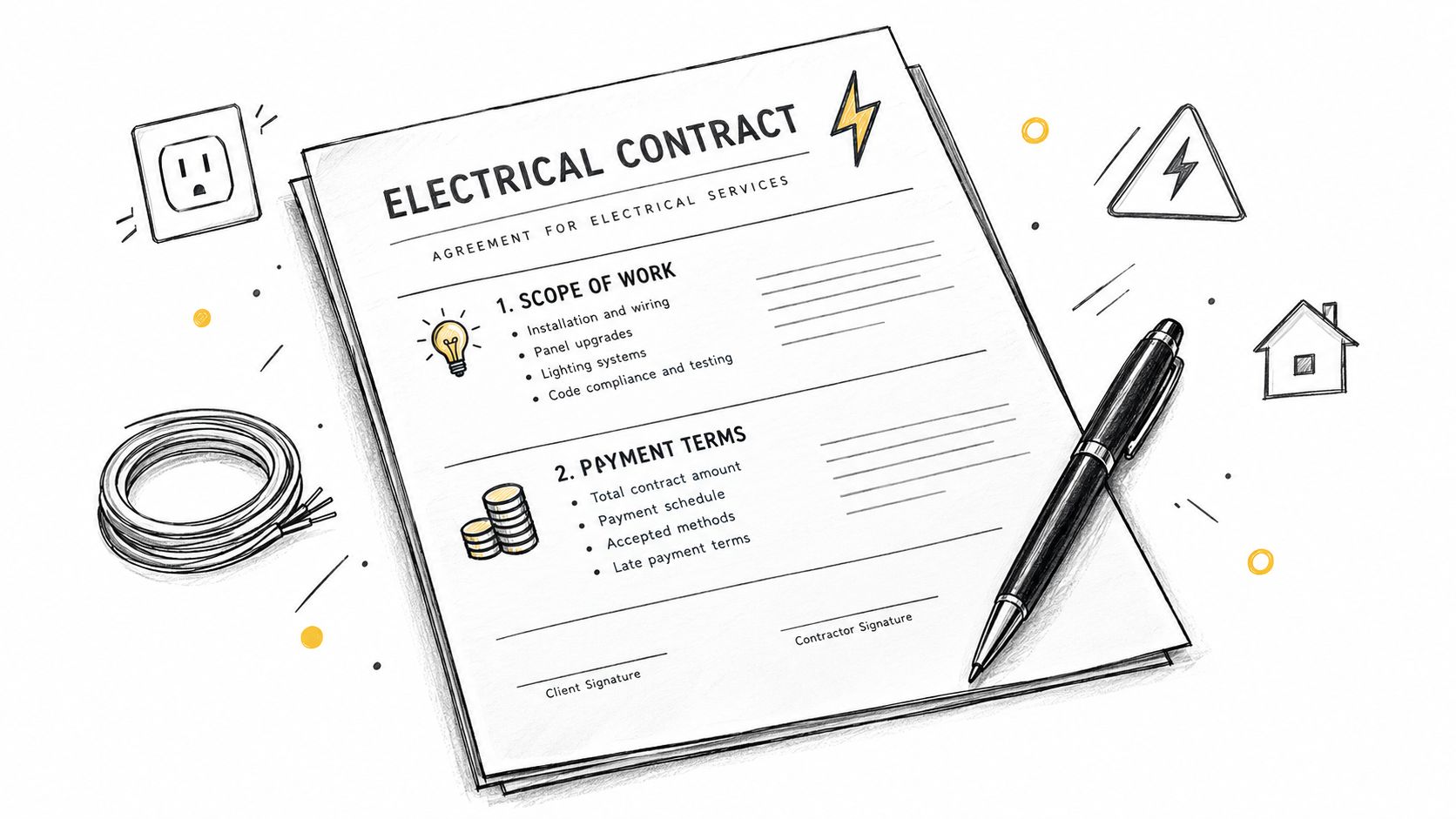
Start with the job record
Put the identifying information at the top:
- Parties: Use each party's legal name, trading name where relevant, address, email, and phone number.
- Site: State the complete service address and identify the building, unit, or area if needed.
- Authorization: Add the contractor's license number where applicable, the customer's authority to approve work, and the signature date.
- Scope: Describe the equipment, locations, quantities, installation method, testing, cleanup, and exclusions.
- Schedule: State the planned start and completion dates, while identifying access, material, permit, inspection, or customer-selection dependencies.
For scope language, adapt a clause such as:
“Contractor will perform only the electrical work described in Exhibit A. Work not expressly listed, including concealed-condition repairs, structural work, finish repair, utility work, and correction of unrelated defects, requires written approval and separate pricing.”
That wording works because it defines the job positively and prevents a vague promise from expanding into an open-ended obligation.
Make payment measurable
Don't write only “payment due upon completion.” Identify the amount or agreed price, the deposit if used, each progress milestone, the final billing event, accepted payment methods, and the effect of late payment. Tie billing to work that the customer can verify, such as material procurement, rough-in completion, inspection readiness, or final testing.
A useful structure might read:
“Customer will pay the contract price according to the payment schedule attached to this agreement. Contractor may invoice approved additional work separately. Customer must raise payment disputes in writing with reasonable detail, and undisputed amounts remain payable under the stated schedule.”
Have a qualified local professional review language about deposits, interest, suspension of work, lien rights, or collection costs because those rules vary by jurisdiction. For broader drafting principles, these key clauses for clear agreements can help you check whether your terms are understandable and complete.
Separate warranty promises
Your contract should distinguish workmanship warranty from a manufacturer's warranty. You control the quality of your installation, but you don't manufacture a panel, breaker, fixture, generator, or other supplied product. State what your workmanship promise covers, how the customer reports a defect, what remedies are available, and what conditions void or limit the promise, such as unauthorized alterations or misuse.
Don't promise that an installation will solve a condition you haven't inspected. If existing wiring, equipment, or structure remains in place, identify it and state whether you warrant only the new work. You can also use a separate service agreement workflow, such as the contract tools available through AurenWell's contract features, to keep the signed record connected to the client file.
Use the same discipline for signatures. Both parties should sign the same version, and the document should preserve the date, attachments, approved specifications, and any referenced estimate. A clean file is far more useful than a collection of text messages that each describe a different version of the work.
The following video provides another visual reference for organizing contract terms and approval steps.
Protecting Your Business with Critical Clauses
The clauses that protect a solo operator are usually the ones that seem inconvenient before the job begins. Change orders, responsibility for customer property, limitation of liability, suspension, termination, and dispute procedures all feel less urgent when the customer is friendly. They become central when the scope changes or an installation encounters a problem.
Control changes before they become costs
A change-order clause should cover more than “extra work will be billed separately.” It should identify the trigger, approval method, price adjustment, schedule effect, and timing of payment. The practical rule is simple: no added work starts until the customer signs the change order, except emergency action needed to protect people or property.
Use language such as:
“Any change to the scope, materials, code requirements, layout, or schedule must be described in a written change order signed by both parties before the changed work begins. The change order must state the added or reduced price and any extension or adjustment to the completion date.”
This approach matches electrical contractor change-order terms that require written documentation and clarify how changed work affects the contract. It also addresses the most common solo-operator failure: doing the work after a verbal “go ahead,” then discovering that the customer never understood the added price.
Record a customer's text or email request, but don't treat an informal message as approval unless your contract expressly allows that method and the message clearly states the price and schedule effect. A signed digital change order is stronger because it connects the request, revised amount, and authorization in one record.
Allocate responsibility for damage and delays
An indemnification clause can address claims arising from the customer's own conduct, unauthorized work, misuse of equipment, or failure to disclose known conditions. It shouldn't be copied blindly from a large commercial contract. Broad wording may be unenforceable or may create obligations you can't insure, so have local counsel review it.
Your liability clause should define the relationship between your responsibility and matters outside your control. It may address pre-existing conditions, customer-supplied materials, interference by other contractors, consequential losses, and damage caused by unauthorized modifications. Don't use a liability clause to excuse negligent or unlawful work. The clause should clarify risk, not replace sound workmanship and insurance.
Keep emergency work separate from ordinary changes. If a hazardous condition requires immediate action, document what you found, what you did to make the site safe, and what work still requires approval. A force majeure clause can also address events such as unavailable materials, access restrictions, or events outside either party's control. For examples of how such clauses are commonly structured, review force majeure clause examples.
A solo contractor who needs help organizing documents or reviewing administrative workflows may also consider virtual legal assistant support in California, while reserving legal interpretation and contract drafting decisions for a qualified attorney in the relevant jurisdiction.
Navigating Permits, Codes, and Local Requirements
Electrical contracts fail when they describe the commercial deal but ignore the regulatory work behind it. A customer may think the price includes every permit, filing, correction, and inspection. You may have priced only the installation. The contract must identify who carries each responsibility and what happens when an authority requires work outside the original scope.
The National Electrical Code is widely used as a baseline safety reference in the United States, and current electrical agreement formats commonly include explicit code-compliance language and state licensing information. Those requirements don't eliminate local variation. States, municipalities, utilities, and authorities having jurisdiction can impose different licensing, permit, inspection, and documentation rules, so the contract should name the governing requirements rather than make a broad promise that “all laws” are covered. Current electrical agreement guidance reflects this emphasis on code, licensing, dates, payment, termination, insurance, and warranty terms.
Assign the permit task clearly
State whether the contractor or customer will apply for the permit, pay the fee, provide property information, arrange access, and schedule inspections. If the customer holds the permit, say whether you can begin work before it is issued. If you hold it, state whether permit fees are included in the price or billed as a pass-through cost.
Also describe the effect of failed inspections. A failure caused by your installation may require correction under your workmanship obligations. A failure caused by pre-existing conditions, another contractor's work, changed authority requirements, or customer-requested revisions may need a change order.
Treat insurance as a contract requirement
List the insurance documents you can provide and avoid promising coverage that your policy doesn't contain. A certificate of insurance is evidence of selected policy information, not a substitute for reading the policy, endorsements, exclusions, and completed-operations terms. If a general contractor requests additional-insured wording, waiver language, project-specific limits, or other conditions, send the contract requirement to your insurance adviser before agreeing.
Your contract can state that the contractor will maintain legally required coverage and provide available evidence upon request, subject to policy terms. It can also require subcontractors to provide their own insurance documentation before they begin. Keep license records, permit approvals, inspection results, certificates, and customer approvals in the same job file.
Streamlining Execution and Payment Collection
A contract that sits in your truck unsigned hasn't protected the job. The field workflow should take you from estimate to approval without forcing the customer to print, scan, or search through a long email thread.
Start with a reusable template containing your business details, standard warranty language, payment rules, insurance statement, change-order process, and signature blocks. Customize the scope, materials, dates, price, exclusions, and permit allocation for each job. Read the final version before sending it. A copied address or outdated equipment description can create the same confusion as a missing clause.
Use a field-ready approval process
A practical sequence looks like this:
- Send one complete document: Include the estimate, scope, exclusions, specifications, payment schedule, and attachments in one approval package.
- Get approval before mobilizing: Don't order special materials or schedule labor until the required signature and initial payment have cleared according to your terms.
- Store the audit trail: Retain the signed agreement, timestamps, revisions, change orders, inspection records, and customer messages with the job.
- Bill from the approved scope: Convert completed milestones into invoices rather than rebuilding the price from memory.
- Record every payment: Keep card, ACH, check, cash, and bank-transfer records tied to the correct invoice.
Browser-based signing is useful when the customer is at the property and you're standing beside the panel. Mobile-friendly documents also reduce the temptation to start on a handshake and “sort out the paperwork later.”

For a solo business, a tool such as AurenWell can keep contracts, browser-based signatures, audit trails, invoices, estimates, and online payments connected to the client record. Other systems can work too. The important test is whether you can find the signed agreement and payment history quickly when a customer questions an invoice. Use a clear customer payment collection process so follow-up doesn't depend on memory after a long day in the field.
Common Mistakes to Avoid in Your Contract
Most contract problems don't come from a missing legal phrase. They come from a document that doesn't match the job being performed. A polished template won't help if the scope says “install lighting” while the estimate includes fixtures, controls, circuit extensions, ceiling access, patching, and disposal.
Check these failure points before sending an agreement:
- Vague scope: Identify locations, equipment, quantities, testing, cleanup, and exclusions.
- Unclear payment timing: Tie deposits, progress bills, and final payment to stated events.
- Missing change-order procedure: Require written approval that states both price and schedule impact.
- Unassigned permit responsibility: Name the party responsible for applying, paying, coordinating, and responding to inspections.
- Overbroad warranty language: Separate your workmanship commitment from manufacturer coverage and existing-condition issues.
- No termination process: State how either party can end the agreement, what notice is required, and how completed work and ordered materials are paid.
- Uncontrolled revisions: Keep one final signed version and attach every approved change order to it.
- No customer-access terms: Address access, power, water, storage, pets, occupancy, and coordination with other trades where relevant.
Before you start: Read the agreement aloud as if you're the customer. Any phrase that could produce two reasonable interpretations needs a clearer scope, exclusion, or approval rule.
The strongest electrical contract agreement format is not the longest one. It is the document that tells you what to do before work starts, what to bill when the scope changes, and what evidence to produce if someone later remembers the job differently.
Before your next service call, build a reusable contract with your legal details, scope, exclusions, payment schedule, warranty boundaries, permit allocation, insurance wording, and change-order clause. Have a local attorney review the template for your jurisdiction, then send the signed agreement and required deposit before ordering materials or beginning work.