
The usual advice for pricing a service is to choose an hourly rate, check what competitors charge, and add a little for profit. That's backwards for a one-person business. Before choosing a rate, you need to know how much billable work must pay for the entire business, including the hours customers never see.
A low hourly price isn't competitive if you have to work unpaid evenings to make it viable. A higher fixed price can be the better offer when it includes preparation, delivery, cleanup, and clear limits. Your cost of service sets the floor. Your scope and pricing model determine how you sell above it.
The Cost Stack Behind One Billable Hour
In a hypothetical monthly budget, the same business can appear to need $46.25 an hour or $69.81 an hour, depending on which hours it expects to invoice. Neither figure tells you what customers will pay. The difference tells you whether your calculation acknowledges unpaid work.
Say you want $5,000 in monthly owner compensation, have $2,400 in recurring overhead, and expect 106 billable hours out of 160 working hours. These are planning assumptions for the example, not recommended earnings or spending targets.
Monthly cost stack per billable hour
| Cost layer | What it covers | Monthly amount | Per billable hour |
|---|---|---|---|
| Owner pay | Target compensation for the owner's labor, before the separate tax reserve | $5,000 | $47.17 |
| Recurring overhead | Insurance, software, phone, vehicle, and similar fixed costs | $2,400 | $22.64 |
| Combined floor | Owner pay plus overhead before materials, tax, and profit | $7,400 | $69.81 |
| Same costs on 160 hours | Understatement from treating every hour as billable | $7,400 | $46.25 |
| Job materials | Parts, supplies, and mileage used on that job only | Total the job receipts | Add on the job |
| Tax reserve and profit | Set aside, not spent as wages | Set aside separately | Markup on loaded cost |
The owner-pay row isn't profit. It pays you for operating the business, whether you're cleaning a driveway or answering an estimate request. If you need a particular after-tax take-home amount, work backward with your tax adviser rather than treating the compensation figure as spendable cash.
The overhead row covers expenses that continue between jobs. Don't include the same vehicle expense both in fixed overhead and as a full job-specific mileage allocation.
Cost of service = owner hours × loaded owner rate + allocated overhead + job materials + payment costs.
Here, the loaded owner rate means compensation and applicable labor-related burden, with overhead shown separately. If you combine labor and overhead into a single recovery rate, don't add overhead again.
Why the denominator matters
Labor represented an average 55.1% of aggregate service-sector inputs, compared with 27.2% in manufacturing, in the U.S. Bureau of Labor Statistics analysis covering 2019–2023. For a solo operator, that labor includes the owner even when the accounts contain no payroll expense.
In the hypothetical budget, dividing by every working hour understates the required recovery rate by about 34%. The calendar includes quoting, scheduling, collections, and other work that doesn't produce a separate invoice.
Use expense tracking for small business to separate recurring costs from job purchases before choosing your denominator. For HVAC operators considering how customer acquisition fits the economics, Transactional LLC's resource on how to improve HVAC margins with local SEO offers a complementary perspective. Marketing decisions still need to work against your own delivery costs.
Replace the example's owner compensation and overhead with your actual requirements before choosing how to charge.
Calculate the Minimum Price for One Job
Start with a defined job, not an appealing price. A minimum price should describe a deliverable you can complete under stated conditions, with enough room to pay for the resources it consumes.
This workflow turns those resources into a quoteable amount.
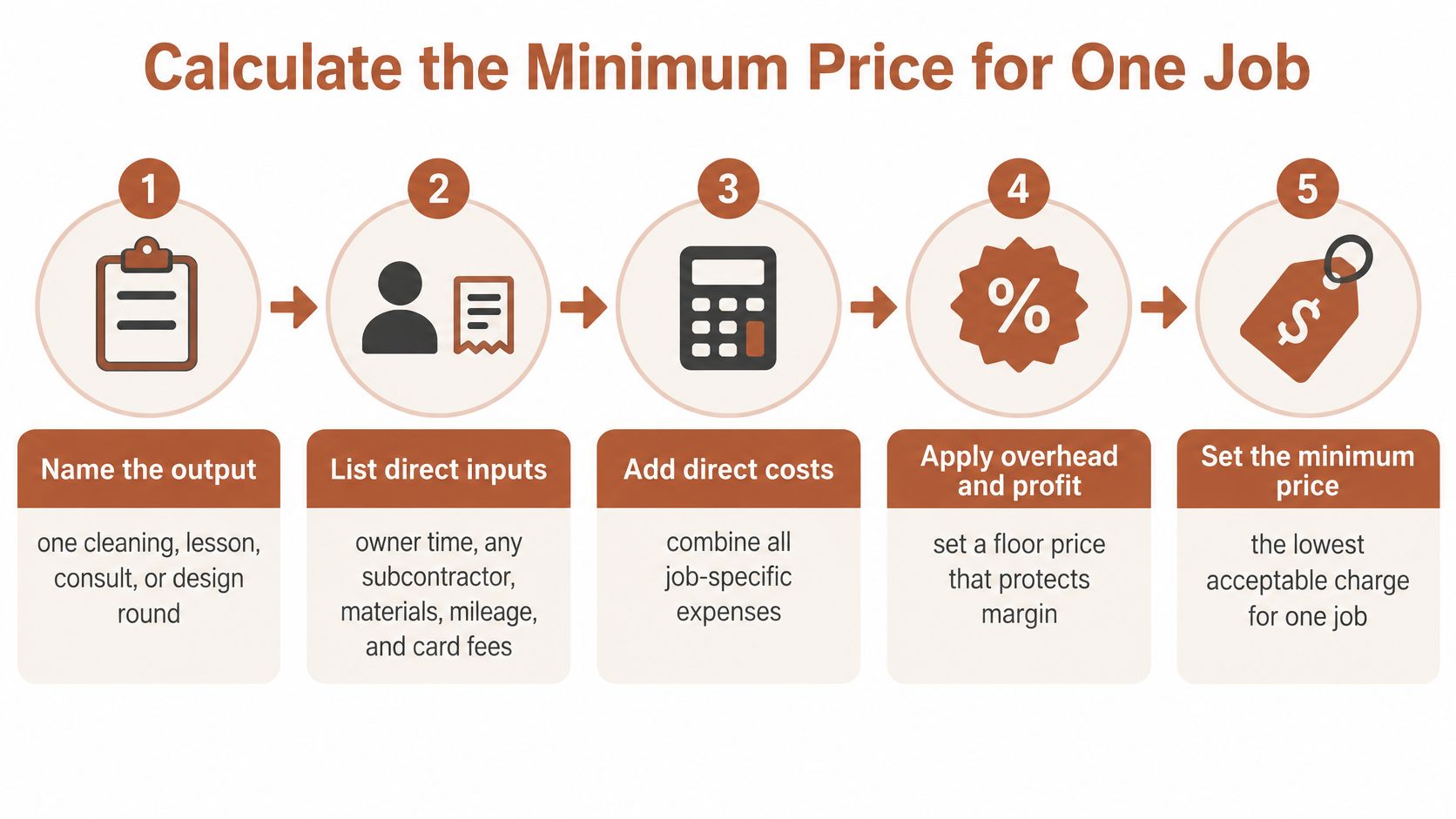
Build the estimate from the work
Name the output. Specify a completed cleaning, lesson, consultation, or design deliverable. Include the conditions that affect completion, such as access, surface condition, client-supplied information, or revision limits.
List the direct inputs. Record owner time, subcontractors, materials, travel, and payment costs. The U.S. State Department estimating guide uses a task-based approach that applies labor rates and direct expenses before overhead, general administration, and profit. Small jobs still need their share of indirect costs.
Estimate time by task. Separate preparation, delivery, travel, editing, and closeout. For a hypothetical photography assignment, a three-hour shoot plus three hours of editing, travel, and invoicing consumes six hours, not just the appointment shown on the client's calendar.
Choose a realistic capacity base. Billable utilization means billable hours divided by available working hours. SPI Research's 2025 professional-services benchmark reported average utilization of 66.4%, which gives about 106 billable hours from a hypothetical 160-hour month; at 75%, that month provides 120 billable hours, reducing a hypothetical $2,400 overhead allocation to $20 per billable hour. These are capacity illustrations, not targets every solo trade should copy.
Allocate without double-counting. Decide which tasks belong to the job and which belong to general operations. If your billable-capacity calculation already absorbs general quoting and bookkeeping, don't charge those same hours again as direct job labor. Job-specific editing or unusual travel still needs an explicit allowance.
Add reserves and profit deliberately. Your tax reserve should reflect your tax position, while profit compensates for business risk and funds future needs. A markup isn't the same as a profit margin, and a combined reserve doesn't guarantee a particular after-tax result.
Close the costing loop. Compare estimated time with actual time and receipts after completion. In our app, an expense can be linked to a client when it belongs to a specific job, making it easier to identify which assignment used the materials.
For a field-service startup, equipment selection and operating setup belong in this exercise before the first quote. The Money Maniac startup guide provides useful context for someone planning a pressure-washing business.
Worked job build-up for a 6-hour job
For this hypothetical build-up, assume the six hours are chargeable job-capacity hours, including delivery-related work, and exclude general administrative time already recovered through the capacity rate. Use the rounded hourly allocations from the example budget, add $40 in materials, and apply an illustrative 20% combined tax-reserve-and-profit allowance.
| Line | Calculation |
|---|---|
| Owner labor | 6 hours × $47.17 = $283.02 |
| Overhead | 6 hours × $22.64 = $135.84 |
| Materials | Job-specific receipts totaling $40.00 |
| Loaded cost | $283.02 + $135.84 + $40.00 = $458.86 |
| Tax reserve and profit | 20% of $458.86 = $91.77 |
| Minimum price | $550.63, rounded to about $551, before payment fees |
That $551 hypothetical floor is a costing result, not proof that the market will accept the offer. If customers won't pay it, change the delivery process, scope, or target job rather than hiding the shortfall.
Match the Pricing Model to the Job
Every pricing model must clear the loaded floor. Changing the invoice from hourly to a package doesn't make an unprofitable assignment profitable.
The useful question is who carries the uncertainty. With hourly billing, the customer carries more of the time risk. With a flat fee, you carry it, so your scope and estimating discipline matter more.
Four ways to charge a service
| Model | Best fit | Floor check | Main risk |
|---|---|---|---|
| Hourly | Consulting, tutoring, or coaching with shifting scope | Loaded rate times all estimated hours, not only face time | A low posted rate plus unpaid prep |
| Flat fee | Repeatable visits, sessions, or standard jobs | Expected hours at the loaded rate plus materials and margin | Revisions and travel left out of the quote |
| Tiered packages | Clients choosing good, better, and best | Each tier covers its own hours and materials | The cheap tier subsidized by the middle one |
| Retainer | Monthly coaching, maintenance, or a service route | Monthly fee covers reserved hours at the loaded rate | Hours used up or extra scope with no overage rate |
Choose who carries the time risk
Hourly billing suits uncertain work, such as troubleshooting a consultant can't fully diagnose before starting. State which preparation and follow-up activities are billable, and provide an estimate or spending cap. Otherwise, the client may reasonably assume the appointment is the entire purchase.
A tutor can use hourly billing while still charging for a defined learning package. The package needs to include preparation and feedback, not merely multiply the advertised lesson rate by the number of appointments.
Flat fees suit repeatable outcomes. A lawn visit can specify the area, mowing, edging, and removal conditions. A photography session needs equally clear boundaries around locations, deliverables, editing, and rescheduling.
HomeProBadge's pricing guide for drone pilots is a relevant companion when turning a creative assignment into defined deliverables. For your own quote, the important distinction is between the capture session and everything required to deliver usable files.
A higher fixed price that includes unpaid work is more sustainable than a lower hourly rate that leaves that work unrecovered.
That doesn't mean every customer will choose the higher offer. It means the apparently cheaper offer isn't a sound benchmark unless both providers include comparable work.
Package scope rather than discounts
Tiered packages work when the differences are operationally real. A designer might separate a tightly defined deliverable from an expanded package with additional formats and revision access. Don't make the entry package deliberately unprofitable in the hope that most buyers upgrade.
Retainers sell reserved capacity. A coach can reserve recurring sessions and a defined amount of between-session support, while a maintenance provider can reserve scheduled visits. Both need a written boundary for additional work, cancellation, and unused capacity.
A retainer without limits can become an open-ended promise at a fixed price. Reserving availability also means you may turn away another buyer, so price the commitment rather than only the minutes eventually used.
Pick the model that matches your next assignment, then write its included scope in a sentence. If you can't state the boundary clearly, you're not ready to fix the price.
Raise the Price Without Losing the Client
A lower quote is not automatically more competitive. If it ignores the unpaid work needed to deliver the job, it can leave you earning less for the same commitment. Choose among raising the base rate, adding a specific fee, or reducing scope, based on what is driving the cost.
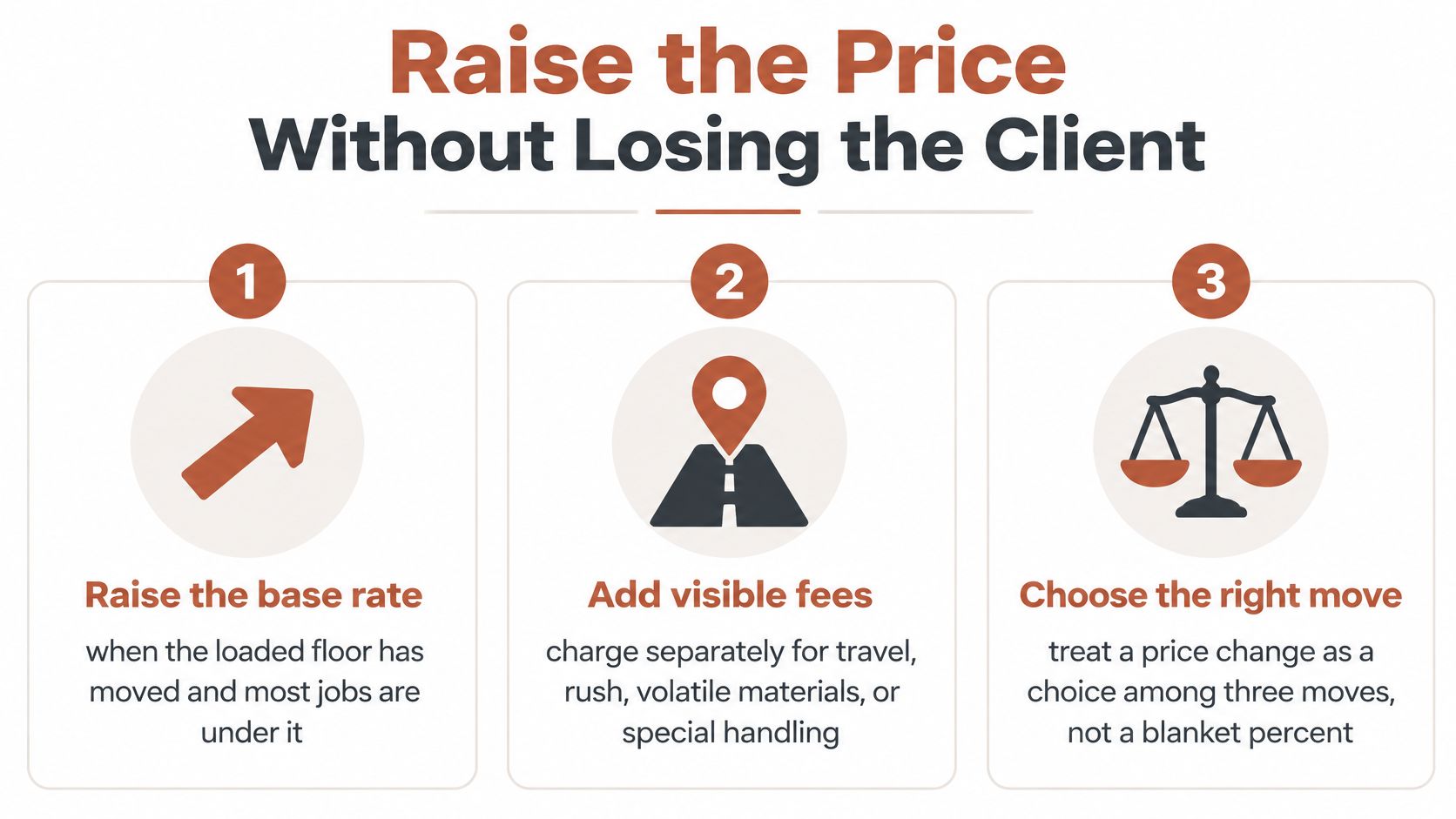
Match the change to the cause
- Raise the base rate when ordinary assignments no longer cover their full costs, including unpaid work. Use the revised rate for comparable new quotes, rather than bargaining it down before the customer responds.
- Add a visible fee when a particular job involves extra travel, rush scheduling, special handling, or materials with changing costs. Explain the trigger before approval, and check applicable rules before passing through payment charges.
- Reduce scope when the customer's budget supports a smaller job. Remove a named revision round, service area, or optional task instead of delivering the full service for less.
The NFIB August 2025 small-business report found that 21% of U.S. small-business owners reported raising average selling prices, while 11% identified inflation or higher input costs as their most important operating problem. These figures can prompt a review of your own costs, but another owner's increase is not a pricing target for your business.
Test acceptance and contribution
After changing a price, track quote-to-job conversion, average job value, and repeat-client rebooking. Record the service type and scope with each result. Otherwise, a shift toward smaller jobs could look like a pricing failure.
Lower conversion can still be acceptable if the work you win earns enough contribution within your available capacity. A higher average invoice can also mislead if those jobs take disproportionately longer. Compare the price with the time and costs required to deliver the agreed work.
Retention rule: Keep client relationships through clear choices, not an indefinite promise to work below cost.
Give existing retainer clients notice consistent with their agreement. If you temporarily keep an old rate, state when it ends and what replaces it. Use estimate terms and conditions to make scope, approvals, and payment expectations clear before work begins.
Use this video as another prompt for reviewing how you present the offer.
Cost recovery sets your minimum; value-based pricing considers whether speed, convenience, specialist skill, or reduced client effort can support a higher price. A customer's willingness to pay more does not replace the need to measure delivery costs.
Turn the Price into an AurenWell Invoice
An accepted price needs to survive the trip from estimate to payment. If the invoice contains unexpected extras, or you forget approved materials, the calculation won't match what you collect.
Keep the customer's approved scope, deposit, and final balance connected. Our invoicing features support that administrative path without requiring you to rebuild the job in separate documents.
Use this checklist to keep approval and payment tied to the same offer.
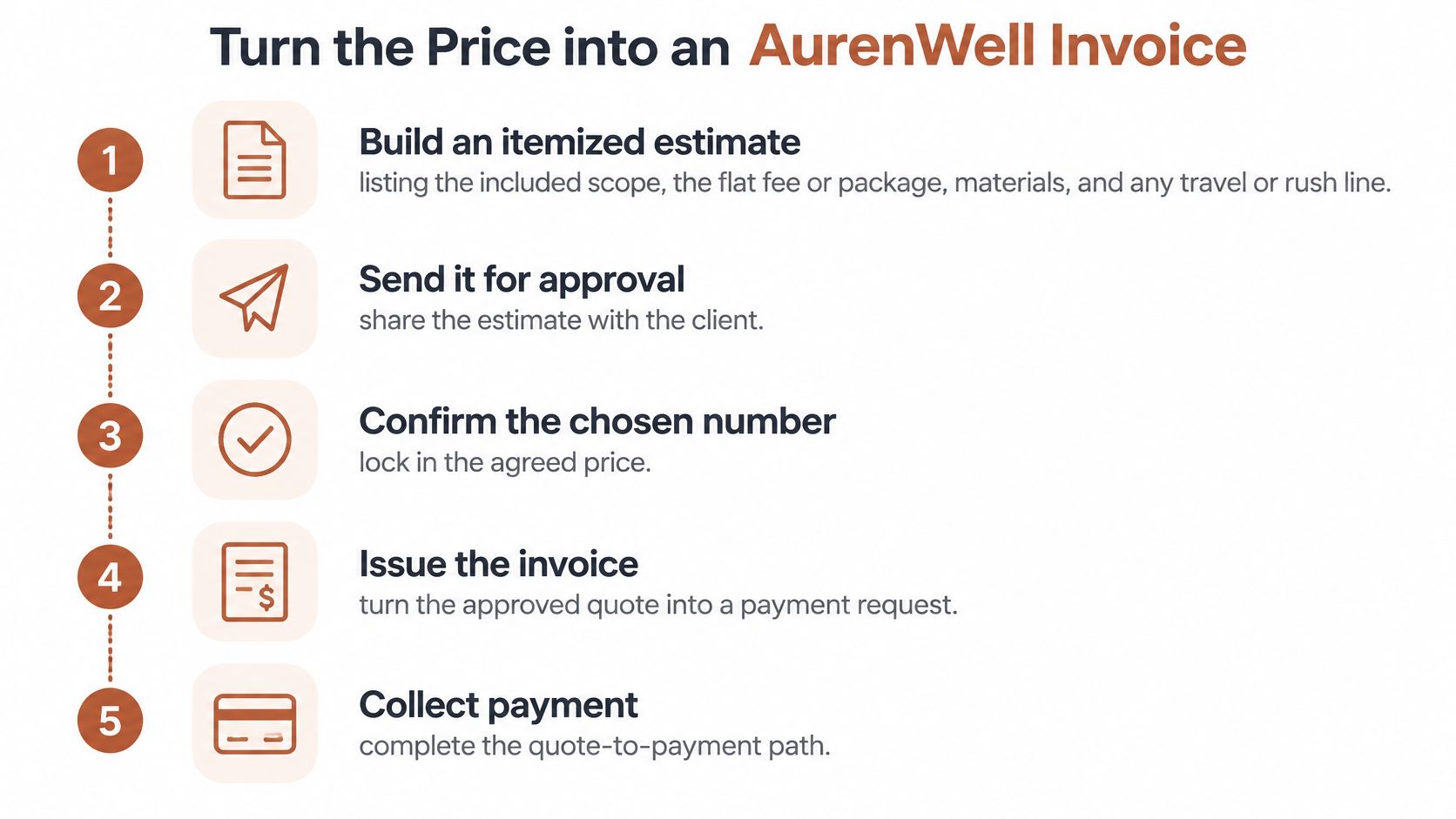
Approve the scope before starting
Build an itemized estimate. List the service or package, included deliverables, materials, and any approved travel or rush charge. A flat fee can remain a flat fee without exposing your internal wage calculation, but the customer should understand what they're buying.
Send the estimate through its online approval link. Collect the agreed deposit on approval, then have the service agreement signed and stored with the client record. Keep exclusions and cancellation terms in the agreement rather than relying on a conversation the client may remember differently.
Convert the approved estimate to an invoice without rebuilding it. Check that the invoice reflects approved changes and the remaining balance. If the customer requests additional work, document that approval rather than slipping an unexplained amount onto the final bill.
For hourly assignments, use tracked time rather than reconstructing the week from messages and calendar entries. Logged hours can be added to the invoice, giving you a billing record that matches the work recorded.
Choose how payment costs are recovered
Our invoices can include a percent-based processing-fee line passed to the client. Decide before approval whether your displayed price includes payment costs or whether an allowed, disclosed fee will appear separately.
Online card and ACH payments carry Stripe's standard processing fees plus a 1% AurenWell platform fee. Recording cash, check, or bank transfer has no platform fee. Don't treat a card-payment calculation as interchangeable with an ACH calculation, and don't describe the platform fee as the entire processing cost.
Clients can pay by card, ACH, QR code, or a recorded manual payment. Offer methods you can reconcile reliably, and distinguish an issued invoice from money received.
- Keep recurring work stable. Leave the monthly service schedule in place when a customer needs extra equipment, parts, or repair labor. Create a separate estimate or invoice for that additional work.
- Make balances visible. Overdue and partially paid statuses are calculated from dates and payments, so an invoice doesn't disappear just because the customer paid part of it.
- Use scheduled reminders. Polite overdue reminders, such as those at 3, 7, and 14 days, reduce the need to write each follow-up manually.
Close the job only after checking the payment record, time entries, and expenses. That review gives you a usable result for future estimating rather than a paid invoice with no indication of whether the work was profitable.
Send the Next Quote at the True Cost
Don't send another quote at the old rate if you already know it fails your cost floor. An underpriced booking commits capacity you can't sell again, and a full calendar won't correct that decision.
Write down your monthly owner compensation, recurring overhead, realistic billable capacity, and resulting loaded recovery rate. Use those figures to evaluate the assignment sitting in your drafts, then add its direct purchases and the reserves appropriate to your business.
Make the scope fit the budget
If the customer's budget falls short, offer a smaller job with a clear boundary. A photographer can reduce deliverables; a cleaner can remove an optional area; a consultant can narrow the question being answered.
That's different from discounting the same promise. The customer should be able to see what changed, and you should be able to deliver the revised work without depending on unpaid extra effort.
- Before approval: Confirm access, deliverables, exclusions, and the deposit requirement.
- During delivery: Record actual time and purchases while the details are fresh.
- After completion: Identify the task that exceeded its allowance and adjust the next estimate accordingly.
Don't retroactively charge for an estimating mistake unless the agreement supports the charge and the customer approved the relevant change. Improve the next quote instead of turning closeout into an argument.
The estimate, deposit, agreement, and payment can remain together in our workflow, so the revised price becomes an operating decision rather than a number left in a spreadsheet.
Does the quote in your drafts cover the work at your loaded floor, plus its direct costs and reserves? If yes, send that estimate through AurenWell today with the scope stated clearly and a deposit requested before work starts. If no, remove a named piece of scope or decline the assignment. Don't send it unchanged.