
A client is comparing your quote with another solo contractor's. Yours includes preparation, cleanup and a clear finish standard; the other just says pressure washing. Unless your proposal makes those differences obvious, the client may compare only the totals, then expect you to include whatever they thought the job involved.
A useful contractor proposal template does more than help you win the work. It records what the client approved and gives you a stopping point when someone asks for something extra.
Required Sections Every Contractor Proposal Needs
Build the document around the decisions a client must make, not around a decorative cover page.
Required sections and minimum content
| Section | What It Does | Minimum Content |
|---|---|---|
| Cover block | Identifies who is bidding on what | Legal business name, contact details, client name, project address, date |
| Scope of work | Defines the outcomes you will deliver | Measurable deliverables, site conditions, access notes |
| Inclusions and exclusions | Stops assumed work from becoming free extras | Separate lists with specific items, such as oil stains or interior windows |
| Assumptions | Records what must be true for the price to hold | Water and power access, parking, client-supplied materials |
| Schedule | Sets the start window and completion | Earliest start, duration, weather or access dependencies |
| Pricing | Shows the total and how it was built | Line items, quantities, unit prices, tax, total |
| Payment terms | Says when money moves | Deposit amount, milestones, balance due date, late-payment rule |
| Change-order rule | Governs added or changed work | Written approval before changed work starts, repricing method |
| Warranty and insurance | Defines warranty commitments and identifies coverage | Warranty period, licence number where applicable, insurance details |
| Validity and acceptance | Sets the offer expiry and acceptance method | Expiry date, signature block, approval method |
Separate the work from the price
The GSA's federal construction bidding guidance describes technical or management proposals separately from price proposals. That distinction is useful for a small residential job too: the client should understand what you're delivering before deciding whether the price makes sense.
Keep the scope readable without making the client decode your internal costing. You can disclose a unit rate without disclosing every overhead calculation behind it.
Keep the front page useful
Leave the long company history and generic marketing copy off the cover. Put relevant qualifications beside the work they support, and reserve a short custom-notes box for project-specific details such as gate access or an agreed protection method.
For a document you can adapt rather than format from scratch, the free proposal template from Estimatty provides a starting framework. Check it against the sections above before using it.
An expiry date prevents an old offer from looking indefinitely available. A named authorised signer identifies who can accept, while accurate licence and insurance details prevent misunderstandings about your eligibility or coverage. Neither replaces properly drafted terms.
Create these headings in your own document before entering any pricing. Missing sections are easier to spot in an empty template than in a polished PDF.
How to Write Scope and Assumptions Step by Step
Start with the result the client wants, then work toward the conditions under which you can deliver it. Don't start with a price and try to squeeze the scope underneath it.
Use this visual as a quick field reference.
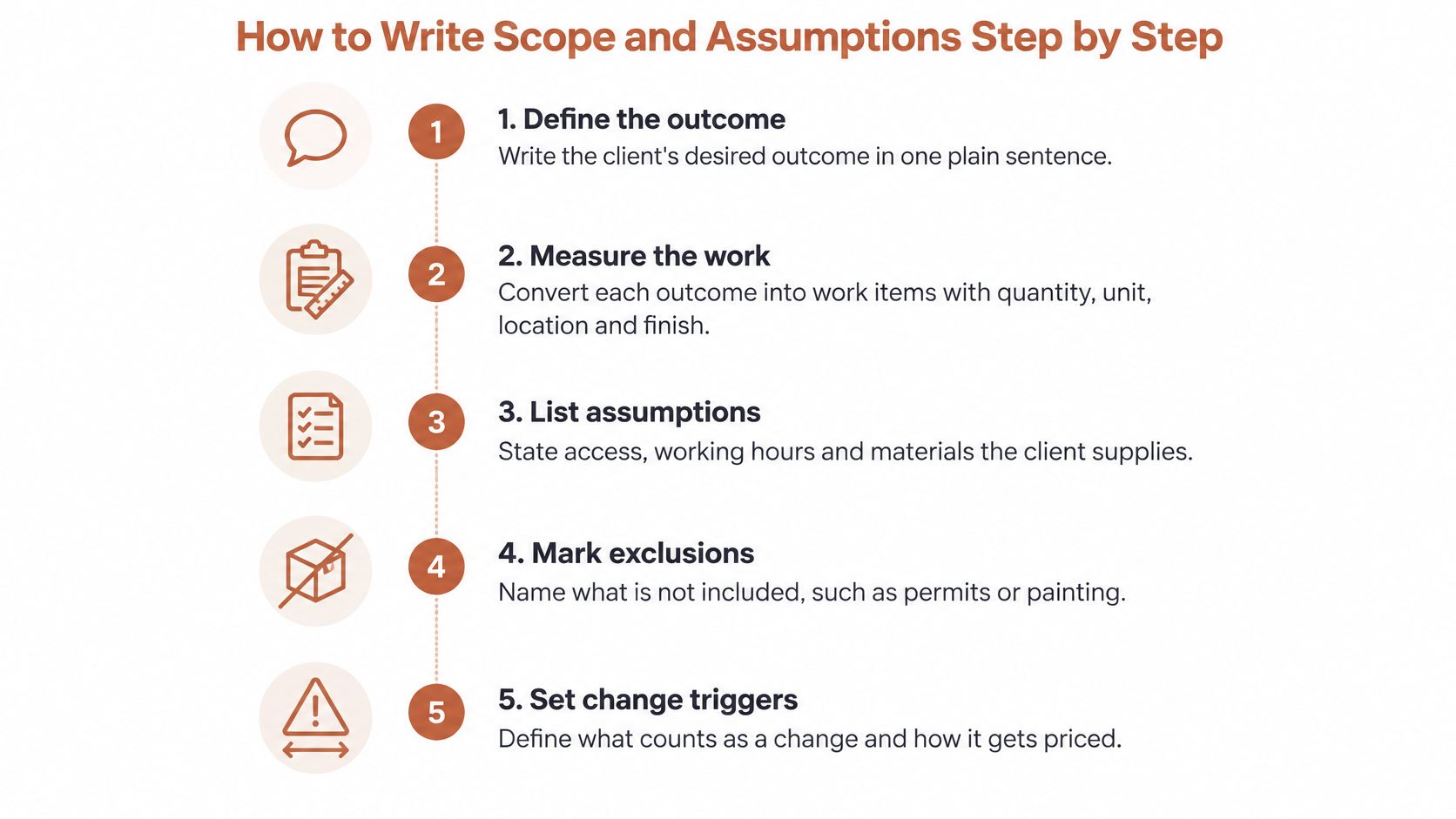
Build the scope in a reliable order
Write the desired outcome. Use a plain sentence describing the result, such as removing loose dirt and organic growth from the driveway. The common slip is promising that an old surface will look new when permanent staining or damage remains.
Turn the outcome into measurable work. Give each item a quantity, unit, location and finish standard. Clean patio is incomplete because it doesn't identify the boundaries or what clean means.
Separate exclusions from client responsibilities. Identify omitted treatments and anything the owner supplies. Don't bury furniture removal inside a general access statement if the client must clear the work area.
Record access constraints and allowances. Note locked gates, occupied rooms, parking restrictions and uncertain materials. An allowance needs an identifiable purpose and approval process, not just a miscellaneous label.
Attach a price basis and milestone. State whether the item is fixed-price, measured or billed by time, and when it will be completed. Otherwise, the client may mistake an estimated quantity for an unlimited commitment.
Write the change trigger. Name the event that requires fresh approval, such as added surface area or a return visit caused by unavailable access. Avoid relying only on the vague phrase additional work.
Run the completeness check. Check scope, quantity, unit, location, finish standard, responsible party, timing, price basis, tax, deposit, balance due, expiration date and change-order trigger. A complete description still fails commercially if nobody can tell when payment becomes due.
Make each clause earn its place
For a hypothetical driveway job, a useful starting line is:
Pressure-wash approximately 600 sq. ft. of driveway. Oil stains excluded. Client supplies water access within 50 ft of the work area.
The area establishes the working boundary. The stain exclusion prevents the client from treating specialist stain removal as ordinary washing, while the water-access condition identifies an owner responsibility that affects setup.
Add the finish standard separately, such as removal of loose dirt and organic growth without a promise to erase permanent discoloration. Mark the work boundary on an attached photo if the driveway joins other paved areas.
An ASCE-linked study of change-order causesCO.1943-7862.0000550) reported that, among 145 change orders, approximately 52% arose from errors or omissions in the work plan, compared with 33% from owner plan changes and 9% from unforeseen circumstances. That's a reason to resolve missing scope before acceptance, not an excuse to label every clarification an extra.
Use matching line labels for the work item, price and acceptance condition. The driveway line should lead directly to a completion check for that driveway, not a general satisfaction statement covering the whole property.
For the commercial wording around those checks, use this guide to estimate terms and conditions.
This video offers another format for reviewing the proposal-writing process.
Pricing Models and Deposit Terms That Protect Cash Flow
The pricing model you pick decides who absorbs the cost when scope slips or quantities move. Whatever model you use, build the number from the actual cost stack:
- Labour: Direct hours multiplied by a loaded labour rate, including employment-related costs where applicable.
- Job costs: Materials, subcontractors, equipment, travel, disposal and permits.
- Business costs: A deliberate allocation for overhead.
- Risk and return: Contingency for defined estimating risk, followed by profit.
The money left after materials is not your earnings. Equipment wear, unpaid administration and travel still consume the margin.
Pricing models and deposit approach by job type
| Pricing Model | Best For | Main Risk to You | Deposit Approach |
|---|---|---|---|
| Lump sum | Fixed, well-defined jobs with clear scope | Labour overruns you absorb | Deposit on acceptance, balance on completion |
| Unit price | Measurable work such as square feet or linear feet | Quantity disputes after measuring | Deposit on mobilisation, then per-unit billing |
| Time and materials | Diagnostic or repair work with unknown scope | Client sticker shock and slow approval | Deposit covering the first visit, then weekly billing |
| Hybrid, lump sum plus allowance | Known core work with uncertain extras | Allowance overspend without approval | Deposit on the core price, allowance billed at cost with sign-off |
Choose who carries the uncertainty
A lump sum is easy for a homeowner to approve, but you own the estimating error within the agreed scope. Unit pricing handles uncertain quantities better, provided both parties agree how measurements will be taken and recorded.
Time and materials suits investigation and repair, but it needs more communication. State the labour rate, material charging basis, billable travel treatment and the point at which you will pause for further authorisation.
Use an allowance for an identifiable uncertain item. Explain what it covers, how unused funds are credited and whether handling or procurement charges apply. A priced alternate works better when the client can choose between distinct options before work begins.
Change orders can push a contract price well above the accepted figure, and the size of that movement grows with how much scope was left open at signing. Don't transfer a generic percentage into a residential contingency automatically. Price your own exposure, and keep the risk built into your rate separate from work that needs its own written approval before it starts.
Write payment terms the client can follow
State the deposit amount, what triggers payment, milestone amounts, the balance due point, cancellation treatment and any lawful late-payment terms. Define milestones by completed work rather than a loose phrase such as halfway through.
For a hypothetical fixed-price job, payment wording could read:
A deposit of 30% of the accepted total is due on approval, subject to applicable deposit limits. The remaining balance is due on completion of the listed work and the agreed walkthrough.
That percentage is an example, not a universal recommendation. Local requirements may restrict deposits or require particular contract wording, and the guide to how much deposit contractors should ask for helps frame that decision.
For time-and-materials work, use a different mechanism:
The stated initial-visit deposit is credited against the first invoice. Labour and materials are invoiced weekly with supporting records; each invoice is due on receipt. Work beyond the agreed authorisation limit requires written approval.
Avoid calling every deposit non-refundable. Explain what happens to committed materials, completed work and unused funds if the client cancels, using terms appropriate to your jurisdiction.
A deposit protects you before mobilisation by limiting how much cash you commit to someone else's project. It can't compensate for an undefined scope or make an unsuitable job worth accepting.
Change Order Language That Prevents Unpaid Work
You're packing up when the homeowner asks you to wash the side path too. It sounds small, so you agree. At invoicing, the homeowner says they thought it was included.
No extra work starts until the change is written, repriced and approved. That rule needs to be usable while you're standing beside the equipment, not buried in legal wording you can't find.
Use a clause you can act on
Additions, substitutions and work arising from concealed conditions require written approval of the changed scope, price and schedule before the affected work begins. Verbal requests don't authorise additional work. Unaffected work may continue where safe and practical.
Identify who may approve a change. A tenant, neighbour or employee giving access isn't automatically authorised to increase the owner's bill.
The signed change should be easy to recognise and retrieve.
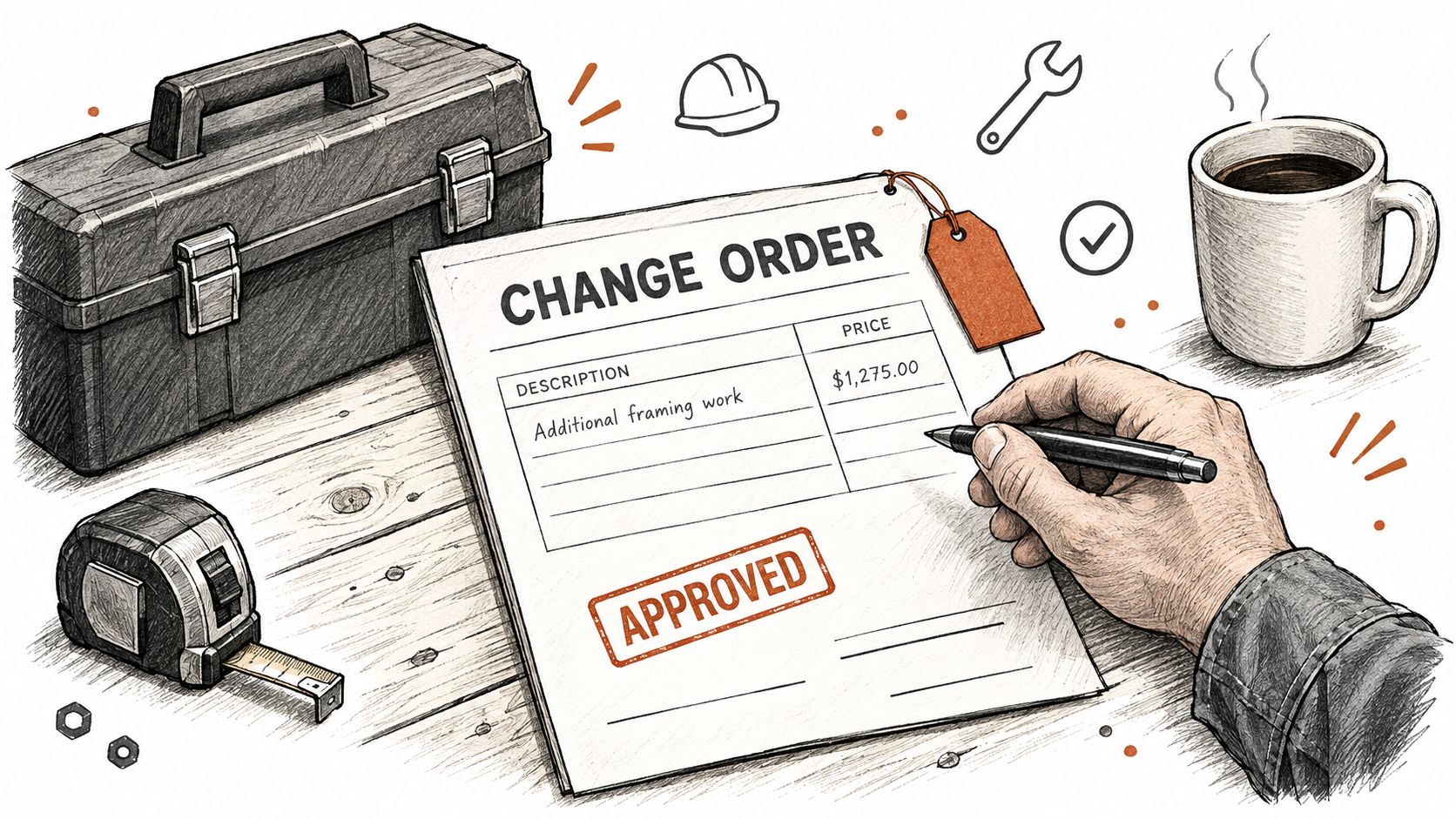
Attach a mini-form to the proposal:
| Field | What to Record |
|---|---|
| Requested change | Exact work added, removed or substituted |
| Reason | Client request, changed selection or discovered condition |
| Labour and materials | Additions and deductions shown separately |
| Schedule impact | Revised completion or no change |
| Revised total | Approved adjustment and new contract total |
| Approval | Approval date and authorised client's name and signature |
Don't charge for your own ambiguity
Repair damaged subfloor discovered after demolition can be a genuine concealed-condition change. Install flooring is less clear: ordinary preparation may already fall within the promised installation.
Before asking for more money, compare the request with the accepted scope and exclusions. If your original wording reasonably included the task, a change-order form doesn't turn it into an extra.
The Construction.live discussion of HKA's CRUX findings notes that scope change affected more than 28% of disputed projects in HKA's 2025 analysis of over 2,200 projects across 114 countries. Those are disputed projects, not a prediction about the likelihood of a dispute on your next residential job.
Test the form against realistic decisions:
- Normal completion: The invoice matches the accepted work, with deposits credited.
- Client-requested addition: The adjustment appears only after the authorised client approves it.
- Concealed condition: You document the discovery, protect the site and obtain a decision before undertaking the affected repair.
Check that each path produces a clear invoice amount and an identifiable approval record. If the software allows silent edits to accepted scope, preserve the accepted version before making a revision.
In our workflow, a declined estimate can be edited and resent if the scope of the work changes. Keep that revised offer distinct from an approved change to a job already underway.
A short mandatory approval checkpoint is more useful than a long proposal that never establishes who can authorise the bill.
Approval, Signature and Payment Flow
Say a homeowner finds a route to get quotes from local professionals through ShamFix and asks you to price an exterior-cleaning job. Once they choose your proposal, your task is to keep the accepted scope connected to the agreement and payment.
This is the handoff sequence to make visible.
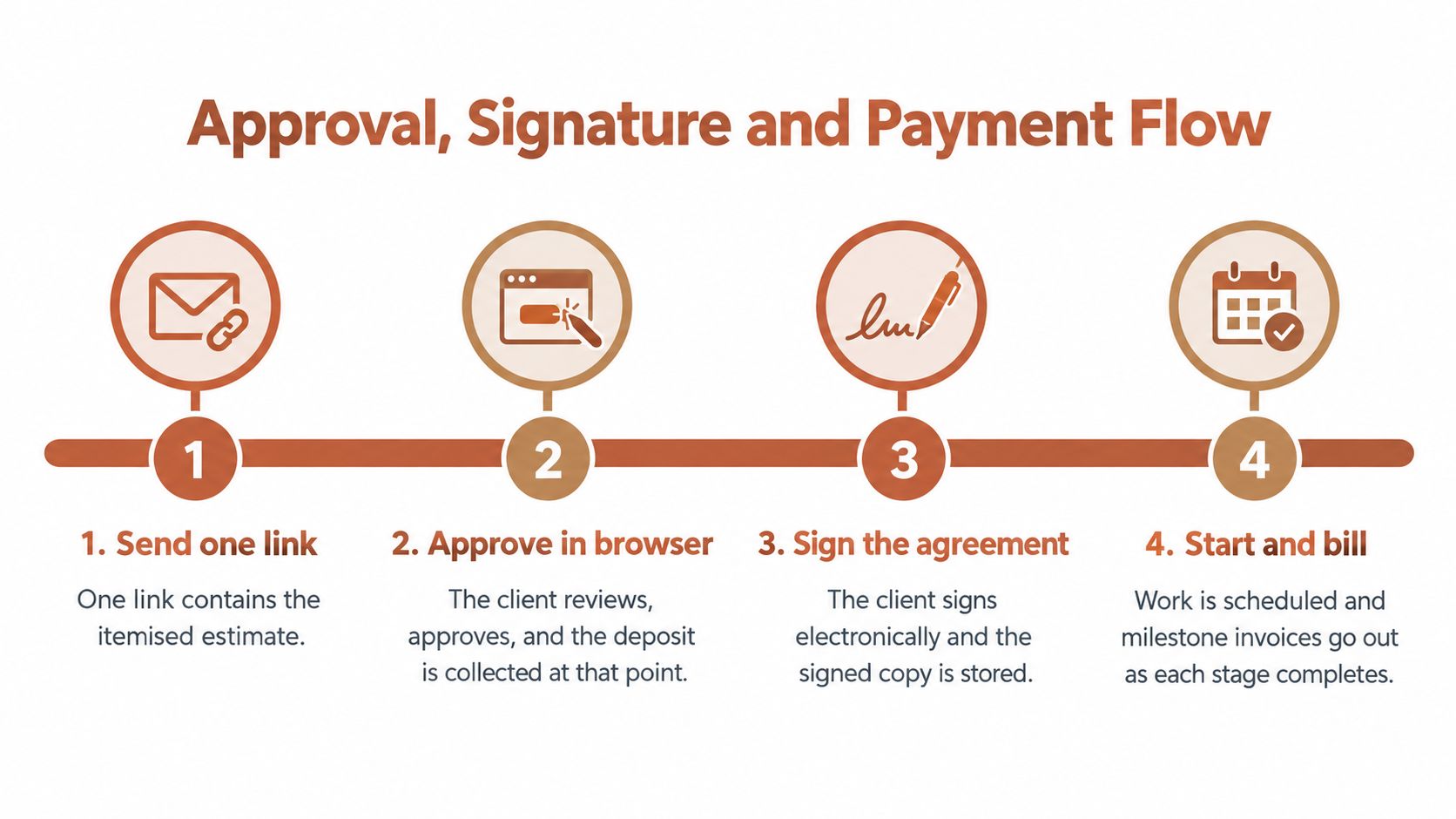
Follow the job through each handoff
Send the itemised estimate link. The homeowner reviews the actual work and terms, not a total copied into a text message. If you revise the offer, identify which version replaces the earlier one.
Collect approval and the deposit. The client approves online, with the deposit collected at that point. If approval is recorded but payment hasn't completed, leave the job awaiting payment rather than assuming the bank transaction succeeded.
Send the service agreement for signature. The client opens the public contract link and signs from their phone. Estimate acceptance and contract signature are separate tasks, so check both statuses before scheduling work that requires the agreement.
Preserve the signed document. We keep the signed contract separately from the draft agreement text, with the client record. A later draft edit must not be mistaken for what the client signed.
Convert the accepted estimate. In our workflow, open the accepted estimate and choose Convert to invoice. The approved line items become a draft invoice without rebuilding the job; review credits and approved adjustments before sending it.
Record the payment against that job. The client can pay by card, ACH bank transfer or QR code, while cash, cheque or another manual payment is recorded against the same record. Don't leave an offline payment only in a notebook while the invoice still appears unpaid.
Stop at incomplete approvals
The vulnerable handoffs are estimate approval without a signed agreement, and recorded approval without a completed deposit. Treat either as an incomplete booking when both are required by your terms.
For exterior-cleaning wording, the pressure-washing contracts guide helps distinguish the service agreement from the quote itself.
Keep the deposit, signed scope and final balance under the same client record. That lets you answer a payment question from the job history instead of searching through messages, downloaded PDFs and bank notifications.
Mobile and Field-Friendly Formatting
Build the template for a client holding a phone, not for your laptop's preview window. A document that requires sideways scrolling makes important conditions easy to miss.
Use a single column. Stack each price item with its description, quantity, unit rate and total. Reserve wide comparison tables for your own estimating workbook.
Lead with an action verb. Start scope entries with Pressure-wash, Clear or Install, then add boundaries and the finish standard. Split a crowded entry rather than compressing it into tiny text.
Expose the decision amounts. Put the total, deposit and validity date near the top, then repeat the accepted total beside the approval control. Optional work shouldn't look included.
Spell out units and labels. Use square feet instead of an unexplained abbreviation where space permits. Keep body text readable without zooming and distinguish exclusions with a clear heading.
Shorten field entry, not the approval record. Use a compact change form for requested change, added or deducted amount, schedule effect and approve or decline. Store the supporting reason, itemisation and authorisation with it.
Test the actual delivery formats. Export a printable PDF and open the approval webpage on someone else's phone. Check wrapping, signature controls and payment access before sending it to a client.
Field check: If the client can't find the amount they're approving without hunting through the document, revise the layout.
Filled-In Sample for a Small Pressure Washing Business
Consider a hypothetical pressure-washing job covering a 600-square-foot driveway, a 120-square-foot patio and gutter cleaning at a single-family home. The sample uses pricing rules rather than invented market rates, so you can insert your own calculated amounts.
Filled-in proposal for a pressure-washing job
| Template Field | Sample Entry |
|---|---|
| Client and project | Example homeowner; single-family residence at the service address on the client record. Contractor's legal name, contact details and issue date appear in the header. |
| Scope: driveway | Pressure-wash approximately 600 sq. ft. of concrete driveway; price basis per sq. ft. |
| Scope: patio | Pressure-wash approximately 120 sq. ft. of concrete rear patio; remove loose dirt and organic growth. Client clears furniture before arrival. |
| Scope: gutters | Clear and flush gutters on the single-storey front and rear; price basis flat fee |
| Exclusions | Oil and rust stains, sealing, interior windows; repairs to cracked concrete not included |
| Assumptions | Working outdoor water connection accessible within the agreed hose reach; driveway clear of vehicles; gate unlocked; safe gutter access available |
| Line pricing | Driveway area × quoted unit rate; patio area × quoted unit rate; gutter cleaning at quoted flat fee. Tax shown separately at the applicable local rate, or identified as not applicable. |
| Deposit and balance | Stated mobilisation deposit due on acceptance, credited against the total; remaining balance due after completion and walkthrough |
| Schedule | Hypothetical start window of 3 to 5 business days after acceptance; one-day job; weather delay notice by phone |
| Change trigger | Any added area, stain treatment or extra visit needs written approval; repriced before work starts |
| Validity and signature | Hypothetical offer expires 14 days from issue; actual expiry date printed before sending. Client signs in the browser or on phone, with name and approval date recorded. |
Complete the decisions behind the entries
The driveway and patio use area-based pricing because their boundaries are measurable. The gutter line uses a flat fee for the stated accessible sections, not an open-ended promise to clear every drainage problem on the property.
The hypothetical expiry window gives the homeowner time to decide without leaving your schedule and price available indefinitely. Replace it with a period that fits your purchasing exposure and workload, and print the actual expiry date.
Before choosing cleaning language, the Ventura County Roof Cleaners washing overview offers useful driveway-service context. Your own proposal still needs to state the method and result appropriate to the surface you inspected.
Adapt the rows without losing the controls
A handyman can replace the surface-cleaning rows with repair locations, materials and finish expectations. A lawn-care contractor can substitute service boundaries, clipping disposal and gate-access requirements while retaining the payment and acceptance structure.
Copy the table into a working document, then add your actual amounts, warranty terms and insurance details. Each row maps to a proposal section, making omissions easier to catch before the client receives it.
Confirm the Template Before Your Next Bid
Treat the final check as a release decision, not a spelling pass. The Virginia Tech construction-contracting text identifies bid validity, submission requirements and signed bid forms among the controls in standard construction bidding documents.
Run the pre-send check
- Check the first page: Confirm the expiry date is visible and consistent with the acceptance section.
- Match the identities: Use the legal name shown on your applicable licence and insurance certificate. Confirm that the signer has authority to accept for the client or business.
- Inspect the pricing block: Keep the change-approval requirement beside the commercial decision, not solely in a footnote.
- Reconcile the test invoices: Run normal completion, an added request and a concealed condition through the sample. Confirm each produces a definite amount or a clear pause pending approval.
- Protect the master: Save the reviewed blank structure as your master template, then duplicate it for each job. Preserve accepted job documents separately rather than overwriting them.
Have locally appropriate contract wording reviewed before relying on it, especially for deposits, cancellation and warranty obligations. A clean PDF is presentation; complete terms and a usable approval process are what make it a working proposal.
AurenWell offers free invoice, estimate and contract templates, with contracts included in its plans without another subscription, so your approved template can move into the estimate-to-invoice flow.