
A client says, “Just do the usual.” You clean the kitchen, bathrooms, floors, and baseboards because that's what “usual” meant last time. Then the invoice goes out, and suddenly the client thought inside windows were included, the fridge should've been wiped, and the extra guest room “wasn't that much more.” Payment slows down. You start arguing over memory instead of work.
That's where most cleaning businesses lose money. Not on bad labor. Not on weak effort. On vague agreements.
A lot of people look for cleaning services contracts as if they need a template to fill in and send. What they need is a document that can survive a disagreement. If the contract can't answer what was included, how often it was supposed to happen, how quality gets checked, and what happens when the client changes the job halfway through, it won't protect you when it matters.
That matters in a large industry, not some tiny niche. The global contract cleaning services market was estimated at USD 383.99 billion in 2024 and projected to reach USD 406.56 billion in 2025, with a projected 6.4% CAGR from 2025 to 2030 according to Grand View Research's contract cleaning services market analysis. In the U.S., janitorial services under NAICS 561720 recorded USD 74.03 billion in receipts in 2022, employed 1,067,762 payroll workers, and paid USD 30.78 billion in annual payroll, as summarized in this commercial cleaning industry breakdown. So these disputes aren't edge cases. They're part of a very large service economy where unclear scope turns into delayed payment fast.
If you want another practical perspective from the buyer side, this guide for facility managers is worth reading because it shows what clients look for when they review vendor agreements.
Practical rule: If a sentence in your contract can be argued two ways, it will be argued two ways after the work is done.
This guide is written for solo cleaners and small teams doing house cleaning, office janitorial work, recurring service, and one-time jobs. The focus is simple. Turn cleaning services contracts into an enforcement tool. Define what done looks like. Prove it. Bill cleanly when the scope changes.
Introduction to Cleaning Services Contracts That Actually Protect You
The worst cleaning contracts sound polite. They say things like “general cleaning,” “as needed,” “deep clean when required,” or “client will provide access.” Those phrases feel harmless when everyone is getting along. They become expensive the first time a customer says the service wasn't complete or refuses to pay for “extras” you thought were obvious.
Why vague language causes most of the trouble
Most disputes in this business start in one of four places:
- Scope confusion: The client expected tasks you never priced.
- Scheduling confusion: You planned a standard visit. They expected priority service around events, guests, or late office use.
- Payment confusion: The work was completed, but the invoice terms left too much room for stalling.
- Access confusion: You showed up ready to work and lost time because entry, alarms, pets, keys, or occupied rooms weren't handled.
None of that gets fixed by downloading a prettier template. It gets fixed by making every promise measurable.
What a protective contract actually does
A solid contract does three jobs at once.
First, it prices the job. Second, it controls the work. Third, it documents proof if there's a disagreement later. Most templates only do the first part.
That's why strong cleaning services contracts read less like marketing copy and more like a field checklist. They spell out rooms, tasks, frequency, who supplies what, when payment is due, how changes get approved, and what inspection standard applies if someone says the work missed the mark.
A contract should answer, without interpretation, what gets cleaned, how often, to what standard, and what happens if either side changes the plan.
House cleaning and office janitorial work need different pressure points
Residential clients usually create friction around add-ons, skipped rooms, laundry, dishes, pets, fragile items, and cancellation timing.
Commercial clients usually create friction around access windows, after-hours entry, consumables, security procedures, periodic work, and sign-off across multiple decision-makers.
The structure can stay similar. The weak points don't.
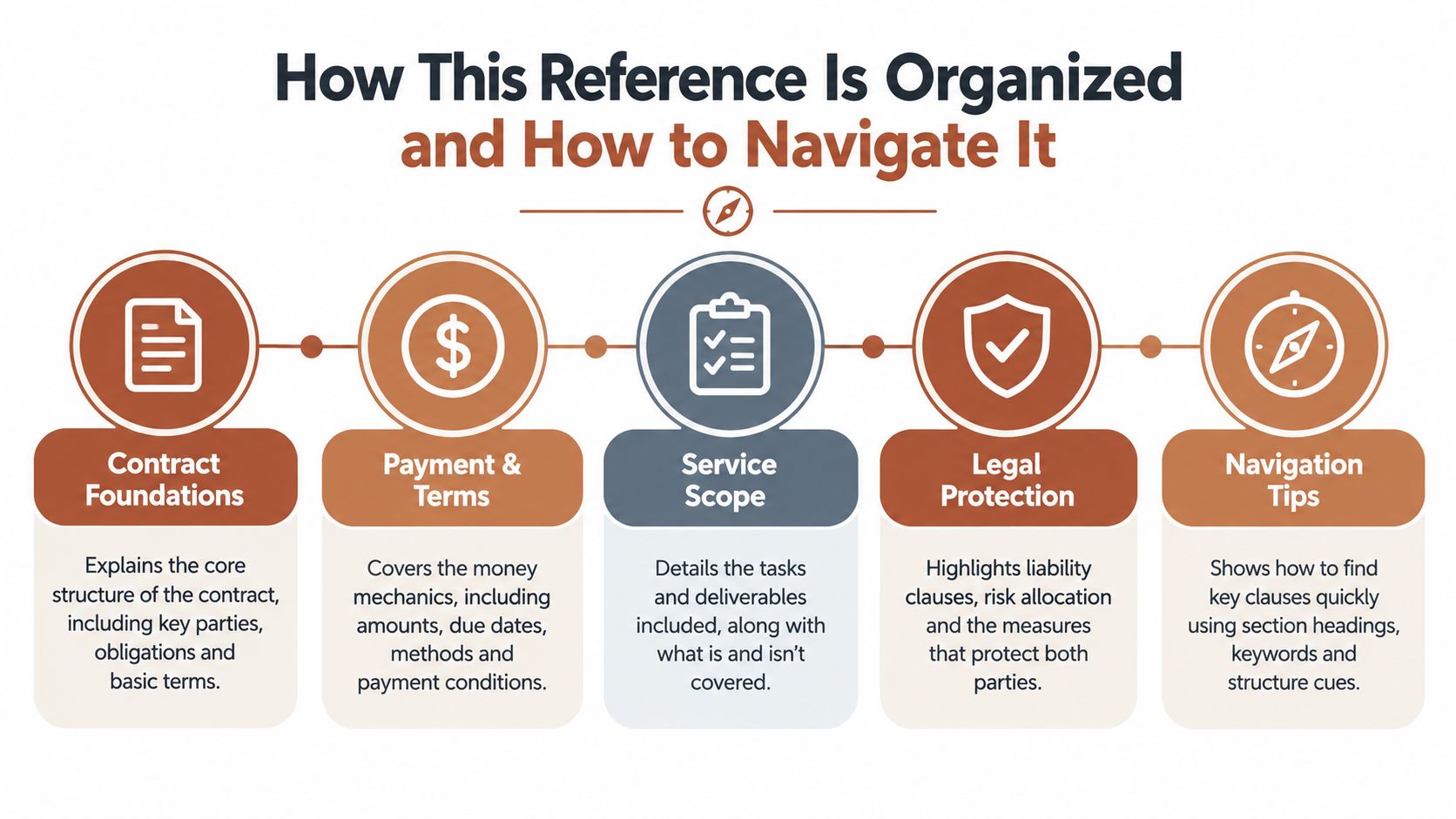
How This Reference Is Organized and How to Navigate It
A cleaning contract gets easier to use when you stop thinking of it as one long legal document and start treating it like a set of working parts. When a client asks for a weekend visit, you need the scheduling rule. When they add two rooms, you need the change-order rule. When they challenge quality, you need the inspection rule.
Five buckets that matter in the field
Use these categories when you draft, review, or fix cleaning services contracts:
- Contract foundations cover the parties, service address, term, renewal setup, and the rule that the written scope controls the job.
- Service scope handles rooms, tasks, frequencies, exclusions, periodic work, and any standards the crew can inspect.
- Payment and terms cover deposits, recurring billing, due dates, approved extra work, pauses for nonpayment, and how manual payments get recorded.
- Legal protection includes damage reporting, limits around pre-existing conditions, key handling, confidentiality, and termination rights.
- Proof and enforcement covers checklists, photos, walkthroughs, cure periods, re-cleans, credits, and dispute handling.
How to find the right clause fast
When I review a contract before sending it, I don't read it top to bottom first. I scan for the pressure points that usually produce unpaid work.
Look for these first:
- The scope attachment because that's where underpricing and overexpectation start.
- The scheduling language because “weekly” means different things to different clients unless days and windows are fixed.
- The extra-work approval rule because verbal add-ons wreck margins.
- The payment trigger because “invoice due upon receipt” means nothing if your process doesn't say when the invoice is issued and what confirms completion.
- The remedy section because quality disputes need a re-clean process before they turn into withheld payment.
Read by problem, not by sequence
If you're dealing with a one-time move-out clean, jump to scope and payment first. If you're taking over a small office account, focus on recurring schedule, access, proof of service, and periodic tasks. If you already have a client relationship and need fewer disputes, spend your time tightening enforcement language.
That's the pattern throughout this guide. Start with the problem that costs you money. Then fix the clause that controls it.
Defining Scope of Work With an Auditable Task Matrix
If your scope lives in a paragraph, it's probably too vague to enforce. A usable scope lives in a matrix. It should show area, task, frequency, materials if needed, performance standard, and exclusions in a format that anyone can inspect on-site.
Industry guidance on cleaning scopes recommends turning the scope of work into an auditable matrix and using measurable intervals such as “5 days per week” or “once per calendar quarter” instead of loose words like “daily” or “regularly,” while also listing exclusions clearly, as explained in this cleaning scope of work guide.
What belongs in the matrix
An effective matrix answers five practical questions:
- Where is the work happening
- What exact task is performed
- How often it happens
- What standard counts as complete
- What is not included
The exclusion line matters just as much as the task line. If inside ovens, dishwashing, biohazard cleanup, exterior pressure washing, or moving heavy furniture aren't included, write that plainly.
Separate recurring work from periodic work
A common mistake is mixing maintenance cleaning and deeper rotational work into one list. That's how clients start assuming every visit includes everything.
Public-sector janitorial specifications commonly break work into fixed cadences such as daily, 3x/week, weekly, monthly, quarterly, semiannual, and annual, and they tie those schedules to room-specific tasks like restroom sanitizing, trash relining, carpet vacuuming, drinking fountain cleaning, and streak-free window cleaning, as shown in Oregon State's janitorial service specifications.
That structure works because it separates routine upkeep from deeper periodic items.
Sample Scope Matrix for House and Office Cleaning
| Area | Task | Frequency | Standard | Exclusion |
|---|---|---|---|---|
| Kitchen | Wipe countertops and accessible exterior appliance surfaces | Every scheduled visit | Surfaces visibly free of crumbs, residue, and streaks | Interior of oven and refrigerator unless listed as add-on |
| Bathroom | Sanitize sink, toilet, tub, shower, mirrors, and fixtures | Every scheduled visit | Fixtures visibly clean, mirrors streak-free, trash removed | Mold remediation and drain clearing |
| Living room | Dust reachable horizontal surfaces and vacuum or mop floor | Every scheduled visit | Visible dust removed from reachable surfaces, floors visibly free of debris | Moving heavy furniture |
| Bedroom | Make bed if linens are left out and clean floors | Every scheduled visit | Floor cleaned, bed made if fresh linens provided | Laundry folding unless included |
| Office restroom | Sanitize fixtures and refill client-supplied consumables if assigned | 5 days per week | Fixtures visibly clean, supplies restocked from on-site stock | Supplying consumables unless stated |
| Office workstations | Empty trash and clean exposed hard surfaces | 3 days per week | Trash removed, liners replaced if needed, surfaces visibly wiped | Papers moved or confidential materials handled |
| Lobby | Vacuum entry area and spot clean glass | Once per business day | Floors presentable, interior glass visibly free of fingerprints | Exterior glass above reachable height |
| Conference room | Wipe table, reset chairs, clean floor | 2 days per week | Room ready for use, surfaces visibly clean | Event teardown unless approved as extra work |
Wording that works better than “daily”
Use fixed language like:
- “Every scheduled Tuesday visit” instead of “weekly”
- “5 days per week, Monday through Friday, excluding client holidays” instead of “daily”
- “Once per calendar quarter” instead of “quarterly as needed”
- “After client-approved event use” instead of “when necessary”
Field test: If a supervisor walked the site with your contract in hand, they should be able to check off completed work without asking you what you meant.
Essential Clauses Every House and Office Cleaning Agreement Needs
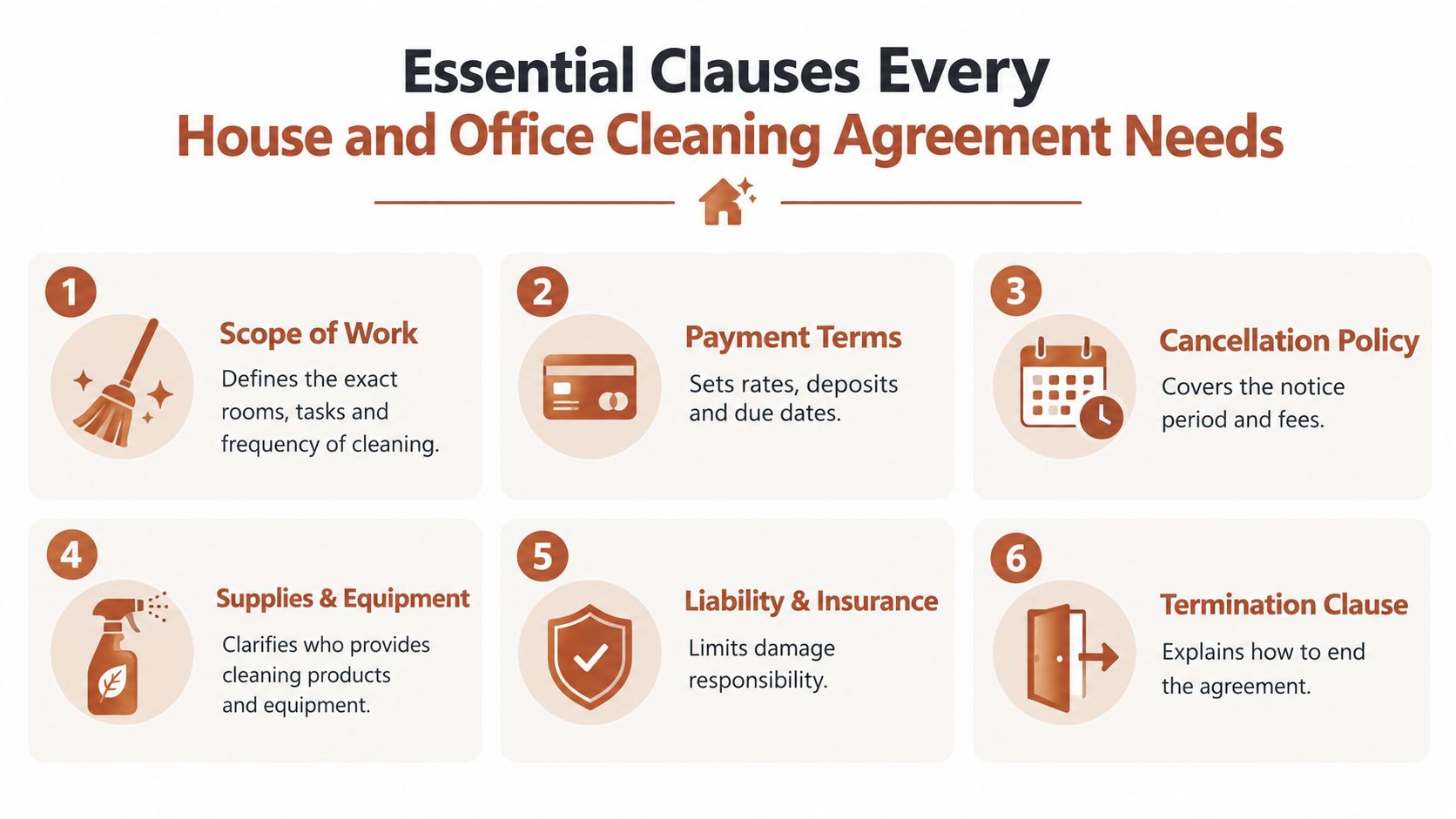
Most weak agreements don't fail because a clause is missing a legal phrase. They fail because the clause exists but doesn't control behavior. The best cleaning services contracts use plain language that a client can understand and a cleaner can follow on the job.
Parties term and service location
This sounds basic, but it's where sloppy paperwork starts. Use the legal names of the provider and client, the service address, and the start date. If the work is recurring, say whether it renews until cancelled or ends on a fixed date.
Bad wording: “Services begin this month and continue as discussed.”
Better wording: “Service begins on [date] at [service address]. Recurring service continues until terminated under this agreement.”
For readers working through negotiation details with counsel, this overview on how to negotiate contract terms in Florida is useful because it breaks down how contract clauses function in practical terms.
Scope incorporation and schedule
Your scope matrix should be attached and incorporated by reference. Don't leave the body of the agreement saying “general cleaning to be performed.” Point directly to the schedule or appendix.
Residential example: “Cleaner will perform the tasks listed in Attachment A during each scheduled visit.”
Commercial example: “Janitorial services are limited to the areas, task frequencies, and periodic services listed in Exhibit 1.”
Supplies and equipment
This clause stops arguments over product preferences and missing items. State who provides chemicals, liners, paper products, vacuums, ladders, and specialty equipment. If you won't use bleach, harsh solvents, or client-supplied unlabeled products, write that down.
Use this clause to handle special requests too. If a client wants fragrance-free products, green products, or a particular disinfectant, include whether that changes price or lead time.
A simple contracts workflow helps here. Tools like AurenWell contracts can store the signed service agreement with the client record and audit trail so you're not digging through old email attachments when there's a dispute over what version was signed.
Pricing payment and approved extras
Price needs three parts, not one:
- Base service price for the defined scope
- Extra-work pricing rule for add-ons or out-of-scope tasks
- Invoice timing and due date so nobody pretends they didn't know when payment was expected
Bad wording: “Additional cleaning will be billed if needed.”
Better wording: “Work outside the attached scope is billed only after client approval by text, email, or signed change order. Approved additional work is invoiced separately or added to the next invoice.”
After you've read the clause, ask one question. Can a stranger tell how extra work gets authorized and charged? If not, tighten it.
The video below is a useful quick primer on service agreement basics before you customize language for your own jobs.
Cancellation rescheduling and access
House cleaning and office cleaning start to diverge.
For homes, define notice requirements, lockout charges, pet control expectations, and what happens if utilities are off or conditions are unsafe.
For offices, define after-hours access, alarms, badges, elevator use, loading dock limits, and what happens if event use or occupied meetings block cleaning zones.
If the crew arrives and can't safely or reasonably perform the scheduled work, the contract should say whether the visit is skipped, partially performed, or billed as a failed access appointment.
Liability damage confidentiality and keys
Keep this clause practical. Require prompt reporting of damage claims. Exclude responsibility for pre-existing wear, unstable fixtures, items not secured properly, and damage caused by ordinary handling of cluttered or overloaded areas. If you hold keys, garage codes, or alarm credentials, state how access information is stored and when it must be returned.
For offices, add confidentiality around visible documents and restricted areas. For homes, add language around valuables and sentimental items. The contract can say cleaners won't open drawers, safes, or closed containers unless expressly included.
Payment Terms Deposits and Late Fees That Improve Cash Flow
If your payment clause is soft, clients feel it immediately. They may still like your work, but they'll treat the invoice like a suggestion. Good cleaning services contracts make payment routine, not personal.

Pick a payment structure that matches the job
A first clean, deep clean, move-out, or catch-up job usually justifies a deposit or prepayment because the calendar block is harder to refill if the client cancels late. Recurring maintenance work often works better on a standing invoice rhythm with a clear due date tied to each visit or billing period.
The trade-off is simple.
- Prepayment protects your schedule and reduces collections work, but some clients resist paying before service.
- Due on receipt is easy to explain, but only works if you invoice promptly and follow up consistently.
- Net terms can help commercial accounts that need internal approval, but they put more pressure on your cash flow.
If you're deciding how to word deposits, this practical article on how much deposit contractors should ask for can help you think through the risk side before you set your policy.
Tie payment to proof, not to debate
The cleaner way to structure billing is to connect it to a defined service event. That might be completed service, completion plus same-day photo log, or completion plus a client walkthrough if the job requires sign-off.
Use language like this:
- For one-time jobs: Payment is due before service or immediately upon completion.
- For recurring service: Invoice is issued on the service date or on a recurring billing cycle stated in the agreement.
- For add-ons: Extra work must be approved first, then billed either same day or on the next scheduled invoice.
That keeps the argument away from “I'm still deciding if I liked it enough to pay.”
Late fees and pause rights
Late fee language should be clear, legal in your jurisdiction, and paired with a service pause rule for recurring accounts. Don't write a threatening collections paragraph if you won't enforce it.
What works better is a short ladder:
- Invoice due date
- Courtesy reminder
- Late fee under the agreement, if applicable
- Pause of future service until the account is current
Record every payment method cleanly. Cash, check, bank transfer, ACH, and card payments should all map back to the same invoice. If a client makes a partial payment, note what balance remains and whether future visits continue.
Keep the admin simple
Solo operators don't need a giant accounting suite just to send invoices and collect signatures. They need one clean trail from estimate to signed agreement to paid invoice. If that trail is broken, clients exploit the gaps, sometimes intentionally and sometimes because the process itself is messy.
Proving Service Quality and Handling Performance Issues
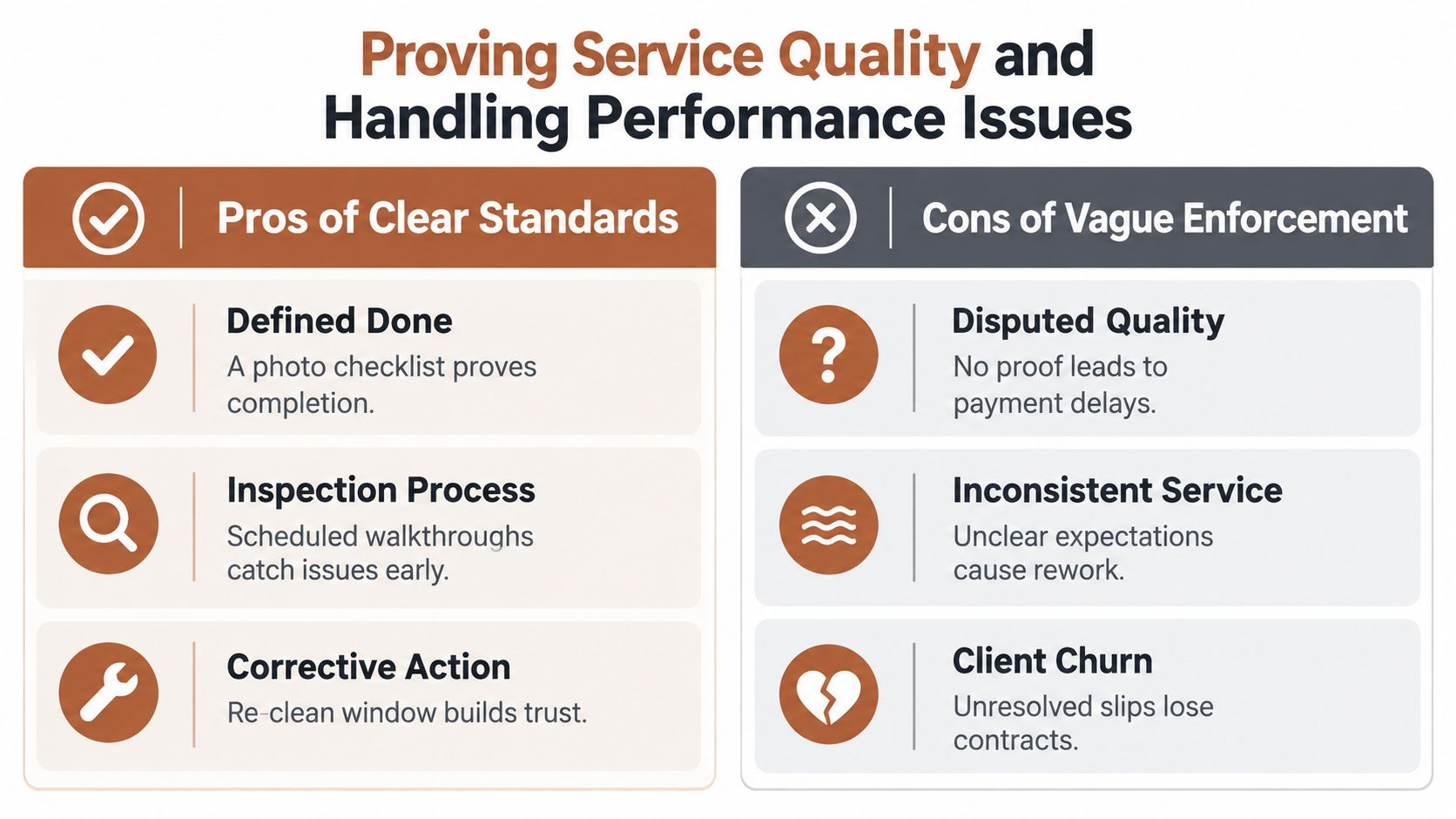
A lot of contracts explain what should be cleaned. Far fewer explain how anyone proves it was cleaned well enough. That's the gap that causes most “I'm not paying until this is fixed” conversations.
Independent facility guidance makes this point directly. A contract should answer what gets done, how well it must be done, and what happens if it isn't. That same guidance argues many agreements carry a measurable 15% to 25% scope gap between the written terms and delivered service because of scope drift, staffing shortages, and deferred periodic tasks, as discussed in this cleaning contract guide from Millfac.
“Done” has to be visible
The phrase “clean to client satisfaction” sounds nice, but it's a weak enforcement standard because it leaves completion open-ended. A better contract defines observable results.
Examples:
- Mirrors streak-free
- Trash removed and liners replaced
- Floors visibly free of loose debris
- Fixtures sanitized and free of soap residue
- Reachable surfaces visibly dusted
Those are not perfect legal formulas. They're workable inspection standards.
Build an inspection process into the agreement
Quality problems go bad when there's no timeline. The client waits days to complain. The cleaner says the space was fine when they left. Nobody can reconstruct the condition.
Write a simple process:
- Complaint window: When the client must report a missed item or quality issue
- Inspection method: Photos, checklist, walkthrough, or supervisor review
- Cure period: When you get to re-clean before credits or termination come up
- Remedy ladder: Re-clean first, then partial credit if the issue isn't corrected, then termination for repeated failure
That keeps one complaint from becoming an automatic nonpayment event.
Clear standards don't just protect the cleaner. They also give the client a fair way to document a real miss and get it corrected.
Use proof of service that matches the job
Not every job needs the same evidence.
For residential work, a simple arrival and completion message, checklist, and occasional after-photos may be enough.
For office and regulated environments, buyers increasingly expect proof of service and performance-based service levels. Market reporting also notes that long-term agreements hold a 62.76% majority share in 2025, short-term contracts are projected to grow at 6.23% CAGR, and on-demand services are noted at 32.7% share, alongside growing use of occupancy-triggered service models, according to Mordor Intelligence's contract cleaning services market coverage. That shift is why fixed calendars alone often aren't enough anymore.
Remedies that work in real life
Write remedies you'll use:
- Re-clean option for reported deficiencies within the stated window
- Service credit only if re-clean isn't possible or the issue remains unresolved
- Termination for cause after repeated documented failures
- No blanket withholding for unrelated or unreported complaints
A contract becomes enforceable when it controls the next step after something goes wrong. Without that, the agreement is just a scope list with a signature at the bottom.
Choosing and Customizing Templates for Recurring and One Time Jobs
Most contract problems start before editing. People pick the wrong template, then try to patch it with a few custom lines. That usually leaves the wrong assumptions baked into the document.
Match the template to the job type
A house cleaning agreement works best when the pressure points are personal property, room access, pets, cancellations, and optional add-ons.
An office janitorial contract needs stronger language around access windows, alarms, confidentiality, consumables, periodic tasks, and proof of completion across multiple areas.
A move-in or move-out agreement should focus on condition assumptions, utility availability, appliance interiors, cabinet interiors, wall marks, and whether the service includes haul-away or not.
A one-time deep clean should be tighter on deposits, start condition, and task limits because clients often expect restoration work under a standard cleaning price.
Recurring and one-time jobs need different control points
Use recurring templates when the job depends on routine and repeatability. Use one-time templates when the biggest risk is expectation mismatch.
The biggest clause differences usually fall here:
| Job type | Most important clause focus |
|---|---|
| Recurring house cleaning | Rotation schedule, add-ons, cancellations, access |
| Recurring office cleaning | Scope matrix, proof of service, site access, periodic work |
| One-time deep clean | Start condition, exclusions, deposit, completion standard |
| Move-in or move-out clean | Appliance interiors, cabinet interiors, wall spots, utilities, empty property assumptions |
Handle change orders and occupancy shifts directly
This is the part many smaller providers skip. Then the client hosts an event, adds staff, opens another room block, or starts using the site differently, and everyone acts surprised that the original price no longer works.
A better contract says extra work must be approved through a written change order, text, or email confirmation that identifies the added area, task, schedule, and price impact.
If you need starting points for different job types, a practical library of service agreement formats can help. A broad set of business contract templates is useful for adapting a recurring version separately from a one-time version instead of forcing one document to do everything.
Occupancy changes are scope changes when they alter traffic, soil load, access time, or room count. Treat them that way in writing.
Don't hardcode every schedule if the site is variable
Some commercial spaces no longer fit a rigid calendar. Shared offices, event spaces, and part-time occupied buildings may need trigger-based wording, such as service after booked events, after occupancy spikes, or within a set window after client notice.
That doesn't mean “as needed.” It means the trigger itself is defined.
Quick Reference Checklists Cross References and Signing Workflow
When a contract goes sideways, it's rarely because the signer missed the page count. It's because the agreement was sent before someone checked the details that control the job.
Pre-send checklist for cleaning services contracts
Use this before anything goes out for signature:
- Scope complete: Every room or area is listed, along with exact tasks and exclusions.
- Frequency specific: The agreement uses fixed intervals or named service days, not vague words.
- Access clear: Keys, alarms, pets, gate codes, occupied areas, and contact procedures are stated.
- Supplies assigned: The contract says who provides cleaning products, liners, paper goods, and specialty items.
- Extras controlled: There is a written approval rule for out-of-scope work.
- Payment defined: Due dates, deposit rules, late-payment handling, and accepted payment methods are all stated.
- Quality process included: Complaint window, inspection method, re-clean terms, and credit rules are in writing.
- Termination workable: Either side can end the agreement using a stated notice method and timeline.
Useful clause cross-references
Some clauses only make sense when paired together.
- Scheduling and access belong together because missed entry can look like missed performance if the contract separates them.
- Scope and payment belong together because extra work pricing is meaningless without a clear baseline scope.
- Proof of service and quality remedies belong together because a complaint process needs evidence and a next step.
- Keys and liability belong together because access control and damage reporting often get disputed at the same time.
A signing workflow that holds up later
A repeatable signing process saves more trouble than fancy wording.
- Send the estimate first and confirm the service assumptions in writing.
- Attach or embed the final scope matrix.
- Send the contract for browser-based review and signature.
- Store the signed copy with the client's invoice and payment history.
- Keep any later change approvals in the same record, not scattered across text threads and email chains.
A mobile-friendly e-signature flow matters because a lot of clients won't print, scan, or open attachments correctly. If they can review and sign in one link, turnaround improves and you keep a cleaner record.
The best part of this workflow is simple. When a client later says, “I didn't know that wasn't included,” you can pull up the signed agreement, the scope attachment, and the approved changes in one place. That's what a contract is for. Not to look formal. To end the argument.