
You've already done the hard part. The walkthrough is over, the client liked you, and now you're staring at a notebook full of room notes, worn carpet details, and odd requests that don't fit neatly into a clean little template. That's the moment where a cleaning service business proposal either feels like a professional sales document or like a vague price sheet that gets compared only on cost.
The good proposals don't try to sound fancy. They sound specific. They show the client you understood the site, the frequency, the weak points, and the places where scope can go sideways if nobody defines the work clearly. A strong proposal also makes the next step easy, from approval to deposit to first invoice, which matters just as much as winning the bid.
Your First Impression After the Walkthrough
A solo cleaner can leave a walkthrough feeling confident, then freeze when it's time to turn notes into a document. The trick is to stop thinking like you're filling out a form and start thinking like you're building a case. Your proposal has to say, in plain language, “I saw the building, I understand the work, and I know how to price it without guessing.”
That matters because the proposal is often the first piece of writing the buyer studies after the visit. If it reads like a generic template, the client assumes the walkthrough didn't matter. If it reflects the site, the access issues, the high-touch areas, and the cleaning rhythm, the proposal feels customized instead of copied.
A clean way to organize your workflow is to capture notes during the walkthrough, then convert them into sections that answer the buyer's real questions, what gets cleaned, how often, what's excluded, how the work will be checked, and how the price was built. For a simple starting point, you can also keep your intake and estimate process tied together with a workflow tool like AurenWell's house cleaner setup, especially if you want the same client record to carry through from estimate to payment.
Practical rule: if your proposal can't be traced back to what you saw on site, it won't feel defensible when the buyer compares bids.
The best documents don't overwhelm the client with a wall of text. They give enough detail to prove you listened, then make it easy to say yes.
The Anatomy of a Winning Proposal
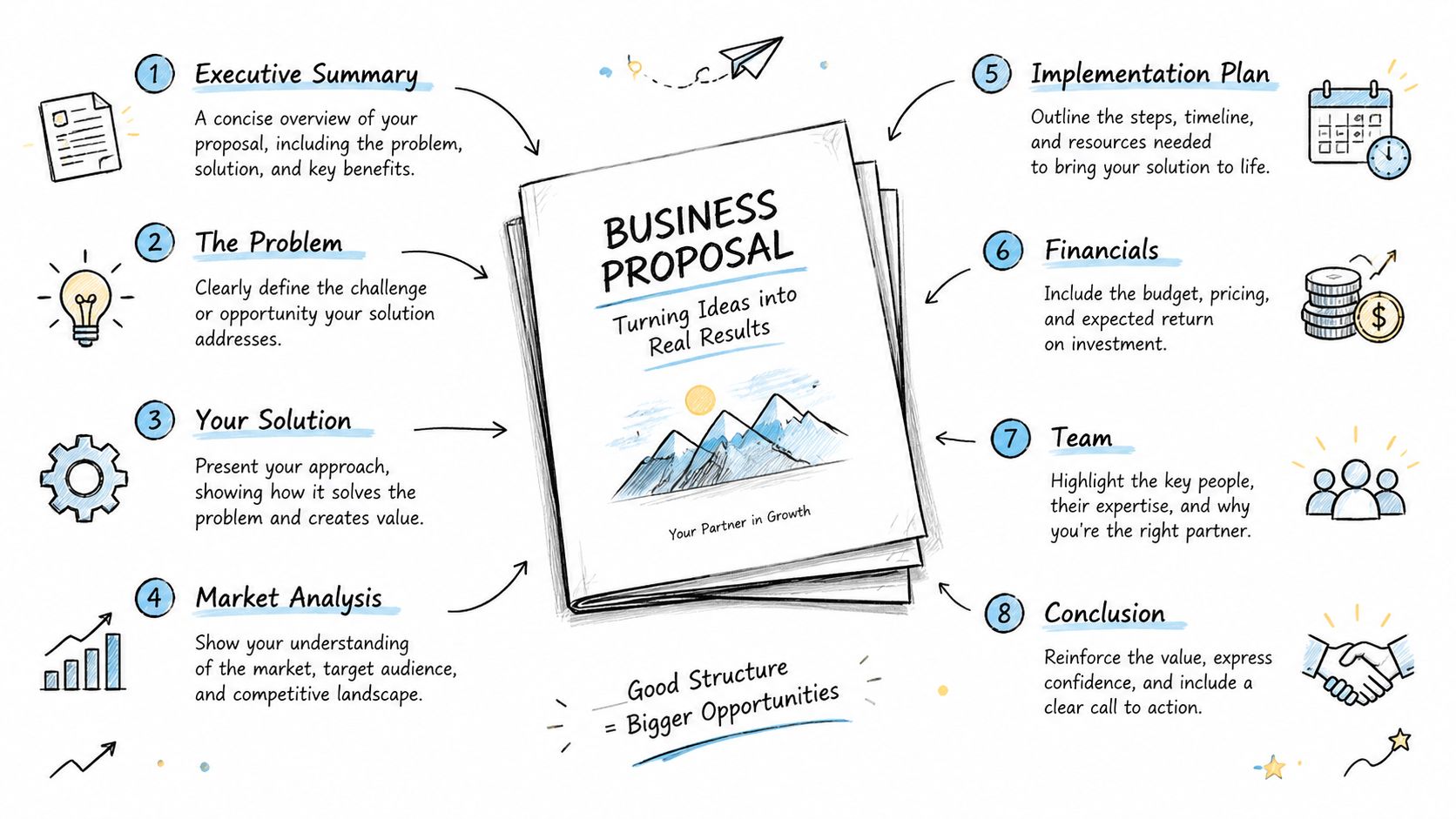
A professional proposal starts with structure. Buyers shouldn't have to hunt for the scope, the price, or the terms. They should be able to scan the document and quickly understand what they're buying and what stays outside the deal.
The opening pages matter because they set tone. A short cover page, business name, contact details, and a brief introduction are enough. Keep the introduction grounded in the walkthrough, not in generic claims about being reliable or detail-oriented, because those phrases mean little without specifics tied to the property.
Build the scope from the walkthrough, not from memory
The Scope of Work is the center of the whole proposal. The strongest version turns your walkthrough notes into line-item tasks organized by area and frequency. That means writing what happens in the lobby, restrooms, break area, offices, and shared spaces, then separating daily work from weekly or periodic work.
A buyer needs to see where the labor is going. “Clean offices” is weak. “Dust desks, wipe horizontal surfaces, empty waste bins, and spot-clean fingerprints in four office rooms” tells the client exactly what you'll do and gives them something concrete to compare against another bid.
The same logic applies to exclusions. Spell out what's not included, such as carpet extraction, window washing, deep sanitizing, or supply restocking if those aren't part of the base price. That keeps the proposal defensible and lowers the chance of scope creep later.
The public market still leaves too much of this at checklist level, even though buyers want transparent scope and proof of execution, not just a polished PDF, as noted in this guide on cleaning proposal examples. That's the gap good operators can exploit.
Add schedule, exclusions, and verification
Once the tasks are clear, define when the work happens. Recurring service is easier to approve when the client can picture the cadence, arrival window, and access method. Then list the verification method, such as supervisor sign-off, completion photos, checklist initials, or a digital service log.
A simple way to think about this is, scope tells the buyer what you'll do, exclusions prevent disputes, and verification shows the work was completed. That last part is especially important in commercial cleaning, where trust often depends on proof, not promises.
The structure can be simple, but it should feel complete. A proposal that covers those basics gives the buyer fewer reasons to delay or compare you only on price.
Use the terms and conditions to protect both sides. Payment timing, late charges if you use them, rescheduling rules, site access requirements, and change-order language all belong there because they keep the job from drifting after signature.
Use a reusable estimate template to keep scope and line items consistent if you want to standardize the structure without turning every bid into a fresh document from scratch.
Nailing Your Pricing and Payment Terms
Pricing should come from production, not from a hunch. If you estimate by gut feel, you'll win a few jobs and then wonder why the margin disappears when the site takes longer than expected or the client adds “just one more” area after approval. The more defensible approach is to anchor the price to measurable units, then connect those units back to the walkthrough.
For commercial work, the benchmark range for U.S. proposals is about $0.07 to $0.25 per sq ft per visit depending on size and complexity, and hourly loaded labor often lands around $18 to $28 for standard janitorial work, with specialty environments priced higher, according to Lead Duo's commercial cleaning proposal template. Those ranges don't replace your judgment, but they do give you a grounded starting point when a client wants to know why the number looks the way it does.
Choose the model that matches the job
Different jobs call for different pricing logic. A small recurring office might be easier to quote hourly if access is irregular. A consistent building with predictable square footage often works better as a per-square-foot price. A flat rate can work too, but only if you've already done the math behind the scenes.
| Pricing Model | How It Works | Example Calculation | Best For |
|---|---|---|---|
| Hourly | Charge for labor time, then multiply by your loaded rate | Crew hours × loaded hourly rate | Irregular jobs, access-heavy sites, variable scope |
| Per Square Foot | Price based on measurable area and cleaning frequency | Sq ft × per-visit benchmark range | Larger commercial sites with stable routines |
| Flat Rate | Set one total after estimating labor, supplies, and risk | Total job price based on scope review | Simple recurring work with predictable conditions |
The safest habit is to test your estimate against the site reality. If the client has restricted access, special surfaces, or high-touch zones, that extra friction belongs in the number. A quote that ignores those issues may look attractive, but it can turn into a bad contract.
Make payment terms part of the sale
Payment terms shouldn't feel like an afterthought. They tell the client how serious you are about cash flow and how smoothly the relationship will run. For one-time work, a deposit can protect your schedule and reduce no-shows. For recurring contracts, a clear billing cycle keeps everyone aligned.
Keep the language plain. State when invoices are issued, when payment is due, and what happens if the client changes scope after approval. If you accept card or ACH, say so in the proposal so the approval path and the payment path are connected.
If the client has to ask how to pay, the document isn't finished yet.
This is also where software helps. A tool that lets you convert an approved estimate into an invoice cuts out the copy-paste work and reduces billing errors. If you use an all-in-one document workflow, the pricing, approval, and payment steps stay linked instead of living in separate email threads.
Differentiating Your Service from the Competition
Most buyers won't choose the cheapest proposal if another cleaner looks more trustworthy and more prepared. Price matters, but it rarely wins alone in commercial work because the client is also buying consistency, access to proof, and less risk. That's why a cleaning service business proposal should sell more than labor, it should sell confidence.
One of the clearest differentiators right now is sustainability. Independent 2025 trend coverage says eco-friendly cleaning solutions are becoming dominant, driven by consumer awareness, stricter environmental regulation, and CSR pressure, but many templates still mention green practices as a throwaway line instead of a real buying criterion, according to Samsic's commercial cleaning trends coverage. If you use green products, say so clearly and tie it to the actual service, not vague virtue language.
Lead with proof, not slogans
The strongest differentiators are specific. Insurance and bonding matter because they lower buyer anxiety. Training matters because it affects consistency. Reliability matters because missed service shows up fast in a commercial setting.
A proposal can call these out without sounding promotional. List the policies, tools, and service habits that support the promise. If you carry insurance, include the fact that coverage exists. If you follow a standard method for verification, explain it. If you use eco-friendly products, identify where they're used and where they aren't.
That's also where client fit comes in. A proposal aimed at a medical office won't sound the same as one aimed at a coworking space. The more your language reflects the site's priorities, the more your price feels earned.
Avoid the common trust killers
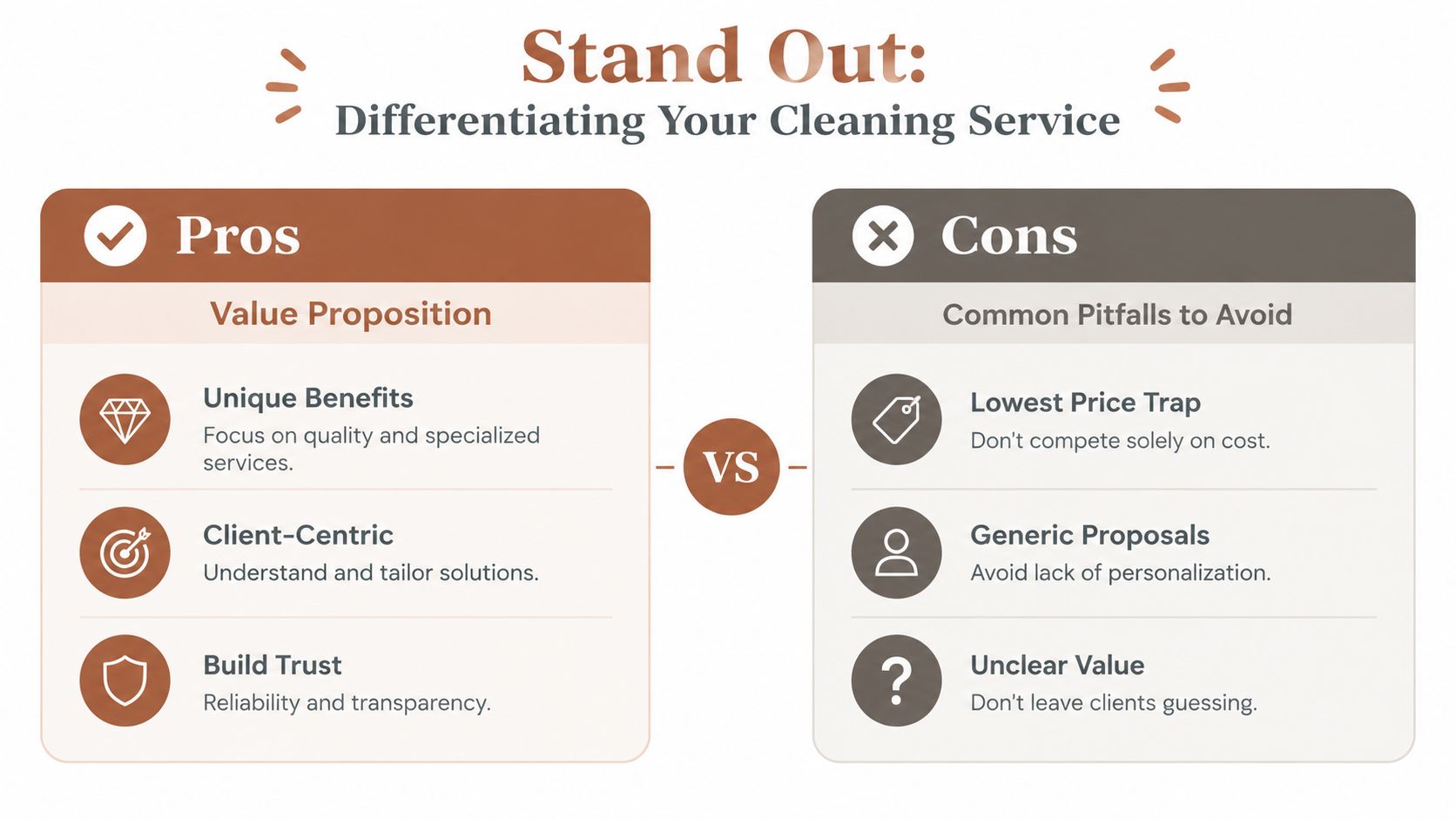
A lot of proposals fail because they chase the wrong story. The lowest-price trap is obvious, but so is the generic-document problem. Buyers can tell when the same copy is sent to every prospect, and that usually kills confidence before the pricing discussion even starts.
- Unique Benefits: show what you do better than a basic checklist clean.
- Client-Centric: tailor the scope to the building, schedule, and use pattern.
- Build Trust: make insurance, verification, and communication easy to see.
- Lowest Price Trap: don't position yourself as the cheapest option unless you are built for that model.
- Generic Proposals: remove filler and replace it with site-specific detail.
- Unclear Value: explain why your method is worth the number on the page.
A polished proposal isn't enough on its own. The client has to see a reason to choose you over the cheaper name next to you on the bid list.
From Draft to Delivery The Signature Workflow
A proposal can be well written and still lose momentum if delivery is clumsy. If you send a messy PDF with no clear next step, the client has to figure out how to approve it, how to sign it, and how to pay. Every extra step gives them a reason to stall.
The cleanest version is simple. Make the document easy to scan, keep the sections short enough for a decision-maker to review quickly, and put the action button in the right place. If the buyer can open the proposal, review it on a phone, sign it, and submit a deposit in one flow, you remove friction at the exact point where deals often slow down.
Format for fast review
Use short paragraphs, clear headings, and enough white space to make the proposal feel readable. Put the scope near the top, because that's where buyers look first. Keep the pricing table easy to find, and don't bury payment terms under generic service language.
The handoff matters too. A browser-based document works better than a static attachment because it keeps approval and payment inside one link. In practice, that means less back-and-forth, fewer lost files, and fewer excuses about missing signature pages. A tool such as AurenWell's contract workflow can support that kind of approval path when you want the signed document and client record to live together.
Use the approval path to shorten the sales cycle
Once the proposal is sent, the goal is to make the next action obvious. “Review, approve, sign, and pay deposit” is better than “let me know what you think.” The first version moves the deal forward. The second version invites delay.
A modern workflow also helps after signature. The accepted proposal should flow into the first invoice or recurring schedule without retyping the same client data. That saves admin time and reduces mistakes, which matters when you're running the business and doing the cleaning yourself.
Good workflow rule: the handoff from estimate to contract to invoice should feel like one chain, not three separate jobs.
Software demonstrates its true value. The best systems don't just store PDFs, they connect documents so approval turns into billing without extra manual work. That's what keeps the sale from dying after the client says yes.
The Art of the Follow-Up and Conversion
Sending the proposal isn't the finish line. It's the start of the closing process. Good follow-up is calm, structured, and short. Bad follow-up is either silence or pushiness, and both create drag.
A strong proposal process should move from walkthrough to quote within 24 to 48 hours, because momentum drops after that window, according to SweptWorks proposal guidance. The same guidance suggests keeping the proposal valid for 15 to 30 days and following up 3 to 5 times over two weeks, since most decisions close after the second or third follow-up.
Use a simple cadence
The first check-in should feel helpful, not needy. Confirm that the client received the proposal, ask whether anything needs clarification, and remind them of the next step. After that, keep each message short and focused on one point, not a full re-pitch of everything you already sent.
A useful rhythm looks like this:
- First follow-up: confirm receipt and answer questions.
- Second touchpoint: restate the main scope and value in one sentence.
- Third touchpoint: ask whether they want to move forward or adjust the scope.
- Later follow-ups: stay courteous, keep the door open, and move on if they're not ready.
What works is consistency. What doesn't work is pressure without usefulness. The client should feel that you're organized and available, not hovering.
Turn approval into billing immediately
Once the proposal is accepted, convert it into the first invoice or the recurring billing schedule right away. That keeps your payment cycle moving and prevents the common delay where the job is approved but the invoice gets forgotten for days. If you're using a document system that links approval to invoicing, the transition is cleaner because the same client details, scope, and payment terms carry forward.
That final step matters because it reinforces professionalism. The client sees a business that knows how to sell, schedule, and bill without confusion.
If you want fewer stalled bids and faster starts, build your next cleaning service business proposal around a real walkthrough, a line-item scope, and a payment path the client can approve in one step. Tighten your template, test your pricing against the job, and use a document workflow that turns acceptance into billing without retyping the same details.