
You're in the driveway, buffer still in the trunk, and a new lead texts three facts. Two bathrooms, needs it Friday, how much. If you reply with a single number, you've priced the clean and created the dispute at the same time. A good cleaning estimate template prevents that. It shows the work behind the price, states what could change it, and records approval before you start.
Why Cleaning Estimates Need More Than a Total
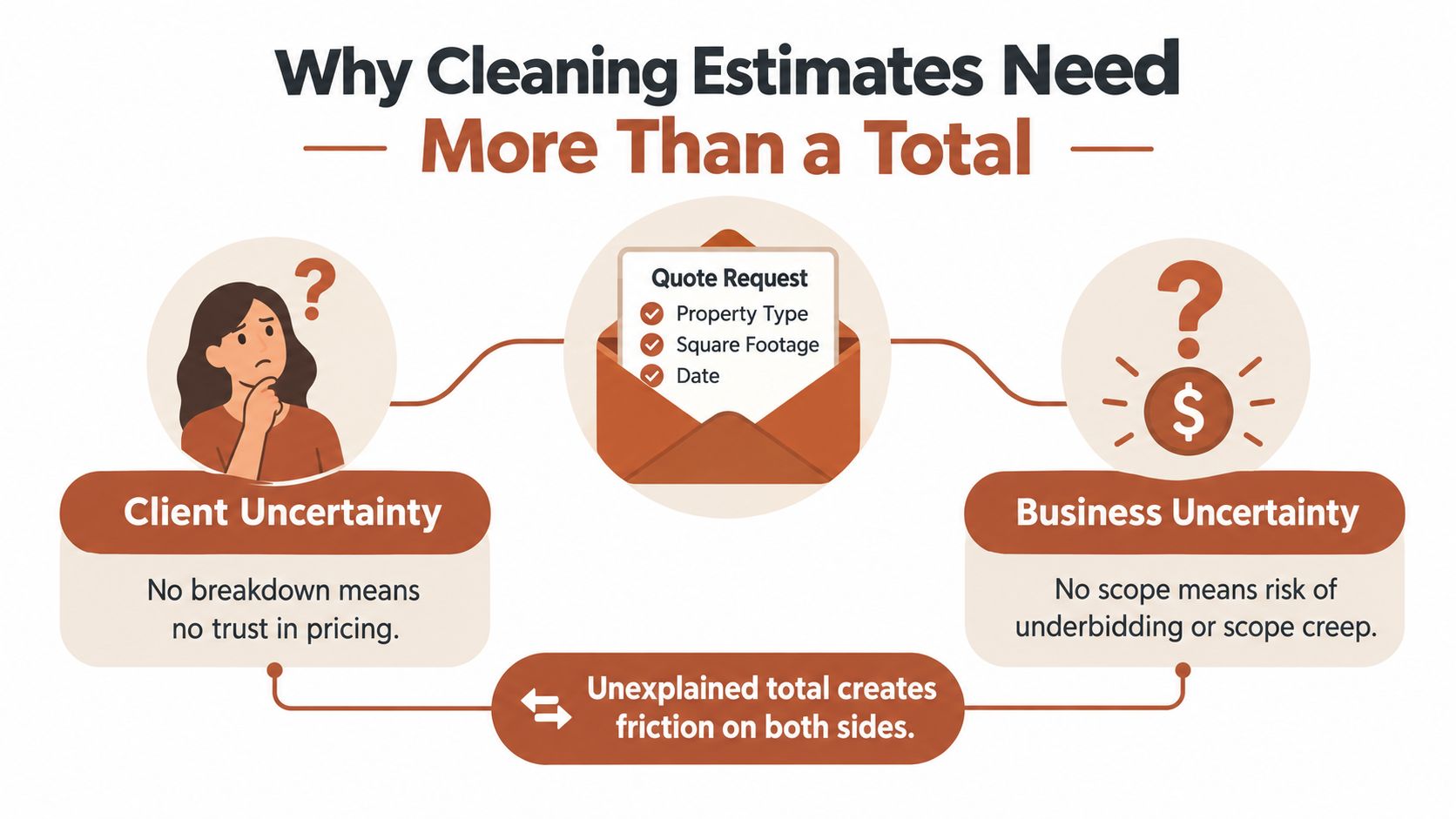
That short request hides the variables that decide your labor. A weekly office visit with emptied bins and maintained floors is predictable. A heavily soiled one-time clean with clutter, pet hair, and rooms you haven't seen isn't. Sending both customers an unexplained total asks them to trust a number they can't check, and leaves you arguing from memory when they add a fridge clean or expect move-out detail at maintenance pricing.
The scale of work behind these quotes is not trivial. Janitorial-services revenue reached $77.47 billion in 2024, up from $60.82 billion in 2020, according to Census Bureau data reported through the Federal Reserve FRED database. That figure covers recurring contracts and institutional work, not every independent house clean, but it explains why a template has to handle repeat visits, one-off projects, and add-ons without rebuilding the form each time.
The visual below maps the friction an unexplained total creates for both sides.
What the estimate must settle before work starts
- Frequency and service period: Weekly maintenance, a single deep clean, and a move-out aren't comparable prices, even at the same square footage.
- Scope and exclusions: Included tasks belong in line items. Excluded tasks belong in plain language, not in your head.
- Assumptions that can change labor: Soil level, access, pets, and time since the last professional clean should be visible and adjustable.
Practical rule: Treat the estimate as two documents in one, a price the customer can understand and an approval record you can invoice from.
Build the Core Cleaning Estimate Template
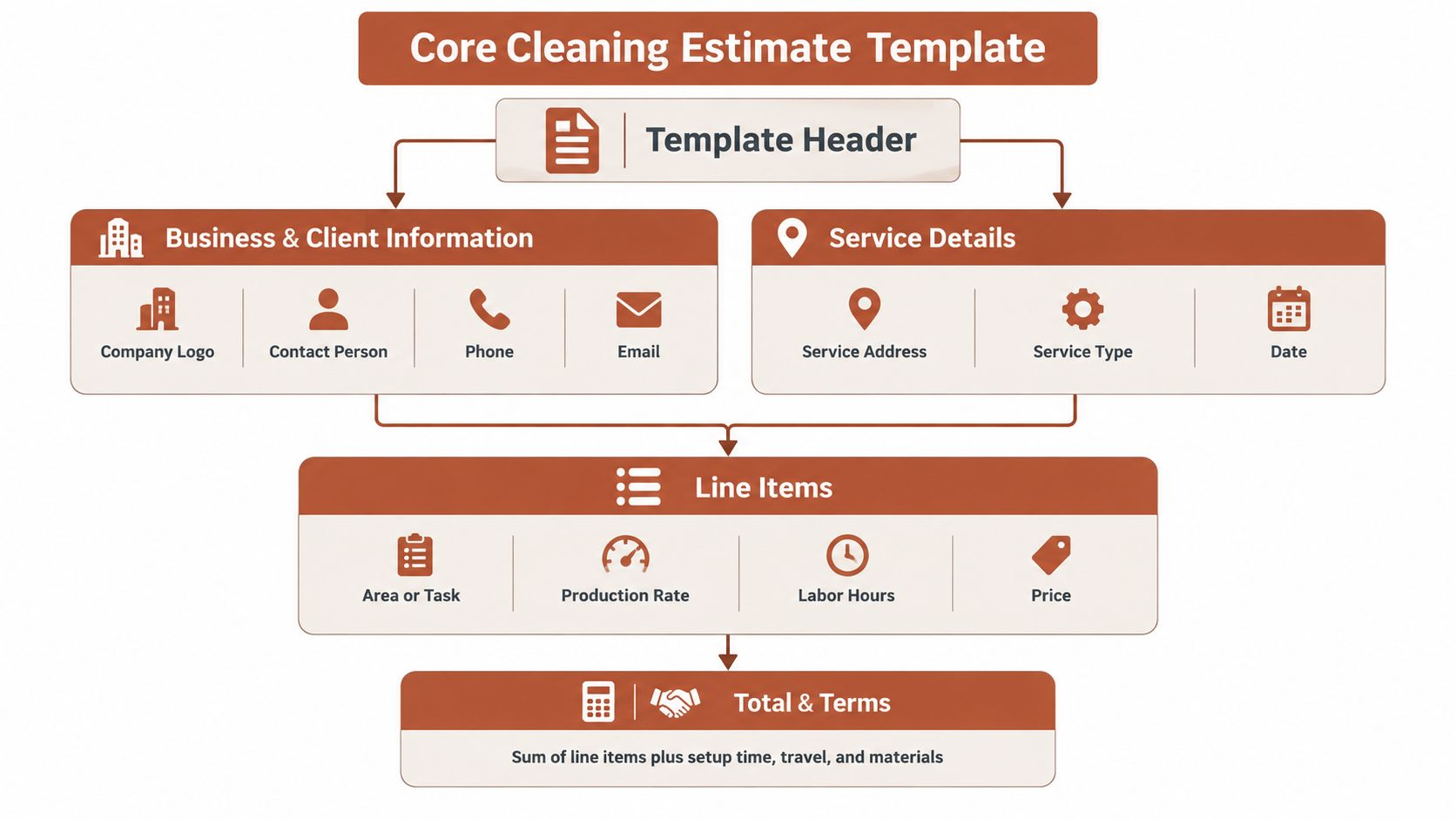
Build the fields in the order a customer reads them. Start with business and client information, service address, and contact details. Add the estimate date, service date, and an expiration date so an old quote doesn't get accepted months later at stale pricing. Then identify the service type and frequency before you list any prices.
This diagram shows the header, line-item, and terms layers working together.
Scope fields that remove ambiguity
Record property measurements, rooms or zones, fixture counts, and included tasks room by room where that helps. Follow that with exclusions and assumptions on the same page. Prompt yourself during the walkthrough for access instructions, pets, parking, usable water and power, heavy soil, hazardous materials, and special surfaces that need different chemicals or slower handling. If you don't ask then, you'll discover it on the clock.
Required fields are the ones that affect price, scheduling, or approval. Optional fields, such as preferred products or entry notes, still help the visit run smoothly, but they shouldn't bury the decision points. Keep the decision points prominent.
Pricing and acceptance fields
List each area or task as a line item with quantity, rate, and amount. Show subtotal, tax treatment, discounts if any, deposit due, and balance due as separate lines. Finish with cancellation terms, a notes field, and an acceptance block with name, date, and signature or e-signature.
The walkthrough below shows how those fields come together on a working estimate.
The same layout works as a downloadable PDF, a browser approval screen, or a mobile form you complete in the driveway. Format matters less than consistency. If every quote uses the same field order, customers compare scope instead of guessing, and you stop forgetting the one prompt that would've changed the price.
Calculate Cleaning Prices From Measurable Work
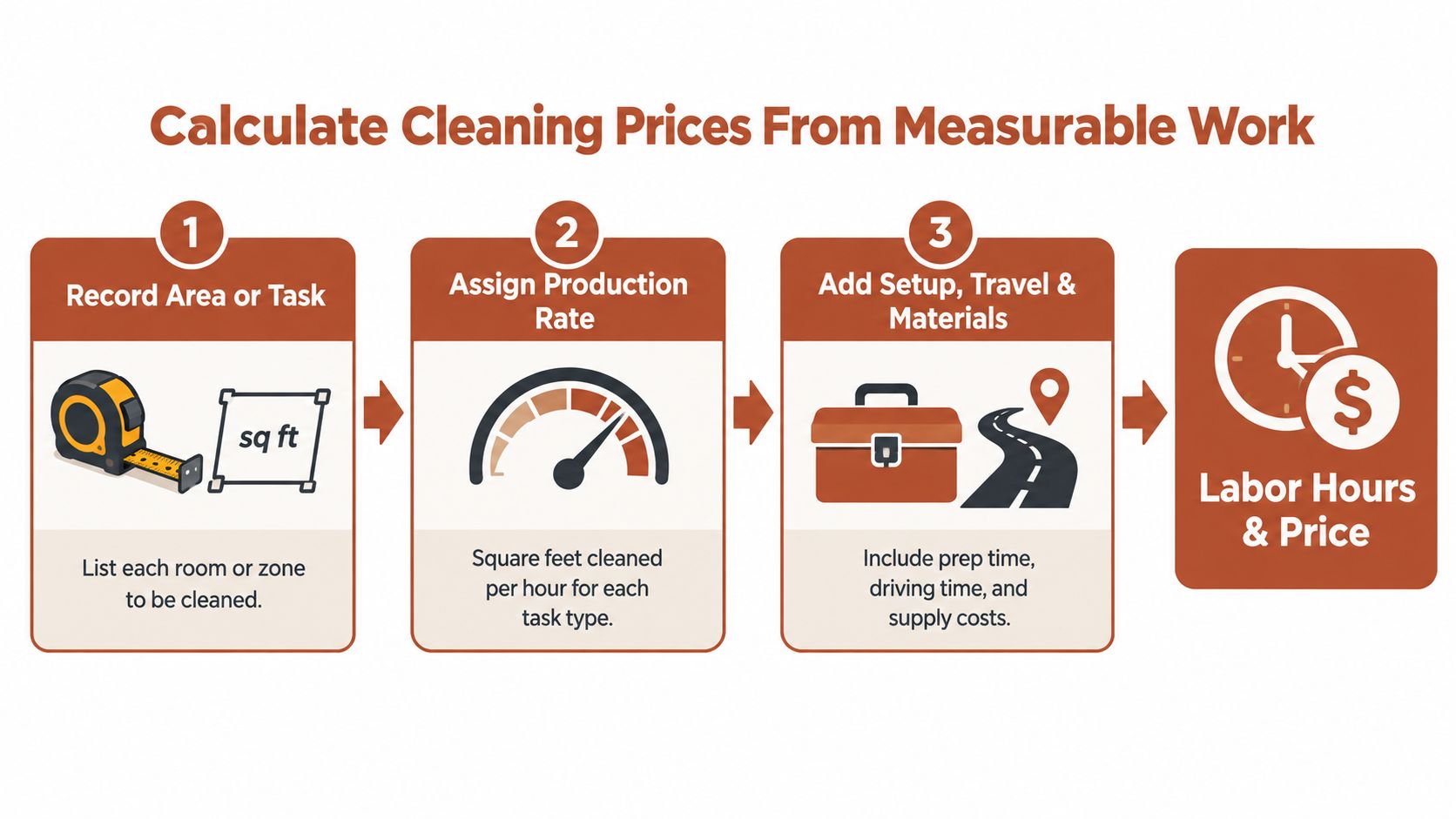
Square footage alone won't price a job. Two properties with identical area can need very different labor because of restroom density, cubicles, floor type, furniture, and soil. Convert scope into measurable labor instead. Record the area or task, assign a production rate, and divide quantity by that rate to get labor hours.
The three-step flow below shows that conversion from measured work to price.
Published ISSA-referenced figures place blended office production near 3,289 square feet per worker-hour, while wet mopping runs roughly 1,500 to 2,500 square feet per hour and restroom service takes 15 to 20 minutes per standard restroom, according to ISSA-referenced production rates in a cleaning time estimator. Use those as starting benchmarks, then apply a productivity adjustment for clutter, heavy soil, or restricted access. A 10,000-square-foot office shouldn't be priced from one blended rate if restrooms and cubicle density will slow every pass.
From labor hours to a loaded price
Add setup, travel, inspection, restocking, and administrative time to cleaning time. Multiply total hours by your loaded labor rate, not the bare wage. The median wage for janitors and cleaners was $17.25 per hour in the occupation data reported by the U.S. Bureau of Labor Statistics industry wage data, but that's an employee benchmark, not a customer price. Payroll taxes, insurance, supervision, transport, chemicals, equipment replacement, overhead, and profit still have to be covered. That's also why a minimum service charge is fair on short appointments. State it as its own line so a brief visit doesn't look overpriced per hour. If you're sanity-checking what customers expect on move-in work, the Sweet Home Cleaning Service cost breakdown is a useful customer-facing reference to compare against your own cost math. For setting your underlying rate, work through how much you should charge for your services before you lock the template.
Cleaning Estimate Calculation Inputs
| Input | Recorded value | How it affects the estimate |
|---|---|---|
| Area or task quantity | Square footage, rooms, fixtures | Drives labor hours through the production rate |
| Production rate | Rate per task, adjusted for conditions | Converts quantity into realistic time |
| Non-cleaning time | Setup, travel, inspection, restocking | Prevents unpaid work around the clean |
| Loaded labor rate | Wage plus burden and overhead | Turns hours into a sustainable price |
| Materials and wear | Chemicals, liners, equipment use | Keeps consumables out of your margin |
Two ways the math plays out
For a recurring office, price each zone separately, total the hours, and present a per-visit price tied to the stated frequency. Recheck after the first few visits using actual clocked hours. For a one-time deep clean, expect slower production, label the soil assumption, and show add-ons as separate lines the customer can accept or decline. In both cases, preserve the original estimate and the variance. Your own production history will beat a generic benchmark within a few jobs.
Choose Pricing Methods for Different Job Conditions
One formula for every property is convenient and wrong. The right method depends on how predictable the work is. Existing guidance often separates deep cleans, recurring cleans, and add-ons without explaining how to price the uncertainty between them, a gap noted in CleanOS guidance on cleaning estimate templates. More detail isn't automatically better. A long checklist can create false precision if it doesn't say which unknowns can change the price.
Pricing Method Decision Guide
| Pricing method | Best when | What to document |
|---|---|---|
| Flat package price | Scope and historical labor time are predictable | Included tasks, frequency, exclusions |
| Hourly pricing | Condition is hard to assess before starting | Rate, estimated hours, approval point for extra time |
| Low-to-high range | Property is unfamiliar or soil level is uncertain | Assumptions, what pushes price to the high end |
| Recurring service price | Visits repeat on a stable schedule | Per-visit scope, service period, review timing |
A flat price works once you know the property. Customers like certainty, and you keep the benefit when you get faster. Hourly pricing is more honest for a first visit or neglected property, provided you state an estimated duration and check in before exceeding it. A range is fairest when you haven't walked the site, as long as you name the conditions that decide where the final price lands. Exterior trades face the same choice, and the logic behind how to price pressure washing jobs profitably translates well. You're still matching method to surface, access, and uncertainty.
The assumptions block that makes any method fair
Put this in plain language near the price, not in fine print.
This price assumes accessible rooms, ordinary household soil, usable water and power, and no hazardous materials or post-construction debris. If conditions differ on arrival, extra work needs your approval before it starts.
That one block does more to prevent disputes than a longer task list. It tells the customer what you priced, tells you when to stop and ask, and gives both sides a written change-order trigger instead of an awkward doorstep negotiation.
Customize Estimates for Common Cleaning Services
Keep one master cleaning estimate template and make service-specific copies. The customer, pricing, and approval blocks stay consistent. The scope fields change with the job.
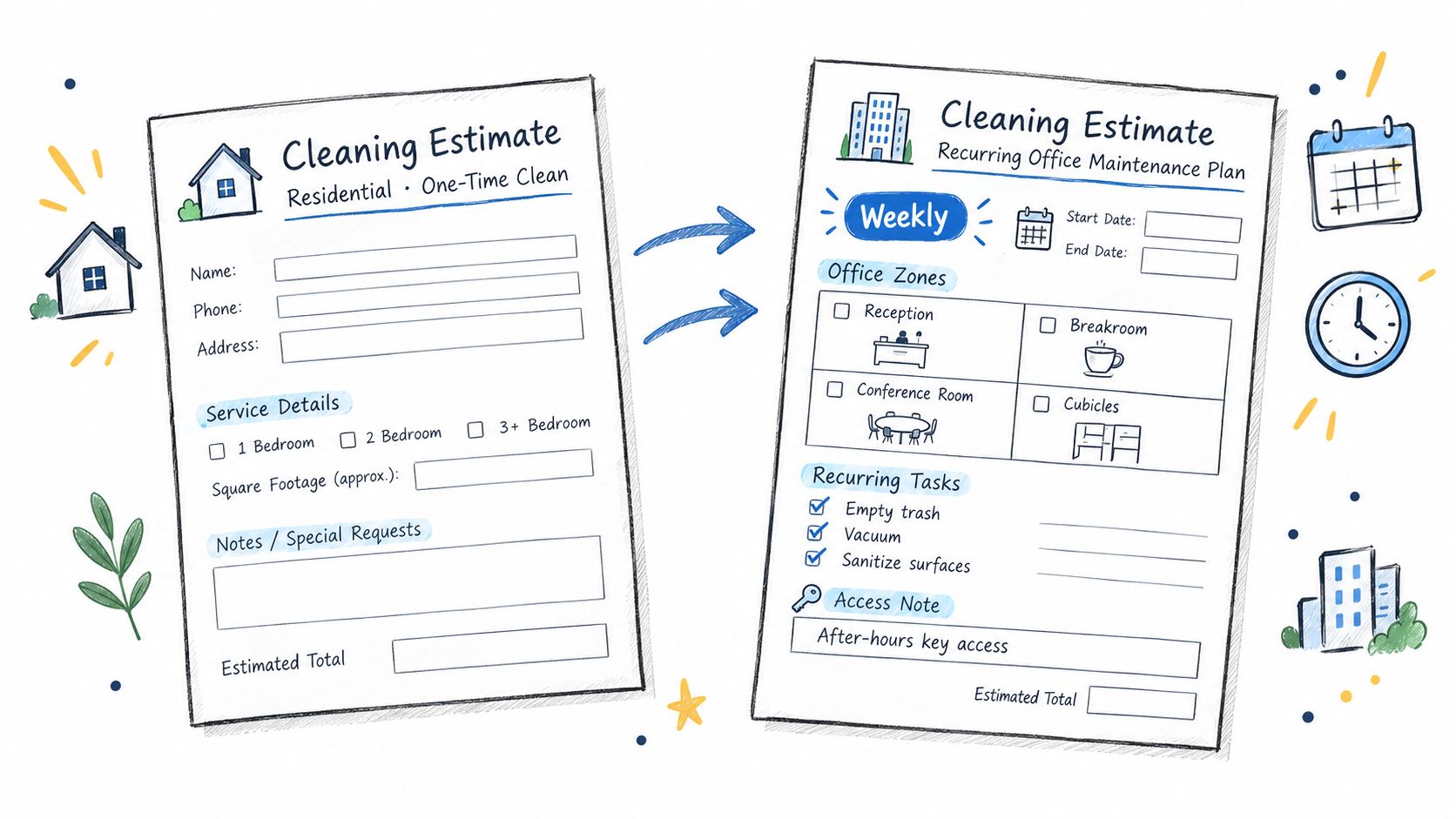
The comparison below shows how a one-time residential form differs from a recurring office plan.
Recurring office maintenance
Emphasize frequency, start and end dates, and zones included. List recurring tasks per zone, such as restrooms, break areas, floors, and waste removal. Record access arrangements and the next scheduled visit. Sample language: "Twice-weekly maintenance of office, restrooms, and break room as listed. Periodic tasks are priced separately when scheduled." That last sentence stops quarterly detail work from being assumed into the per-visit price.
Residential deep cleaning
Capture intensity room by room. Note whether heavy soil is included, which appliances or interior windows are in scope, and your time estimate with its assumptions. Sample language: "Initial deep clean including kitchen and bathrooms as listed. Interior oven and refrigerator cleaning are separate line items." Customers often think deep means everything. Your line items define what it means here.
Move-out and specialty work
Highlight inspection conditions, fixture and appliance counts, and whether disposal or haul-away is included, excluded, or priced on approval. Empty properties look simple and often aren't, because remaining debris and utility status decide your day. Add a change-order approval line for anything found after keys change hands.
Different services shouldn't share one unexplained lump sum because they don't share the same risks. Recurring work rewards stable scope. Deep cleans reward honest condition notes. Move-out work rewards inspection language. The template should make those differences visible before anyone signs.
Add Deposits, Approval, and Mobile Payment Terms
An estimate that presents price well but handles payment vaguely hasn't finished the job. Payment friction is common for small businesses. The 2025 QuickBooks Small Business Late Payments Report found 47% of surveyed businesses had invoices more than 30 days overdue, as reported in coverage of the QuickBooks late payments findings. Your template can't fix a customer's cash flow, but it can remove every ambiguity about when and how you get paid.
Match the payment structure to the risk
- Larger one-time work: A deposit or card authorization before scheduling reduces your exposure if the customer cancels late or disappears after a move-out.
- Recurring maintenance: A clear due date, accepted payment method, cancellation policy, and reminder process usually matter more than a deposit.
- Uncertain first visits: State the deposit, the estimated balance, and the approval point if conditions push the price into the higher end of your range.
Don't copy a deposit policy from another template without asking what it covers. State what the deposit secures, when it's due, whether it's applied to the final balance, and what happens on cancellation. If you accept cash, check, or bank transfer alongside card payment, list those manual options so customers aren't guessing at the door.
Make approval recordable from a phone
The customer should be able to open the estimate in a browser, read the scope, approve it, and sign without printing anything. Keep the approved version unchanged afterward. If scope changes, issue a change order rather than editing history. Review your estimate terms and conditions wording once, get it right in the master template, and stop rewriting legal language per job.
Include quote expiration alongside payment terms. It protects your pricing and gives the customer a clear decision window. Short, specific, and visible beats long and buried every time.
Convert the Approved Estimate Into an Invoice
Approval is where many solo cleaners start retyping. They rebuild the job in a new document, mistype a line, forget the deposit, and send an invoice that doesn't match what the customer signed. The approved estimate should carry forward intact. Scope, service date, price, deposit, balance, and client information move together.
The handoff, step by step
- Confirm the approved version: Check that accepted line items, declined add-ons, and any range outcome match what you did.
- Invoice the total, credit the deposit separately: Show the full job price, then the deposit recorded as paid, then the balance due. Customers trust arithmetic they can follow.
- Bill extras only through change orders: If the customer approved extra work in writing, add it as its own line referencing that approval. If they didn't, don't surprise them with it.
- Send with a payment link: Let the customer pay online from the invoice. Record cash, check, or bank transfer payments manually against the same invoice so the balance stays accurate.
Tooling earns its place here. AurenWell converts an approved estimate to an invoice in one click, with browser-based approval, e-signature, optional deposit collection, online payment links, activity logs, and client history kept in one record. A paper or spreadsheet template can follow the same logic. The discipline matters more than the software. If you're formalizing the billing side, a dedicated house cleaning invoice format keeps the invoice fields consistent with the estimate fields you've already built.
Contingency deserves a final word here because it is where honest estimates get padded. Federal Highway Administration estimating guidance notes contingency is commonly around 5% to 10% in its cited project-estimating context, per Federal Highway Administration cost estimating guidance. Don't copy that mechanically into every quote. Well-inspected recurring work may need little risk allowance. A neglected first-time property justifies more, labeled openly or handled through a range. Hidden markup erodes trust. Named allowance builds it.
Verification before you send
- Scope is measurable: Quantities, areas, and tasks are stated, not implied.
- Assumptions are visible: Soil, access, and utilities match what you priced.
- Costs are separated: Labor, materials, travel, and add-ons aren't buried in one figure.
- Deposit and balance are unambiguous: Amounts, timing, and payment methods are explicit.
- Approval is recorded: The signed version is the version you're invoicing from.
Review after the job, not just before it
Compare quoted hours with actual hours on every job for the first few visits, then monthly after that. Note which extras were approved before work, whether payment arrived on time, and what questions the customer asked. Repeated underestimation means a production rate is wrong or scope is missing. Repeated overestimation means you're pricing yourself out of work you could win profitably. Fix the rate, not the markup.
Keep records portable as you go. Export estimates and invoices as PDFs for customers and your files, and export clients, income, or expenses as CSV when tax time or a software change demands it. Save one master template, create service-specific copies, and update production rates from your own variance data. Within a few months, your estimates stop being guesses with good formatting and start being measurements with a track record.
Build your master cleaning estimate template today using the field order above, price your next quote from measured labor instead of a lump sum, and add the assumptions block before you send it. Then track quoted versus actual hours on that job and adjust one production rate. That's how a template becomes a pricing system that gets you approved, scheduled, and paid.