
A freelance designer signs a fixed-fee contract in January. A few weeks later, the client asks for a second deliverable that effectively doubles the scope, but the original price still reflects the first brief. The designer agrees in a friendly email, starts the extra work, and assumes the paperwork can wait.
That delay creates a problem for both sides. The scope, fee, timeline, and approval process no longer match the signed agreement. An amendment to agreement template turns that informal change into a dated record showing what changed, when it took effect, and who accepted it. The useful workflow is straightforward: identify the affected terms, draft exact replacement language, obtain valid signatures, and store the executed amendment with the original contract.
Why You Need a Formal Amendment After a Deal Changes
A signed contract should describe the arrangement people are performing. Once the parties change a commercial term, continuing to rely on the old document leaves a gap between the written deal and the working deal. That gap can affect invoicing, delivery expectations, approval rights, and responsibility for additional work.
A formal amendment doesn't replace the whole contract. It records the agreed departure from the original while preserving everything that wasn't changed. Standard drafting guidance recommends identifying the original agreement by its date and parties, stating the exact clauses being modified, and confirming that all other terms remain in force. LegalZoom's amendment guidance also distinguishes contract-modification requirements across service agreements, goods contracts, and certain financial arrangements, so a general form shouldn't be treated as suitable for every transaction.
The practical lifecycle
Use the amendment as a workflow record, not just a page of legal language.
- Identify the change: Compare the proposed adjustment with the executed contract and locate each affected clause.
- Draft the revision: State the section number and write the replacement wording precisely.
- Confirm the effective date: Make clear whether the new term applies immediately, from a future date, or only to specified work.
- Obtain consent: Have the original parties, or authorized representatives, sign according to the contract's execution rules.
- Store the record: Keep the signed amendment beside the original and log its version, date, parties, and affected clauses.
Practical rule: If you can't explain the change by pointing to one dated document, your contract record is incomplete.
A standalone amendment protects the relationship by replacing memory and scattered messages with one record both parties can review later. It also makes recurring changes manageable. When several substantial revisions accumulate, Juro's contract amendment guidance recommends using a new amendment rather than crowding every revision into the original text.
What an Amendment to an Agreement Actually Is
An amendment is a written modification to an existing contract. It changes, removes, or replaces identified terms while leaving the rest of the agreement in force unless the document expressly says otherwise. The amendment should identify the original contract by full title, execution date, and parties, so nobody has to guess which agreement it modifies.
The legal effect depends on mutual consent, authority, applicable law, and the original contract's own modification clause. A person can't make a binding change merely by editing a PDF or sending a revised invoice. The amendment must also avoid contradicting mandatory legal requirements that apply to the transaction.
Several documents look similar but perform different jobs:
| Instrument | Purpose | Effect on Original |
|---|---|---|
| Amendment | Changes, deletes, or replaces existing terms | Modifies identified provisions while the remaining terms continue |
| Addendum | Adds supplementary terms or information | Sits alongside the original and shouldn't alter existing wording |
| Restated agreement | Reissues the entire deal in consolidated form | Replaces the earlier presentation with a complete new contract |
| Side letter | Records a parallel understanding between parties | May create separate obligations, but can leave uncertainty about its relationship to the main agreement |
Numbering prevents version confusion. Use a clear label such as “Amendment No. 1” and continue the sequence for later changes. The number isn't a substitute for precise drafting, but it gives the contract record a visible order.
The distinction also matters operationally. A solo consultant who changes a payment milestone needs a clause-level amendment. A business adding a technical schedule without changing existing obligations may need an addendum. A complete rewrite may call for a restated agreement. These choices belong within governed contract workflows that connect drafting, approval, execution, and storage.
Common Situations That Require an Amendment
Most small service-business amendments fall into a few recognizable categories. Matching the problem to the right category helps you collect the correct information instead of sending a vague “updated terms” document.
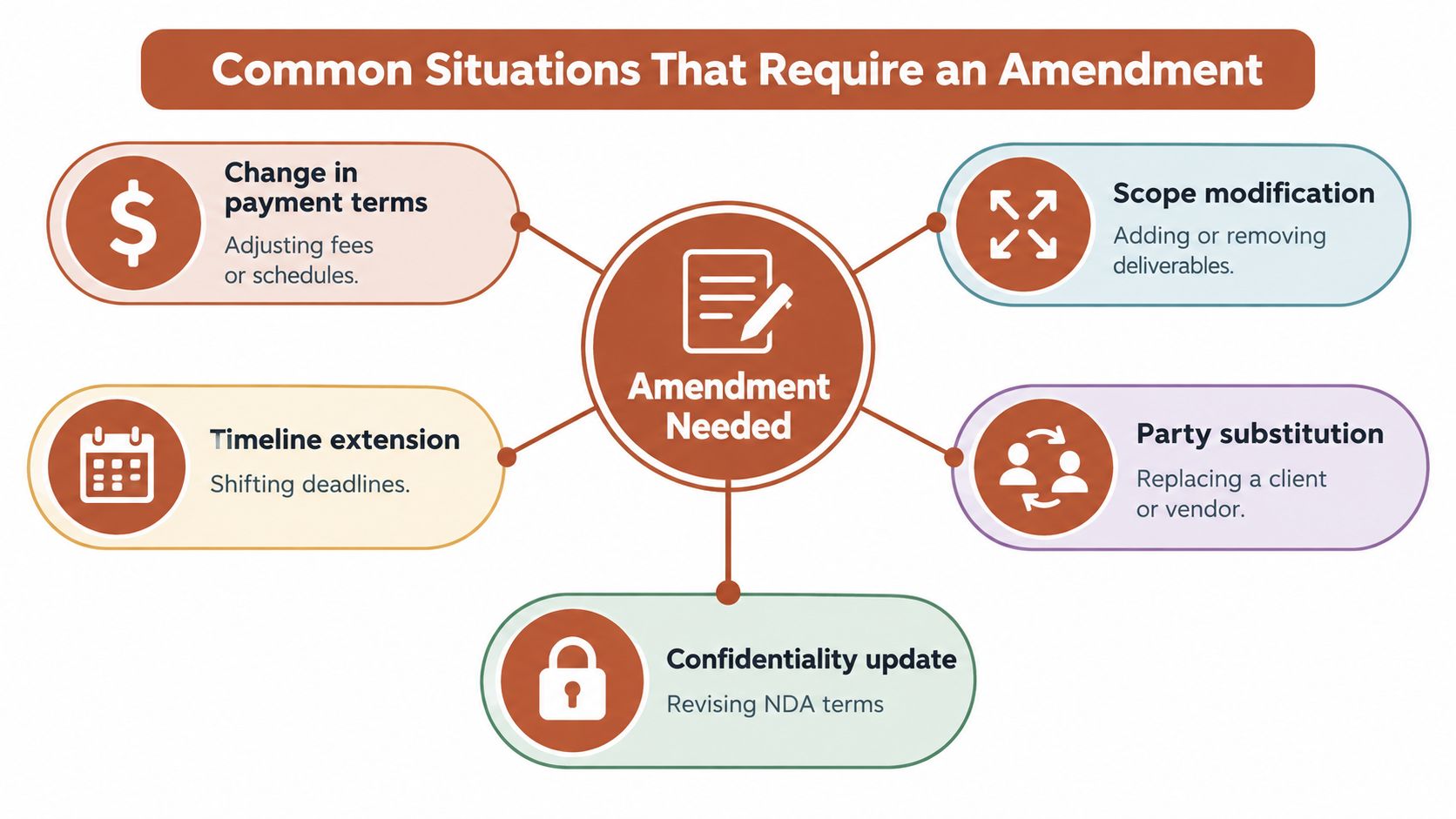
Scope modifications
A client adds deliverables, removes a service, or substitutes one task for another. A photographer might add edited images to an existing package. A marketing consultant might remove reporting and add campaign setup. The amendment should identify the original scope clause and describe the revised deliverables, acceptance standard, dependencies, and any resulting fee or deadline change.
Pricing adjustments
A fixed-fee engagement may move to hourly billing, a rate may change for future work, expenses may become reimbursable, or payment milestones may be reorganized. Don't rely on an invoice to carry a new commercial term. The amendment should state the new amount or pricing method, the applicable work period, invoice timing, and any deposit or approval condition.
Timeline extensions
A deadline can move because the client delayed approvals, the parties added work, or an ongoing retainer needs a longer term. State the affected date or period and explain whether related milestones, renewal dates, reporting cycles, or payment triggers move with it.
Administrative corrections
A misspelled legal entity name, changed notice address, or replacement signatory can justify a targeted amendment. Administrative changes still deserve precision because the party block controls who owes and receives contractual obligations.
Minor clarifications may be handled through ordinary project communication when they don't alter a commercial term, obligation, or risk allocation. Once the change affects scope, price, timing, responsibility, confidentiality, or liability, formalize it. Each category maps to template fields, including affected clauses, new wording, effective date, and signature blocks.
Field-by-Field Walkthrough of the Template
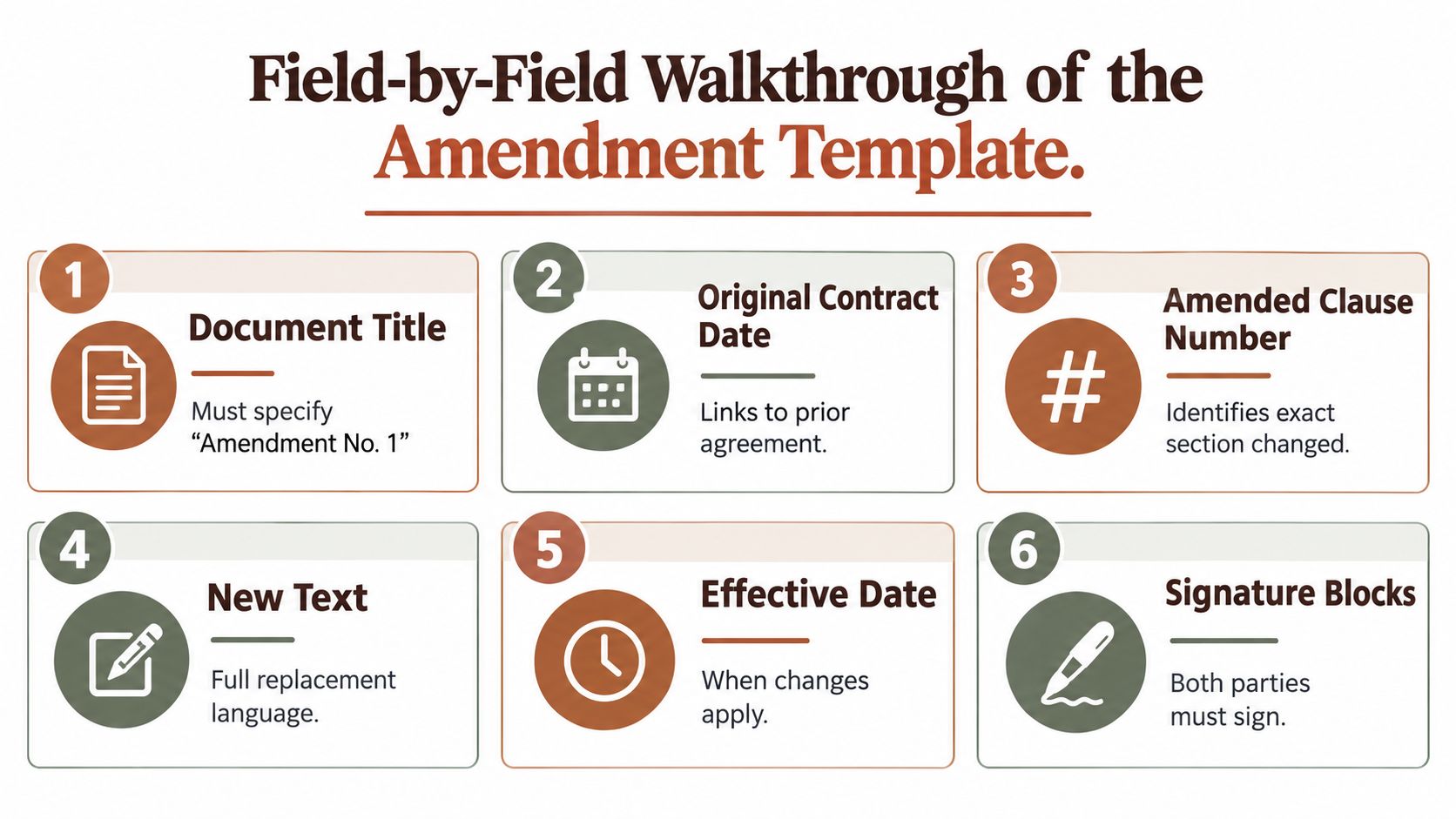
A useful amendment template makes every input answer a specific recordkeeping question. Who changed what, under which agreement, from which date, and with whose authority?
Start with identity
The document title should state the instrument and sequence, such as “Amendment No. 1 to Services Agreement.” Then identify the original agreement by its full title and execution date. Copy each party's full legal name exactly from the signed contract. Don't shorten a company name, swap a trading name for a legal entity, or copy a client contact's name into the party block.
The amendment's effective date is separate from the signature date. The parties may sign on different days, while the revised pricing or scope applies from a specified date. State that date clearly and avoid leaving the reader to infer it from the signature page.
Identify and replace
For every change, cite the original section or clause number. Use the numbering in the executed contract, not the numbering from an abandoned draft. Then state the replacement wording in full, including defined terms and cross-references. Partial edits often create uncertainty because nobody can tell which sentence survives.
Include savings and ratification language. A typical structure confirms that the original agreement remains in full force except for the express modifications and that the amendment controls if the two documents conflict. The template should also state the governing law, either by restating the parent agreement's provision or by clearly incorporating it.
Finish with execution data
Each signature block should include the legal party name, signature, printed name, title or capacity, and date. Check that the signer can bind the organization. AurenWell's contract templates can be used as a reference point for keeping document fields organized, but the wording still needs to match the underlying contract and transaction.
Writing Clause-Level Changes That Stay Auditable
An amendment should let a third party reconstruct the change without comparing a chain of emails and draft PDFs. That means each amendment item needs a precise connection to the parent agreement.
A reliable item usually contains three parts:
| Element | Example |
|---|---|
| Original reference | “Section 4, Fees and Payment” |
| Change instruction | “Section 4 is deleted and replaced with the following” |
| New wording | The complete revised clause, including relevant defined terms and payment conditions |
During negotiation, strikethrough can show deleted text and underline or bold can show insertions. That visual comparison helps the parties review the draft. For the executed copy, clean final wording is usually safer. A signed document shouldn't force a reviewer to decide whether formatting marks are operative language or editorial markup.
Draft one item for each change
Number amendment items separately. If the scope and payment clauses both change, write separate items for each. This structure makes review easier and gives your amendment register a clear list of affected clauses.
Check every defined term against the original contract. If the parent agreement uses “Services” as a capitalized term, don't introduce “Work” casually. Confirm that cross-references still point to existing sections and that a replacement clause hasn't accidentally removed an exception, notice requirement, or approval mechanism.
Audit test: Someone reading only the amendment should be able to identify the old location, the new wording, and the date the new wording applies.
Avoid vague language such as “the parties agree to update the scope as discussed.” It records an intention, not the operative change. Also avoid describing a material reallocation of risk as a “clarification.” The label won't prevent the text from changing the parties' obligations.
Signatures, Authority, and Execution Rules
A drafted amendment isn't binding merely because one party prepared it. The original legal parties generally need to consent, and each organization needs a signer with authority to accept the modification. LegalClarity's amendment guidance emphasizes matching the original parties, confirming signer authority, using the required written form, and storing the executed document with the original.
Check the parent contract before sending the amendment. It may require written modifications, a particular notice method, multiple signatures, witnesses, or notarization. Some changes may also require internal approval, a power of attorney, or other evidence of corporate authority. Whether a witness or notary is needed depends on the contract, the transaction, and applicable law.
Electronic signatures can be valid where applicable law permits them. In the United States, the Electronic Signatures in Global and National Commerce Act and the Uniform Electronic Transactions Act provide important frameworks, but their application depends on the transaction and jurisdiction. Use a signing process that records the final document, signer identity, completion time, and available envelope or audit information.
Don't backdate an amendment. If the parties want a change to apply from an earlier date, state the agreed effective date while showing the actual signing dates. Don't sign personally when the original agreement names a company, and don't treat an unsigned PDF as proof that both parties accepted the new terms.
The governing law and venue clause can usually carry forward from the parent agreement, but the amendment should say so clearly or restate it. For practical guidance on organizing contract records and related documents, see AurenWell's contract help resources.
Storing and Audit-Logging the Executed Amendment
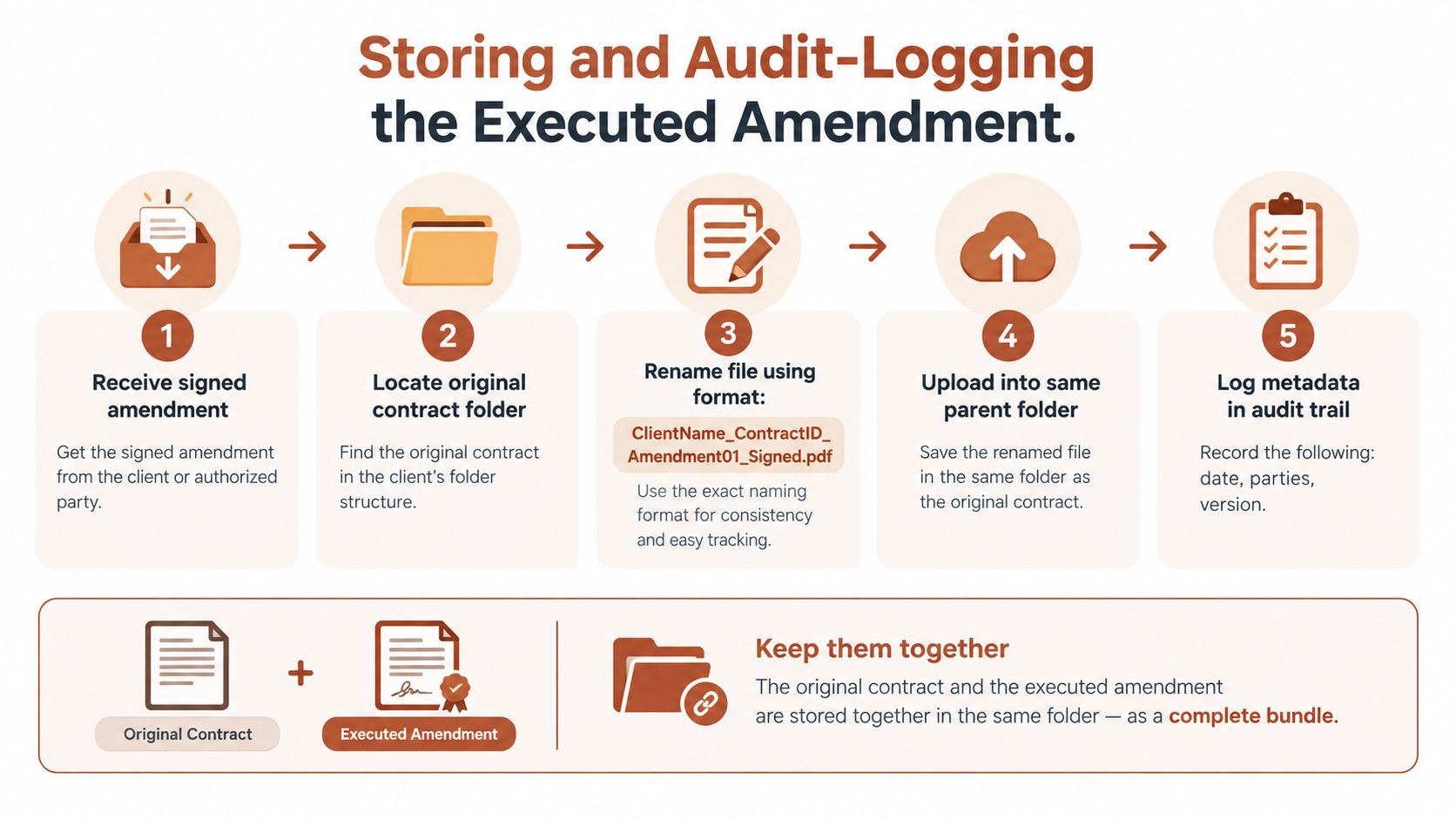
Treat the original contract and signed amendment as one record bundle. A solo operator shouldn't have to search an email inbox for the agreement, a cloud folder for the amendment, and a signing platform for proof of completion.
Create one parent folder keyed to the client and contract identifier. Store the original agreement and each executed amendment there. Use names that reveal the sequence, such as ClientName_ContractID_Amendment01_Signed.pdf, and keep draft files separate from signed records.
Maintain an amendment register
A simple spreadsheet or contract log should capture:
- Document identity: Contract ID, client, amendment number, and executed-file link.
- Change summary: A short description of each affected clause.
- Effective date: The date the revised obligation applies.
- Execution record: Signing completion time, signer names and titles, and the e-sign envelope identifier or other available audit reference.
- Operational follow-up: Whether invoicing, project tracking, and client records were updated.
The register doesn't replace the signed document. It gives you an index for finding the authoritative file and reconstructing the sequence of changes. Guidance on how to manage audit trails is useful when deciding which metadata belongs in the document record and which belongs in a companion log.
Running the Amendment Workflow in AurenWell
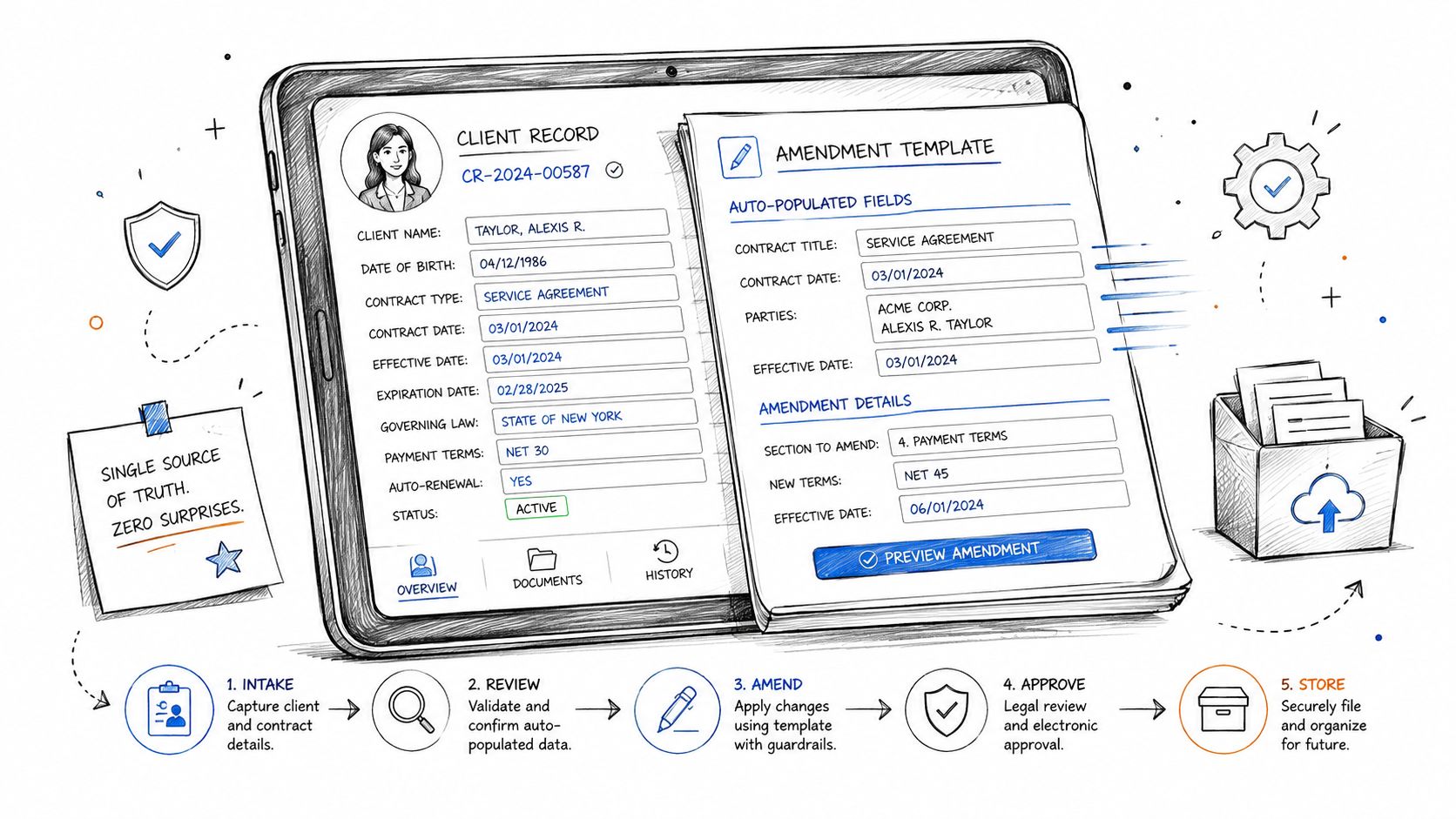
A single workflow app can keep the amendment connected to the client's existing contract record. In AurenWell, the practical flow starts by selecting the amendment template inside the client record and reviewing the original agreement details before entering the new clause language.
The operator then fills the change items, sets the effective date, previews the document, and sends it for electronic signature. The product's contract workflow supports service agreements, client selection, editable agreement sections, signature requests, and downloading the signed PDF. Its stated workflow also associates signed documents and audit trails with the client record.
A workable sequence
- Select the client record: Open the record that contains the original service agreement.
- Choose the amendment document: Use the amendment format and verify the party block against the source contract.
- Enter clause changes: Add the exact section references, replacement text, and effective date.
- Preview before sending: Check names, dates, numbering, cross-references, and ratification language.
- Capture signatures: Send the signing request to authorized representatives and retain the completed file.
- Confirm storage: Check that the executed amendment sits beside the original and that the client timeline reflects the update.
The point isn't to eliminate review. It is to reduce the chance that a solo operator copies stale party details, loses the final PDF, or forgets to update the record after signature. AurenWell's contracts feature is one example of a workflow designed to connect contract creation, signing, and document storage.
The Unilateral Amendment Trap and Informal Change Risk
One party usually can't rewrite a bilateral contract and bind the other side by sending a new version. Mutual consent matters, and the original agreement may impose additional written-form or execution requirements.
Three patterns create avoidable disputes:
- The invoice update: A service provider increases the price on the next invoice without changing the pricing clause or obtaining acceptance.
- The replacement PDF: One party sends a fresh contract with a new scope but doesn't identify it as an amendment or show which original terms remain.
- The chat promise: The client and provider agree informally to extend a deadline, but neither signs a document or checks the contract's modification rules.
The problem isn't that every email is meaningless. The problem is that informal communications may not satisfy the parent contract's execution requirements, may not identify the complete revised obligation, and may leave disagreement about whether the exchange was a proposal or acceptance. The answer is to convert the informal agreement into a formal record.
Pull the change into the amendment template. Identify the original contract, restate the affected clause in full, specify the effective date, obtain signatures from both sides, and file the executed document with the source agreement. That process preserves the commercial understanding without forcing the parties to renegotiate provisions that haven't changed.
Amendment Checklist and Quick-Reference Summary
Use these lists before and after every amendment. For broader guidance on best practices for contract compliance, focus on keeping the signed document, operational records, and approval evidence aligned.
Before execution
- Verify clause references: Compare every section number with the executed original.
- Match party names: Copy the full legal names and confirm authorized representatives.
- Set the effective date: Tie the date to the affected work, fee, or deadline.
- Write replacement text: State the complete revised wording and preserve defined terms.
- Confirm remaining terms: Include savings, ratification, and conflict language.
- Review execution rules: Check written-modification, witness, notarization, and notice requirements.
- Circulate the draft: Give every party a chance to review before signature.
After execution
- Check signatures: Confirm every required party signed and dated the final copy.
- Save the bundle: Store the executed amendment with the original contract.
- Update the register: Log the amendment number, clauses, effective date, and file link.
- Notify operations: Update invoicing, project tracking, and deliverable records.
- Distribute copies: Send the final document to each party and relevant internal records.
- Annotate the source: Mark the original contract record with the amendment reference.
An amendment works when the paperwork, consent, and operational records all tell the same story. Before you accept extra work, change a price, or move a deadline, complete the template, obtain both signatures, and file the final document beside the original. If the change affects liability, ownership, confidentiality, regulated activity, or a significant payment obligation, have a qualified lawyer review the wording before execution.